


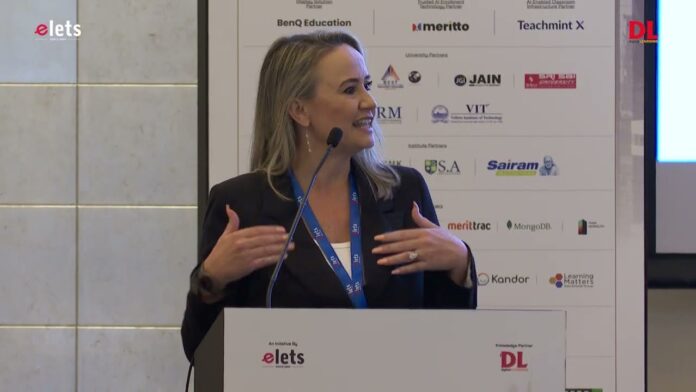
Education is at a pivotal juncture. As our world evolves at a rapid pace, driven primarily by accelerated technological advancements and unforeseen global events, the question arises: Are our schools truly preparing students for the future? Nikki Williams, Director of Education, provides an insightful perspective on this matter, challenging our conventional approach to education at the recently concluded 35th Elets World Education Summit on 4-5 February in Dubai.
Understanding the Future: A Look Back
Predicting the future has always been fraught with challenges. Few could have foreseen a global pandemic, political unrest, or the rapid advancement of artificial intelligence (AI) in recent years. These events have underscored the inadequacies in our educational systems’ preparations for such changes. Educators and institutions must rethink their strategies and pivot toward equipping students with skills relevant to today’s world.
Evolving Career Paradigms
The careers students aspire to have shifted significantly. The traditional aspirations of becoming doctors, lawyers, or pilots are now supplemented, and sometimes even replaced, by roles like content creators, app developers, and prompt engineers. This shift points to the evolving skills required for success in these new arenas. The need for creativity, communication, problem-solving, and ethical decision-making remains paramount, regardless of career choice.
Historically, education has been content-driven, concentrating on rote memorization and regurgitating facts for exams. However, as Williams emphasizes, education should emphasize competencies such as adaptability, collaboration, and critical thinking. These foundational skills have been essential for decades but gain renewed importance in today’s technology-driven landscape. AI and technology may process information, but human connection, empathy, and adaptability remain irreplaceable.
The Role of Human Connection
Despite technological advances, human connection remains a critical aspect of learning and growth. The COVID-19 pandemic highlighted the importance of human interaction, with enforced isolation leading to a rise in mental health concerns globally. Education systems must incorporate the development of empathetic and collaborative skills to prepare students for real-world complexities.
The Need for Educational Flexibility
The static nature of educational assessments poses a significant barrier to preparing future-ready students. Testing models have remained largely unchanged for generations, failing to adapt to modern needs. Williams argues for more dynamic curricula and assessment strategies that incorporate real-life situations and allow flexibility, ensuring students engage in meaningful learning experiences rather than rigid routines.
Also Read: Building Leaders, Not Just Achievers
Redefining Success in Education
Presently, educational success is often quantified through grades and standardized test scores. However, Williams challenges this notion, suggesting that true success should also consider a student’s ethical decision-making abilities, societal impact, and adaptability in unforeseen circumstances. Preparing students for an unknown future necessitates a shift in assessing outcomes and focusing on lifelong skills.
The analogy is clear: assessing students with outdated models is equivalent to teaching modern pilots to navigate digitally-assisted aircraft using only paper maps. It is time for educational systems to evolve. By altering assessment strategies and emphasizing essential human skills, we can ensure our students are truly prepared for an unpredictable yet promising future.
Views expressed by Nicki Williams, Director of Education, Taaleem, UAE at 35th Elets World Education Summit on 4-5 February in Dubai.