
Home Blog Page 1271

Students strike hits medical college hospitals

Normal functioning at the five medical college hospitals in Kerala continued to be hit for the fourth day on Friday as post-graduate students have struck work, demanding a stipend hike and fee reduction. The strike called by Kerala Medical Post Graduates' Association turned more serious after the house surgeons also joined it on Thursday. In all, more than 2,000 professionals are on strike. Barring emergency operations and casualty functions, the normal functioning of various departments in the five medical colleges' hospitals has been affected since on Tuesday, with patients having no other option but to go back or seek medical help from private hospitals. “In the past one year, we have been assured many times by the health minister (P.K. Sreemathi) that a raise would be given, but nothing has happened,” said an angry student, requesting anonymity. “We were on Wednesday told that a final decision would be taken after consulting Finance Minister Thomas Isaac, but as he is busy preparing the state budget, and the meeting with him is yet to happen,” the student said. “Medical colleges are for poor patients like us and we get no solace when we come here. It is surprising that the state government is silent,” he added. Leader of Opposition Oommen Chandy asked Chief Minister V.S. Achuthanandan to intervene to end the impasse. “It will take only half an hour for the health, finance and chief minister to end this if they decide to sit down to tackle the issue. Those on strike can do it, but they should also see that the patients are not left high and dry,” Chandy said. Former chief of the Kerala Government Medical College Teachers Association, Varghese Thomas, blamed both the government and the striking doctors for the present impasse. “The government has to intervene and the striking doctors should note that when they (teachers) went on strike they always saw to it that the patients are not affected in any way. Arrangements have to be made to see that patients do not suffer,” Thomas said. Sreemathi will shortly hold talks with the representatives of the striking doctors, officials said.


Students must get level playing field in competitiveness – President

President Pratibha Patil on Tuesday said that there should be level playing field so that students from all sections of society can attend premier institutions like Indian Institutes of Technology. “Our endeavor should be to create a level playing field in educational competitiveness so that students from all sections of society can enter premier institutions like the Indian Institutes of Technology (IITs) and the Indian Institutes of Management (IIMs),” Patil said in her address to the nation on the eve of Republic Day. Patil said, “Our special efforts to reach out to students from tribal and remote areas, Scheduled Castes, Scheduled Tribes and other backward communities must be augmented”. She added that special focus has to be given to primary education. “It is said that mother is a child's first teacher and the next is the primary school teacher. Both make lasting impressions on children in their formative years. In primary schools, teachers are doing good work. We should regularly assess issues relating to training of teachers and quality of education including checking instances of absenteeism of teachers,” the president said.

Indian students to sham US varsity face deportation

Hundreds of Indian students, mostly from Andhra Pradesh, face the prospect of being deported from the US after a “sham” university in California was shut down for allegedly selling US visa to willing students. The Tri-Valley University in Pleasanton, a suburb in San Francisco Bay Area, was raided on Tuesday and reportedly charged with helping foreign nationals illegally acquire immigration status. A complaint filed by the US Immigration and Customs Enforcement (ICE) against the “sham” university alleged that the school's founder and president, Susan Xiao-Ping Su, was using the school to issue a US visa to any foreign national willing to pay for it. The complaint states, “Since its inception … Tri-Valley University has been a sham university, which Su, and others, have used to facilitate foreign nationals in illegally acquiring student immigration status that authorizes them to remain in the US.” The immigration investigation began in May 2010, after it was noticed that the school applied for an excessive number of US student visas when compared to the previous year. In February 2009, Tri-Valley University was approved to issue visas and by May of that year, 11 students were issued a US visa to study. However, by May 2010, a total of 939 students were issued visas to study at the school. Over 95 percent of the students were from India, and the school allegedly gave the same apartment's address for over half of them. The apartment manager reportedly told ICE officials he only had four university students ever living there and that was only from June 2007 to August 2009. He said he has had none since. Classes were scheduled to start again on January 10, once the winter break was over, but that has not happened. ICE found that while students were admitted to various residential and online courses of the university and, on paper, they lived in California, in reality they illegally worked in various parts of the country as far as Maryland, Virginia, Pennsylvania and Texas. For a student to maintain an active immigration status, they must show proof that they are making reasonable progress towards completing course work and physically attend classes. Federal authorities are now sweeping out for all those students, who paid lakhs of rupees for obtaining student visas and also student work permits.

Sibal blames state for implementing RTE

As schools in the national capital have been reported not cooperating in taking students from economically weaker sections, Human Resource Development Minister Kapil Sibal on Tuesday said it is the state governments' responsibility to ensure that schools implement the Right to Education Act. Speaking at a function to mark achievements of UNICEF's 'Awaz Do' campaign which aims at spreading awareness about the Right to Education Act, Sibal said the responsibility of implementing the act remains greatly with the state government. “First of all, it is the responsibility of the school to ensure the RTE, then state government has to figure out if the schools are complying with the rules of the act or not,” Sibal said, addressing a function at a school here. “If schools are not complying, there is a mechanism in the act, but first of all its state government's responsibility to see it is implemented,” he said. Sibal noted that over 80 lakh children are out of school in the country, and urged the citizens to ensure that the act is implemented. “It is our duty to ensure that every child goes to school, every citizen should speak for right to education,” he said. 'Awaz Do', a digital campaign started by UNICEF, registered two lakh people in its campaign launched in October last year. The campaign aims at spreading information about the act and making people a part of the process of providing education to all children between 6 to 14 years of age, as mentioned in the act. As per the findings of a study conducted in October 2010, only one out of six people has heard of the act but does not know anything else. Only three percent have heard of the National Commission for Protection of Child Rights (NCPCR), which is tasked with enforcing the act.

Padma Awards

Veteran Malayalam poet O.N.V. Kurup and Oriya poet Sitakant Mahapatra are among 25 people named for the Padma honors in the field of literature and education this year. While the two got the Padma Vibhushan, the second highest civilian honor, three were awarded Padma Bhushan and 20 were given Padma Shri for their work in the field. Kurup, who won the Jnanpith Award, last year, is also a recipient of the National Award for best lyricist and the Padma Shri. Mahapatra has received high literary honors like the Sahitya Akademi Award and Jnanpith Award. He was conferred the Padma Bhushan in 2002. The Padma Bhushan winners also included political columnist and biographer Thayil Jacob Sony George, Bengali poet and critic Sankha Ghosh and Ramdas Madhava Pai, president of the Manipal Academy of Higher Education. The Padma Shri award winners included poet Mahim Bora, Sanskrit academician and researcher Pullella Srirama Chandrudu, and Urdu poet Balraj Komal along with 17 others.

Canada to host Year of India in March

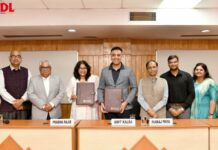
India has unveiled year-long activities and programmes for its Year of India in Canada with the signing of a memorandum of understanding with Carleton University to fund an India Chair at the university's Canada-India Centre for Excellence in Science, Technology, Trade and Policy. The Year of India in Canada will start on March 4 with cultural performances. Under the MoU, the Indian Council for Cultural Relations (ICCR) will establish a Visiting Chair focused on India-related studies at Ottawa's Carleton University, according to Indian High Commissioner S.M. Gavai who signed the MoU with Carleton president Roseann O'Reilly Runte on Monday. “The government of India will fund the Chair for ten years. Though the amount has not been quantified, our government will pay its expenses,'' said India deputy high commissioner Narinder Chauhan. Thanking India for its gesture, Roseann O'Reilly Runte said, “We are most grateful to the Indian government. This generous contribution will make Carleton's centre a unique resource for the university, the community and our country. '' After launching its Canada-India Centre of Excellence in Science, Technology, Trade and Policy in February last year, Carleton now becomes the first Canadian university to have a full-fledged India Chair. The Canada-India Centre of Excellence in Science, Technology, Trade and Policy is aimed at bringing together members of the academic, business and public policy communities in both countries to provide cutting-edge research, analysis, training and exchanges.

Indian students still waiting for due clearance from Australia

Thousands of Indians are still waiting for a refund of their tuition fees following the closure of several colleges in Australia, said an official of an Indian students' federation. Gautam Gupta, spokesperson for the Federation of Indian Students of Australia (FISA), said, “There are thousands of ordinary Indians who are still waiting for refund of their tuition fees following closure of several colleges in Australia. “This total figure although unknown could be in millions – much more than the Commonwealth Games dues owed to Australian companies.” He said this issue was raised by India's then human resource development minister Kapil Sibal when he visited Australia in May 2010. A large number of Indian students who had enrolled in some colleges in Australia were hit hard following the closure of their colleges. The Indian students have also faced a string of attacks in Australia over the past two years, causing an uproar in India. Nitin Garg, an Indian student, was fatally stabbed in an attack in January last year. On External Affairs Minister S.M. Krishna's January 19-21 Australia trip, Gupta said: “Krishna's focus on improving bilateral trade is welcome. It is also commendable that the minister raised the matter of Indian student welfare with Minister Kevin Rudd.” “The two issues of safety and immigration visa's which formed the central issues raised by the minister were good. However many issues were forgotten and overlooked,” a statement quoted Gupta as saying.

American Corner opens in Jaffna

The US embassy has opened an 'American Corner in Jaffna in Sri Lanka's north to broaden educational opportunities and improve IT and English language skills in the Tamil heartland. US ambassador Patricia A. Butenis declared open the American Corner on Tuesday. This is the third such centre in the country after Kandy, Oluvil and Colombo. In her welcome address, Butenis said, “An American Corner is much more than a small library where people can read books, magazines, or current newspapers. The American Corner is a place that will connect Jaffna with the rest of Sri Lanka, and with the world. “Through digital video conferences, the Jaffna public can now interact with American scholars or business leaders in New York, Los Angeles, or Washington. Of equal importance, you can also connect with a network of universities throughout Sri Lanka and with our American Corners in Kandy, Oluvil and Colombo.”

Class XII marks may play crucial factor in IIT-JEE from 2011

This may be good news for those who had scored very good percentage in their XII board exam as Marks scored in the Plus Two board examinations are going to decide your eligibility in the Joint Entrance Examination (IIT JEE) for admission into the prestigious Indian Institutes of Technology (IITs) by 2011. Union human resource development ministry has set up a committee of IITs professors, to suggest reforms to JEE, is expected to submit its report recommending ways to consider the marks scored by students in higher secondary examinations while preparing the IIT merit list. A meeting of all IIT directors and JEE representatives in Chennai over the weekend discussed the proposed changes. “We hope to devise a methodology to compute a normalised Plus Two cut-off eligibility score for each educational board (CBSE, ICSE, and State Boards). Once it's approved then only students who have scored this cut-off mark would become eligible to appear for JEE,” said IIT Madras deputy director V G Idichandy, who is heading the committee. Four years ago, IIT standing council had proposed 85% marks in XII as minimum cut off percentage for JEE but it has been reduced to 60 per cent by considering it too high for benchmark In the current scenario the admission processes in IITs, nowhere consider the XII marks in process which is opposed by various committees as it totally ignore the importance of XII board exam and give rise to coaching culture

DTU to use AIEEE scores for admission

From 2010-11 academic sessions the Delhi Technological University (DTU) would be admitting aspirants from the NCT on the basis of their All India Engineering Entrance Examination (AIEEE) conducted by the Central Board of Secondary Education (CBSE). Formerly known as the Delhi College of Engineering, an affiliated college of Delhi University (DU), DTU has been upgraded to an university. While changing its admission policy DTU has now decided to complete the admission process for its undergraduate programmes on the basis of merit of rank of AIEEE results. DTU has 85 per cent of seats reserved for Delhi candidates and 15 per cent for outside Delhi students. While students for outside Delhi category has been admitted on the basis of rank obtained in AIEEE so far, the students from Delhi were selected on the basis of the rank obtained in the Combined Entrance Examination of DU. “From the next academic session the admissions for both the category would be based on AIEEE rank, through the counselling conducted by DTU,” said assistant registrar, K Singh. The admissions would be made to 14 BTech courses including 10 programmes of the erstwhile DCE, and four new courses introduced this year including B Tech in software engineering, electrical and electronics engineering, automotive engineering and engineering physics. The combined intake of these courses would be 910. The prospectus is expected to be made available from February.

LATEST NEWS