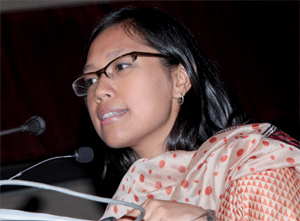
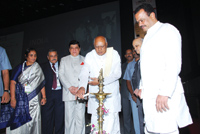
“…I believe that apart from showcasing and presenting ICT for development projects and initiating discussions around them, it is equally important to recognise the successful endeavours in this field. eINDIA Awards would encourage others to follow in the footsteps of their visionary counterparts.” Agatha Sangma, Minister of State for Rural Development, Government of India at the inauguration of eINDIA2010 Awards ceremony
The eINDIA Awards is the premier accolade to innovative endeavors made in assimilating technology in developmental concerns. The initiative aims at identifying and felicitating unique and innovative initiatives in the ICT for development space, as also the projects that can be easily replicated in a sustainable manner.
While eINDIA Awards had a formal two-tier Jury process, it also had a parallel online mechanism for the Citizen’s Choice Award in all 26 sub-categories under eGovernance, Education, Healthcare, Agriculture, Municipal IT and Telecentre. The online voting process allowed citizens to vote and recognise projects that have impacted their lives the most. As part of the formal evaluation process a panel of 25 distinguished international Jury members had to first assess the nominations on certain pre-defined criterion, with each project being evaluated by a minimum of three Jury members. The average weighted score was then used to select the Top 5 from each category. The list was then used by the In Person Jury, which met in Delhi on July 22, 2010 to decide on the winners in each of the segment.
The award jury
- Ashish Sanyal
Sr Director, DIT, Government of India
- Shakila T Shamsu
Joint Adviser, Planning Commission
- Rajen Varada
Resource Person, UN Solution Exchange
- Dr Ashok Kumar
DDG & Director, CBHI, Government of India
- Dr Basheer Ahmad Shadrach
Executive Director, Telecentre.org Foundation
- Dr V Balaji
Global Leader, ICRISAT
- Dr Gopi N. Ghosh
Assistant Representative & Resource Person, FAO
- Dr. B S Bedi
Adviser-Health Informatics, C-DAC
- Dr Ananya Raihan
Secretary General, B’desh Telecentre Network
- Michael Riggs
FAO, Italy
- Hardik Bhatt
CIO, City of Chicago
- Dr R Sreedher
Director, CEMCA
- Anir Chowdhury
Policy Advisor to PMO, UNDP, Bangladesh
- Dr S S Jena
Chairman, NIOS
- Sri B S Raghupathy
Joint Director, DET, Bangalore
- Brig (Dr) R S Grewal
Vice Chancellor, Chitkara University
- Sourav Banerjee
Senior Education Specialist,
USAID
- Prof Arun Nigavekar
Former Chairman, UGC
- Prof Vasudha Kamat
Joint Director, CIET, NCERT
- P Vigneswara Ilavarasan
Assistant Professor, IIT-Delhi
- Rufina Fernandes
Chief Executive, NASSCOM Foundation
- Michael Gurstein
Sr Journalist, The Journal of Community Informatics Centre for Community Informatics Research, Canada
- lekha Kumar
Commissioner, Income Tax, Government of India
- Dr R Siva Kumar
CEO, NSDI & Head-NRDMS, Government of India
- Dr Akhilesh Gupta
Adviser, DST, Government of India
- Sunil Kapoor
Zonal Director, Fortis Healthcare Limited
- Ndaula Sulah
Executive Director, Ugabytes,
Uganda
|
eINDIA2010 Leadership Award
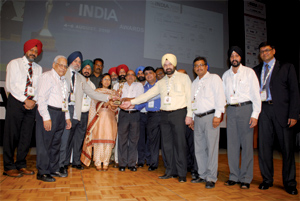
Lt Gen (Retd) Bhopinder Singh, Lt Governor of Andaman and Nicobar Islands
 Lt Gen Bhopinder Singh was accorded the prestigious eINDIA2010 Leadership Award for bringing ICT to remote and difficult terrains like Andaman and Nicobar Islands and connecting distant communities through effective use of IT.
While sharing his views, he said that the Andaman and Nicobar Islands require IT in myriad ways. There are several challenges which have to be addressed in these areas, and for that eGovernance is of crucial importance. “eINDIA has been a great learning experience in terms of getting exposure into the field of IT, and I will take back this learning for furthering the ICT cause in Andaman and Nicobar Islands”, he added.
 ICT enabled school
DESTINATION Success
IMPLEMENTING AGENCY
Indian High School, Dubai
OBJECTIVES
-
Enable teachers to teach in an efficient and effective way
-
Create paperless office, quick and fast communication, virtual classrooms, video lessons, online assessments, and extended learning
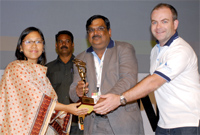 Destination Success is a holistic educational solution with digital content, print and digital activities, lesson plans, interactivities to evaluate student learning, professional development services, IT executive for technical maintenance and teacher support. This is one of the largest eLearning implementations in the region covering more than 7000 students, 220 classrooms with Interactive Boards, complete connectivity in school, Wi-Fi campus, more than 100 hours of IT training for over 600 teachers, and digital interactive content deployed in the school in association with S. Chand Harcourt.
Outcome
 MKCL Digital School Programme
IMPLEMENTING AGENCY
Maharashtra Knowledge Corporation
OBJECTIVES
-
Empower school children to capture various technology enabled learning experiences
-
Give an opportunity of personalised, self paced, collaborative learning experience to school children
 Digital School is a program that empowers school children to capture various learning experiences in a technology enabled and teacher facilitated environment by means of different activities and interactivities complementing school curricula. The target group includes school children, reaching out to 14 districts of Maharashtra and number of schools where the program has been implemented is 397 schools. The project ensures the deployment of eLearning platform inside school for school children to offer co-curricular and extracurricular multimedia based interactive learning content.
Outcome
ICT enabled university
LEARNING Management System & Computer Based Tutorials
IMPLEMENTING AGENCY
Punjab Technical University
OBJECTIVES
-
Enable Students to learn online, anywhere any time
-
Enhance learning capability by providing gist of subject with animation and illustrations
-
Enable students to learn on their own pace
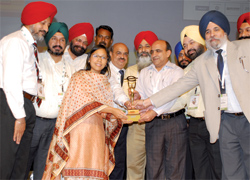 The Project is being jointly executed by the UGC- INFONET Digital Library Consortium, INFLIBNET Centre and the INDEST-AICTE Consortium. In the project IIT Delhi provides for cross-subscription to e- resources subscribed by the two Consortia, i.e. subscription to INDEST-AICTE resources for universities and UGCINFONET resources for technical institutions; and access to selected e-resources to colleges. The authorised users from colleges can now access e- resources and download articles required by them directly from the publisher’s website once they are duly authenticated as authorised users through servers deployed at the INFLIBNET Centre.
Outcome
-
Provides access to more than 2,100 journals
-
Currently, 684 eligible colleges are already accessing e-resources
-
More than 25,000 faculty members and students in 684 registered colleges have been given User ID and Password to access e-resources
N-LIST for Scholarly Content
IMPLEMENTING AGENCY
Information and Library Network (INFLIBNET) Centre
OBJECTIVES
-
Provide access of electronic resources to government /government-aided colleges
-
Enable cross- subscription to e-resources
-
Fill-in the serious gap of providing access of e-resources to colleges
 The Project is being jointly executed by the UGC- INFONET Digital Library Consortium, INFLIBNET Centre and the INDEST-AICTE Consortium. In the project IIT Delhi provides for cross-subscription to e- resources subscribed by the two Consortia, i.e. subscription to INDEST-AICTE resources for universities and UGCINFONET resources for technical institutions; and access to selected e-resources to colleges. The authorised users from colleges can now access e- resources and download articles required by them directly from the publisher’s website once they are duly authenticated as authorised users through servers deployed at the INFLIBNET Centre.
Outcome
-
Provides access to more than 2,100 journals
-
Currently, 684 eligible colleges are already accessing e-resources
-
More than 25,000 faculty members and students in 684 registered colleges have been given User ID and Password to access e-resources
Academic Institute Management System
IMPLEMENTING AGENCY
MIT School of Management, Pune
OBJECTIVES
- Make learning more effective, more inclusive, more flexible, more interesting and personalized
- Aid the teaching faculty to cater to a large group of students more effectively
 The project was started with an aim to evaluate the teaching-learning process, wherein the primary stakeholders are the teachers and students, and for the management and administration of the institute, wherein the primary stakeholders are the administrators and staff members. The Learning Management System (LMS) part of the project brings in “Blended Learning” paradigm into the curriculum. Using the Institute Management System (IMS), the administrative staff, increases the efficiency of the workflow and makes it more responsive towards the other stakeholders of the system. The program is an attempt in creation of a single platform
for all the tasks related to any stakeholder in an institute under one centralised system.
Outcome
Skill development
Jawahar Knowledge Center Initiative
Implementing Agency
Institute For Electronic Governance
OBJECTIVES
 The Institute for Electronic Governance (IEG) is a state level non-profit society established by Government of Andhra Pradesh, to offer solutions in the discourse of quality human resources by bringing synergy among the institutions of the government, industry and academia. IEG has started its training programe by establishing Jawahar Knowledge Centers, in order to bridge the gap between industry and academia and thus improve the rate of employment. At present IEG is training nearly 100,000 students. IEG has also started a separate program called Special Training Program (STP) to ensure that all the socially challenged sections of the society have equal opportunities for employment.
Outcome
Computerji Jode Duniya se
IMPLEMENTING AGENCY
Aga Khan Rural Support Programme India
OBJECTIVES
-
Impart training on computer skills at a very nominal rate
-
Introduce community to the use of computers for livelihood enhancement activities
-
Address all gaps in IT training and skill development
 Aga Khan Rural Support Programme (India) [(AKRSP (I) ] has partnered with Microsoft for an information technology project. “Computerji Jode Duniya se”. This initiative of AKRSP (India) focuses on enhancing livelihoods in remote rural areas of Gujarat, Madhya Pradesh & Bihar by using information technology as a tool. The AKRSP (I) is active in six districts of Gujarat and three districts of Madhya Pradesh. In 2007, AKRSP(I) initiated its work in Samastipur & Muzaffarpur districts of Bihar. The Computerji project was initiated to address all gaps in IT training and skill development. Computerji centres are located in areas with tribal and marginalized population.
Outcome
Open & Distance learning
Implementing Agency
Punjab Technical University Distance Education Programme
OBJECTIVES
-
Provide affordable, flexible and relevant technical education
-
Reach out to a strong network of 32 regional centers & 1600+ Learning centers providing services to over 1,50,000 students
 Punjab Technical University, (PTU) started its Distance Education Programme (DEP) in 2001. In DEP, PTU offers undergraduate and post graduate Diploma and Degree programmes in the field of IT and management, hotel management, airlines and tourism, paramedical and allied technologies, fashion, interior, jewellery and textile designing, fire, safety and hazards management, mass communication and journalism and multi-media technologies. In PTUDEP, there is a unique model of PPP. The administrative, conduct & secrecy powers rest with the University wherein the University designs courses, syllabi & curriculum, prepares learning material, establishes learning centers, conducts & evaluates examinations, provide certification and maintain quality.
Outcome
-
There are more than 1,50,000 students acquiring qualifications in different courses
-
There are more than 1600 learning centres all across India
Pocket Education
IMPLEMENTING AGENCY
Universiti Sains Malaysia
OBJECTIVES
-
Provide education though Mobile devices
-
Develop course content to suit SMS requirements
-
Incorporate pacing by constructing the text message according to the sequence of topics in the learning materials
 The Universiti Sains Malaysia (USM) through the School of Distance Education (SDE) boasts of state-of-the-art telecommunication capabilities and innovative educational approach to enhance the educational architecture and learning environment in Malaysia. The dawning of the age of the Internet saw SDE produce a home-grown learning management system in 2003 with full migration to Moodle in 2005. In the 2007-08 acedemic session, SDE piloted the use of the hand phone in distance teaching via the use of SMS in a second year Physics optics course with the code JIF212. The chosen topic of ‘dispersion’ was redesigned in a SMS fashion such that the students could receive short messages based on the topic.
Outcome
-
The mobile learning initiative was evaluated via a questionnaire and the evaluation showed that the students highly accepted the SMS learning
-
The messages received were easy to understand and are easy to remember
ICT Enabled Engineering College
IMPLEMENTING AGENCY
Vidya Academy of Science and Technology
OBJECTIVES
 DSpace (online repository) and Moodle (online digital learning portal) was implemented in the college by the in-house IT team. The project was implemented using FOSS (Free and Open Source Software) and was started with the intention of sharing the resources online. Teaching notes, slides (PPTs), lab manuals, assignments etc can be shared in DSpace. Assignments and online examinations are given using Moodle so that the students have an option of submitting their answers online. The tools automate the valuation process and the results can be declared immediately after the examination. The target group are students and teachers who would use these tools for effective teaching – learning processes.
Outcome
Private Sector
Teaching Learning Paradigm through ICT Intervention
Implementing Agency
Educomp Solutions Ltd, Haryana
OBJECTIVES
-
Bridge the digital divide by improving education delivery in predominantly rural Government schools through ICT
-
Reach out to even those schools for whom technology would have remained but a dream and to make their aspiration
a reality
 Educomp has ushered a whole new teaching-learning paradigm in schools across India by developing quality courseware and multimedia in regional languages, and providing quality training to teachers, developing training modules to contain 21st century learning skills, project based learning, on making lesson plans and unit plans, and continuous evaluation. It has introduced local language empowering MagiKeys Software to enable ‘Online’ or ‘Offline’ learning in different languages. Special local language multimedia training aids and courseware have also been developed to enable speedy and intuitive adoption by both students and teachers.
Outcome






 The education sector is witnessing tumultuous changes. One aspect is the humungous growth in the number of institutions. The 11th Plan Initiatives quoted in the Union Budget for India 2010 envisage 10 more NITs, 20 new IIITs, 2 new SPAs, 5 new IISERs, 7 new IIMs, 8 new IITs and 16 new central universities. These government-led initiatives are but the tip of the iceberg, with private institutions mushrooming by the day. Increasing competition among institutions is a natural fall out of such explosive growth in numbers.











 CSR is not only about benefiting the company one owns but also benefiting the employees and the community, one is a part of.
 plan projects that they want to indulge in, set objectives to be in a particular time frame, stipulate a time limit for completion of the project, decide upon mechanisms for monitoring the initiative and rectify according to feedback collected. Evaluation and timely feedback would help rectify any challenges involved in
 DISSEMINATING THE