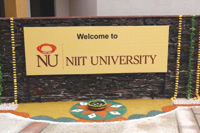
 NIIT University, formally inaugurated on November 15, 2009, is situated in the foothills of Aravali, in Neemrana, Rajasthan. The University is set to become an ideal example of learning in innovation, backed by end to end technical infrastructure in the lap of nature.
“Learn What You Want, How You Want, Where and When You Want. But Learn You Must!”
NIIT University (NU), a not-for-profit academic organisation, is a new and futuristic institution of higher learning. The University is committed towards bringing innovation in learning, in the emerging global knowledge society.
 NIIT University is poised to develop around the Four Core Principles of providing Industry-linked, Technology-based, Research-driven and Seamless education. It promises to build great minds and original thinkers, besides ensuring exceptional job opportunities for all its students. The University is focused on developing learning structures that are technology-enabled and research-driven, which will equip learners to solve problems in their daily lives.
According to research by NU, recruiters are increasingly looking for research-driven minds that can bring more innovation into the workplace. Taking a cue from the industry, the University has designed each of its programmes in a way that students are drawn towards research through R&D projects, methodology courses and inspirational lectures by eminent professors and experts.
Formally inaugurated on November 15, 2009, the University is situated in the foothills of the Aravalis, in Neemrana, Rajasthan. The first public announcement about the launch of NIIT University was made on March 31, 2009 and the first session began from September, 2009. The idea of the University was initiated in the '90s, but got mobilised when domain leaders from across academia and industry came together in 2005, and along with the initial Advisory Board, worked on the core principles and objectives of NIIT University.
The Founding Advisory Board members included, Prof P V Indiresan, former Director, IIT Chennai, the late Prof C S Jha, former Director, IIT Kharagpur,
Dr Kiran Karnik, then President, NASSCOM, Prof R C Malhotra, former Director, IIT Kanpur, Dr R A Mashelkar, then Director General of the Council of Scientific and Industrial Research (CSIR), Prof. Ashok Misra, (who later became Director of IIT Mumbai), Prof J R Isaac of IIT Mumbai and Prof M P Kapoor, former Vice Chancellor, Thapar University, among others.
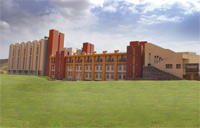
The 100 acre, fully-residential green campus of NIIT University is situated around 100 kms from Gurgaon and 130 kms from Delhi and Jaipur, on the Delhi-Jaipur NH-8 Expressway. The campus is equipped with state-of-the-art technology, cutting-edge teaching methodologies and a strong research and development infrastructure.
NIIT University offers BTech Programmes in Computer Science and Engineering, Information and Communication Technology and Biotechnology; MTech Programmes in Pervasive Systems, Embedded Systems and Bioinformatics and Educational Technology. PhD programmes in Computer Science and Engineering, Information and Communication Technology, Educational Technology and Bioinformatics and Biotechnology are available to students.
The University has also recently announced its MBA Programme, a two year course that meets and exceeds the academic requirements of typical management degrees. The NU-MBA program aims to equip students with the new age skill sets required to seamlessly navigate through the challenges faced by today's business leaders , and also expose them to the vibrant Asian and African economy that are poised to become pivotal economies of the future.
The NU-MBA has a unique initiative by which every student is assigned a mentor from industry who guides him throughout the program. This has brought together 16 CEOs from some of the most reputed companies in the country. Names like Manoj Kohli (Airtel), Raghupati Singhania (JK Industries), and Bhaskar Pramanik (Oracle India) are a few who have agreed to mentor the NU-MBA students through structured personalised interactions. The Mentorship Program is supplemented by other distinctive industry-linked elements, so that students are immediately productive at their post-MBA jobs.
The programme encompasses 36 courses over six terms (trimesters), of which nine are Electives, and requires a specialisation in one out of the six Concentration Areas offered.
Driving towards a futuristic model of education
The aim of NU is to provide students with occupational, spatial and temporal mobility demanded by today's globalised economy. It is about maximising the choices of students and giving them an all-round, holistic education with no artificial constraints. The academic structure and educational process at NIIT University are based on the Four Core Principles of providing Industry-linked, Technology based, Research-driven and Seamless education, derived from the best examples of the global knowledge society.
Industry-linked:
Extensive connectedness with industry is the hallmark of the NIIT University because of the focus on building great careers. This deep-connect is visible through initiatives of:
-
Six months, or a full semester, devoted to Industry Practice for undergraduates or an Internship for post graduates ensures rich hands-on experience in the workplace
-
Creating an advisory board constituted by industry experts and accomplished academicians, to update the curriculum regularly and ensure regular tutorials by industry professionals
-
Encouraging students to participate in industry-sponsored R&D projects in the latest industry research
-
Guiding students extensively in career development with the help of a dedicated career development team
-
Establishing an incubation centre to catapult successful R&D projects into commercialisation by implementing them as live projects, or through patenting, licensing and technology transfer. Twenty-five acres (25% of the total campus master plan) is set aside for Incubation and allied activities.
|
 Four Core Principles of NIIT University Four Core Principles of NIIT University
The founding philosophy of NIIT University is based on Four Core Principles that aim to establish a technologically-enabled University with a holistic learning approach.
Core Principle I: Industry-linked
NIIT University is focused on building extensive connectedness with the industry to remain more relevant and train industry-ready graduates.
Core Principle II: Technology-based
NIIT University is committed to using cutting-edge technology in all its activities to improve transparency, convenience and to sharpen the professionals skills of students.
Core Principle III: Research-driven
Creating knowledge-based education is the approach of NIIT University. Students from the orientation course are trained to examine problems through the eyes of researchers and innovators. NU's goal is to inculcate the habit of research, analysis and documentation in students and build a research culture on its turf.
Core Principle IV: Seamless
Seamless is a word that is applicable to NIIT University academic programmes and operations, administrative processes and external linkages. Higher education in India needs reforms, that are tuned to the global knowledge society. NU will work cohesively in institutionalising seamlessness, and changing the prevailing practices in higher education within the existing regulatory framework.
|
Technology-based and Synchronous:
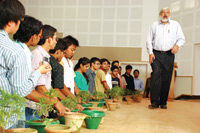 The NIIT University believes in using cutting-edge technology in all activities to improve transparency, convenience and to sharpen student's professional skills. NU ensures that:
-
All its programmes cover the latest technological developments, so as to keep students abreast of industry developments
-
Synchronous learning technology is available, that brings students face-to-face with professors and industry leaders from across the world
-
All students are provided extensive computing facilities, with over 1.3 nodes per student even in the first year and computer access throughout the campus
-
There is seamless integration in administration, education delivery and assessments through online software to improve the administrative process and reduce paperwork
-
An AV Studio transmits lectures from the campus to learning centres and facilitates the preparation of professional quality educational material
-
Advanced IT-enabled science labs facilitate computer-assisted learning
-
There is a readily available campus-wide Gigabit LAN and universal Wi-Fi Internet, that provide anytime, anywhere access
Research-driven
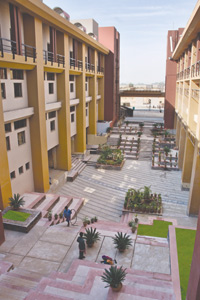 At the NIIT University, creating knowledge starts from Year 1. Minds trained to approach every problem through the eyes of a researcher are the need of the hour in today's complex and fast-changing Knowledge Society. This training of the mind is manifested through distinct attributes such as the habit of critical inquiry, hypothesizing, analyzing, experimenting, creatively discarding and documenting. NIIT University is building this 'research culture' through a variety of means:
-
Courses like Problem Solving, Design of Experiments, Research Methodology and Scientific Method for BTech students
-
Extensive R&D Project and Research Methodology courses for all PG students. Already four patents have been granted, eight patent applications are under review, and 29 papers have been published in international journals
-
Guidance from highly experienced mentor professors in courses and co-curricular activities. Lectures by outstanding researchers are a part of the mentoring process
-
Creating a research advisory board constituted by researchers in industry and accomplished academicians, to advice and actively engage with NU on all research related matters
|
The Synchronous and Seamlessness Learning at NIIT University
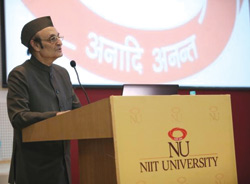 “The concept of knowledge is increasingly being looked upon from a holistic rather than a sectional point of view. The rigid demarcation into departments and disciplines is giving way to inter-disciplinary approaches, whereby students can not only take advantage of the latest technology, but also ground themselves in our rich, pluralistic, multi-faceted spiritual and intellectual heritage. This green-field university being built by the creative team led by Rajendra Pawar and his colleagues, represents a new and innovative approach to knowledge in the 21st century. NIIT University gives a glimpse of what future education institutions should be. It is my hope and vision that one day this will become a unique centre of holistic learning, not only for India but for the whole world.” “The concept of knowledge is increasingly being looked upon from a holistic rather than a sectional point of view. The rigid demarcation into departments and disciplines is giving way to inter-disciplinary approaches, whereby students can not only take advantage of the latest technology, but also ground themselves in our rich, pluralistic, multi-faceted spiritual and intellectual heritage. This green-field university being built by the creative team led by Rajendra Pawar and his colleagues, represents a new and innovative approach to knowledge in the 21st century. NIIT University gives a glimpse of what future education institutions should be. It is my hope and vision that one day this will become a unique centre of holistic learning, not only for India but for the whole world.”
|
Seamless
Seamlessness is an all-pervasive concept that will manifest across the NIIT University program structure, curriculum, academic operations, regulations, teaching-learning strategies, modes of education delivery and external linkages. Seamlessness is about maximising students' choices and ensuring that they receive all-round holistic education with no artificial constraints. The key dimensions of seamlessness to enhance the core student experience include the following:
-
Students must construct a significant portion of their own curriculum. While BTech students select 23%, MTechs decide on 55%of their overall course credits
-
More than 50 percent of the BTech curriculum comprises lateral integration across knowledge disciplines, including basic sciences, mathematics, technical arts, humanities and languages
-
Each students audits two co-curricular activities from physical education, performing arts, community engagement, crafts or languages
-
There are courses like Research Methodology and Contemporary Issues to bridge a wide variety of disciplines within one single course
-
The delivery of teaching is through a rich blend of methodologies including classroom learning, interactive learning, e-Learning, project-based learning and open-ended problem solving
|
The Eternity of the Mobius Ring
 The power of knowledge is universal and eternal. 'Learn What You Want, How You Want, Where & When You Want. But Learn You Must!' – The emblem of the NIIT University depicts a mobius ring, symbolising eternity. The mobius ring greets everyone who enters the campus and takes a curve towards the entrance of the academic building atop of a hillock. The sides of a mobius ring merge in and out, back and forth to create the most graceful, seamless and complete structure imaginable to the human mind. The ring is engraved with Anadi-Anant, an ancient concept implying that the Universe is eternal The power of knowledge is universal and eternal. 'Learn What You Want, How You Want, Where & When You Want. But Learn You Must!' – The emblem of the NIIT University depicts a mobius ring, symbolising eternity. The mobius ring greets everyone who enters the campus and takes a curve towards the entrance of the academic building atop of a hillock. The sides of a mobius ring merge in and out, back and forth to create the most graceful, seamless and complete structure imaginable to the human mind. The ring is engraved with Anadi-Anant, an ancient concept implying that the Universe is eternal
|


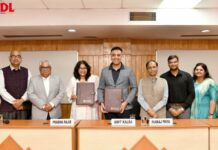



 Human Resource Development (HRD) Minister Kapil Sibal on 8th April 2010, made an agreement as the two countries India and Australia signed an education pact. Indian students continued to come to Australia for higher studies and the government had not discouraged them for doing so. An India-Australia Education Council comprising experts from both countries will now be set up. Sibal also reported that he believed the attacks on young Indians had declined. A media report said it was recently revealed that international student numbers were down nationally three percent and 12 % in Victoria.
  The Indira Gandhi National Open University (IGNOU) is now spreading its wings not only at national level but also internationally, as a part of its plan to spread across the message of education. The university is set to start its centre in London from July this year that aims to offer undergraduate and postgraduate programmes. According to the officials, after London, Paris would be the next destination for expansion. It was also reported that the London venture, despite the university's experience in running centres abroad, might not prove to be an easy task as it is expected to face a tough competition from the UK Open University (UKOU).
  Zee group, known for providing entertainment and news, recently, announced that it plans to set up 50 schools in just one year across the country and aims to set up 300 schools by 2015. The Chairman of the group, Subash Chandra, mentioned in a statement that within a year the group has set up 50 schools and that it is a strong step being taken towards enhancement of the country's human capital by making children realise their own respective potential. The company had already laid out an investment of INR 350 crore for setting up schools and developing innovative learning content.
  O.P. Jindal Global University and Cambridge University signed a formal pact, at New Delhi recentally, to train and teach IPS officers for a knowledge based policing system in India. The course designed by eminent scholars, researchers, academicians from the field of Law and Crime from Cambridge University and JGU would be for the enrichment of the IPS officer which in turn would benefit the entire police force and the society at large. The Ministry of Home Affairs, Government of India has awarded this training contract to Cambridge University working with its Indian partner, O.P. Jindal Global University.
  While sharing his views on impact of ICT on Indian society and the next phase of ICT revolution, through a video link from Chicago, Sam Pitroda delivered a keynote at the recent conference Microsoft Tech.Ed developer, held in Bengaluru. He described that the ICT revolution in India is about to enter into its second phase that would be based on broadband, data, applications, processes and new infrastructure. This would change the nature of education, health, government services, public delivery systems available in India. He elaborated that in the next two decades information is to play a critical role in restructuring a lot of development in India.
  Higher education in India is currently going through a transitional phase while coming across a critical era of development and turmoil. Witnessing and getting into the process of upholding the glory of the developmental phases, digitalLEARNING magazine organised the Higher Education Summit with the aim of stimulating debate and shaping strategies to deal with the rising challenges of the inclusion of ICT in the higher education sector on 9th of April, 2010. The Summit whirled debates on the key developmental agenda that will revolutionise the application of ICT in learning and administrative facilities for higher education institutes across India.
  NASSCOM Foundation (NF) has spearheaded many programmes that leverage the power of ICT for the benefit of the society and development of communities as a whole.
 Poverty Alleviation programme is aimed to provide employability and encourage micro-entrepreneurship to rural youth and people from under-served communities including women, people with disabilities as well as unskilled workers. NF currently facilitates this through Anizooms and CEDAT.
 NASSCOM Foundation provided the basic training module, and cultivation started on an experimental basis. Now with the help of GSK, NF, Nehru Yuva Kendra (NYK), and Orissa Universal Agriculture Training (OUAT), the Friends Club of Siripur has started producing mushroom seeds. The village has been selected by NYK, Govt. of India, Ministry of Youth Affairs and Sports and OUAT of Orissa as a model village.
 In view of the government’s National e-governance plans as well as other initiatives like NREGA, RTI and others, NASSCOM Foundation started a three year nationwide initiative called ConnectIT to provide the much needed advanced IT training support to NGOs and government officials at an advanced level.
 What are the strategies that Thotmatrix has adopted to provide end to end technological solutions to the education sector?