




Business Vertical Manager, LG Electronics India
There is a paradigm shift in using the tools for purpose of education today. Educational Institutes are trying to develop a system of more and more scientific gadgets to create much effective teaching-learning process. This also cut down the cost in the process. Because good faculty cause a high expenditure and replacing manpower with effective technology results in good quality of teaching with lesser cost. There is an obvious major boom to see in the education sector in India in terms of using technology in comparison to the global scenario. As the world is moving towards technology driven education system, India is also not far behind and capturing the pace very fast. There is also a good competition growing in between the private and government/state run institutes in India in terms of the quality of education, using technology and resulting a huge potential of quality development of mankind.
Manager, (Analyst & Media), Scientech Technologies Pvt. Ltd.
IWB's are the most important tools of learning. They have changed the way we teach & train because education has become Edutainment providing a greater learning experience to both, the Teacher and the student. We provide Interactive Classroom Solutions consisting of Clasus, Legamaster and Luidia's Interactive White Boards or eBeam Interactive Devices, Quizdom Voting Pads, Document Camera, Wireless Tablet, Projector etc. In comparison to international market, Indian market is slow paced but a potential market. There are still a million classrooms left to be made Interactive. The penetration of equipments is much higher in private schools than Government schools. Government should promote them more widely through a policy. Otherwise the growth will be slower. We are sure India will be emerge as the fastest emerging market for quality education in the next few years.
Senior Business Manager, Visual Instruments, Epson India Pvt. Ltd.
Considering the world wide market scenario the only segment where there is consistent growth is Education across the globe. The teaching methods are drastically changing from the conventional black board to computer based teaching with interactive content. Interactive classroom teaching (ICT) is the current trend in education with graphical representation where students gain much more practical knowledge in reality world. In this the teacher is using the computer, IWB & projector for the teaching. This kind of teaching is motivating students to be involved in every aspect and teachers are in receipt of good results from maximum students. The growth in India is almost 15% – 20% every year on the education segment and lot of funds being allocated to education from the government very year. Epson has range from 35K to 70K for the standard class room projector.
Director of Sales-Asia Pacific-Latin America-New Mexico, mimio
There is probably no other nation like India, which has seen the transformative impact of a well educated and technologically literate workforce on the national economy. India already has some of the worlds most highly innovative providers of ICT to education bringing comprehensive interactive classroom solutions which integrate equipment, content, training and support to schools. The rapid growth in adoption of ICT and IWB's in the private schools sector will migrate to the public or government schools sector in the coming years and when it does, will be of unprecedented scale. At this moment, mimio provides a range of portable and highly affordable solutions for creating Interactive Whiteboards in classrooms. The cost of these systems can start at prices as low as Rs 32,000.
India is no doubt an emerging market in the segment of IWB and audio-visual equipments in the education sector. But lot needs to be taken care of, though. There is a dearth of proper knowledge of the usage of the equipments. Continuous feedback required from teachers as well as parents. There need to be awareness about the products and the usage of it. The premium and good schools always include these equipments in their infrastructure. But there is still a dearth of general consciousness in the subject. Dispro Visual Technologies Ltd., with over a dozen firsts to his credit.,having 30 years of practical experience in projection displays. Dispro Visual has an exclusive range of Interactive products like Dispro E-Board, Intensaa H18 Interact, High Quality Rear Projection Systems, Dispro Touch LCD TV, Inwall Interact, Holo Magic Screen, 3D Plasma and LCD, Interleaved 3D LCD Panel and Dispro 3DTV 100 System.
Senior Consultant, Futuresource Consulting Ltd. UK
In the Indian education sector, the estimated installed base of IWBs is 9,000 and projectors 112,000. These numbers are forecast to increase to 111,000 and 276,000 by 2011.The Indian Government already realises that there is a real need for quality education in order to match international standards and allow them to compete and not get left behind. With 4.9 million classrooms the Indian market clearly provides a significant market opportunity for suppliers of ICT equipment. However, the market is extremely fragmented with a vast disparity in the education system throughout the country. Driven by continued technological developments, our projections show that one in six classrooms will have an Interactive Whiteboard by 2012. In the 66 countries covered within the Futuresource report, there are over 31 million classrooms, a huge market potential for companies operating within this sector.
Vice President,
Promethean Ltd.
Interactive Whiteboards are becoming an increasingly common classroom resource and already schools and colleges are seeing the benefits that this technology has in transforming teaching and learning across the curriculum. Teachers are using the technology to develop their range of pedagogical strategies and are beginning to exploit the technology to act as a catalyst in enhancing teaching and learning. IWBs are taking education to the next level, by actively engaging the students and make them understand the things rather than just remembering the facts. The impact is tremendous as there is a saying that rather than explaining in thousand words, show a picture. Promethean was the first to launch integrated voting products, the first with integrated board and short throw projector and the first interactive whiteboards with multi-input capability, Promethean leads from the front.
Director Mobile & IT,
Samsung Electronics
IWBs demonstrate clear effectiveness in improving student participation, concentration and learning efficiency. Globally IWBs are showing a healthy acceptance in schools. In the US, the IWB Market is set to grow from 375K units in 2009 to about 637K units in 2010. At Samsung, we have focused on creating IWBs that are not only sleek in design but also have a brilliant technical edge. Our innovative Touch screen 650 E IWB has a wide viewing angle and supports multimedia display ranging from photo, flash and video. We feel that the IWB has a good potential in India with the focus in education gearing towards drawing greater interactiveness and participation from students. The market in India for IWBs is just about getting created. As the classroom environment progresses towards an engrossing interactive session with av aids, IWBs would serve the purpose of integrating digital content and enrich the learning experience.

 A collaboration recently took place between the Linux Professional Institute Potrugal (LPI), the world's premier Linux certification organization, and UMIC, the Knowledge Society Agency of Portugal's Ministry of Science, Technology and Education. This collaboration is to promote training and certification of professional skills in the use of Linux, open source technologies and free software in higher education institutions in Portugal. Jim Lacey, president and CEO of the Linux Professional Institute mentioned that LPI's major objective is that its affiliate in the region would be providing TTT that is 'train-the-trainer' programmes in order to certify instructors within participating academic institutions under this initiative. The Portuguese Ministry of Science, Technology and Higher Education through UMIC has also been working with Portugal's universities and polytechnics over the past five years to develop more than 60 professional training courses in ICT for more than 2,200 students.
  U21 Global, the online university promoted by a consortium of international universities, is one of the Manipal Group investee, is soon to get a facelift. To get into agreements with around 10 other institutions, U21 Global, mostly private universities in India. Its focus also lately, has been shifting to corporate education despite originally setting up an online university offering masters degree programmes. Established in 2001 as a joint venture of 17 member of international university consortium Universitas 21 and Thomson Learning, it was to offer online business degree programmes to students. Manipal Education Group, however, in 2007 acquired a 50 % stake in U21 Global by purchasing the holding of Cengage Learning and gradually upped it to 75 %. The Rest of the partners in U21 Global include institutions like the Universities of Melbourne,Nottingham, Birmingham and Virginia.
  Starting soon, Allegany College of Maryland through its popular continuing education course, will teach corporate coaching, practical skills that managers can use for work place results. Corporate coaching is to deal with the practical application of coaching and mentoring employees so that they deliver results, grow their capabilities and improve communication. Jeannette Rudy Fitzwater, a registered corporate coach, uses an interactive curriculum that allows for the discussion of real workplace issues and solutions. The aim of the course is to guide employees to think and do for themselves to deliver the needed results, motivating employees to take on responsibility and perform effectively, and growing employee capabilities that lead to future growth and success.
  On March 16, 2010, Pepsi Consumer advocacy groups announced that the company will stop selling full-sugar soft drinks to primary and secondary schools around the world by 2012, very happily. Kelly Brownell, Director of Yale's Rudd Center for Food Policy and Obesity, lauded companies action. The Center for Science in the Public Interest also applauded the move, which stems from a campaign led by CSPI called the 'Global Dump Soft Drinks Campaign.' Coca-Cola and the International Council of Beverage Assns. were also at negotiations that led to the PepsiCo announcement, these took place in Geneva, convened by the World Heart Federation. Earlier this month, the American Beverage Assn. released a report on school beverages, in which it reported an 88% decrease in total calories in beverages shipped to schools and a 95% decrease in shipments of full-calorie beverages.
  TIndian schools will be hit with Encyclopedia Britannica textbooks, along with an online study module from April 2010. These textbooks will cover matter in four subjects – computer science, mathematics, environmental studies and general knowledge, told President, Encyclopedia Britannica, Jorge Cauz. This information has been revealed after the knowledge giant made inroads into the school textbook business in India with a collection of 30 books, 10 knowledge CDs and nine teacher's manual. The Britannica books cover the National Council for Education, Research and Training (NCERT) syllabus from classes one to eight. The internet modules under Britannica Online School Edition (BOSE) have been created for three levels including elementary (primary), high school and senior high school, covering classes one to twelve.
 Recently, at the 20th annual convocation of Kuvempu University, Union Minister of State for Human Resource Development D. Purandeswari mentioned that the regulatory bodies of higher education such as the University Grants Commission (UGC) and the All-India Council for Technical Education (AICTE) will not be done away with, after the constitution of the National Council for Higher Education (NCHE). These institutions will be subservient to the latter.
 According to the Foreign Educational Institutions (regulation of entry and operation) Bill, the foreign universities will be checked from repartriating profits from Indian campus though education, by making it mandatory for the universities to publish a prospectus for settling in India. The new education providers settling down in India are required to deposit an amount of INR 50 crore with the body that will register them, which is the University Grants Commission (UGC).
 To increasse the number of students in government schools and to reverse the trend of decreasing number of students, the Punjab School Education Department (PSEB), for the first time, a proactive stratgey has been adopted by the latter. The department has made a decision of sending its teachers, including over 28,000 anganwari workers to convince parents of children, including those not part of anganwaris, to admit them in government primary schools.
 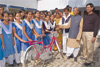 Class 8 girl students in Jharkhand are to receive free bicycles, to check the dropout rates in government schools, mentioned state Human Resource Development (HRD) minister Hemlal Murmu on March 15, 2010, night while replying in the assembly on his department's budget for 2010-11. Earlier, free cycles were provided to girls of tribal and Dalit families.
 On 15th March 2010, the proposal to allow foriegn universities to set up campuses in India was passed by India's cabinet. This is to reduce the flow of Indian students abroad. Tens of thousands of students head to universities in the United States, Britain and Australia among others for quality education each year. Political parties have in the past opposed the entry of foreign universities, saying the poor will not be able to afford the fees. A figure of 13.8 million will be reached most likely, as far as the demand for graduates goes over the next five years, analysts have estimated. But with only 13.2 million students graduating over the same period, India will face a shortfall of 600,000 graduates. India is to turn into a sought destination for top foreign universities, with India's large English-speaking population and growing middle class.
  The former Reserve Bank of India deputy governor Rakesh Mohan, who was previously appointed as the faculty with the prestigious Yale University, recently told that he was not offered a teaching job by any Indian university, as a professor. This was in response of a query regarding him not chosing any Indian university for teaching. Mohan added he would like to see India as the intellectual centre of the world in the coming years. He hoped that India would work towards re-structuring its higher education system, to level up with the huge amount of work taking place across Asian counrties. He is currently the non-executive vice-chairman of the Indian Institute of Human Settlements, and global advisor to the McKinsey Global Institute, McKinsey and Company. The economist will formally serve the faculty from July 1.
 Genee World is headquartered in Wolver-Hampton, West Midlands, England and has a presence in seven countries worldwide; Genee World, currently in India is known as Genee Solutions India, earlier located at Gurgaon(Haryana) but now shifted at Delhi.
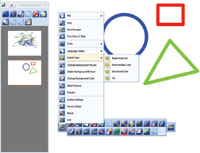 The laser pen allows the user to draw a line to highlight or indicate text or an object on the whiteboard. The line drawn will flash until a different tool is selected from the toolbar which prompts the line to then disappear.
 Promethean's vision is to develop the learning process into one that inspires, enriches, enlightens and excites people with a passion to positively transform lives.
 Twenty-two years ago, SMART’s executive chairman and co-founder,
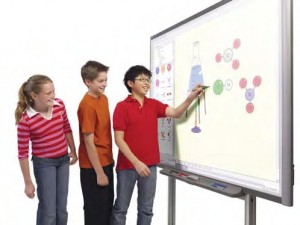 David Martin, conceptualized the SMART Board interactive whiteboard executive chairman and co-founder, David Martin, conceptualized the SMART Board interactive whiteboard – the fi rst and most widely installed interactive whiteboard in the world. In 1991, the fi rst generation of the SMART Board interactive whiteboard was introduced. Currently in its sixth generation, the MART Board interactive whiteboard line has expanded to include models integrated with projectors and other tools. SMART’s focus has expanded to include a variety of supporting hardware, software and content to create complete classroom and meeting room solutions.











Union Budget 2010 – 11 in Education
Plan allocation for elementary education increased by 16% from INR 26,800 crore in 2009-10 to INR 31,036 crore in 2010-11. In addition, States will have access to INR 3,675 crore for elementary education under the XIIIth Finance Commission grants for 2010-11.
The education sector is considered as the virtual base of the country's economic and social developmental agenda. India is known for its intellectual capital worldwide, a lot remains to be done though.
The excerpt from the speech by Pranab Mukherjee, Minister of Finance, during the presentation of the Union Budget, 2010-11:
“Madam Speaker, I rise to present the Budget for 2010-11….. For the UPA Government, inclusive development is an act of faith. In the last five years, our Government has created entitlements backed by legal guarantees for an individual's right to information and her right to work. This has been followed-up with the enactment of the right to education in 2009-10….. To fulfil these commitments the spending on social sector has been gradually increased to INR1,37,674 crore which now stands at 37 per cent of the total plan outlay in 2010-11. Another 25 per cent of the plan allocations are devoted to the development of rural infrastructure. With growth and the opportunities that it generates, we hope to further strengthen the process of inclusive development.
The Right of Children to Free and Compulsory Education Act, 2009 creates a framework for legal entitlements for all children in the age group of 6 to 14 years to education of good quality, based on principles of equity and non-discrimination. In recent years, Sarva Shiksha Abhiyan (SSA) has made significant contribution in improving enrolment and infrastructure for elementary education. About 98 per cent of habitations are now covered by primary schools. I propose to increase the plan allocation for school education from INR 26,800 crore in 2009-10 to INR 31,036 crore in 2010-11. In addition, States will have access to INR 3,675 crore for elementary education under the Thirteenth Finance Commission grants for 2010-11.”
In order to support the developmental measures in the economy, adequate investment in training, skill development and education in the larger economy was necessary and need of the hour as indicated by the experts.
The Budget announced a major allocation with an increment of INR 31,036 crore in the current fiscal year against the previous year's allocation of INR 26,800 crore for elementary education which is a INR 4,236 crore or 16% increase from the 2009-10 fiscal. In addition to this, the states' access to a grant of INR 3,675 crore in the current year for basic education will ensure states' responsibility of the 65:35 Centre-State funding arrangement dedicated to the Right To Education (RTE).
National Skill Development Corporation has approved three projects worth about INR 45 crore to create 10 lakh skilled manpower at the rate of one lakh per annum.
An extensive skill development programme in the textile and garment sector to be launched by leveraging the strength of existing institutions and instruments of the Textile Ministry to train 30 lakh persons over 5 years.
The spending on social sector has been gradually increased to INR 1,37,674 crore in 2010-11, which is 37% of the total plan outlay in 2010-11.
Another 25 per cent of the plan allocations are devoted to the development of rural infrastructure.
Allocation for Mahatma Gandhi National Rural Employment Guarantee Scheme stepped up to INR 40,100 crore in 2010-11. However, there is no specific mention of the Higher Education allocations this year, though.
Union Budget 2009-10 announced the provision for the scheme 'Mission in Education through ICT' substantially increased to INR 900 crore and the provision for setting up and up-gradation of Polytechnics under the Skill Development Mission enhanced to INR 495 crore. INR 827 crore allocated for opening one Central University in each uncovered State. INR 2,113 crore allocated for IITs and NITs which includes a provision of INR 450 crore for new IITs and NITs. The overall Plan budget for higher education was to be increased by INR 2,000 crore over Interim B.E. 2009-10.
Impact on education sector