Home Blog Page 1347

Tracking the life and times of the acheivers

It was probably in my class 3 or 4 history textbook that I read that 'Augustus Caeser completely transformed Rome. When he became emperor, it was not a great city. But when he died, it was completely transformed with miles of good roads and good facilities'. Somehow, those lines have always stayed with me. Years later, some of us asked ourselves 'Can one person (or a small group of people) change the world?” and told ourselves that the answer was 'yes'!

All-India Exposure: I did my schooling in Calcutta and Delhi, engineering in Madras and have now lived for the past 15 years in Ahmedabad, giving me a strong basis to claim to be 'all-Indian'. I got a ZX Spectrum home computer thanks to a generous uncle in the US when I was in class 9, and at IIT Madras moved from punch cards to a Siemens mainframe computer. IIM Ahmedabad upgraded their PC lab (from XTs!) the year I was there and I was in-charge of the lab. At IIT, I used to bunk my engineering drawing classes (having had the advantage of already having done that in class 11 and 12) to work on my passion

Emerging Directions in Global Education: Catalysing Change

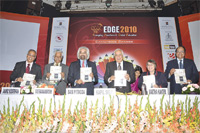
Left to right: Anand Sudarshan, Dr. V S Ramamurthy, Sam Pitroda, Shri Kapil Sibal, Dr. Martha Kanter and Prof. V N Rajasekharan Pillai at the inauguration of EDGE 2010

EDGE 2010 was a conference that was spread over a period of three days (3-5th March 2010), at Indian Habitat Centre, New Delhi, with agenda that was to address the 'Emerging Directions in Global Education'. The first day witnessed registration for workshops and inaugration of the conference and two workshops.

The First Day

Workshop I: “Lessons Learned: Issues to Consider in Building a National Admissions Test” by The College Board, USA. The panelists for the workshop consisted of  Janine M. Farhat, Senior International Specialist, The College Board, who also chaired the session; James Montoya, Vice President, Higher Education Relationship Development, The College Board; Dr. C. Peter Magrath, Senior Presidential Advisor, The College Board; Dr. Andrew Wiley, Executive Director for Higher Education, The College Board; and Madan Padaki, Co-Founder 7 CEO, MeritTrac Services.

Workshop II: Education Governance

The panelists coinsisted of Prof. N. Ravichandran, Director IIM Indore; Prof. Rachel Davis, Adjunct Professor, National University of Singapore; Prof. Krishna K. Ladha, Professor, IIM Kozhikode; Prof. C.V. Baxi, Former Director, MDI Gurgaon; Sharat Kumar, Former Director, IMT Ghaziabad; Dr. Pallab Bandyopadhyay, Vice President

&lsquo:Classroom of the Future&rsquo:

Technology plays the most important role in modernising global education systems and India shows no exception in that. In such scenario, the usage of Interactive Whiteboard and Audiovisual equipments is emerging as one of the powerful pedagogical innovations in the teaching and learning process.

sangita ghosh de, digitallearning, explores.


The advancement and inventions in the domain of technology are having an unprecedented effect on the methods of teaching-learning process globally developing the concept of “classroom of the future” as an extremely advanced and modified picture.

Technology plays the most important role in modernising global education systems and India shows no exception in that. Need and awareness for technology-enabled education is spreading in across the verticals of the education system in India. According to the researchers and experts, technological determinism and the predictability of technological change in education have now become the area of research and analysis.

In the process, the idea of multi-media concept in education, has gained much momentum where the integration of voice, data and video resources creates synergistic effect. The emergence of this new concept of media convergence is also changing the curriculum in universities all over the world.

Multimedia, which also connotes to Audiovisual term of the medium, is usually a combination of computerised and electronic devices that includes a combination of text, audio, still images, animation, video, and interactivity content forms in contrast to conventional media which only use traditional forms of printed or hand-produced material. Here particular attention is paid to the audio and visual presentation of the material with the goal of improving comprehension and retention. In that scenario, the usage of Interactive Whiteboard (IWB) and Audiovisual equipments is emerging as one of the powerful pedagogical innovations in the teaching and learning process.

The background and opportunity

According to a recent research report by Futuresource Consulting Ltd. of United Kingdom, India provides a significant market opportunity for suppliers of IT equipments, because of its 4.9 million classrooms spread across 1.2 million schools (of which 1.6 million  are in private schools – private schools only represent 19% of the total number of schools in India). Overall, there are almost as many private schools in India as there are government schools which have computers, however, the market is extremely fragmented with a vast disparity in the education system throughout
the country.

In most schools, IT equipment tends to be located in an IT lab as opposed to individual classrooms, thereby limiting the potential penetration opportunities for IWBs and projectors.

According to Jaemes Shanley, Director of Sales-Asia Pacific-Latin America-New Mexico, mimio – a leading IWB vendor, “Given that today's students tend to be already “digital” in their awareness and orientation, one could also argue that use of Interactive Whiteboard in the classroom simply makes the environment more relevant for students. The IWB and related interactive systems at work in the classroom not only utilise the power and versatility of digital media and information as content for learning but also synchronise the classroom context with the contemporary world outside the school.”
Outside IT Labs, a cost-effective bundled solution incorporating PC, projector and IWB


Distributed Education: Learning and Beyond : Thimmiya A.M, Manipal Education

 Manipal Education provides with a service of distance education. Can you tell us about the importance of distance learning and skills education?

Present day distance learning is based on ideology of creating and building on human capital. It has moved to another level all together with objective of creating substantial work force that can aid in raising the economy of a country to newer heights. The former is supportive of what is known as the ‘Earn & Learn’ model. This model enables people who are already in jobs or people who want to get into jobs, to avail educational opportunities whereby they can learn the fundamentals of a particular skill and gather knowledge from hands-on practicals with certification. Scope of vocational training is now being realised at a wide scale. This is applicable right from 10+2 level to Post Graduation. There is provision of scalability in between employment. ODL programmes help in enhancing career profiles.



What are the challenges in the field of distance education?
What are the challenges in the fi eld of distance education? Rather than a specifi c challenge, be it across – distance education or campus education – is employment versus employability. The biggest challenge is whether people today fi t into their work spaces or not. I think the challenge that organisations face is that they need people fi rstly and with full productivity,
gone are the days when they could hire people put them for induction for years and then get productivity out of them. So they need people on priority basis who can give immediate productivity. So largely distance education appeals to people who are working largely education appeals to people who are working. So they bring with them their experince, that exposure of the practical work and the course is also laid out in such a manner that it helps them optimise their productivity. Our courses are also geared to meet the challenges.
We have in our own way tried to design the curriculum including lot of practical experiences, presenting real-life situations so that candidates are more competent. In formal learning streams, all subjects are not possible to fi nd and that is where distance learning education opens doors to different courses. What is your understanding of the eLearning scenario w.r.t distan e education? eLearning is basically seeing a paradigm shift. From Teacher – Centric to Learner – Centric in both campus nad distance education. We have come up with inititaives like EduNext, which is collaborative learning – which addresses the issue of teacher and student centric learning. Now earlier in Teacher centric mode, teacher would come teach and
go and student would also go bakc home and learn from what teacher had taught. So what answers were gathered were the ones taught, while in a learner centric mode, a student can browse for information, and gather as much information as student wants. The challenge equally exists for the teacher fraternity, with technology that has come to stay. Everything and every information is available fl exibily anywhere, at any time. What are the kind of supportdoes an education service provider like yourself, expect of the government?
I think support isn’t the correct thing that we seek, it is the clarity that we want.I think if rules and regulations are not opaque or grey, and there is a clear cut policy and farmework, of what can be and what can not be done with no ambiguity on that one; but keeping in view all theaspirations and fl exibility. The rules that are rigid are not helpful. Inclusiveness
and expansion are two things that are to be implemented if you need to proceed with any action in relation to above. What do you opine of PPP, especially, when people mostly see it as a
profi teering collaboration for the private sector? You listen to any world leader, from developed or a developing country, you  ill fi nd two important pegs in that, oneis education and health. We at Manipal Education, ever since inception 57 years back we have dedicated ourselves to education and health. We did not enter this sector becasue of the commercial
aspect. The amount of investment we made, that people asked us not to for various reasons, was made for a casue not profi t. And distance education is a cause to support increase in GER.
Even the courses that we initially started were to provide customised and professional education to the masses. As well as to help the existing professional sector. \\
Rather than a specific challenge, be it across

India will become one of the world

What are the major impacts that Interactive Whiteboards and Audiovisual equipments have overall in transforming education system? 

The universal appeal and educational impact of Interactive Whiteboards, of which more than 750,000 units were sold and installed worldwide in 2009, derives from their ability, when utilized by appropriately trained teachers to create lessons and learning exercises that are more engaging and stimulating to students.   
 
How does the use of IWB and AV aids change the dynamics of the classroom?

Given that today’s students tend to be already “digital” in their awareness and orientation, one could also argue that use of Interactive Whiteboard in the classroom simply makes the environment more relevant for students.  Most students recognise that the world they will enter as adults will be characterised by ubiquitous information technology and that both social and professional communication, interaction and collaboration will be enabled by digital tools. The IWB and related interactive systems at work in the classroom not only utilise the power and versatility of digital media and information as content for learning but also synchronise the classroom context with the contemporary world outside the school.
 
How do you see the Indian market of IWB and AV aids is growing in comparison to the international market?

While India is at an early stage in the adoption of classroom technologies like IWB’s, we see three important factors at play, in addition to India’s huge population size, which are likely to catapult India to the forefront of large markets for educational technology in the near future.  

Firstly, there is probably no other nation which has seen the transformative impact of a well educated and technologically literate workforce on the national economy that can accelerate the extraordinary growth of the Indian economy in the future. Secondly, India already has some of the worlds most highly innovative providers of ICT to education. India the fastest growing and one of the largest markets for mimio outside of North America over the past two years.Thirdly, that the rapid growth in adoption of ICT and IWB’s in the private schools sector will migrate to the public or government schools sector in the coming years and when it does, will be of unprecedented scale.
 
What is the comparative ratio of the usage of IWB and A/V aids in India comparison to the global perspectives?

In mimio’s experience, most IWB and A/V adoptions in the K-12 educational system of India are primarily in the private schools today, with some some of the national government schools just beginning to trial some solutions.I would describe government education authorities’ position today as one of interest, analysis and trial more than active support of adoptions but that can and probably will change quickly and fairly soon.
 
Could you please mention about the range of the products the price range?

At this moment, mimio provides a range of portable and highly affordable solutions for creating Interactive Whiteboards in classrooms. The cost of these systems can start at prices as low as Rs 32,000.   The additional of whiteboard digitizing tools and accessories or RF wireless computer interface can increase the price up to as much as Rs 60,000 but overall the combination of low product cost, negligible installation costs, and unsurpassed warranty (5 years) and low warranty service costs makes mimio an ideal solution to bring ICT to a maximum number of students within any given budget. 
 
How do you see the future picture in terms of usage and the tentative market size?

India will undoubtedly become one of the world’s largest ICT markets in the coming years.   It already has an exceptional world class infrastructure of knowledgeable expert companies fully capable of delivering highly effective ICT implementations nationwide. In my opinion, what will both trigger and catapult the growth will be the alignment of these highly capable Indian private company resources and suppliers of world leading solutions with government policy and commitment to applying the powerful leverage of ICT to Indian public education.

Foreign universities can now apply to open campuses in India

On 15th March 2010, the proposal to allow foreign universities to set up campuses in India was passed by India's cabinet. This is to reduce the flow of Indian students abroad. Tens of thousands of students head to universities in the United States, Britain and Australia among others for quality education each year. Political parties have in the past opposed the entry of foreign universities, saying the poor will not be able to afford the fees. A figure of 13.8 million will be reached most likely, as far as the demand for graduates goes over the next five years, analysts have estimated. But with only 13.2 million students graduating over the same period, India will face a shortfall of 600,000 graduates. India is to turn into a sought destination for top foreign universities, with India's large English-speaking population and growing middle class.

Yale welcomes Rakesh Mohan, with no offerings from Indian Universities

The former Reserve Bank of India deputy governor Rakesh Mohan, who was previously appointed as the faculty with the prestigious Yale University, recently told that he was not offered a teaching job by any Indian university, as a professor. This was in response of a query regarding him not choosing any Indian university for teaching. Mohan added he would like to see India as the intellectual centre of the world in the coming years. He hoped that India would work towards re-structuring its higher education system, to level up with the huge amount of work taking place across Asian countries.

Mohan has been appointed as professor in the Practice of International Economics and Finance in the Yale School of Management, and as a senior fellow in the Jackson Institute for Global Affairs at the Yale University. Mohan has done his masters and Doctorate in Economics from Princeton University and graduation from Yale, besides a Bachelors of Science in Electrical Engineering from Imperial College of Science and Technology, University of London. He is currently the non-executive vice-chairman of the Indian Institute of Human Settlements, and global advisor to the McKinsey Global Institute, McKinsey and Company. The economist will formally serve the faculty from July 1.

Korean School established at the Philippines

Recently, the Government of Philippines established a Korean school in the Philippines to support and enhance the country's Education system and offer quality education to Koreans abroad. Being on of the 30 Korean schools operating in 15 countries, the Korean International School Philippines was in process of being established since the early 1960s to allow Koreans abroad to continue their education under the government curriculum.

This is the first school that Education Ministry had reportedly opened, with English as an official language. The school is, however, to offer education in both English and Korean. Arts, physical education, health, English, Filipino and special activities will be taught in English, while math, science and social studies will be taught in Korean. The school has 30 teachers and 91 students enrolled in it, and is to offer both elementary and secondary education. In a ceremony marking the opening of the school, some 150 people, including Choi Joong-kyung, Korean ambassador to Philippines, and Taquig Mayor Sigfrido Tinga, participated.

ICT education cluster by IGNOU for Five countries

In near future, Indira Gandhi National Open University (IGNOU) is planning to start an Information Communication Technology (ICT) cluster in five South Asian countries. A proposal has been prepared and suggested by IGNOU with the idea of building capacity in education sector. A presentation has already been given by the University, outlining the details of the plan to parliamentarians of Bangladesh, Bhutan, the Maldives, Nepal and Sri Lanka. It was given at the first ever contact group meeting of parliamentarians on education organized by the United Nations Educational, Scientific and Cultural Organisation (Unesco).

It was mentioned by Rajashekharan Pillai, IGNOU Vice Chancellor (VC) that IGNOU has given a presentation on developing an ICT cluster in these countries. India will lead the action and IGNOU will be the nodal body to implement and operate it. According to the authorities, since, IGNOU had been doing similar work for years, developing an ICT based education cluster won't be costly. 

First Convocation at IWSB, Greater Noida

The Indus World School of Business (IWSB) achieved a major milestone on Saturday, March 27 as it awarded diplomas to its first batch of 40 students who successfully completed the Post-Graduate Programme in Management 2008-2010. To mark this occasion, the First Annual Convocation was organized at the Institute's plush new Campus at 15-A, Knowledge Park II, Greater Noida. Sunil Kant Munjal, Chairman, Hero Corporate Service Ltd and Member of the Hero Honda Board was the Chief Guest and graced the occasion by delivering the first Convocation Address. Chairman Board of Governors Satya Narayanan R led the Convocation procession. Chairman of the IWSB Academic Council, Professor Ishwar Dayal, one of the pioneers of management education in India talked about the key assumption underlining academic programmed of IWSB. He gave details about the planning approach adopted by listing on a blackboard as to what body of knowledge skills and capabilities in business management areas would a person need to handle a managerial job keeping the future in perspective. He also enumerated five key areas of IWSB Post Graduate Management Programme, which includes thrust on research, developing entrepreneurial ambitions through mentorship, Spirit of enquiry, encouraging critique, inventiveness and interdependence.

To foster the spirit of encouraging entrepreneurship, IWSB has undertaken various initiatives. The Institute has a Business Incubation Centre with a seed fund of US$ 1 million. A nation-wide business plan contest 'Srijan' has already been conducted twice to identify business ideas that are currently being incubated at IWSB. Addressing the students, parents, faculty and the press Director IWSB talked about how trust of 40 young and bright future leaders gave IWSB infinite courage to tread a path that was not going to be an easy one. He further elaborated on beliefs shared at IWSB, like belief in evolving organically and which is not possible without experimentation and research as well as integrity of approach to looking at organizational issues. Additionally, the Rural Immersion Program is an integral part of the PGP at IWSB. It provides an exposure to the rural environment with an aim to sensitize students about the challenges faced by local people in leading their lives, their developmental issues, their culture, system, institutions, and local governance.

LATEST NEWS