Home Blog Page 1355

Prometric strives on improvement

The company making news lines across country for the technical bumps during the Indian Institutes of Management's (IIMs) Common Admission Test (CAT) in 2009, Prometric Testing Pvt. Limited, has recently strived to improve upon its application and delivery fronts, announced its CEO Charles Kernan on Monday. The CAT 2009 faux pas was a significant phase that dented the image of IIM with major glitches.

Kernan mentioned that 13% of networks went kaput during the first three days of the examination, with smooth sailing otherwise, with no displacements during re-testing conducted in January for some students. Further, Kernan mentioned that over nine million tests were conducted annuallly by Prometric, including Graduate Record Examination (GRE) and Test Of English as a Foreign Language (TOEFL) in India. It has been a pathbreaker in tranforming the way in which eams are conducted from traditional paper-pencil format to computer based format.

ICT certification of teachers Under ELearning Jamaica

Certification of recently, received by a total of 580 teachers for basic computer skills under the e-Learning Jamaica Project. The project aimed to enable them to integrate information and communication technologies in their lesson plans. At a graduation ceremony held recently at the Manchester High School, the teachers, who have gained competences in operating a personal computer, word processing, spreadsheet elements, database management, power-point presentations, among other areas, were presented with their certificates at a graduation ceremony.

The keynote address was given by Minister of Finance and the Public Service, and Member of Parliament for North East Manchester, Hon. Audley Shaw, at the occassion. The minister stated that the computer is an important tool in the teaching and learning processes, and in building a more prosperous society. Chief Executive Officer of e-Learning Jamaica Project, Avril Crawford, in the meantime, informed that the initiative is succeeding in its mission to equip high schools with the necessary technology to enhance learning.

Promoting ICT in Education

To enable students of Ghana to enter and fit into the modern employment market, the Deputy Minister for Communication, Gideon Kwaku has reiterated government's commitment to promoting ICT education in the country. The same was announced by Kwaku at a ceremony for the construction of an Information Centre for the Women Training Institute (WTI) in Ho. The centre will be named after the mother of a philanthropist, Dr. ken Kwaku who is building it in collaboration with Intercom Programme and Manufacturing Company.


Peason tops at the 2010 SIIA CODiE Education Awards

Amongst 13 finalists in the 2010 Software & Information Association (SIIA) CODiE Awards, the education, technology and services company leads the prestigious competition, Pearson leads the way. The innovative ed-tech solutions for K-12 and Higher Education sector by Pearson are recognised across the awards program's education categories, honoring the company's worldwide leadership in harnessing technology to personalise and improve learning. The CODiE Awards honours outstanding achievement across the software, digital information and education technology industries.

Nominated products underwent an intensive review by subject matter experts, analysts, journalists and others with deep expertise in education technology. Pearson's 13 finalists were chosen from more than 327 education nominations submitted by 124 companies. The company's products moving on to the next round of competition in the CODiE Awards are CourseConnect

Govt may allow IITs, IIMs to open campus abroad

It was hinted by the Ministry of Human Resource Development (MHRD) that it may be open, down the line, to the idea of Indian Institutes of Technology (IITs) and Indian Institutes of Management (IIMs) opening campuses in foreign countries. After declining a proposal from IIM-Bangalore to open a campus in Singapore, MHRD had said the Memorandum of Association (MoA) of IIM-B does not empower the institute to open campuses abroad.

However, Union minister of state for education, D Purandeswari, left a door open on the issue in her reply to a query on the subject in the Rajya Sabha. To another query on the Central University in Himachal Pradesh being a non-starter, Purandeswari told the House that the person appointed as the vice-chancellor has declined the offer and the process for selecting someone else had started.


Srei Sahaj

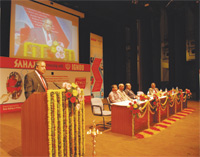
Left to right: M Damodaran, Shankar Aggarwal, S R Rao, Prof. V N Rajasekharan Pillai, Arvind Mayaram

Srei Sahaj e-Village Limited, a subsidiary of Srei Infrastructire Finanace Limited, under the umbrella of its unique partnership with the Indira Gandhi National Open University (IGNOU), the largest Open University offering distance learning programmes, launched a new learning methodology called ‘Education That WorksLearning System’ (ETWLS). This is a unique learning system for which a Global Patent has been fi led.In this methodology, actual skill assessment will be done in an online mode. After a student has studied a topic, the environment for practice opens and the student actually practices what he is supposed to have learnt. e can move to the next level only if he implements his learning correctly. A total of fi ve programmes will be currently availbale as a part of ETWLS; a diploma in Advanced Computing and a certifi cate programme in Java, SQL, Flash and HTML, respectively. The initiative is aimed at making up for the lack of rated educational insitutes in the rural India and help students in the villages get quality skill upgradationwithout problem of relocation. The programmes are also supported by Chaakri.in, Srei Sahaj’s job portal dedicated solely to the rural population. All the learners who register on theportal will be guarateed at least one job offer. It is projected that in the next 12 months, about 80,000 youth will be trained on these courses and over a period of time, more certifi cate courses, diploma and degree courses will be launched. Commenting on the launch, ChiefGuest Thiru A. Raja, Union Minister for Communication and Information Technology said, “I laud the initiative taken by Srei Sahaj and IGNOU for introducing the rural population to the innovative skill development programmes thereby creating opportunities for the rural youthto become more skilled and technically trained, which would further increase their scope of employability. The plan would greatly benefi t and augment the growth and development of the socioeconomic landscape of rural India.” Sharing his views on the new mode of delivery of its services to ruralIndia, Dr. Sabahat Azim, CEO, Srei-Sahaj said, “Currently, one of the biggest bottlenecks in India’s growth story is the lack of skilled manpower. In rural India, the biggest stumbling block is the lack of livelihood opportunities and skill development programmes availbale to the rural population. Therefore, the latest offering from the Srei Sahaj and IGNOU partnership is set to go beyond all commercial considerations and achieve the avowed objective of  empowering rural India through the innovative course on offer.”

Mark Your Calender: April 2010

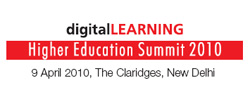
The Summit is organised with the aim of stimulating debate and shaping strategies to deal with the rising challenges currently facing IT in the higher education sector. Participation in this Summit will provide senior administrators of leading colleges and universities with the opportunity to discuss and debate the IT challenges facing their institutions.

The Best Technology Practices Award, which forms an integral part of the Summit, will recognise excellence in technology enabled learning and teaching in Higher Education systems, across various streams.

The Summit aims to be a prolific interface between investors aspiring to be part of the emerging education growth story of the country. At a broader level, it will also help all stakeholders to explore newer potential for their growth and an opportunity to build new partnerships or refresh existing collaborations.

“Public Safety and Security” in the backdrop of terror attacks have increasingly become a major area of concern since the later half of 2008. The focus area of this Summit will be: IT in critical infrastructure security; Access control & identity solution; Public safety-use of high speed connectivity; Cyber security ; and Pandemic response, among other issues

The Summit aims to address the growing investment opportunities in the healthcare sector by bringing together PE and VC fund providers, institutional investors, entrepreneurs, policy makers, health professionals, chief executives and directors, healthcare technology vendors, and solution providers and suppliers, for greater understanding of each other's perspectives.

Channelising Skills and Employability through Vocational Education and Training

Skill Development, Vocational Education and providing employable skills are the crucial issues to be addressed by our country in order to achieve an inclusive growth, with the existing Government declaring the decade 2010 -2020 to be the ‘Decade of Innovation’.  However, the biggest constraint remains the availability of skilled manpower. India has the target to create 500 million skilled technicians by the year 2020 to cater to the requirements of not only to the work force in India but across Globe.The Prime Minister’s National Council for Skill Development, chaired by the Prime Minister, National Skill Development Board, coordinated by the Planning Commission and National Skill Development Corporation are formed to promote skill development both in public and private sectors.

While the Government has announced in the union budget 2010

Community Colleges Unearthing Hidden Talents

Article 26 of the Universal Declaration of Human Rights (1994) states, “Everyone has the right to education. Education shall be free at least in the elementary and fundamental stages… higher education shall be equally accessible to all on the basis of merit”.But the current status of the scenario of higher education in India presents a  very dismal picture in this regard. The Gross Enrolment Ratio (GER) is only 12.4%, which is much below the average for the developed nations. While access to mainstream higher education should
be increased, this also calls for creation of avenues for vocational and continuing education.
Among the developing nations, India is a fast developing economy. But the diffi culties still persist in churning out more employment opportunities. Proper  skill-based education and training of the working population will equip them to stand out in the global market. One of
the targets for creation of pool of skilled workforce is the section of vast population where the education system has not been able to penetrate. Access to vocational education and training system has to be created for them.

THE NEED OF THE HOUR
Nevertheless, while moving towards a knowledge-based economy, the country needs the support of educated and skilled people who can drive India towards its desired level of growth. Following the footsteps of the developed countries, a large pool of skilled workers can give
India a sustainable economic growth by enhancing the effi ciency and fl exibility of the labour market and therefore investment in vocational education and skills development will help making India’s economy competitive in the global market.Community College as an alternative and fl exible system of higher education and vocational training was one of the early concepts of educational institutions that probably established itself in the early 20th century in the United States. Recognising the potential of the Community Colleges as the need of the hour, Indira Gandhi National Open University (IGNOU) has made its effort
to align Indian vocational and higher education sector with its open learning philosophy.
As an alternative system of education, Community Colleges aim to empower individuals through appropriate skill development leading to gainful employment in collaboration with the local industry and community. They offer the advantage of tailoring programmes to local needs and state-based requirements by using approaches that will be most acceptable to
workers in the given community. The aim is to empower individuals, who were deprived of the opportunities of the conventional education system, through skill development with the help of local ndustry and community. These colleges  would primarily target the disadvantaged section of the rural and urban population with special reference to women.

For the development of the Community College programme IGNOU is following the public-private participation mode where the University is coordinating with the colleges catering to particular communities and the latter is getting registered with the University to offer
Certifi cate, Diploma ad Associate Degree Programmes. Keeping in mind the quality of education necessary for imparting such degrees, IGNOU has created a mechanism for selecting the Community  Colleges to be registered under this scheme. Every prospective Community College has to apply to IGNOU by sending an ‘Expression of Interest’ (EOI). The EOI is later heard in the form of a presentation made by the applicant before a panel of experts and assessment is made on the basis of that. As on date 309 Community Colleges have got registered under this scheme. The Community Colleges offer a fulltime or part-time associate degree with mandatory apprenticeship in the fi rst year generally dedicated to foundation
courses of 16 credits and application oriented courses of 16 credits. The second year is supposed to consist of electives of eight credits, internship of eight credits and project work of 16
credits. They also offer Certifi cate and Diploma Programmes of 16 and 32 Credits respectively and these are tailored to form the fi rst and second modules of the Associate Degree. Moreover, there is provision for lateral exit after completion  of Certifi cate and Diploma.The key feature of the scheme is the proper defi nition of the ‘Community’ and the analysis of its needs. The community can be local based, region based, trade based, ICT enabled service based and
so on and the academic programmes identifi ed should be capable of serving the community.
Community Colleges generally have a 2-year curriculum that leads to an Associate Degree either for the students’ direct entry into any occupation or trade or for transfer to an undergraduate college. Besides, after completing the  programme the students can also have
vertical mobility to an undergraduate programme. To enroll in the Associate Degree Programs a candidate hasto be a 10+2, there is no age bar. A non 10+2 can also join through the Bachelors Preparatory Programme of IGNOU. THE PROGRAMME The Community Colleges are institutions registered with IGNOU and conduct examinations as per the guidelines of IGNOU. The Certifi cation is one by IGNOU. The academic programmes on offer
by the Community Colleges can be broadly divided into three categories, viz IGNOU Programmes directly taken up by the Community Colleges, IGNOU Programmes being handled differently by the Community Colleges and Programmes conceived by the Community Colleges. For the fi rst category, the students concerned will have to follow the
guidelines of IGNOU without any departure and take IGNOU Term End Examinations following the usual norms and procedures. In such case, a Community College can be identifi ed as an examination centre provided there are 50 or more candidates or if the place is located more than 50 km away from the nearest IGNOU examination centre. The sending of Question Papers and management of other logistics will be handled by IGNOU. For the second and third Categories, the examinations are conducted by the respective Community Colleges and the
credits attached with such programmes are actually packaged under validation by the Community College Examination Board as per the guidelines of IGNOU. The Academic Council of IGNOU has approved the programmes on offer at Community Colleges at three levels. These are Certifi cate with 16-20 credits, Diploma with 32-36 and Associate
Degree with 64-68 credits. One credit is equivalent to the workload taken up by a full time student for 15 hours and by a Distance Learning mode student for 30 hours.
Community Colleges can prepare the resource material for the Certifi cate, Diploma and Associate Degree Programme (ADP) as per the local requirement. They are supposed to
receive guidance from the regulatory bodies. These are the Community College Board, which happens to be the apex governing body of the college, the Academic Committee which looks after all academic activities undertaken by the college and the Examination Committee
which manages all assessment and evaluation related tasks undertaken by the college.
It should develop active linkages with rural, agricultural, industrial and commercial organisations of the locality for empanelling part-time instructors providing on-the-job training and placement to successful students. After launching and spreading it across
the length and breadth of the country, it will be more important to evaluate the success rate, trade-wise vocational education imparted, state-wise vocationalstatistics, percentage of  students going n for the further programmes, placement of the students, etc. IGNOU is also into the process of ensuring the quality of operations of academic offerings at the Community Colleges. Capacity building of the faculty and non-teaching staff to ensure quality is highly important and regular training programmes are also being conducted by IGNOU on
various areas such as need assessment, curriculum development, teaching and evaluation methodologies and so on.

CONCLUSION
The article is being concluded by touching upon a question which is frequently being asked – Are the degrees to be awarded to a successful learner of a Community College recognised by UGC, AICTE, etc? The same question is being asked about IGNOU Degree/Diploma ever
since the establishment of the University. However, with the phenomenal growth of IGNOU, the intensity of the question has got somewhat lessoned. Nevertheless, the simple answer to the question raised about IGNOU Community Colleges is that the degrees are recognized to the
extent every IGNOU Degree/Diploma is recognised. In this connection, one has to remember that the main issue of recognition is a matter of mind set of the people, and not the paper documents. So let us ask our students to concentrate on their performances. Only by way
of their performance refl ected through their usefulness to the society, they can establish their credibility as well as that of this landmark initiative of IGNOU. \\ Community College does need based analysis of local job equirements and opportunities and incorporate these fi ndings
in the curriculum. Dr. C.K. Ghosh joined IGNOU in the School of Sciences as a Reader in  hysics.

Culture Specific Skills for Youth in North East

Lying in the lap of easternmost Himalayan hills are the eight states constituting North-East India, namely, Assam, Arunachal Pradesh, Meghalaya, Mizoram, Manipur, Nagaland, Sikkim and Tripura. Spread over an area of  2,55168 sq km as one of the most ethically and linguistically diverse regions in Asia, each state has its distinct cultures and traditions described as a “rainbow country, extraordinarily diverse and colourful, mysterious when seen through parted clouds”.

The Scenario

North East India has developed a network of education generally that is fairly wide and accessible to the majority of its population with a large number of institutions from the primary to the university level. The NE states have a high literacy level, higher than the all India average of 64.8% and female literacy rate of 53.7%. In contrast, in the North Eastern Region (NER) the literacy level stands at 68.5% and 61.5% respectively. However, in the NER the high level does not indicate a high level of productivity in the region or higher employability of the educated labour force.

In the NE Region nearly 80% of the enrolment in the college level institutions is in the Arts/Humanities stream. Writing in the context of higher education in the region, the North East Region Vision 2020 notes that ‘higher education infrastructure in the region has focused largely upon producing college graduates in the arts and social sciences, who have looked to the government for employment.’ Although attempts have been made to introduce vocational education at the +2 level in North East India, not much emphasis was given to it as a stream of study. The infrastructure and activities of the ITIs in North East India also has not come much into the limelight. The North Eastern Council (NEC) statistics of 2006 indicate that the total amount of them, which includes the new ones, plus the strengthening of the old ones, is around 55, with Assam having the highest‘higher education infrastructure in the region has focused largely upon producing college graduates in the arts and social sciences, who have looked to the government for employment.’ Although attempts have been made to
introduce vocational education at the +2 level in North East India, not much emphasis was given to it as a stream of study. The infrastructure and activities of the ITIs in North East India also has not come much into the limelight. The North Eastern Council (NEC) statistics
of 2006 indicate that the total amount of them, which includes the new ones, plus the strengthening of the old ones, is around 55, with Assam having the highest – over 20.

THE FRAMEWORK
Indira Gandhi National Open University n its endeavour to bring quality  education o the Region has further expanded its activities in the Region by establishing theIGNOU Institute for Vocational Education and Training (IIVET) at Shillong, Meghalaya to equip people with skills and knowledge to expand their life choices. Keeping this in mind and the National Policy on Skill Development and the Vision 2020 for the NE Region, IIVET endeavours to focus on three areas of training: those which fuel the development of the region such as, agro-based activities, water conservation, organic farming, horticulture, tourism and paramedical sciences; those that tap the opportunities created by global trendsand expanding professions, the most obvious being IT and ITES sectors; andareas which focus on ‘core competencies’ of the people in the region, that is, in areas that the people of the region have an innate talent and interest, such as, fashion technology and product design,airlines industry, sports and physical fi tness and music, or those based on indigenous knowledge and technology, such as, bamboo, silk, traditional textiles and so on.Hence, IIVET has two broad sections – one focuses on contemporary vocational training and the other on indigenous knowledge and technology which focuses on selecting/identifying the indigenous skills, if necessary value add them for the contemporary society and imparttraining in such skills, which will become  livelihood generating. Accordingly, IIVET envisages a plan of action that is multi ayered – it aims to create a work force  among the youth of the region through wage employment or self employment in both the organised and the unorganised sector by imparting skills in pre-service conditions, to impart training for skills upgradation to in service workers,to certify prior knowledge of unskilled workers, to give to the term ‘Vocation’ fresh and long standing implication; from manual labour skills, skills for mechanics, electricians etc, literacy and numeracy, to training for people on their jobs such as school services management, IT training, training on writing and speaking skills. Against the backdrop of the Government of India’s and the NationalKnowledge Commission’s emphasis onVocational Education, IIVET will strive to fulfi l this objective by garnering private public partnership and the industry academic alliance, to establish career counselling centres for the educated
youth of the region and to help form entrepreneurial skills and self help groups after training programmes among the youth and women. IIVET attempts to impart skill development to both skilled and unskilled workers in the form of both short term and long term training
programmes ranging from 5 days to 3-4 months.

THE FOCUSED AREA
Amongst the many segments of the society that will be identifi ed and targeted for vocational educational and training will be the educated unemployed, school drop outs, street children, domestic workers, the differently abled and artisans. IIVET will network and collaborate with
community based organisations, local educational and fi nancial institutions as well as government departments of the States of the NE Region, including Polytechnics, ITIs and Common Service Centres. Amongst the several trainingprogrammes already orga ised and conducted by IIVET are in the areas of Community Radio, Tally Accounting Software, Multi skilled & Leadership Development for girls, Mobile Hardware & Software Maintenance, Advance Auto CAD, Bamboo based Handicrafts,Computer Literacy & Communication Skills for Domestic Workers, Conversational English Courses, Technician (Masonry) Machine Operator-Injection Moulding and Plastic Processing , Electrical Wiring integrated with Computer Literacy and repair of Electrical HouseholdAppliances. IIVET is also envisaged and strongly recommended as a research centrewhere there will be need assessment studies, follow up all the workshops and training programmes, by keeping in constant touch with the participants .
THE CHALLENGES
The obstacles of vocational education in an open university are many and impinge upon the very mechanisms and methodologies of a distance education and open university such as IGNOU. IIVET will have an innovative model by using the best of all forms of technology: relevant and appropriate to regional expectations and preferences. Technology aided
instruction with the use of broadcasts, telecasts and the Internet for delivery services will be blended with face to face mode of instruction with emphasis on skill based activities and practical work.Judicious use of technology and print materials will be used to augment and
enhance such training. A holistic planning in vocational education is essential if we have to provide to the North Eastern Region enough opportunities for gainful employment leading to income generation, increase in productivity and development of the individual through his recognition and identity as a contributor to the sustained development of the Region

LATEST NEWS