
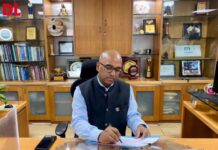
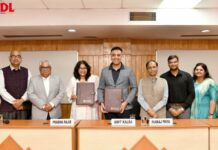



What, according to you, are the emerging trends in Professional Management Education in India, as we move towards a knowledge economy? Have students been interested in pursuing research after completing their course?
Research Trends in Management Education: Renewed Emphasis on Holistic Approach
Prof Kuriakose Mamkootam, Dean, Faculty of Management Studies (FMS), Delhi University
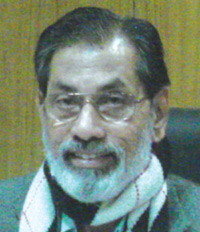 The research undertaken by the faculty at FMS is largely in their own primary background such as Sociology, Commerce, Finance and related areas. Management is an interdisciplinary subject and therefore research topics vary accordingly. Corporate governance, poverty alleviation, entrepreneurship, and various kinds of health care systems are some of the few areas of research.”
The trend in management education is moving towards a holistic approach, which not just focuses on profit maximisation. The empahasis is to locate business in a larger societal context. Myriad stakeholder perspectives, and not just that of the investors, are to be taken into consideration. Therefore, issues like Corporate Social Responsibility, Corporate Governance, Work-life Balance are the emerging areas which business education has to adjust to sooner than later.
From the curriculum perspective, changes occurring in the industry would also reflect in the course content. The attempt is to make the curriculum relevant and contemporary. We are in the process of revising the syllabus thereby incorporating these changes.
With regard to students' interest in research, very few pursue research immediately after completion of their course. The salary packages are quiet enticing, and it is difficult to retain students for the same. Usually, some of the students work for a few years, gather experience and come back to pursue academics and research.”
Prof B S Sahay, Director, Management Development Institute (MDI)
“Management education in India needs to consciously focus on maintaining excellence and quality. The mushrooming number of business schools with proper accreditation is a positive aspect, although teaching standards have to be maintained.
However, one of the disturbing trends has been the decline in the ranking of management education. The World Economic Forum Report 2007, on management education in India, ranked it at 8th position. By 2008, it came down to 12th position. 2009 saw further decline in the ranking. This trend has to be arrested, and therefore, quality education in management is crucial.
The younger management graduates should also be encouraged to pursue academics to meet the dearth in the number of teaching faculty.”
Dr H. Chaturvedi, Director, Birla Institute of Management Technology (BIMTECH)
“The recent developments in the world economy have had major influence on the trends in management education. There is a renewed emphasis on business ethics. The focus is now heavily on key areas including Business Ethics, Corporate Social Responsibility, Corporate Governance, and Sustainable Development. Some of the new areas that have emerged include: Management of business during recession or slowdown; Management of risks arising out of national and international relations; Entrepreneurship; Micro-Enterprise and Micro-Finance; Micro-Insurance; and Social Entrepreneurship.
Most of the students are interested in taking up lucrative jobs after they finish their course, and it is difficult to bring them towards academics. However, last year, owing to the economic slowdown and the dearth of campus placements, we had started the Research Fellowships programme. Seven students had enrolled in the programme and are pursuing PhD and also earning a stipend.
Management is an inter-disciplinary field and the research areas vary according to the area and interest of students.”
The Management Development Programmes have been offering significant expertise in different functional and cross-functional areas of business management. Could you elaborate on these training programmes?
Developing Industry Academia Interface through Management Development Programmes
Prof B S Sahay, Director, Management Development Institute (MDI)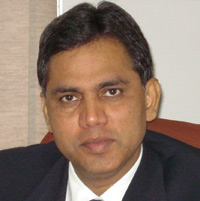 “MDI's educational programmes attempt to help executives in broadening their understanding and improving their skills to prepare them to face the challenges at higher positions. More than 100 Management Development Programmes every year of varying duration are conducted. The structure focus is on the current areas of interest to executives at the senior, middle, or junior management levels. While the programmes provide inputs to fill knowledge gaps, the emphasis is also on broadening the horizons of participants through case studies, business games, role-plays and exercises.
Interaction with experienced faculty and fellow participants provide new insights and help crystallize concepts to enhance the thinking process for better quality decision-making.
The Advanced Management Programme (AMP) focuses on examining strategic issues – both functional as well as cross-functional – that leaders need to deal with in their quest for creating successful, globalised organisations.
The Quality Improvement Programme is for the faculty members of AICTE recognised business management institutes. The Government of India launched the Quality Improvement Programme in the year 1970. One of the main objectives of the programme is to upgrade the expertise and capabilities of the faculty members of the degree level institutions in the country.”
Dr H. Chaturvedi, Director, Birla Institute of Management Technology (BIMTECH)
“While continuously striving to raise our educational standards BIMTECH has been evolving and developing new skills and teaching & training methodology. Based on this strength, BIMTECH is offering these Management Development Programmes for the working executives. BIMTECH team has been designing and conducting custom designed training modules on industry specific requirements. Towards this, BIMTECH team undertakes a detailed training need assessment at the site of the requesting organisation. Based on the training needs as established by the assessment, appropriate training schedules are prepared.
In addition to the in-house resources available at BIMTECH, we also associate industry experts in specified functional and operational areas to conduct the programmes, which meet the customer's specific needs and requirements. BIMTECH has, in the recent past conducted more than 60 such in-house programmes for organisations like State Trading Corporation (STC), Gujarat Cooperative Milk Marketing Federation (GCMMF) and many others.
There are specific training programmes we have been offering to the industry, which includes Green Business, attended by 21 countries.
We have designed a unique programme for inclusive marketing in collaboration with MART, a leading consulting agency in rural marketing, with the objective of disseminating entrepreneurship skills among the rural and urban poor.
We are trying to integrate technology with sustainable development, and we are the first B-school to launch an MBA for sustainable development.”
Dr Anwar Ali, Director, Institute of Management Technology (IMT), Ghaziabad
“IMT, Ghaziabad offers management development programmes in different areas of management focusing on the twin objectives of broadening the horizon of thinking and strengthening the skills of the practicing managers and developing industry academician interface.
Our MDP's are designed and executed to broaden the horizon of thinking and strengthening skills of the practicing managers.
Programmes are offered in diverse functional areas.
Participants gain valuable insights on the subject through participation in classroom activities and interaction with other participants in the group.
Looking at the ever-increasing need for such programmes, IMT decided to set up a separate MDC building dedicated to the MDP programmes. The institute has in-house experienced and learned training facilitators in the field of HRD Management, Financial Management, Operations Management, Marketing Management, Information Technology and Strategic Decision Making etc.
MDP & Consultancy has remained a major focus area in the last year. The MDP & Research Centre has a dedicated facility of 3 ultra-modern, state-of-the-art class rooms for conducting programmes and a MDP hostel for offering residential programmes.
Some of the list of companies for whom programmes have been conducted by IMT inlcude NTPC Ltd. , Alstom Power, Steel Authority of India, Planning Commission, Cyber Media etc.”
Collaborative and exchange programmes with various institutions in India and abroad have facilitated inter-cultural knowledge sharing and promoted greater regional understanding. Our readers would like to know more about the same.
Academic Collaborations: Advantage students and faculty
Dr Anwar Ali, Director, Institute of Management Technology (IMT), Ghaziabad “IMT Ghaziabad is one of the prestigious institutions to have signed the Erasmus Mundus 2009-2013 which aims at excellence in quality and international cooperation between European and other countries.The objective of the ERASMUS programme is to encourage and support academic mobility of higher education students and teachers within the European Union and other countries. The ERASMUS programme aims to improve the quality and increase the amount of multilateral cooperation between higher education institutions and enterprises and to spread innovation and new pedagogic practice and supports to developing closer links between universities.
Thus, this programme would enable the students and faculty at IMT to avail scholarships and grants for their research and academic exchange programmes. Furthermore, it would open a window of opportunities due to the alliances with a number of prestigious institutes in Europe. We are working on the execution, implementation and research opportunities through this arrangement.
This initiative further reiterates our commitment to strive to keep up the quality of our academic collaborations by ensuring quality partnerships that would help in value addition to the students and faculty at IMT. It would definitely add an international flavour in all our academic endeavors henceforth.”
Prof Mamkootam, Dean, Faculty of Management Studies (FMS), Delhi University
“We have had faculty exchange programmes for many years and our first lot of professors were trained in Harvard and Cornell. This scheme was revised in the eighties, when we started sending the faculty to universities in Europe. For the last two years we have again started sending our faculty to Harvard for short term training programmes.
The world for which the MBA's are preparing is multicultural and multinational. Keeping this in mind, the FMS has given its students an opening to develop and apply functional, management and cross-cultural skills and concepts in global business contexts. FMS has a rich history of collaborations with institutions around the world.
As far as students are concerned, we are exploring the possibility of developing the exchange programmes further. Through Universita 21, we have entered into an MoU with 21 universities across the world. We are exploring the possibility of sending our students to these Universitites for a semester.”
Dr H. Chaturvedi, Director, Birla Institute of Management Technology (BIMTECH) “BIMTECH is one of the few business schools which started the student exchange progamme as an integral part of the education and exposure process for students. MINT B-School 2008 methodology ranked BIMTECH in the top 10 in India and 4th in private business schools on international collaborations. The student and faculty exchange programmes are key to our success and growth. Few of our International partnerships include Royal Melbourne Institute of Technology (Australia), Erasmus University (Netherlands), Chartered International Institute (UK), Philadelhia University (USA).
Our National partnerships include TCS ( Delhi), Bombay Stock Exchange (Mumbai), Mysore University (Mysore), Reliance World (Mumbai).” 

 The FMS Information Technology Group seeks to keep the institute at the forefront of technology applications in management education.
  “We have been using IT ever since the founding years of MDI. Technology has been integrated into all aspects of the course content to include quizzes, presentations, examination and evaluation systems and all administrative activities,” says Prof. B S Sahay, Director, MDI.
 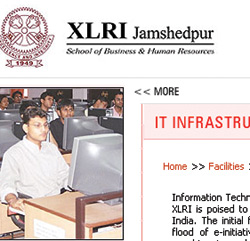 XLRI Jamshedpur has contributed in developing managerial competence among the pupils through acquisition of specialised knowledge and skills.
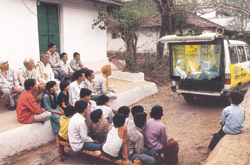 Initially use of computer was considered synonymous with use of Information and Communication Technology (ICT) in education, especially in schools and colleges. Do you think that the former notion justifies the latter? What do you opine about utilisation of ICT in current Scenario in India?










IDIOTs in vogue?
We don’t need no education; we don’t need no thought control; no dark sarcasm in the classroom; teacher, leave those kids alone – The Wall by Pink Floyd
Just think if Lata Mangeshkar’s father had not permitted her to sing, or Sachin Tendulkar was restricted from playing cricket. What would they have been doing? It is said that one’s life is all about listening to the heart and chasing own dreams. 3 IDIOTS, the award winning and record breaking film by Rajkumar Hirani and Vidhu Vinod Chopra conveys the message of pursuing dream and education in one’s life.
Demystifying the myths
“It’s a very well-made film with a message and with a big star. It brings back memories of people’s experience of the education system in India,” says Taran Adarsh, eminent movie reviewer, on the film’s overseas success. The success of ‘3 Idiots’ is just the tip of the iceberg, criticise experts. Though 3 Idiots is thoroughly enjoyable and humorous, the core of the film has fetched criticism on what it says about the future of India’s youth and the “rat race” for joining centres of excellence to study or teach in them.
Every child in our society is not as gifted as Mangeshkar or Tendulkar, and most of the them end up living his father’s dream at an engineering institution or a medical college. In the film, Aamir Khan’s critical argument runs across on our highly institutionalised education system with the underlying message of serious indictment in that. The film also shows a student committing suicide at the beginning raising a pertinent question: Was it suicide or murder?
In the media reports, the director himself revealed that like in ‘3 Idiots’, he had tried hard to convince his father about his desire to pursue film-making. Therefore, according to him, pursuing one’s dreams is very essential, provided it is backed with proper education.
Story and Characters The THREE IDIOTS ON SCREEN
In the fi lm, the three idiots, Rancchoddas Shyamaldas Chanchad (Aamir Khan), Raju Rastogi (Sharman Joshi) and Farhan Qureshi (R Madhavan), are perfect archetypes of the new age
Indian who is essentially a non-conformist, questioning outmoded given premises, choosing to live life on his own terms and chartering new roads that consciously skirt the rat race due to societal or parental pressure – but refuse to become cogs in the wheel. Naturally, they end up
as the Frostian hero (Robert Frost’s Road Not Taken) who made all the difference to his life, and the world, by taking the road less travelled. The campus here could be any Indian college. Usually a dreaded professor, referred to by his initials or acronym, walks around to dry you out of any interest in learning. Rancho points out India’s education system as competitive, high-prssure, rote-heavy, illogical and almost cruel and tutors the audiences through the
messages guiding his friends that says one should follow his heart’s calling if they want to make a difference, having a choice to spend an entire life doing what he likes. The message is no less relevant for the metropolitan youth who are crippled by a despotic disregard for their natural creativity and run after Engineering and medicine like Raju and Farhan who enter the elite engineering college, only to be taught through books and classrooms and not the lessons of life. Not surprisingly, this rote-learning, even from India’s best institutions, produces more of a bureaucracy to serve the corporate and fi nancial sector, rather than producing original thinkers. In the fi lm Sharman Joshi’s character Raju represents the lonely hope for lower income group India, craving only for professional degrees, preferably engineering, to support his family. Madhavan as the third ‘idiot’, who wanted to be a wildlife photographer takes admission into Imperial College of Engineering, which for him and many
others in this country is a ticket to “neighbour’s envy, parent’s pride” territory. Principal Viru Sahastrabuddhe known as Virus, venerating the cuckoo whose life begins with murder, denotes the high level of stress and competition, to reach the top. He praises students like Chatur (Omi) who end up as conformists for becoming successful, portraying the likes
of the eventual winners.
INDIAN EDUCATION TODAY – WHAT SAYS 3 IDIOTS
3 IDIOTS belongs to everyone. On the whole, the fi lm has tremendous youth appeal and feel-good factor to work in a big way in delivering the underlying message to our social system. Idiot 1 – Education System: Which is mainly performance-oriented with its
focus on scoring high marks and too much of emphasis on examinations forcing students to learn by rote rather than encouraging depth understanding. In the fi lm Rancho (Aamir Khan) goes beyond the book to gain mastery. Idiot 2 – Teachers: Faculty-led fi xed curriculum based pedagogy where the teacher gives no room to the students to convey originality. Boman Irani as Viru Sahastrabuddhe portrays it. Idiot 3 – Parents: They pressurise children to take up courses according to their own choice rather than their child’s. In the fi lm the Quereshis and the poorer Rastogis portrays typical Indian parents.
THE EFFECT
In an elective course called ‘Learning What is Not Taught’ the faculty at the Indian Institute of Management Ahmedabad (IIMA) decided to follow 3 Idiots, adopting the line of teaching
students to learn about life from beyond the textbooks and curriculum. According to media reports, Executive Director of Tata Sons Ltd R Gopalakrishnan, the lead faculty of LNWT says, “What the students learn in the classrooms is only the beginning of learning. The rest of the lessons are to be learnt from what life teaches them.” According to a report by Hindustan
Times, 3 Idiots also triggers attention in some institutions in Punjab. Some of the dialogues of Rancho and their purpose have been rephrased as remarks on answer sheets of postgraduate students in a Ludhiana college. “Education is the ultimate objective,” and “learning to apply
theoretical knowledge is essential” are some of those remarks. At a Government Primary School in Ludhiana, teacher Ravinder Kaur convinced her colleagues to contribute Rs 500 each to install audiovisual aids in the classroom. A.P. Singh, who teaches mathematics
at Malwa Central College of Education in Ludhiana, has started giving good marks to students who had reproduced what they had excerpted from textbooks acknowledging the students’ effort.
PERCEPTION AND REALITY
The indifferent assembly-line approach of our current education is not enabling students to cope up in the world and that is what the 3 idiots’ message says. Because education is always developing one’s mind and soul and not just only learning by rote, conveys the fi lm.
But there are winds from opposite direction as well. According to Sagarika Ghose, eminent columnist and journalist, the fi lm is perhaps a better refl ection of the vast number of engineering colleges mushrooming across India, which are indeed soul-less factories where real education is substituted for cramming. According to her, the fi lm establishes that
unless one is a naturally gifted scientifi c enius like Ranchordas Chanchad, there’s no point wasting time with your books. Then one is better off singing songs or becoming a wildlife photographer. “If we continue to lose our minds over fi lms like 3 Idiots, we will soon become
a nation of idiots and will have to hire foreign brains to do our thinking for us because we will be wallowing in hatred of the system and escapist pleasure. Do we want to bring up children on the notion that the education system is idiotic and deserves to be screwed?” argues Ghose
in her column. Criticisms are there that ‘Three Idiots’ encourages to throw away books and
whose central message is “the education system sucks”, “we learn nothing at our centres of excellence” and “teachers are unable to teach and only want to ruin students lives,” saying that the fi lm is dangerously juvenile. Of course, there is a need for reform. Of course, there is a need to urgently relieve the pressure and strain – The pressure that comes from the huge number of students applying for too few IITs, too few medical colleges and too few quality
universities and the diabolical teachers and emotionally blackmailing parents. herefore, there is a need to relook at our education system, ensure that parents do not pressurise children. But in the pursuit of educational reform, the standards of excellence should neither
be compromised upon nor should we engage in an escapist fantasy and convince ourselves that education does not matter. In the fi lm as depicted, Rancho was a genius. But in reality every student is not genius, there is no short cuts for them in excellence for higher education.
Everything said and done, there is no denying the fact that the Indian education system as it stands today does not adequately equip the students to ask “why – what – where – when?”. It
teaches students how to answer well but in today’s complex world, asking the rightquestions is of paramount importance. Given a problem, we can solve it very well but when it comes to identifying a problem, even students from premier institutes lag behind. The education system needs to correct that. Also, inline ith the fact “everyone is not a genius”, it is also equally true that “everyone does not need to get into an IIT”. There should be other rewarding avenues identifi ed for the masses who are “non-genius”. Meaningful vocational training coupled with an acceptance by the society which could only stem from dignity of labour
would go a long way in making the masses idolise idiots. This is particularly true for a country like India where the job market is unable to adequately reward even the highest degree in general education, a Ph.D.