
Home Blog Page 1417

14th Prof G Ram Reddy Memorial lecture by kiran karnik

“Distance and open education system is the only approach which can meet the challenge of educational problems in the third world.”

Late Prof. G Ram Reddy

Every year on 2nd July, Indira Gandhi National Open University (IGNOU) commemorates the death anniversary of its Founder Vice-Chancellor, the legendry late Prof. G Ram Reddy, a memorial lecture in his name. The annual memorial lectures were instituted in 1996 by IGNOU following the sudden death of Prof. Reddy on July 2, 1995. The 14th Prof G Ram Reddy Memorial Lecture, an annual event, ritually, took place on July 2, 2009 at IGNOU to commemorate the death anniversary of the Founder Vice Chancellor of IGNOU, Prof G Ram Reddy. This year Shri Kiran Karnik, Former President, NASSCOM, was invited to deliver the memorial lecture on ‘Education, Media and Development’. Digital Learning presents you with the report on the memorial lecture which was attended and witnessed by some of the finest academicians, think tanks of the country to honour the legendary late Prof. G Ram Reddy.

The hour long programme began with a welcome note by Prof. Parvin Sinclair, Pro-Vice-Chancellor, IGNOU. She, on behalf of the IGNOU fraternity, welcomed Smt. G Pramila Ram Reddy, wife of late Prof. G Ram Reddy and other family members, Shri Kiran Karnik, Prof V N Rajasekharan Pillai, Vice Chancellor, IGNOU and the present distinguished guests to the memorial lecture evening. The evening was marked with the lighting of lamp by G Pramila Ram Reddy, Kiran Karnik, Prof V N Rajasekharan Pillai, and Prof Sinclair respectively.

Following this, Prof Pillai, in his Presidential address, said that IGNOU has ventured into various avenues of Open and Distance Education/Learning that late Prof. G Ram Reddy envisioned. The Vice-Chancellor shared that IGNOU has emerged as the largest mega University in the democratic world towards meeting its mandate, which is “to provide seamless access to sustainable and learner-centric quality education, skill upgradation and training to all, at affordable costs, by using innovative technologies and methodologies, and ensuring convergence of existing systems for the massive human resource required for promoting integrated national development and global understanding”. Presently, IGNOU serves the educational aspirations of over 2 million students in India and 33 other countries through 21 Schools of Study and a network of 61 Regional Centres, more than 2300 Learner Support Centres and 53 overseas Partner Institutes. The University offers 310 Certificates, Diploma, Degree and Doctoral programmes.

Kiran Karnik started his deliberation on a nostalgic note by recalling his long association with late Prof. Ram Reddy. He shared with the audience that Prof. Reddy always advocated the use of media and technology for furthering distance education. He said that in the present day India, convergence of three critical areas – Education, Democracy and the Media – is very crucial. Information and Communication Technology (ICT) has produced the revolution in New Media. Television too has progressed in delivery and communication. Social networking and Internet videography has also improved communication. FM has reinvigorated the radio with interactive content. e-Mails, blogs and instant messaging have grown as means of communication and there are new beginnings in their uses.

New Media has become a medium of the young presenting its own sets of challenges. These reflect many commonalities of the 1980s when TV network, spurred and complemented by satellite TV, opened up exciting new possibilities. However, this new initiative remained a ‘partial success’ for various reasons. The potential use of TV in schools and for educational purpose, the Krishi Darshan programme (1967) – the brainchild of Dr. Vikram Sarabhai and Dr. M S Swaminathan, had certain social ramifications (community viewing). TV became a force for economic and social change, rather than a luxury.

The success of Krishi Darshan gave an impetus to plans for a national TV system, using a satellite to reach rural and remote areas. To test and prove the technologies involved, and to understand better the overall system, a one year pilot project, Satellite Instructional TV Experiment (SITE) was undertaken in 1975-76 to broadcast programmes through an American satellite to TV sets in 2,400 villages spread across India. SITE also encouraged extensive social and communications research; it was an attempt of accruing and processing hard data to implement larger projects.

In parallel with SITE, an intensive, limited coverage experiment was initiated in Kheda district of Gujrat. The Kheda Communications Project attempted to use the media for social change and development through participation in communications and programme development.

Six years after SITE, India’s own satellite, INSAT (1982), was a leap of faith, envisaged to seal the educational commitment of technology. In spite of the challenges, university level education was taken across the board. University Grants Commission (UGC), in partnership with ISRO, launched Countrywide Classroom – enrichment TV programmes for university level students and others – using the INSAT system. Indeed, many viewers were not university students, but those attracted by interest and curiosity. Since then considerable work has continued in the area of use of TV for education and development.

“In the present day India, convergence of three critical areas – Education, Democracy and the Media – is very crucial”

Kiran Karnik stressed that we are at the cusp of change, where the proverbial gatekeepers filtering information shall gradually whiter away. The next generation of media will lead the educational development. The lessons that we have learnt over the five decades of media experience are:

  • Access is a crucial element, but it is important to note that access to education often depends upon reach. If the concept of ‘reach’ also subsumes quality, then there is a serious problem. However, technology, through media, provides a solution – not necessarily a substitute, but a possible solution, nevertheless.
  • Affordability is equally an important issue for many years. Rural and disadvantaged viewers shall still have to partake of community viewing. TV sets needs to be adopted at the community level with appropriate maintenance back-up. The Common Service Centres being set up for computer access need to be extended to cover all villages as soon as possible.
  • Comprehensibility and relevance of content are key parameters. In the competitive arena of multi-channel availability and the viewers exposure to slick productions, education and development content can no longer be dull, staid and boring. There needs to be room for far greater resources and more imaginative handling in content creation.
  • The production process (of creating content) needs to be re-engineered. The aesthetic, pedagogic and communication disciplines must come together to create truly exceptional content that is relevant, learner-centric and audience-friendly.
  • Communication research must be a key element of social communication, particularly because there are always gaps in knowledge in three areas: the audience, their needs and feedbacks, and the more basic aspect of Human machine interaction and learning process in this milieu.
  • Configuration of the network is important as it determines aspects like extent of local inputs, decentralization, flexibility, interactive capabilities, etc.

Way Ahead

The evolution of media technology and the availability of new media open up new opportunities. It is imperative that the social sector move quickly to leverage the opportunities and challenges of the education and development. In the broader sphere of development, especially rural development, the utilisation of the full capabilities of the media – convention and new – is constrained by the lack of appropriate system-level initiatives. From time to time, there has been discussion about mandating private radio/TV channels to compulsorily carry a fixed percentage of ‘social’ programmes as the role of media in social communication has been minimal. In the context of the pressing need to quickly expand education at all levels, to ensure its outreach across the country and to continuously upgrade and update learning, the role of media is more important than ever before. Educationists, technologists, creative content creators, communications experts and social researchers need to work together to evolve and then implement a multi-modal system that seamlessly integrates media and personal contact, so as to create a new learning paradigm. This may require structural changes in our present systems, especially in the field of development. There is a strong need to do away with the compartmentalisation to necessitate a change in mindset, with boundaries that are often fuzzy and powers that flow down the line. Most important, it will require creativity, innovation and new thinking. Prof. Ram Reddy epitomised these qualities in ample measure, especially in the early years of distance learning. The thought provoking deliberation by Kiran Karnik was followed by a vote of thanks from U S Tolia, Registrar, IGNOU.

Some of the earlier lectures in the series were delivered by Prof. Gajaraj Dhanarajan, President COL; Prof. Wichit Srisa-An, Founding Rector, Sukhotai Thammarthirat Open University, Thailand; Prof. N R Arthenayake, Former Vice-Chancellor, University of Sri lanka; prof. Ian Mugridge, Former Director Programmes, COL; Prof. R V R Chandrasekhara Rao, Former Vice-Chancellor, Andhra Pradesh Open University; Mr. H Ian Macdonald, Preseident Emeritus, York University;
Dr. K Kasturirangan, Chairman, ISRO; Dr. R A Mashelkar, Director-General, CSIR; Dr. G Madhavan Nair, Chairman, ISRO; Prof. N R Madhava Menon, Founder of National Law School of India University; Prof. Yashpal, Former Chairman, UGC; Dr. T Ramaswami, Secretary, DST; Sh. Montek Singh Ahluwalia, Deputy Chairman, Planning Commission
.

Tvs Community College

The temple town of Madurai, one of the oldest and largest centres of Tamil Nadu, which once housed the famous Tamil Sangam, today remains a shadow of the past. Unemployment, brain drain and laggard industrial development are some of the issues present day Madurai is facing.

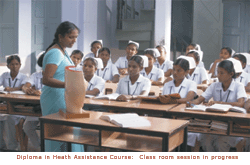
To counter these and  provide the rural youth with necessary education to help acquire a variety of skills and knowledge crucial in earning a livelihood, the TVS Community College, under the TVS led Lakshmi Vidya Sangham (LVS), was set up in 2003.

Says Selvi Santosham, Senior Manager Projects, ‘The LVS is a 45-year-old institution with a vision to educate the masses. Through our regular schools we are able to reach out to 10,000 students in a year. But we wanted to extend the  education services to the school dropout segment of society, as surveys in various corporation and panchayat schools indicated a high percentage of school drop outs (70%) owing to various socio-economic reasons.  Setting up of a Community College enabled us to reach out to people across various social segments regardless of their educational background and age.’

The college imparts employment-oriented courses that are designed incorporating a need-based curriculum to help the rural youth find employment in the highly competitive job market. This enables technology to play its role with greater relevance in the changed socio-economic scenario. Social values and life skills integrated in the syllabus also helps develop their personality in all dimensions.

‘The TVS conducts periodical surveys to find out the type of manpower requirement in the local market. Based on the requirements, students are trained and equipped in various skills to enable them to gain decent employment. A survey was conducted at the industry level and amongst social service segments and the health care industry to study their requirements before deciding on the courses,’ says Selvi.

Courses offered at the college include diploma in health assistance, driving, mecha-nic, electrical works, plumbing, AC repair, masonry, home management, child care, home nursing, secretarial skills, computer skills, security, office despatch, office house-keeping, retail sales, Tally, hospital keeping, etc.

The course content ensures a lot of learning with practical applications. The tech-nical courses allot 60% for practical work and  40% for theory, while the non–technical courses like Construction Skills follow 80% practical work and 20% theory, adds Selvi.

Recognising the fact that the students who come to the college are at a disadvantage due to their socio–economic background and the type of schooling they have received, certain core skills have been incorporated as part of the curriculum in all the courses. For example, to build the self confidence of these youth, unique core skills have been introduced like the life skills module involving communication , etiquette, grooming, team-building, decision making, interpersonal relationship, time management and money management, etc. These classes are 90% activity oriented ensuring participation of every student.

‘Specially trained teachers have been appointed to conduct these classes. Students enjoy these classes and we are able to see a visible change in them by the time they finish their courses,’ says a faculty.

Mrs Jeyaruba, another faculty, says: The TVS Community College provides a chance for self knowledge, self improvement, self study and self help and makes students more self conscious. In short, it makes a person ‘fit for life and fit for job’.

TVS believes that the basic values and attitudes that are sensitised among its students are the distinctive features defining them once they leave the campus. An individual with a healthy attitude is an asset to society, hence emphasis is laid on incorporating basic human values and industrial expectations through case studies, simulation activities and group discussions.

Besides soft skills, training is also provided to make the students aware of technology and computers. Confidence building exercises are also conducted like dramatics, compulsory games, self-defence classes, etc. for girl students.

The TVS students also involve themselves in part–time jobs after school hours and take part in community activities during temple festivals, tourist management, etc.

In the words of Gopalakrishnan (Automechanic student), ‘I am proud to be a product  of TVS Community College. Prior to TVS, I was merely shifting jobs and felt insecure and unsettled. TVS gave me an opening. Now I am working in TVS Sundaram Brake Linings and earning INR 4,500 per month. I have now gained my standing in the society and family and feel self-confident.’

Jayaseelan (Electricals student) says, ‘I am a father of two children and have done schooling only till class IX. Poverty stricken, depressed and frustrated, I entered TVS Community College with a faint ray of hope. TVS gave me a second chance and now I have a job in Firestone TVS  P Ltd. My communication skills and self-esteem have improved.’

A total number of 1300 students have so far graduated from the training centre and are gainfully employed. Apart from the nearby rural community, the college gets students who are sponsored under the Vazhunthukattuvom Scheme and Mahalir Thittam Scheme of the  Tamil Nadu Government and the District Rural Development Agency.
Starting with 25 students on board, the TVS college has grown in the last five years to enrol on an average 700 students in a year. ‘Our dream is to expand the college so that it can cater to 10,000 students in a year,’ says Selvi.

A step in this direction is a massive enrollment drive started by the TVS in 40 corporation and panchayat schools to directly reach out to the drop outs. A scholarship fund has also been provided subsidising 50% of the fees for the students. ‘There is a proposal to start self-sustaining projects to hone the entrepreneurial skills of the students, like automobile service centres, electrical/electronic repair centres and village first aid centers. All these are a step towards the greater goal of of helping the disadvantaged youth integrate into an industrial society  by providing scope for employment,’ says Selvi.

Highlights of the programme

  •  Placement opportunity provided to students on the basis of his/her merit. The organisation ensures that the students earning capacity is enhanced because of the training he/she undergoes.
  • Post placement follow-up done by the college for atleast a year to bridge the gap between the course content and the industry requirements. Steps  taken to upgrade the curriculum so that students are industry ready.

Distinguishing features of the college

  • Market driven courses
  • Caters to all age groups from all strata with varying educational background
  • Course content is certified.
  • Courses aim at equipping students with various skills


Education Budget 2009-2010

The budget aims to create a competitive, progressive and well regulated education system of global standards that meets the aspiration of all segments of the society
The Budget is just a small but nevertheless, a good beginning and one hopes that in the opening remarks made by the Finance Minister on 6th July, 2009 outlining the policy objectives of the new Government, there lies a portent of greater and more radical change for the education sector.

If the Ministry of Human Resource Development sounded the bugle with a 100-day plan for education, the Finance Ministry has echoed the need for focus on female literacy, subsidising the financing costs for higher education, role of Information and Communication Technology (ICT) in education, upgradation of polytechnics and expanding the coverage of Indian Institutes of Technology (IITs) and Central Universities.

India plans to spend 9 billion Indian rupees (US$189 million) on education programmes using ICT in the fiscal year to March 31, 2010, the Finance Minister said. India needs to convert the demographic advantage that its relatively young population gives, into an economic advantage by providing them the right education and skills, he added.

The minister also announced a 20 billion rupee hike in spending on higher education, including on setting up new IITs. The IITs have over the years provided key engineering staff for Indian and multinational technology companies.

India's outsourcing industry benefits from the country's large number of low-cost and highly trained staff.

The immediate benefit from the budget for India's outsourcing industry is, however, likely to come from the extension of tax holidays for exporters up to the fiscal year ending March 31, 2011. The minister said that he was extending these benefits to help tide exporters over an economic slowdown.

Budget to provide education loan subsidiary

The Union Budget 2009-10 has declared a scheme to provide full interest subsidy during the moratorium period on education loans taken from scheduled banks for pursuing any of the approved courses of study in technical and professional streams from a recognised institution in India.

The scheme will be available to students from economically weaker sections to access higher education.

Besides, the tax deduction under IT Act 2000-Section 80E allowed for interest on loans taken for pursuing higher education in specified fields of study, has now been extended to cover all study fields, including vocational studies.

Despite the introduction of universal access to secondary schools in the country, school education received a miss in this budget. The focus instead seemed to be on higher education -essentially as a fulfilment of the government's strategy to introduce a university in each state. Funding for higher education focused on setting up central universities, IITs and National Institute of Technologies (NITs) in uncovered states, and on the expansion of vocational courses.

Higher Education gets a boost

What the budget contains:

  • The Higher Education Budget for the current fiscal has been pegged at INR 15, 429 crore (INR.154.29 billion), including a planned allocation of INR 9, 600 crore. During the last financial year, the total allocation was INR.11,340 crore.
  • University Grants Commission (UGC) has been provided with an allocation of INR 4,374.95 crore, which includes expenditure for both Central and Deemed Universities.
  • The allocation for Central Universities includes a provision of INR 1,033 crore for implementation of Other Backward Castes (OBC) reservation in terms with Oversight Committee recommendations.
  • Provision of INR 900 crore for “National Mission for Education through ICT”.
  • INR 827 crore allotted for one Central University in each uncovered state.
  • Provision of INR 215 crore for Indian Institutes of Science for Education and Research (IISERs).
  • Provision of INR 3,902 crore for Technical Education that includes provision towards assistance to IITs, Indian Institute of Management (IIMs) and NITs.
  • Provision of INR 494.5 crore for setting up and upgradation of Polytechnics under the Skill Development Mission.

What it did not contain!

  • Any specific policy framework
  • Future roadmap
  • Clarity in respect of FDI in educational sector
  • Guidelines expected for community colleges & vocational training

IGNOU gets support after 18 yrs

After an 18-year hiatus, Indira Gandhi National Open University (Ignou) found mention in the Union Budget again with Finance Minister making an allocation of INR 90 crore for the varsity. The funds include INR 9 crore that the university will spend specifically to bolster Open and Distance Learning (ODL) in the north-east region. The allocation has been divided into two specific categories INR 40 crore for the state open universities (SOU) and INR 50 crore for implementation of approved schemes of IGNOU.

The university, which celebrates its silver jubilee in 2009-10, is planning major expansions this year. “This allocation comes as a boost to our plans for expansion and consolidation. Apart from a campus in the north-east region of the country, we are also planning to open more centres abroad,'' said V N Rajasekharan Pillai, Vice Chancellor of IGNOU. Also, IGNOU is planning expansion in Africa and South Asian countries as well in developed countries like Britain. The university is working on a proposal from University of Lincoln to set up an IGNOU Centres for India studies in the UK with cost of the project being shared equally by both the institutes.

IGNOU had not been allocated any grants in the Union Budget since 1991, either for salaries or for any other expenditure. But the university, regarded as the most cost effective in the country, has managed to keep operations running. “We have been sustaining our operations all this time because of our effective use of resources. The government realises open learning has lot of potential and the special allocation implies the same,'' said Prof Pillai.

The education sector is, as of date, not classified as an industry and therefore, there was not much focus other than “allocation & spending”.  However, much need not be read in the budget. As Nasscom,  the national trade body, says the government has made good by fulfilling most of its pre-budget demands, Digital Learning hopes that this step through  the budget announcement will help the industry as well as the other stakeholders in the education community mitigate the impact of the current economic environment and help the country retain its competitiveness, at least in terms of information and communication technology.

Globsyn Group welcomes FMs initiatives to boost education sector

Welcoming the budget announcements made by the Finance Minister for the education sector, Bikram Dasgupta, Chairman and CEO, Globsyn Group has said that the budget has been balanced and has opened doors for education and made sufficient efforts for bringing in much needed reforms in the society.
“The move to set up central university in each state and redefining the investment for higher education by setting up of more IIT's and IIM's are indeed steps in the right direction. Extension to the STPI scheme is welcome as also defining the software product as a service. However much is left for the Small and Medium Enterprises (SME) sector of Software Industry to give it a further fillip in order to march the growing requirements of the economy.”

Presenting some quantifiable goals on the sectoral reform

Dr Ravi, Gupta, Editor-in-Chief, Digital Learning, & Director, Centre for Science, Development, and Media Studies “It is bold and coming on the heels of a strong and clear mandate. A series of initiatives on induction of ICT in education, incentives to individuals for skill building, up-gradation of educational institutions, loan waiver for those from financially weaker areas will go a long way towards enhancing the knowledge capital of the nation.”

Microsoft India

There are no specific allocations on Information and Communication Technologies (ICT) adoption within the country, especially in the context of relevant societal schemes and programmes. We believe there is an opportunity to transform this reality through world-class, pervasive ICT infrastructure to accelerate inclusive, equitable and sustainable growth. Taking the focus on education and employability further, for instance, the government could look at initiatives like encouraging telecom operators to offer an affordable 'Education PC' – which includes a laptop, broadband and educational software and application services – at below INR 500 per month; a 100 per cent depreciation on capital investment in IT by companies and Income Tax rebates to individuals for acquisition of computers.

Aisa News:August 2009

Chaudhary Group partners with Manipal to invest in a chain of schools

Nepal's leading business house, Chaudhary Group is planning to strengthen its hold in the education sector. The group has invested around INR 18 billion in several industries in Nepal and made a foray into the education sector two decades ago with the establishment of Chandbag School in Maharajgunj, Kathmandu. The group's investment saw a lull in this sector since a long time, however, CG has finally demonstrated that it has rejuvenated that interest by entering into partnership with Manipal K-12 of India. Manipal K-12 is a part of Manipal Group, which has 60 years of experience in higher education field.

The announcement made explained that the joint venture between Chaudhary Group and Manipal K-12 will acquire the management of a chain of schools and +2 colleges in Nepal. These institutions will be re-branded as CG-Manipal Schools. New educational institutions will be opened that would include pre-primary to higher secondary level will also be opened throughout the country in the coming days. Additionally, CG-Manipal plans to offer ICT-based school learning solutions and tutorials. But the use of technology will be rightly mixed with pedagogy for an effective learning process. The 138-year-old Chaudhary Group is one of the largest corporate houses in Nepal with over 40 businesses to its name.

Intel and Government to increase ICT capability in Sri Lanka

Intel and Sri Lankan government are working together with Intel's aim at making investment in public-private ventures for the advancement and spread of IT knowledge in the country. With substantial investments in the country's education sector in terms of enhancing IT knowledge among students and especially teachers, discussions were held by Intel with the Education Ministry, the private sector and other PC manufacturers in the country in a bid to increase the Intel Teach programme, and to provide low priced PCs in addition to improving WiMax solutions. The WiMax system will be in place this year. Similar models will be carried out by Intel in other countries like the Philippines, Japan and Malaysia, with the aim of reaching out to the rural areas of those countries, increase users and lower the cost of PCs.

Intel stated that most students have not yet fully benefited from the Internet wave. Therefore, Intel is currently in the process of aiming at the education of teachers in the IT sector in order to assist students to have a more interactive method of education through the use of computers. 

NBQSA Awards for Local ICT talent

The 11th Annual National Best Quality Software Awards (NBQSA) 2009 competition was announced recently by the BCS Sri Lanka section, in association with the British Computer Society (UK). Being the only national competition in Sri Lanka, NBQSA recognises and honours exceptional local ICT achievements and significant technological advancements in the country. Since 1998, the NBQSA has given opportunities to individuals and organisations that make outstanding contributions to the ICT development in Sri Lanka, to display and benchmark their products. The event itself has grown in recognition both locally and internationally, over years.

The NBQSA 2009 competition is to cover 16 categories of ICT products and projects ranging from Application and Infrastructure Tools to In House Applications, with Gold, Silver and Bronze awards being presented to winners in each category, this year. Additionally, the BCS Sri Lanka section announced the addition of a new award category this year, which is to recognise the best application developed using Closed Source and Open Source products. The NBQSA events schedule commences with the launch and call for applications on the 17th of July, with the nominees' and judges' briefings to be held on 4th and 6th of August respectively and concluding with the Gala Awards Ceremony on 16th of October 2009.

Key to Country's Success: Education

Education is a key mechanism to bridge gaps between dissimilar cultures and promoting understanding among people, said Singapore Prime Minister Lee Hsien Loong. Addressing nearly 1,400 school principals and teachers from 40 countries at the ninth World Convention of the International Confederation of Principals, he emphasised that education should be given priority if a country needs to progress on road of development. Deeming education the 'most vital investment' societies could make for the future, he told that it was vital for building a society with a sense of cohesion and identity of 'who we are' in a rapidly changing environment. 'It is crucial for developing economies if they are to go beyond being developing economies to become developed economies.'

Talking about Singapore's educational journey, Lee told that the country had 170 primary schools and same number of secondary schools. With 3.5 % of the country's GDP spent on education, good outcomes were achieved. However, it was no easy task for Singapore to achieve progress in education, as only 60 % of the students completed secondary school until 1980. But difference was made by a host of reforms and consistent efforts.

Nurturing English proficiency through Digital Language Lab

www.wordsworthelt.com

The pursuit to develop English Language skills amongst students is a very healthy consideration apparent of the global scenario. 

Schools and Colleges have recognised the need to develop proficiency in English during the academic years that students May gain the competitive edge. Several Governments have supported such initiatives besides efforts to directly reach students and others.

The ACTUniv Initiate

Words Worth English Language Lab is designed for India and is a highly researched initiative of the ACTUniv Group. It's expertise in technology, multimedia and content development has been instrumental in presenting a world class Language lab solution for schools and colleges across India.

Words Worth has the most comprehensive interactive digital content. It uses the blended learning methodology with digital content for both the trainer as well as the student, enhancing learning, practice and self assessment, judiciously using the best elements of technology and training pedagogy. Words Worth English language lab uses the school's existing computer laboratory PC's and classroom resources to create the International class English Language lab. Each implementation is meticulously executed providing the school with product know-how and training of trainers followed by proactive support.

Training Methodology

Words Worth is a unique product facilitating all round language skill (LSRW) development of the student through the use of modern technology while maintaining the human element (teacher) that matters most in teaching. The training system emphasises on the natural learning approach with emphasis on listening and speaking and progressively towards reading and writing, for the practical use of English for the real world.

Words Worth features

Words Worth takes care of the finest nuance of the English language, improving all aspects such as grammar, pronunciation, vocabulary, free speech, intonation and modulation besides offering remedy to correct regional influences of the mother tongue. The content has rich audiovisual features offering ample practice and self assessment such as 'listen-record-compare' and glossary. The programme allows student to take control of his own pace of learning.

Evaluation

Several self-evaluation tools power programme. The Listen-record-compare feature provides a unique opportunity to learners for self-evaluation. Additionally the programme includes a performance report engine that allows each student to track his or her own progress through the course and generate dynamic personalised performance reports as needed. Teachers can also use performance reports to monitor the progress of their class.

 At Schools and Colleges

Words Worth English Language Lab can be integrated into the academic curriculum seamlessly, uses the institutions existing infrastructure and minimal additions, reducing the total cost of ownership to the lowest. Words Worth

K-12@Hyderabad: From the Principals&rsquo: Desk

Hyderabad has been known as the cyber city & the hub for Information & Communication Technology (ICT) and Research. The impact of ICT has been profoundly visible across various domains such as education, health, industry and defence. In the domain of education, especially in the school education sector, with the surge in communication and technological innovations, newer and better educational practices, pedagogy and learning approaches have come into play, which has made classroom teachings more interesting and exciting for students and teachers alike.

While, on the one hand, the city boasts off its new found status of being the ‘cyber city’, on the other it faces the rampant challenges of arresting the drop out rates of the school students, encouraging differently abled students, promoting the girl child education, etc. The new educational technologies, without replacing the teachers, have become a supplementing tool for teachers to use, in their effort to reach students in the classroom. It has also become a means by which students learn outside the classroom. Technology is not only being used in formal education, but also in the non-formal education sector to bring out-of-school children back into the education fold.

As part of our ongoing effort of advocating the use of ICTs in school education, we bring to you a special issue on K-12@Hyderabad: From the Principals’ Desk, where the principals have shared their experience of implementing ICTs in their school activities, curriculum, administrative tasks, evaluation process and how they have engaged the students with the help of ICTs, etc. We observed in our study that while there are schools that are far ahead in their understanding of technology enhanced learning and have effectively incorporated ICTs in the school curriculum, there are still a majority of them where ICT is in its nascent stage.

We will take this endeavour further through a special Conclave of School Principals along side eINDIA 2009 Conference and Exhibition, at Hyderabad International Convention Centre, Hyderabad, India, which will bring together school principals from across India and which will witness a spectrum of views and debate on the current role of Information and Communication Technology (ICT) in school education along with the challenges, opportunities and expectations that it poses. As we understand, applying new ideas of technology to education would also help it in creating a key for the communities of higher education and industry players, eINDIA 2009 will provide similar platform of congregation of University and the Industry Leaders through such Conclaves. We invite all of you to join us in our endeavour and help us making it a success.

See You at C!

ICT Integration at Jawahar Navodaya Vidyalayas : V Nageswara rao, Navodaya Vidyalaya Samiti, Hyderabad

Jawahar Navodaya Vidyalayas are residential schools intended to provide modern quality education to the rural children in the country. V Nageswararao, Deputy Commissioner, Navodaya Vidyalaya Samiti (NVS), discusses the trends and future prospects of  JNV schools in the field of technology integration.

V Nageswara rao
Deputy Commissioner, Navodaya Vidyalaya Samiti, Hyderabad Region

What is your vision for the Jawahar Navodaya Vidyalayas (JNVs)  in the digital age?

JNVs aim to break the digital divide between the rural and the urban India by providing high quality learning environment using technology as a tool. JNVs envision providing opportunity for the parents to access the performance of the children on NET. We wish to see that JNVs extend helping hand to the local school systems in the vicinity of Jawahar Navodaya Vidyalayas as pace setting Institutions.

What is the strategy devised for successful deployment of ICTs in JNVs? What are the specific technologies used in your region?

Turnkey model introduced in 1991 gave us the freedom to implement the ICT in an effective manner at the first instance. In the phase, we have adopted number of initiatives including intensive training for the principals who are the main implementors of the programmes in schools; procurement of VSAT connectivity; connecting all the JNVs through Broadband or dialup connections; many of our schools are being covered under Esusat programmes; all JNVs have been provided with 2 laptops to facilitate the teachers to carry interactions in the class; ever JNV has atleast one DLP projector; every JNV has atleast one Smart Class with one big TV connected to the computer and the Internet; correspondences with JNVs are done on email; web enabled radio is also being implemented in JNVs; and every JNV has a defined curriculum and textual material for ICT introduction prepared by `Samiti`, a well qualified teacher and regular programmes.

What are the initiatives undertaken by NVS, Hyderabad for capacity building?

All the principals and the teachers have been trained in ICT utilities. Many teachers have been trained in ICT application in association with Intel, Microsoft, Oracle and IIIT Hyderabad. These training programmes range from ICT introduction to preparation of digital content. More tan 100 teachers have been able to create their own digital content.

What are the partnership areas where NVS has taken support from the industry players?

As stated earlier, NVS has associated with Intel and Microsoft since 1997. With the help of Edcil, NVS also had brief association with NIIT, ICS, CMC (Erstwhile), Vintech, Aban and many other educational software solution companies. Besides, NVS is in constant partnership with Ernet India, Oracle, Microsoft and Intel in training the teachers and updating their skills in ICT adaptation. Many of Jawahar Navodaya Vidyalayas have received national awards introduced by Ministry of IT since 2004. Most of our Jawahar Navodaya Vidyalayas are conducting training for the teachers of neighbourhood schools and also the government officials.

What are the key areas of concern in the process of ICT integration and how have you overcome those?

The key areas of concern comprise of training provisions for the teachers and the principals with regards to extensive use of ICT in classrooms; and non availability of software, which we are now addressing by linking with big corporates like Microsoft and using freely available softwares.

How are ICT facilities in schools being shared for community benefits?

The facilities available in JNVs are being extended to other government residential school institutions such as Social Welfare and Tribal Welfare schools. There is sharing of information through subject-wise blogs developed by JNVs. Furthermore, students of teacher training colleges and teachers of the neighbouring schools keep visiting JNVs and get exposed to the facilities and practices.

What are your plans for going to the next stage?

We plan to involve the teachers for collaborating with the best institutes in the world through projects; develop multimedia tools, prepared by the teachers, that are customised; link all the classroom interactions through eLearning modules; and to train all the teachers and principals to adopt technology as a way of life.

Wireless Internet connectivity for secondary school

Wireless Internet connectivity has been installed at Maria Regina Girls' Junior Lyceum, Malta meaning that every classroom within the school will have Internet connectivity that may be accessed by students and teachers alike. < ?xml:namespace prefix = o ns = "urn:schemas-microsoft-com:office:office" />


The system, which was launched by Permanent Secretary Frans Borg, is a pilot project meant to facilitate a wider use of ICT across the curriculum in secondary schools by strengthening the infrastructure. Speaking during the launch, the Permanent Secretary within the Ministry of Education said that teachers were realising that ICT can bring a change in their teaching methodology and also boost students' motivation. Subjects that were not traditionally linked to ICT are also adopting the use of the technology, he added, as various ICT resources that are already in place can be used to enhance both the teaching and learning experiences. The Department of Technology in Education has invested in piloting this Wireless Internet Connectivity in secondary schools.

Meet on National Language begins in Gujarat

A linguistic gathering of over 650 speakers representing some 320 Indian languages were seen in a two-day Bharat Bhasha Confluence, that began in C.C. Mehta Auditorium at the M.S. University campus on 8th March 2010. The Bharat Bhasha Confluence got underway with keynote addresses by 20 eminent scholars and cultural activists from across the country. An exhibition on endangered languages, development of Gujarati language and alphabet and Indian literature in general was also opened on the occasion.

Workshop on bilingual dictionaries by IGNOU

The School of Foreign Languages from the Indira Gandhi National Open University's (IGNOU) organised a five-day workshop of scholars in Indian languages. This step is an initiative to create bilingual dictionaries on French to Hindi, Marathi, Tamil, Bengali, Asamese and Santhali. The scholars who also teach French participated in this workshop which has flagged off from 8th March 2010 in this campus. Its inaugural ceremony was telecasted live with the help of video conferencing.

IGNOU's Vice-Chancellor Prof V.N. Rajasekharan Pillai is expected to preside over the inaugural function while French professor Ms. Monique Slodzian will deliver the keynote address. Slodzian will also be joined by three veteran academics in foreign language mechanics to develop the lexicography in the languages. A round table conference will be held near the end on the concluding day, that is Friday.

LATEST NEWS