Home Blog Page 1655

Designing the Z Axis, the Eureka Way

Capt. Kamaljeet Singh Brar, CEO, Designmate
in conversation with digital LEARNING

'As the only animation house in the field of educational content, we have been able to compile a huge volume of data- 135 gigs of top drawer quality animations. Eureka, Designmate's core product and the dynamic teaching aid, with its 3D animation, helps students in grasping complex scientific concepts relatively faster.'

The present day innovations (like that of Designmate's) in education, challenge the present pedagogy and schooling system. What are you views on this?

Your statement is both true and false. Eureka, our futuristic software, or an innovation as you put it, does not really challenge the pedagogy and schooling system. Whatever innovation that any producer introduces has to be within the present system, to be acceptable. We as content producers or generators do have to contend with the inherent resistance, which is a part of the dynamics associated with any change.

The basic concept of Eureka is to be a tool for the teacher, to put across complex topics, for easy comprehension. Individuals, especially children, find it difficult to perceive and conceive in the 3rd dimension

Effectiveness of Online Learning Communities to Enhance Student Learning

Anu A Gokhale

Professor
Illinois State University, USA
aagokha@ilstu.edu
Considerable attention has been given recently to the ‘Net Generation’, also called the ‘Y Generation’. This group of individuals, born between 1980 and 1994, have been characterised by their familiarity with and reliance on information and communication technologies. Several authors have argued that the digital culture in which the Net Generation has grown up has influenced their preferences in a number of key areas related to education. For example, these students are said to prefer receiving information quickly; be adept at processing information rapidly; prefer multi-tasking and non-linear access to information; have a low tolerance for lectures; prefer active rather than passive learning; rely heavily on communications technologies to access information and to carry out social and professional interactions. The Net Generation has embraced the concept of publishing on the Web, and that bode well for the project’s use of emerging technologies to provide topical modules for discussions, communicate with students, and enhance their understanding of the subject-matter.

This project explores and exploits uses of tools like blogs and podcasts, as part of building online communities to enhance student learning in a computer programming class of about 24 students taught at the author’s home institution. The blogs in this project promote a student community knit by common educational interests, and provide a sense of support for students, especially for women and minority students, pursuing a computing major.

Kennedy et al (Questioning the Net Generation: A Collaborative Project in Australian Higher Education, 2006) purport that universities are ill-equipped to recruit and retain a new generation of learners whose sophisticated use of emerging technologies is incompatible with more traditional practices. The integration of  information and communication technologies (ICTs) into teaching and learning brings unique challenges which heighten the critical interrelationships between technology, instruction, and the organisational environment in which they are embedded.

The technologies being used must serve the needs of the curriculum, not vice versa (Gosper et al, 2007).

What are learning communities?

In educational contexts, the term “learning communities” traditionally has been applied to programmes that involve first and second-year undergraduates, along with faculty.  A variety of approaches are used to restructure the students’ time, credit, and learning experiences to build community among students, between students and their instructors, and among faculty members within and across disciplines (MacGregor in Strategies for Energising Large Classes: From Small Groups to Learning Communities, 2000; Senge et al, Schools That Learn, 2000; Springer et al, Effects of Small-Group Learning on Undergraduates in Science, Mathematics, Engineering, and Technology: A Meta-analysis, 1999). Learning communities are popular in current school improvement circles (DuFour, What is a professional learning community? Educational Leadership, 2004), but this concept is not new; it began in the realm of business with the understanding that organisations can learn. Change agents in education borrowed the concept in an attempt to improve student learning.

Why online?

The “online” aspect of learning communities is highly relevant, because learning specialists Fernette and Brock Eide (2005) contend that blogging, podcasting, and similar interfaces have tremendous potential for positive impact on students:

  • Promote critical, analytical, and analogical thinking
  • Be a powerful promoter of creative, intuitive, and associational thinking
  • Be a powerful medium for increasing access and exposure to quality information
  • Combine the best of solitary reflection and social interaction

Objectives

There were two objectives of this study:

  • To identify the attributes of blogs that receive highly favorable rating from students, and
  • To determine if there is a significant difference in performance at the 0.05 significance level, on a class final exam between students who are encouraged to participate in online learning communities versus traditional methods (encouraged to meet in groups).

Methodology

This innovative study, involved one or two computing professionals, two senior computing students, and a student with Web design skills organised into teams to run “online learning communities” from a free Web-based service. Students wrote diary-like entries, placed videos, photos, podcasts and more, but it was all related to the computing class. Examples are: quizzes and games based on computing or mathematics concepts; guided discussions; videos on exciting careers related to computing applications; interesting stories about famous and not-so-famous computer scientists, and contributions of computing professionals in solving societal problems.

The student teams were given the following guidelines: 1) Identify their community purpose or goal; 2) Identify their target audience; 3) Think about which interaction tools would serve their purpose and audience and how to structure the space; 4) Think about how they want to host or facilitate their community; 5) Build it, pilot it, and revise; 6) Draw in the members; 7) Nurture it so it grows.

Hiring students as bloggers

According to Richardson (Blogs, Wikis, Podcasts, and Other Powerful Web Tools for Classrooms, 2006), newer features, such as blogs and videos are much more popular with the Net Generation when younger staff members and current students create the content. The bloggers benefit too; the greater the students’ involvement in the academic life, the greater their acquisition of knowledge and development of skills (Tinto, Classrooms as Communities: Exploring the Educational Character of Student Persistence, 1997).

The women and minority junior/senior computing majors on the teams offered valuable insight into designing blogs that appealed to these populations. The author met the blogging teams regularly to determine what contributions are being made by each of the team members, and to determine any apparent gender- or ethnically-linked patterns to the ideas contributed by students.

Training programmes for student bloggers

The message to the student bloggers was simple: the freshman and sophomores may be intellectually ready for challenging technology-based learning processes and activities, but they may not be personally motivated to seek out online items related to education. It was the bloggers’ task to tap into the current culture of student communication styles and think about what appeals to them, what would strike them as engaging, and then figure out creative ways of applying their own experience to enhance student interest in the field and learning of concepts that may be difficult to grasp. The instructors pointed students in the direction of the online content, but the bloggers had to make that content relevant and engaging to their target audience.

The students on the teams previously completed the course themselves, so they knew about the course content, and about the attitudes typical of students enrolled in the course. The  bloggers were encouraged to seek help with content and resources from computing faculty and professionals in industry. They were free to be creative and innovative, as long as their work remained responsible and relevant to the project.

The online communities were closely monitored by the author and computing faculty, for accuracy and appropriateness of content.

Techniques to motivate participants to explore the blogs

One strategy that proved successful in getting the students to participate was to have them cast a vote for their favorite “online community” every week. Although the criteria for evaluation were developed by a team of faculty, the students in the class determined a winner every week. At the end of the semester, a grand prize for the team that won most number of times during the semester. Since a nearly equal distribution of males and females cast the vote, the online community that won represented one that appealed to
both genders.

Results and discussion

All 24 student participants in the experimental group completed a questionnaire at the end of a 15-week experience with online learning communities. Over 90% of them were highly satisfied with the experience and overwhelmingly agreed that they learned collaboratively as a group. Upon close inspection of open-ended comments, it was found that women were turned off by the aggressive and competitive nature of some content, but when the community was perceived as being supportive with a relaxed, warm
and sociable atmosphere, they participated enthusiastically in the online discussion.

These findings are in agreement with the results of previous work done by the author and other researchers. The study did not find any significant differences among members of different races; however, there was very little racial diversity so the data was insufficient to draw a reliable and valid conclusion on this aspect.
In response to the first objective, the tables provide a comparative study of student perspectives on different attributes of learning communities. At the beginning of the semester, students rated the attributes on their importance in deciding their favorite learning community. At the end of the semester, students rated each learning community using the same attributes. Values are means ± standard deviation of evaluations, with 1 being the lowest and 5 being the highest rating.

The data shows a discrepancy between what students consider “important” attributes of learning communities, and how they ultimately vote. As an example, academic content was rated as being a very important attribute, but the learning community that won the “favourite” vote did not rate very high on this attribute.

In response to the second objective, the effectiveness of online learning communities to enhance student learning and academic performance was evaluated using a pre-test post-test control group design. Using a t-test, the author determined that there were no pretest differences, but the experimental group, when compared to the control group, performed significantly better (t = 2.17) on the posttest (class final exam). It could be argued that more factors are in play and requires more research.

The introduction of new technologies has implications for the whole educational enterprise including infrastructure, curriculum, teaching and learning methods, support for faculty and students, and academic policy and practices. The methodologies and outcomes of this study may be used for different purposes: 1) enhance student preparation before they enter college; 2) promote competence of computing students in specific areas; 3) address specialised topics; and 4) target a segment of the population (like women and minorities) to recruit and retain in computing. In effect, this research demonstrated effective use of emerging technologies to create a network that enhances learning and builds communities, at very little cost.


world

Call to equip African teachers with ICT skills

Fifteen million teachers need to be retrained if Africa is to achieve universal primary education by 2015. Education ministers from the continent resolved that another hundreds of thousands of teachers require Information and Communication Technology (ICT) skills to help achieve this goal.

The first African ministerial round table on ICT for education, training and development also identified the need to involve corporate organisations.

Africa fifth region to open Microsoft Technology Innovation Centre

Africa has become the fifth region to open a Microsoft Schools Technology Innovation Centre (STIC) after Europe, the European Union, Eastern Europe, and the Middle East, which provides teachers with information, training and equipment to encourage the use of ICT in teaching and learning.

The Africa STIC will enable teachers to meet with the latest educational innovations and help schools to adopt learning technologies. The STIC will support skills transfer and teacher training for a 21st century education system. It will expose teachers and learners to innovative technology to move towards greater employability and active citizenship.

ICT course developed for Ireland primary teachers

Educational software company Flúirse has developed a series of online summer courses aimed at improving the ICT skills of primary school teachers around Ireland.

In light of a recent survey carried out by Flúirse, where it was found that 32pc of primary school teachers did not feel comfortable with technology in the classroom, the company decided to develop this series of course aimed at helping teachers get to grips with
ICT basics.

The content of these modules, such as using broadband, Open Office, computer security and Web 2.0, is fairly basic but is a good place to start. So far 100 schools have signed up for this “summer school for teachers”.

NIIT offers scholarship in ICT to 50 Ghanaian students

NIIT Ghana has offered a 100 percent scholarship valued $50,000 to 50 needy and meritorious Ghanaian students under its 50@50 initiative. The scholarship was awarded in association with the Ministry of Education, Science and Sports as part of NIIT’s corporate social responsibility.

NIIT’s annual scholarship programme, “NIIT Ghana Scholarship 2007,” was also launched to boost the Information Communication Technology sector as many students and working professionals have benefited from the programme in the past. NIIT (Ghana) was set up in 2000 and now has four centres in Accra, Kumasi, Takoradi and Tema. NIIT trains 5,000 students in Ghana every year.

Jamaica’s e-Learning project on thrust

The Government of Jamaica is planning to set up the necessary equipment and network infrastructure for its e-Learning project to enhance the teaching/learning environment in the country.

The Ministry of Industry, Technology, Energy and Commerce has commenced the implementation of four of five components targeted in the first year of the pilot phase in 31 educational institutions of the country. These include the provision of necessary technology to the Ministry of Education and Youth (MOEY) and to the schools, the development of instructional materials, providing teacher training, and performance measurement.

The Ministry has identified a site for the Central Repository for Education Materials (CREM) and is procuring computers for the schools, equipment for CREM, and supporting technologies. CREM will support the electronic access by the school system to educational materials. The Union Cabinet and the National Contracts Commissions have approved a $670 million contract for the installation of networks, air-conditioning units, as well as uninterrupted power supply systems in schools.

MSU initiates communication programme for students

The Mississippi State University (MSU) of US has initiated a new communication programme, named Maroon Alert for the students of the university.

The university is implementing a variety of methods to notify students, faculty, and staff of emergency situations. Soon the university will launch a text message notification, which gives students and employees the option of receiving emergency messages on their cell phones. They also may choose to utilise instant messaging options to receive emergency pop-up messages on their personal computers. It has an emergency web page, which provides continuous updates about the situation with email messages sent to official campus addresses. The new alert system offers announcements on the campus radio station and through other public media outlets

ASIA

ICT at AL exams in Sri Lanka from 2009

Information Communication Technology ICT will be included as a subject in the Advanced Level examination curriculum from 2009 in Sri Lanka, as informed by the Secretary to the Ministry of Education Ariyarathne Hewage. He said approval for the ICT policy for education will be obtained soon and it will help develop capacity, train teachers, set up ICT centres and build private public partnerships.

Ariyarathne said information technology and computer science has grown at a phenomenal rate to a US$ 1 trillion industry but the country has not been able to keep pace with developments due to the lack of skilled IT personnel. The challenge today is to get IT professionals for the market. The IT workforce grew by 10,000 during 2004-2006. Over 14,000 IT workers are required to meet the industry needs in the next two years.

Varsities adopt ICT curriculum to meet market needs

The government in Malaysia will ensure that higher learning institutions (IPT) implement curriculums that meet the needs of the industry in the field of information and communications technology (ICT) in efforts to fill up the 60,000 vacancies in that sector in the next four years.

Higher Education Minister Datuk Mustapa Mohamed said the implementation of such curriculums was necessary as some of the human capital churned out could not meet the market requirements to the extent that further training had to be carried out. He said, a new curriculum on software engineering would be introduced in local IPTs beginning with the July session to produce more ICT professionals of world standard.

Bangladeshi Solar power boat for education

The Ashden Awards for Sustainable Energy, held in London, United Kingdom, awarded ventures from Bangladesh, China, India, Laos and Tanzania first prizes of USD60,000 each to further their schemes. One of the prize winners for Education, Shidhulai Swanirvar Sangstha designed a fleet of solar-powered boats to deliver education and supplies to the remote Chalanbeel region of Bangladesh. The locally produced boats provide floating classrooms for primary level schoolchildren, and are equipped with a library and Internet access.

Pakistan Govt to offer satellite based e-Learning programme

Pakistan Government is working on a satellite based distance learning programme to deliver TV, content and Internet for Allama Iqbal Open University (AIOU).

The project will develop the infrastructure for a modern technology based distance education including interactive satellite based TV channels. The programme will create digital content and deliver the content through a satellite based network from studios to study centres, schools, and colleges. The Higher Education Commission (HEC), will connect the main campus to regional centres, elected schools, and colleges through Wide Area Network (WAN). The establishment of an IT Directorate will develop, maintain and provide IT services to the university, students and tutors, as well as improve quality of assessment of students and reform examination system using online assessment methods and tools.

Singapore Foundation to set up schools in Indian State

Singapore-based Global Indian Foundation (GIF) has signed a memorandum of understanding (MoU) with the Gujarat (India) Government to set up world-class schools in the tribal districts of the State.

Under this MoU, the first such school would be set-up at Vejalpur in the Panchmahals district, known as Mahatma Gandhi Eklavya School, and it would be managed by the elite Navrachana International School, Vadodara. GIF, a non-profit foundation set by Non-Resident Indians (NRIs) of Gujarat has already established schools in Asia-Pacific region at Singapore, Malaysia, Japan, New Zealand, Thailand and India. Now GIF is planning to open more schools in Australia and the US.

Mark Your Calendar: July 2007

july

Blending High Tech and High Touch: Improving Customer Service and Student Retention
12 – 13 July, 2007
Boston, United States
http://innovativeeducators.org

International Conference on Imagination and Education
18 – 21 July, 2007
Vancouver, BC, Canada
http://ierg.net/confs

August

International Conference on Management of Technological Changes – MTC
25 – 26 August, 2007
Alexandroupolis, Greece
http://www.cetex.tuiasi.ro/mtc2007

Teaching and Learning in the Changing World of Higher Education
30 – 31 August, 2007
National University of Ireland, Ireland
http://www.aishe.org/events/2006-2007/conf2007/call.html

september

2nd AeA EduAction Thematic Workshop
8 – 16 September, 2007
Hyderabad, India
http://www.aea-india.org/events.htm

iPED Conference 2007: Researching Academic Futures
10 – 11 September, 2007
Coventry, England, United Kingdom
http://www.corporate.coventry.ac.uk/cms/jsp/polopoly.jsp?d=3182&a=18618

Case Study: The Implementation of a Student Success Course at One Community College
27 September, 2007
Online
http://www.innovativeeducators.org

october

2nd Athens International Conference on University Assessment: Assessing Quality
12 -14 October, 2007
Athens, Greece
http://quality.hau.gr/

Institutional Research and Accountability in Higher Education
17 – 19 October, 2007
Reno, NV
United States
http://www.rmair.org/page.asp?page=1246

november

13th Annual Sloan-C International Conference on Online Learning
7 – 9 November, 2007
Orlando, Florida, United States
http://www.aln.ucf.edu

International Conference on Teaching and Learning (ICTL 2007)
15 – 16 November, 2007
Putrajaya, Malaysia, Malaysia
http://ictl.intimal.edu.my

Teaching in Public – The Future of HE
21 – 23 November, 2007 
Cardiff, Wales
United Kingdom
http://c-sap.bham.ac.uk

ICODL 2007 – 4th International Conference on Open and Distance Learning 
23 – 25 November, 2007
Athens, Attiki
Greece
http://artemis.eap.gr/icodl2007/

UNESCO ICT in Education Prize: Call for Entries

Open Access to Education is the theme of the 2007 UNESCO King Hamad Bin Isa Al-Khalifa Prize for the Use of Information and Communication Technologies in Education. Launched in 2005, the prize aims to reward the projects and best practices of individuals, institutions and NGOs in using information and communication technologies (ICT) to enhance learning, teaching and overall educational performance. Funded by the Kingdom of Bahrain, the USD50,000 Prize is divided between two winners.
The deadline for submissions is 31 July 2007.

Winners will celebrate at an award ceremony to be held on 19 December 2007 at UNESCO Headquarters in Paris.

Candidatures must be presented by the government of a Member State of UNESCO or an international non-governmental organisation, maintaining formal consultative relations with UNESCO and active in the relevant fields covered by the Prize. Each government or international non-governmental organisation is entitled to nominate only two candidates per year. A self-nomination cannot be considered.

The nominations should be sent to the address below, which can be contacted for any further information:

Division for the Promotion of Basic Education Education Sector
UNESCO
7, place de Fontenoy,
F-75352 Paris 07 SP, France.
E-mail:
m.patru@unesco.org
Phone: +33 1 45 68 08 07
Fax: +33 1 45 68 56 26/27

Linking Students to the Global Community

Rabia Garib

CEO and Co-Founder
Rasala Publications, Pakistan
editor@netxpress.com.pk

Education does not always have to comprise of the passing of information from educator to student, with the only objective being to make sure that the student has been informed of all that a certain syllabus has to offer. True education, in the real sense of the word, can only be achieved when the educator, comprehending the needs of the student, passes on true understanding of the subject at hand, with there being a transfer of knowledge rather than information. This idea of bringing together students and teachers on to one ‘thought platform’ is the primary idea behind Think.com, an online community developed by the Oracle Education Foundation to engage and inspire students. Think.com provides a web-based application for school aged students globally, providing its users with an online opportunity to utilise basic technology skills to reach out to a global audience for their thoughts and ideas, and thus enabling a more diversified form of education. This article will address not only the success that Think.Com has had in Pakistan over the past few months, but also discuss possible technology platforms, that will be beneficial for the school communities to make use of, to bring the greatest benefit of the same, to the future generations that lead countries such as India and Pakistan.

The role of the teacher has changed more in the past two years than in the past 50 years. For years, futurists and industry professionals have been talking about how technology will change the traditional classroom as we know it, but only now has the software technology been made available through open source and community development, for those changes to actually take place.

For years, teachers have struggled to get students to be creative and original. One of the main reasons students find it difficult to exercise their creativity is they feel constrained in the school environment. After all, our schools have come around to focus more on discipline and rote learning to brainwash the mind to follow pre-defined patterns.

But now we have access to the most exciting technologies. There is an endless list of technical platforms available to be used for teaching purposes. Webcasts, Wikis, Online Community Groups, Podcasting and Blogs are already out there, just waiting to be customised and used. You want original content? There is no way to supersede the originality of an idea than to have them capture it.

Now that we have leaped across the technological challenges to increase the interactivity of software, we are now able to focus back on the education part of the challenge. Are our schools and educators flexible and creative enough to utilise the power of the Internet to its full teaching capacity? Education 2.0 isn’t about the technology at all – it is about looking at the quality of what is being taught and how it is being sent out to the students. Today’s version of education and technology is about networking and bringing different disciplines together. Even ten years ago, could you really have imagined how critical it would have been for the science teacher to coordinate her syllabus with the computer teacher, so that the students would be able to work on a project using the Internet or Powerpoint?

Children love to talk with their friends about one thing or another. Why can’t they be inspired to develop plays or talk into a small recorder so they can put it up online as a podcast? Their stories. Their voices. Their productions. Teach someone else their dialect or something about their culture. For kids that like film, arm a team of students with a topic and let them videotape it as a webcast.

These concepts aren’t as far off into the making as you would imagine. Technology companies have been investing in expanding these platforms into the education curriculum for a number of years already. The Oracle Education Foundation took over the global collaborative web development competition from Advanced Networks a few years ago and went ahead to launch an exclusive educational community for schools around the world. In more than 40 countries, the programme uses Web 2.0 to allow teachers to use the password protected community to interact with their students and integrate their teaching in the classroom with that in the virtual world.

The Oracle Education Foundation, with the assistance of Pakistan’s Oracle office and personal endorsement of the regional country manager, Samina Rizwan, took off in Pakistan in September of 2006. The response was infectious. Even in developing countries in the South Asian region, the willingness to use the computer as a tool is great, however the hesitation lies in the fact that the integration of technology will add another element of dependency on an outsider to train, advise and deploy.

Schools run on lean budgets and limited resources, however the fact that so many of the private and even public schools are looking at technology with such an open mind, just confirms the fact that all this advancement is categorised as a necessity rather than a luxury. School heads realise that with an initial investment into becoming more technology savvy, they will be able to make the quality of their education higher.

Think.Com caught on like a raging fire with the students and surprisingly enough, even teachers who had little experience using computers, were thrilled to be able to publish material on their forums so easily. All of a sudden, members in Pakistan could visit Think.Com members from Australia, India, Malaysia or the United States, and interact with them.

Children want to be online in the various platforms that are made available to them. Whether it is social networking communities or sports and entertainment blogs, website development or reporting, there is literally something for everyone because everyone is in charge of executing their ideas and creating massive amounts of content.

With the increased access to information, there is an inherent problem that we are soon going to be faced with. For the past several years, the focus of IT has been trying to increase the access to information. Companies have created and perfected the means to warehouse and mine information and paths to those storage areas. Beginning with urban, governments and corporations realised that the rural areas would also need access to the information so that a wider population could be served.

eBanking and virtual learning is making its way into the rural areas and organisations such as Unicef and the World Bank are pushing for projects that use efficient and simple technology to allow millions of consumers to engage in simple and instant online activities. It is also interesting to point out the debate that the unfortunate October 8, 2005 earthquake in Northern Pakistan and India triggered off. When the governments insisted on building the structures of schools again in a lot of the effected parts, educators and technology professionals argued back to allow the investment to be re-routed in the actual restarting of the education rather than the physical school buildings. That just pushes the point home that education happens everywhere, not necessarily only in the confines of a classroom.

The Oracle Education Foundation, with the assistance of Pakistan’s Oracle office and personal endorsement of the regional country manager, Samina Rizwan, took off in Pakistan in September of 2006. The response was infectious.  Think.Com caught on like a raging fire with the students and surprisingly enough, even teachers who had little experience using computers, were thrilled to be able to publish material on their forums so easily. All of a sudden, members in Pakistan could visit Think.Com members from Australia, India, Malaysia or the United States, and interact with them.

The question on everyone’s minds is whether all this virtual interactivity that makes it something like Education-on-Demand, will it ever rid the concept of the actual school. That is the same misconception as the fact that automation gets rid of the need for factories or skilled human resource. If anything, the integration of technological innovation has only impressed the need for a higher quality of labor and more emphasis for the creation of jobs that previously had no position. Teachers will just need to pull up their socks and become a lot more proactive and assertive than they have been. The only change I see happening in our education system, will be that being a teacher will be more fun and challenging than before, therefore the quality of the teacher will have to be just that much more superior.

With increased network infrastructure, more powerful hardware and high speed bandwidth, teaching can be moved from within the confines of an institution, to individual workstations or mobile devices. From mainframes to computer workstations, laptops now down to PDAs and cellphones.  As long as communication can be enabled through all of these devices, teaching and learning can also be deployed on the same platforms. Who cares what the technology is anymore, as long as the right kind of person can use it for the right kind of work.

Don’t blame for the teacher for being lost to these nouveau concepts. Right now it just seems overwhelming because it is new. But everyone will realise sooner than later that if the teaching doesn’t catch up with the speed of learning, schools will be out of business very quickly. The impact that technology and the Internet and mobile devices will have on the education process is just beginning. The future is here and now. It is upto us to make the maximum benefit out of it.

Web 2.0 and Personalised Learning!

Imagine a classroom where students read and write daily journals that will later be transformed into a polished paper published on the Internet. Students collaborate on solving a problem, maintain contents and resources online, receive teacher feedback online, view, listen, share videos, and podcasts on their project work, or just discuss their school project, homework, complete their notes and share among an entire school. All these are just a few examples of how Web 2.0 can be used to enhance learning.

Education 2.0 happens when Web 2.0 technologies – blogs, podcasts, wiki, social networking, and even gaming – are used to enhance traditional approaches. It is about how we use the Web as opposed to what it is. While Web 1.0 was all about one-to-many communication without really any interaction, Web 2.0 is the participatory Web that emphasises collaboration, sharing, and community. Unfortunately, established Web 2.0 education projects are popular overseas, but not here.

There are millions of ideas floating around, each of which are being reinvented and bettered than the versions before them. The entire system of education as we know it, has changed. Everything is faster, smaller, more efficient and of course, more interactive than ever before. Personalised education could be the biggest change to teaching and learning for many decades. It has the potential to re-engage theinterest of thousands of unmotivated teenagers. It means taking a highly structured and responsive approach to each child’s and young person’s learning, in order that all are able to progress, achieve and participate, there by strengthening the link between learning and teaching by engaging pupils in learning. Web 2.0 could be the best engine to do so!

This issue of Digital Learning has illustrated some of the routes by which schools can act centres of empowered, collaborative learning and provide practical guidance as to how this is already beginning to be achieved that for the globally interconnected citizens of the present day ICT is redefining learning. Some of the approaches that schools might want to consider include, providing interventions earlier to prevent children falling behind, making greater use of teaching practices that support personalisation such as assessment for learning, or more imaginative ways of setting and grouping, etc.

Through and through our gradual march from Education 1.0 to Education 2.0, we keep hoping that soon there will be a complete immersive virtual learning environment that is more user-controlled, a true read, write, execute web or probably the Education 3.0! We will also try to capture some such visions, views, and viabilities on ‘Education Tomorrow’ in our forthcoming issue, which will be released at the eINDIA2007 forum, the largest platform for knowledge sharing on ICTs for Development. We look forward to seeing you in eINDIA2007 and teaming up with you in our journey towards Education 3.0.

INDIA

Virtual Schools and Learning Home project in Maharashtra

In a unique project, a statewide consortium of 15 organisations and educational institutes will launch Virtual Schools and Learning Home (VSLH) project in Maharashtra, which will include various initiatives based on principles like open educational resources for all, and learning through independent exploration and self-organised groups.

The Indian Consortium for Educational Transformation (ICONSENT) consists of institutions like the Maharashtra Knowledge Corporation Limited (MKCL), the Homi Bhabha Centre for Science Education, Indian Institute of Education (IIE), SNDT University, and others. Starting June 30, ICONSENT will launch a series of initiatives, each of which will be executed by a select institution that will act as a nodal agency.

As part of the initiative to train nearly 20 lakh teachers in the State, the HBCSE will establish an online resource of educational material that can be accessed by anyone at any time. Teachers will also be given a certificate at the end of the training. MKCL will act as the nodal agency to set up Prayog Pariwar Kendras. As part of this programme, computer-equipped laboratories will be set up at 15 talukas as a pilot project in Pune district, which will be digitally connected.

Ghost teachers main hurdle in India`s education system: Study

Ghost teachers, who are on payroll but won't turn-up to take classes, private tuitions replacing the regular classroom and habitual absenteeism are major factors undermining the education system in India, according to a UNESCO study “corrupt schools, corrupt universities: what can be done?”

India stands second and next only to Uganda in absenteeism in the primary schools with 25 per cent of teachers missing from the classes. The 313-page study, conducted by UNESCO's International Institute for Education Planning, says absenteeism has cost 22.5 per cent of the salary budget earmarked for the teachers in India. The figures varied from state to state. In Gujarat teachers absentee rate was 17 per cent where as in Bihar it was as high as 38 per cent.

The study also makes an interesting observation that a habitual absentee teacher will continue to be an absentee no matter how near is the school.

TRAI sets up consumer education fund

The Telecom Regulatory Authority of India (TRAI) set up a Telecommunication Consumers Education and Protection Fund to create awareness among telecom consumers and for protecting their interests. The fund will initially have a corpus of around INR 100 million.

In order to raise money for the corpus, the telecom regulator has instructed all the operators, who May have charged their subscribers any amount in excess of the rates determined under any regulation and which could not be refunded to the concerned subscribers, and thus, lying as unclaimed with the service providers, to transfer the excess amount so collected to the credit of the `Telecommunication Consumers Education and Protection Fund.`

The fund, to be administered by the TRAI, will be used to undertake programmes to educate the consumers about various measures taken up by the government or TRAI for protecting the interests of consumers and to conduct studies and market research projects on matters relating to protection of their interests.

IGNOU spreads wings abroad

The Indira Gandhi National Open University (IGNOU), one of the largest open universities in the world which already has a presence in 35 countries, is about to expand its reach to six more nations in South Asia, the Middle East and Africa.

The authorities in Syria have approached IGNOU to help in capacity building. Apart from opening a centre, the African country of Botswana wants licensing rights of IGNOU study material. In Bhutan and Bangladesh, negotiations are on for opening branches. While Uganda is interested in IGNOU's post graduate courses, Yemen is impressed by low cost educational system. IGNOU provides only 50 courses to foreign students. And the six new countries will get the same number. Over 11,000 overseas students are enrolled under IGNOU.

It began its academic journey by offering two programmes in 1987 with an initial enrolment of 4,528 students. Today, its student base has increased to 1.5 million.

One in 50 has access to a PC, benefits of computerisation yet to reach masses


According to a new survey, one in every 50 Indians has access to a PC. In the fiscal year 2006-2007, the personal computer market in India witnessed a 20 percent unit expansion to over 22 million PCs.

IT Research firm, IDC's India Quarterly PC Tracker, Q1 2007 release, stated that in the overall Client PC market, including both notebooks and desktops, HP topped market share at 21.2 percent. The number two spot went to HCL with 13.5 percent, while Lenovo was able to manage taking 9.5 percent of the market sales for the fiscal year.

Looking at desktop PC shipments alone, HP led by a thin margin, followed by HCL and Lenovo. The overall Client PC market went up 15.9 percent in the first quarter of 2007. In the same period, desktop PCs grew at a rate of 6.3 percent, while notebook PCs revealed a significantly larger market share of 73.1 percent. In the notebook PC market, HP maintained the number one lead with market share of 39.6 percent, while Lenovo tagged second with 17.6 percent and Toshiba rose to third spot edging out Dell.

Indian HRD Ministry to create distance education regulator

The Ministry of Human Resource Development (HRD) is planning to create an independent distance education regulator to monitor and maintain the standards of open learning in the country.

India already has Distance Education Council (DEC) functioning under the aegis of the Indira Gandhi National Open University (IGNOU), but still wants to make it an entity independent of the central university. Under this proposal, the DEC will be an independent statutory body to promote, coordinate and regulate the standards of all distance education programmes offered in the country. The entire range of open learning will be covered from correspondence courses to programmes offered through satellite channels and the Internet.

Govt to create 'knowledge network'

Delhi is all set to become the first state in the country to systematically implement the recommendations of the National Knowledge Commission. The government has agreed to form a special purpose vehicle, and various committees to give impetus to areas like e-Governance, elementary education, vocational education, networking of libraries, hospitals, universities and resource centres for optimal use of information and help create a knowledge network.

Delhi, which has already unveiled its e-governance roadmap, will now have Special Purpose Vehicles – as suggested by the NKC – to implement the projects. The key ingredients in this approach are consultations, data sharing, and resource sharing so to enable researchers to undertake collaborative efforts at reasonable costs. A separate SPV will be formed for digitisation and networking of all the libraries. A separate State Translation Mission would also be set up on the lines of National Translation Mission proposed by the NKC for creating a database of translated texts, undertake translation of texts related to Delhi for making them available to a larger population and develop translation as an industry. A committee on Higher Education would look into all aspects to encourage private investment and e-Governance. A separate group would be constituted on vocational education and vocational training. Good English speaking graduates will be hired to teach English.

Chandigarh Education Dept to 'employ' children from poor background

The Chandigarh Education Department has come up with a scheme under which it will provide employment to underprivileged children as a part of vocational courses being run in government schools.

One in 50 has access to a PC, benefits of computerisation yet to reach masses

According to a new survey, one in every 50 Indians has access to a PC. In the fiscal year 2006-2007, the personal computer market in India witnessed a 20 percent unit expansion to over 22 million PCs.

IT Research firm, IDC's India Quarterly PC Tracker, Q1 2007 release, stated that in the overall Client PC market, including both notebooks and desktops, HP topped market share at 21.2 percent. The number two spot went to HCL with 13.5 percent, while Lenovo was able to manage taking 9.5 percent of the market sales for the fiscal year.

Looking at desktop PC shipments alone, HP led by a thin margin, followed by HCL and Lenovo. The overall Client PC market went up 15.9 percent in the first quarter of 2007. In the same period, desktop PCs grew at a rate of 6.3 percent, while notebook PCs revealed a significantly larger market share of 73.1 percent. In the notebook PC market, HP maintained the number one lead with market share of 39.6 percent, while Lenovo tagged second with 17.6 percent and Toshiba rose to third spot edging out Dell.

The department has decided to involve children associated with various NGOs and underprivileged children in government schools in making packets from waste paper. Officials said the packets will be used to put matthis, which will be provided in government schools from July. The children will make these packets in government schools where teachers will teach them how to make packets. The department will tie up with various NGOs in the city in getting children involved in constructive task.  

Corporate Diary

Partner Stack in IQ PC


  • Competitive Exam Preparation – Brilliant Tutorials: The most trusted institution in preparation of students for competitive entrance exams for professional courses. Each year more than 60,000 students enrolled across the country with contact prorammes in 15 cities and towns.
  • Curriculum Assist – Edurite: Started in 2000 with the objective to combine education with the core, it has percolated in every field of education arena and already created over 80 e-Learning products.
  • Computer-Based Training (CBT) on Computer Basics, Internet – Gurujiworld: Pune based entrepreneurial venture with a vision to improve the computer literacy of the people in India is working on Computer Based Training (CBT) application and has successfully launched two localised versions of its computer training software under the brand name of GURUJI.
  • Counseling – Junior Achievement: Junior Achievement is the organisation dedicated to educating students in grades K-12 about entrepreneurship, work readiness, and financial literacy through experiential, hands-on programmes. It reaches apprx 7.5 million students worldwide annually.
  • Edutainment – Karadi Tales: The partnerships aims to make the digitised edutainment content accessible to all.
  • Tutoring Service – TutorVista: The premier online destination for affordable education -anytime, anywhere and in any subject, TutorVista, helps students excel in school and in competitive exams.
  • English Language Programmes – Karadi Path, Gurujiworld
  • Examination Preparation – Edurite
  • Partner Stack in MSN IQ Beta Education Channel
  • Curriculum and homework assist – Edurite
  • Coaching and Tutoring – Brilliant Tutorials, TutorVista, Junior Achievement
  • Edutainment – Karadi Tales
  • Reference – MS Encarta
  • English as second language – Karadi Path

PRODUCT

Sub-INR 10,000 computing device by Qualcomm

Global patent holder for CDMA chip, the US-based Qualcomm Inc, is engaged in a pilot project to develop a cellphone-based computing device, which can be used extensively in banks, education and e-Governance in rural areas at costs lower than INR 10,000 and free from problems of power crisis, with which these areas are generally plagued.

The devices, on which Qualcomm is currently working,  would be smaller than the traditional desktop computers and bigger than mobile phones and would not need the paraphernalia and related costs of computers and can be easily installed in rural areas and educational institutes.

Experts discover design flexibility with RapideL Discover

RapideL Discover, the rapid elearning content authoring solution developed by Brainvisa has overcome some striking challenges in design. Brainvisa is the learning solution company based at US, UK, Australia and India.

It has been observed through Brainvisa’s research that one of the gravest challenges faced in the use of Rapid eLearning methodologies is control over the look and feel of the course output. Brainvisa’s RapideL Discover allows Subject Matter Experts and Instructional Designers to create eLearning rapidly, using the easy and familiar Microsoft Word as the authoring interface. The tool has a set of pre defined templates which ensure instructional soundness of the course output while also providing flexibility in design.

Brainvisa’s RapideL is enabled with support for language localization and supports up to 22 languages. A free trial of RapideL can be downloaded at http://www.rapidel.com

Eduventures’ new analytic and evaluation tools for higher education

Eduventures, the leading collaborative research and consulting firm for higher education, launches three new services for colleges and universities: Academic Toolkit to evaluate and identify implications of new or existing courses, Marketing Dashboard to track and measure programme effectiveness and Online Education Blueprint to evaluate online courses.

Eduventures Education Services also provides independent education consulting services.

PROJECT

Career education in IBM Software for CCASE students

College of Computing and Applied Software Engineering (CCASE), under the aegis of Rai Foundation, has introduced a three-month Database Administration (DB2) programme with IBM at their Faridabad campus in India.

Under the initiative, IBM has trained CCASE faculty to use IBM’s latest software tools, which they would impart to the students. The programme will enable young graduates with IT-orientation to have a hands-on experience in IBM software products – DB2, WebSphere Rational software testing tools and Tivoli.

PARTNERSHIP

Educomp acquires Singapore based Ask n Learn

India based e-Learning solutions provider, Educomp Solutions Ltd, has acquired Singapore based education technology company, Ask n Learn Inc.

The company has signed the sale and purchase agreement with a majority of the shareholders to acquire the company. The total acquisition price is Singapore $5.98 million in cash in addition to options worth S$1.05 million. This acquisition will provide Educomp a substantial share of the education market in Singapore and add over 100 schools to its portfolio as well as serve as a platform for penetration into the larger Asia-Pacific region.

Wipro to offer e-Learning skills to Indian University students

Wipro Infotech has signed the memorandum of understanding (MoU) with Aligarh Muslim University (AMU), India to provide training, skills and consultancy services to the latter’s Centre for Distance Education in the university.

Under this MoU, Wipro will organise regular seminars and workshops by leading experts to train the staff and students of distance education in all aspects that concern e-Learning. The centre would be engaged in the development of electronic learning courses. The company will engage four students from the campus for training during summers, and shall also offer projects to the students of AMU in IT products marketing.

50 teachers honoured for ideas on technology use in education

from schools in Tamil Nadu in India were honoured at a programme jointly organised by Intel India and the Sarva Shiksha Abhiyan (SSA) wing of the State Education Department.

The teachers were winners of the State level competition on `Best use of technology in education’ organised by the SSA wing and Intel India recently. Nearly 800 teachers across 30 districts submitted their entries and a few were short-listed for the State level contest, from which winners were selected. Prize winner P. Magdalene Premalatha, chose to address the issue of child labour. The English teacher from Panchayat Union Middle School in Tiruvarur identified 12 children who were employed and admitted them to schools.

Intel, through its `Intel Teach’ programme has so far trained about 19,000 teachers in the State, to impart technology-aided education to students. As part of their `Intel Teach’ programme, over seven lakh teachers have so far been trained in India.

MeritTrac Services and Carnegie Speech in strategic partnership

MeritTrac Services, India’s leading skills assessment company, announced a strategic partnership with Carnegie Speech, US to bring the world-renowned Carnegie Speech Assessment automated voice evaluation technology to India. On the occasion, MeritTrac also formally unveiled a thought paper on voice evaluation, which throws new light on benefits that can accrue to the voice-based BPO players by adopting a different philosophy on assessments.

The new automated speech testing technology/tool usually grade users against a general benchmark of English fluency and goes onto classify the quality of individual’s speech providing a cost-effective, objective assessment capability to BPO companies and educational institutions that need to assess large number of applicants.

Commenting on the partnership, Angela Kennedy, CEO, Carnegie Speech, said,” Carnegie Speech Assessment provides micro feedback on parameters such as vowel sounds which would help companies make their training programs more effective.”

While sharing key highlights of the unveiled thought paper, Mohan Kannegal, Co-founder and Director, MeritTrac Services said, “Last year when we unveiled the Communication skills index in Delhi we highlighted the challenges facing the talent pool. Post that we were keenly looking at ways to help the industry address this challenge and we figured that if accurate inputs can be generated for training in voice, it will lead to better yields – thus allowing the industry to tap into more of the existing pool. This will be of immense help to the voice-based BPO players and our thought paper has a case-study which just validates this possibility.”

The tool uses classified customer data for customising the assessment to categorise the prospective agents in the most useful way for each customer, which is unique to Carnegie Speech. The technology could also be customised to focus on known regional speech difficulties, which is of particular relevance to India. Carnegie Speech, US, is a speech assessment and tutoring Software Company focusing on testing and improving English pronunciation for non-native speakers.

&lsquo:KidsRgreen&rsquo: Taking Children Beyond Classroom


The new media in this information age has revolutionised the way information is available and accessed. Increasingly, CD ROMs and the World Wide Web are becoming an important and indispensable reference resource for students and teachers. www.kidsrgreen.org an web resource designed and developed by Centre for Environment Education, is an innovative and interactive environmental education outreach programme harnessing new media to motivate, facilitate and support learning. It uses the strength of the World Wide Web to take children beyond classroom and textbooks and encourage independent learning.
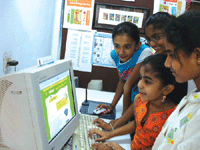
The site uses the web as a medium to encourage and foster the spirit of enquiry through its in-depth lead feature, games that are entwined with environmental messages, hands-on activity ideas that can be carried out individually or in a cooperative situation. It also has an environmental calendar which gives ideas to observe days of environmental significance by giving the purpose of the day, theme if any, for the day, and related activity ideas. The website is in the form of an interactive e-magazine that comes out with a fresh issue every month, inviting children to explore, investigate and discover different facets of the world we live in.
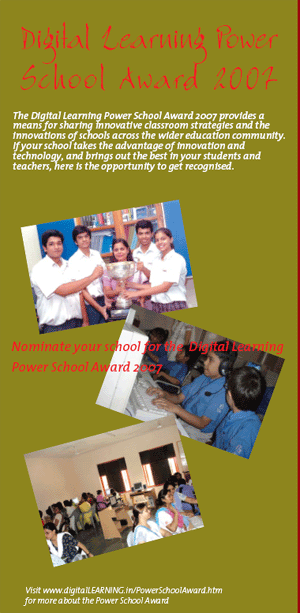
The topics for the 12 monthly issues focus on the themes announced for various environmentally significant days and on issues of current significance and importance. It includes relevant games and activities that harness the potential of interactivity that the web medium offers.

Spaceship Earth is a regular feature in every issue. Each one talks about an interesting aspect of our planet earth. Key points supported by illustrations help to explore different environments, plant and animal life, and learn about systems that support the rich life on earth.

In the Green Games section, children can “logon” and play games that not just challenge skills and abilities but set one thinking, and at the end convey an environmental message.

The Let's Do It! section gives simple do-it-yourself activity ideas. Children can do them on their own, or with friends.

The Celebrate a Day section has a calendar of environmentally significant days, giving a brief history or background of why the day is observed including some ideas for activities that would help anyone to observe these days with in school or with family and friends.


The Krg Club is a forum where children can share poems, paintings and thoughts on the environment. It is a chance to let other children in the world know more about oneself and what one does to improve the environment

The Green Gifts section has attractive downloadable offers. How exciting to select designs for personalized stationery like letterheads, visiting cards, and bookmarks.

Teachers and schools also play an important role in introducing students to use such self learning resources, which provide the opportunity to enrich textbook earning and open up windows to a larger canvas of environment.

Teachers can effectively use such resources to complement and supplement the curriculum. However, there is an overload of information on the web. It is often difficult to look for information that is correct, relevant, current, and presented without any bias. Utmost care is required while introducing children to resources on the web. It is important for the teacher to choose and sieve relevant information on the web and use it effectively. Kidsrgreen offers information that is current, relevant and accurate without being pedantic or preachy.

The relevance and usefulness of such a website is reinforced in the light of the New Curriculum Framework and the national imperative to infuse environmental perspective to all syllabi, as well as the demand of activity and project ideas. The different features of the website provide information in a child friendly way, and also a variety of “do-it-yourself” ideas that support “hands-on” involvement and the “joy of learning”.

CEE established in 1984 as a Centre of Excellence in Environmental Education, supported by the Ministry of Environment and Forests (MoEF), Government of India, is a national institution engaged in developing programmes and material to increase awareness about the environment and sustainable development.  

Oracle Education Foundation honors ThinkQuest award-winning students

The Oracle Education Foundation honours the winners  of the ThinkQuest International 2007 Competition. ThinkQuest, a programme of the Oracle Education Foundation, is a renowned global contest that challenges students to create innovative Web sites to share with their peers around the world. The winning teams collaborated in the research, writing and creation of Web sites on educational topics ranging from sustainability and energy alternatives to poverty and the effects of war on children.



This year's winning students hailed from 17 countries, including Argentina, Australia, China, India, Indonesia, Pakistan, Romania, Singapore, Slovakia, Slovenia, South Africa, Thailand, Tunisia, Turkey, United Kingdom, Vietnam and the United States. Student teams create educational content to be used by teachers and students around the world; their work is published in the popular ThinkQuest Library, visited by 30 million learners each year. The competition is utilised by teachers to engage their students in developing critical skills for life and work in the 21st century. Over the course of completing their team project, students learn important skills including teamwork, critical thinking, problem-solving, self-direction, and utilisation of technology.

The first, second and third place winning teams will travel to the ThinkQuest Live celebration held in San Francisco, California in November 2007. In addition, each student and teacher participant of the thirty winning teams will receive a computer laptop, while their sponsoring school will receive a prize of USD1,000.



Hi-Tech boost for pupils

A four-year United Kingdom Government-funded study into how making technology a key part of education could boost learning, found it improved attainment and classroom practices.

The ICT Test Bed project, managed by the education technology agency Becta, studied 23 primary schools, five secondary schools and three further education colleges. The results of the study showed as the new technology was introduced, a school's national test outcomes improved beyond expectations. It provid

LATEST NEWS