

Home Blog Page 1180

‘Schools on Wheel’ will go a Long Way in Addressing the Digital Divide

Mexus Education, a Bilakhia Group enterprise, has been promoting learning through technology based platforms like multimedia DVDs, motion films and interactive online tools. Anil Goyal, Director, Mexus Education, shares his views on education in Gujarat

The academic foundations of the state can only be strengthened by an all-round development in education. The development has to be right from the primary stage to the higher stages of education. The attempt to branch-out from conventional mainstream areas by setting up nationally recognized Business School, Fashion Technology Institute, Entrepreneurship Development Institute has actually made education more relevant to the citizens.

Initiatives have also been taken at school-level education, to ensure that students step into these academic pursuits with right orientation and mindsets. Efforts like School on Wheels, Kanya Kelavani, and the partnering with NGOs, are designed to make children better skilled, so that they may fit into the changing economy and tap emerging opportunities in the state.

Gujarat to Leapfrog

The opportunities in Educational ICT abounds. These shortcomings are increasingly acknowledged and accepted by the policy makers, as well as school administrators. In this decade, there is a strong need to use technology. Only technology can make education more relevant to current dynamics of economy. This easiest and most convenient way of addressing this pulsating need is by furthering a teaching-learning process through fusion with ICT. Indian Education is poised to incorporate audio-visual learning, collaborative learning and knowledge sharing elements. ICT is imperative to set a framework for these initiatives.

Reaching the Last Mile

For bringing education to the rural masses, we need to develop a model of education that is relevant to them. This will engage rural masses and ensure that they stay with the system, and thereby dropouts will be minimized.

  • Application-orientation specific to their skill sets that can improve the chances of getting proper employment will generate interest. 
  • Setting up a robust technology support which is not only easy to use, but also inexpensive and less dependent on existing infrastructure and facilities. 
  • Ensuring that the system attracts a large number of students so that the economic viability of the model is maintained. 

Initiatives like ‘Schools on Wheel’ would go a long way in addressing the digital divide, as it reaches out to students regardless of infrastructure, as well as the basic facilities.

On eINDIA 2011


eINDIA 2011 is designed to highlight the myriad initiatives that the government has undertaken for improving literacy levels in Gujarat. This event will prove that when it comes to education, Gujarat is far ahead of other states in the country. The coming together of academicians, educators, government officials and the corporate on a single platform will definitely lead to solutions that foster an inclusive growth in education sector.


“Out-of-class Activities should be Conducted Regularly”

Mosaic Network develops innovative tools that are used in educational institutions, government organizations and social agencies. Saurabh Sethi, Vice President, Mosaic Network (India) Pvt. Ltd. shares his views on transforming education…

IT has made it possible for us to bring quality education to India’s remote areas. The rural areas and the smaller towns can enjoy the same quality of education as the developed cities.

Last two decades have seen major turnaround in the way technology is used in education – we have systems like digital boards, eLearning, and mobile learning. IT is helping educational bodies by enabling micro management, any time access to information, quick and proper assessments and evaluation of education. IT has transformed education into a process that is learner-centric, engaging, attention grabbing, cost effective and reachable. The guru is now the IT empowered guide. Having said all that, it must also be accepted that IT has its limitations, which the innovators must address.

Gujarat to Leapfrog

Digital education has seen tremendous growth in the past 4-5 years. I strongly feel that this will continue to grow at higher rates in coming years. Only 10 percent of over 100,000 educational institutions are technology enabled and out of these only 12-15 percent have technological penetration in their classrooms. A market this big cannot be affected by competition and I can’t see any factor that might slow the growth. Right now, I am not even considering the government sector, which has the potential of making the opportunity even bigger.

Valuable lessons can be learned from the best practices being implemented around the world, but there is no formula for determining the optimal level of ICT integration in the educational system. Significant challenges that policymakers and planners, educators, education administrators, and other stakeholders need to consider include educational policy and planning, infrastructure, language and content, capacity building, employment and financing.

Reaching the Last Mile

We must accept the fact that technology alone cannot help us bridge the knowledge and opportunity divide. There are issues related to limited infrastructure, and it is also a fact that many teachers are hesitant when it comes to adopting new technologies. A comprehensive approach to tackle multi-level challenges in implementation as well as delivery has to be followed.

  • The digital content access shall be made available through a very easy to use tool, with minimal features.
  • Teaching processes must be standardized to take into account the low skilled teacher/trainer, who needs to follow simple instructions. They must be provided incentives for taking this additional burden.
  • Periodic inputs should be provided for improving the system if the learning level drops. 
  • Authorities and teachers should have timely access to reports and all kinds of feedback, so that the overall progress being made can be monitored.

“Drop-outs” are one of the biggest challenges for any education system. We should keep in mind while developing the learning content that the idea is to supplement the learning. The digital content should not become an additional burden on the students. The delivery must be engaging and the content should be contextual and theme based. It should adapt to the learners requirements. Motivational exercises and out-of-class activities should be conducted periodically to break the monotony.

On eINDIA 2011


We have been actively participating in your eINDIA events since 2009. We feel that eINDIA is a wonderful platform for enhancing knowledge, networking with companies, and gaining insights into the challenges faced by organizations in the field of education

“Gujarat Leads in Adopting IT in Education”

Next Education, a technology-driven education enterprise, provides ICT-based products in the K-12 segment. Veena Raizada, Director (Academics), Next Education, speaks about infusing IT into education in today’s world…

The educational space is being revolutionised with new technologies, and Gujarat is at the forefront of this revolution. The traditional chalk and blackboard model is no longer in vogue; we are gravitating towards interactive white boards and digital content for imparting education.

According to the Sarva Shiksha Abhiyan policy of the Union Government, schools are adopting technology in a big way. Next Education wholeheartedly supports this initiative. The strong IT infrastructure in the state will go a long way in making quality education available to every student.

Gujarat to Leapfrog

The policy initiatives on IT taken by the Government of Gujarat are quite encouraging. The telecom and the IT sectors in the state are well developed, and the state’s literacy rate is almost 70 percent. The Bhaskaracharya Institute for Space Applications and Geo-Informatics (BISAG) has satellite communication facilities with a dedicated bandwidth.

These are good signs. Gujarat can be a leader in adopting IT in education. The IT network in the state is strong. The transport network is good. Investment in the IT sector is very high. The state is ripe for having a much deeper tryst with digital education.

There are several challenges in the adoption of ICT in the education sector. Among them are low literacy levels, unwillingness to adopt technology, monitoring and evaluation, lack of guidelines, and institutional fragmentation. Even those deemed literate may not be competent enough to receive IT education. Educational standards would need to be raised before citizens can become digitally literate.

Steps need to be taken to overcome the unwillingness for adopting new technology, so that the digital literacy levels among students and teachers can be increased. Teachers are wary of technology. They need to be made aware that IT training will help them rather than pose as a threat to their jobs.

Hardware penetration in schools in quite high, but with no auditing or monitoring system in place, there is no way for us to evaluate the effectiveness of this hardware. The most common issue faced by schools is related to identification of quality content, but this issue can be resolved by providing clear guidelines.

There is a need to bring about some harmonisation and co-ordination in the aspects of curriculum, infrastructure, content, policy and implementation. The framework for these things is developed by several bodies at several levels. India also has linguistic diversity and income disparity. The digital divide in the country is so acute that it becomes difficult for policy-makers to frame universal policies to be implemented.

Reaching the Last Mile

Digital solutions on any media that can be operated through the simplest of technological applications will make the mission possible.

The myriad challenges in the path of digital learning can definitely be overcome through dedicated approach. The concept of “School on Wheels” can succeed with all coming together for running it successfully.

On eINDIA 2011


Gujarat is poised for a big leap into the world of digital learning. An event like eINDIA 2011 becomes very relevant in this context, as it is a platform for discussions on the best ways of infusing IT into the educational curriculum.

Narendra Modi’s Messege

Chief Minister, Gujrat State
Narendra Modi, Chief Minister, Gujrat State

MESSAGE “Gujarat, with its all inclusive, sustainable and rapid growth, is emerging as a globally preferred place to live in and to do business.”

Over the years, the Gujarat has emerged as one of the most dynamic, prosperous, investor friendly and fastest growing states of India. The importance of well thought governance initiatives with significant use of technology in this success cannot be overemphasized.

Good Governance is the key to sustainable development. The state has been constantly innovating, aiming at excellence in governance. The opportune understanding of the importance of technology in effective and efficient delivery of services has enabled the state to take up many innovative steps for empowering people.

While the State’s emphasis has been on building educational infrastructure, training of teachers and computerization of schools, we have successfully been able to come up with 11 new universities, 400 colleges, 1.25lakh new teachers, 38000 new schoolrooms and to double the seats for technical courses. The State has witnessed a massive reduction in the dropout rate at all primary levels. Improvement in the health and nutritional status of the population has been one of the major thrust areas of the social development programmes in the state. Over the years, Gujarat has developed good health infrastructure and human resources. The state has initiated a wide variety of Public – Private collaborations, involving NGOs/Private Sector practitioners. Gujarat is now emerging as a global medical tourism destination.

It gives us immense pleasure to share with you that Department of Science and Technology, Government of Gujarat and Elets Technomedia Pvt Ltd are jointly organizing eINDIA 2011, an annual ICT conference and exhibition at Mahatma Mandir International Convention Centre, Gujarat from December 15 – 17, 2011 as one of the prelude/precursors and warm up exercises to Vibrant Gujarat 2013. The vision roadmap that we have carved for the state will certainly get reflected in various thematic conferences under the umbrella of eINDIA 2011.

We warmly welcome all delegates and look forward to participating in what promises to be an immensely enriching event. (Narendra Modi)

“Method of Delivery needs to be Structured and Consistent”

Pearson Education Services (PES) provides end-to-end customised education solutions in the K-12 segment, with a focus on technological innovations. Meena Ganesh, CEO and MD, Pearson Education Services, sheds light on the subject of transformations in education space in Gujarat

Gujarat is home to five top postgraduate institutes. Usage of IT in education helps further improve the education scene. It will change the face of teaching in terms of how teachers interact with students as well as the quality of content used. Technology will help add a whole new set of learning strategies that were never available before.

The proactive nature of the government has contributed largely to the overall growth and development of Gujarat and the state is now poised for taking development in education to the next level. The state government plays a pivotal role is making education available and accessible to all and it has come up with a range of to meet this goal. The Education policy needs to eliminate financial, legal and administrative barriers. It is most important to remove all obstacles to compulsory schooling. It should also ensure proper fiscal allocations through training of teachers and elimination of myriad social discriminations.

Gujarat to Leapfrog

Gujarat has always been known for its entrepreneurial ways. A similar attitude towards ICT in education would help in taking it a long way forward. Being home to India’s top educational institutions, Gujarat is always been an inspiration to all the other states and any step that this state takes tends to get followed by all the other states.

Introduction of ICT in education will go a long way in making students in India competent enough to compete with their counterparts across the world. The biggest challenge is acceptance of usage technology in education and overcoming the apprehension that comes with something new and unfamiliar. Most educators are uncertain of using technology and fail to see its benefits. But such issues can be resolved by training teachers and making them understand how to effectively use ICT.

Reaching the Last Mile

Reaching out to students from every cross-section of society is a major challenge. The VSAT technology platform seems to be an ideal model for making education available to all. This platform facilitates live classrooms by enabling two-way audio/video interactions, thus giving students access to the best faculty, irrespective of their location.

While Schools on Wheels is an excellent concept, for education to be effective, the method of delivery needs to be structured and consistent, and that is one area in which the scheme lags. Only when the instruction is structured, children will be able to grasp what they are being taught and there can be proper monitoring of progress.

On eINDIA 2011


eINDIA 2011 will bring together government, civil society, academia, and private sector enterprises across the world. This event will bestow international attention to the successes that Gujarat has achieved in the education space. It will also provide immense exposure to the stalwarts’ active in the education scene. They will be able to gather relevant experience for taking education in Gujarat to a new high.

Shiksha

Implementing Agency: Microsoft Corporation (India) Pvt. Ltd

Website: www.microsoft.com/india/msindia

To address the priorities in national educational through focus on three core areas: Innovative Teachers, Innovative Students and Innovative Schools.

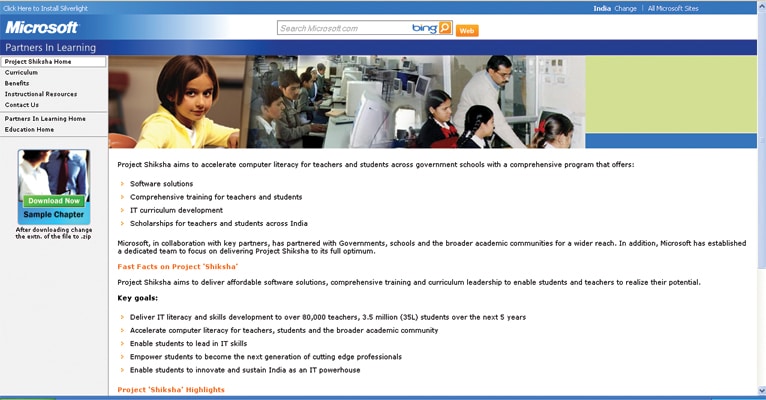
The first phase of Partners in Learning entailed the launch of Project Shiksha, which is targeted towards teachers in government schools. Launched in December 2003 by Bill Gates, Chairman, Microsoft Corporation, this scheme is designed to deliver affordable software solutions, comprehensive training and curriculum leadership for students and teachers in government schools. The lofty aim of the exercise is to ‘Empower the future’.

The curriculum seeks to make it easy for teachers to understand how to integrate IT tools in classrooms. Currently, this curriculum is available in six regional languages and includes a lot of self-practice exercises. Entire training is delivered over 8-12 full day sessions..

At the onset, the project had a target of reaching out to 80,000 teachers by December 2008, a period of five years. The second phase of Partners in Learning, Shiksha Pragati, was launched in April 2011 in India. Shiksha Pragati is a logical progression of Microsoft’s Project Shiksha and is designed to equip schools with a capacity building mechanism in order to reduce their dependence on external agencies for ICT and 21st century teaching-learning skills.

Need for the Project

Project Shiksha will bring relevant technology to the education sector and help address the problem of huge gap between the citizen’s expectations and the services that are being provided. We are committed to digitize the classroom environment and thereby contribute towards economic growth of the country.

Innovation Factor

  • Public private partnership works directly with Educators, Institutions and Governments for furtherance of education
  • Computer based learning (ICT) is promoted across government schools with emphasis on providing software solutions and scholarships to teachers and students
  • Each teacher designs a digital lesson around their respective subject, which is a direct take-away to be used in the class-room post training.
  • Monitoring the teachers to ensure use of IT post training. 
  • Follows a 360 degree approach, which allows the teachers to be in touch with trainers.


Achievements

  • Microsoft has trained over 6,77,000 government school teachers across 12 states. 
  • Over 50,000 teachers have integrated technology in their teaching methodology
  • These teachers have imparted their IT knowledge to over 32 million students. 
  • Tie-ups with educational institutions and other government schools have increased the reach of the scheme. Microsoft has also tied up with various state-run District Institutes for Education and Training (DIETs)
  • Several teachers have created their own websites post ‘Shiksha’ training and are regularly participating in e-communities, ICT contests with the help of various relevant websites. For instance, there are websites like www.partnersinlearningnetwork.com and www.learninghub.com.

Eureka.in: Visual Aid for Understanding Science and Maths

Implementing Agency: Designmate 

Website: www.designmate.com

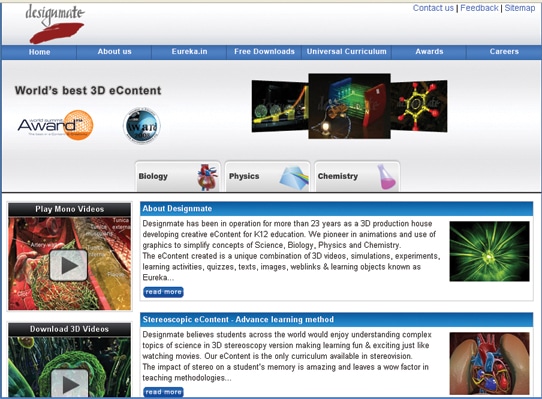
A digital library of Learning Objects for Science and Mathematics, Eureka.in contains learning resources like text, video, simulation, quiz and web-link. The animation in the videos and simulations are done in 3D, which is conducive for providing viewers with an enriching, fulfilling and engaging experience. The digital content comes in two formats Mono (without glasses) and Stereo (with glasses) and caters to students from 6th to 12th grades. The product is already operational in 5000 schools around the world.

Need for the Project

It is a well known fact that teachers often find it difficult to explain many crucial concepts in science and mathematics to their young students. Hence Design-mate decided to come up with teaching material in visual format so that the students can actually make visual contact with the scientific and mathematical ideas and thereby achieve better understanding. One thing is for sure – the time when a teacher did all the talking and the students sat as passive listeners is passé. Today teachers and students can developer better bonding through digital teaching materials.

Localisation

Translating the entire content into regional languages around the world and then mapping the same according to the respective curriculums. To overcome the same Design-mate started entering different countries by partnering with big local companies in different countries operating in the field of education and started translating and mapping the content with partner companies help, assistance and guidance.

Piracy

The content can be safeguarded from getting pirated, by building a robust encryption after years of research.

Global reach

To treat this issue Design-mate has been attending educational exhibitions across the Globe and have partnered with big players in the field of education.

Compatibility

The content is made compatible with various devices across the world. To cater to this issue Design-mate started procuring various SDKs of devices and today after years of research and development over it the content is compatible with most of the contemporary devices.

Innovative Factor

  • Immersive 3D experience
  • Virtual Labs
  • Learning resources
  • Device compatibility
  • Localized content
  • Comprehensive K12 library
  • Extensive visualization and detailing
  • Ability to render into HD stereo vision 


AchievementsFirst 3D stereoscopic educational software in the world
Manthan Award for e-education 2006
World Summit Award 2007
World Didac Award 2008

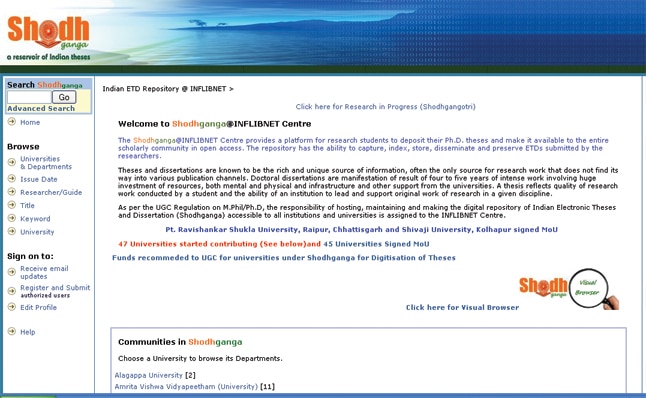
Shodhganga : A National Repository of ETD

Implementing Agency: INFLIBNET Centre
Website: http://shodhganga.inflibnet.ac.in

All universities in India are expected to join the National Repository of Electronic Theses Dissertations (ETD) after UGC issues a gazette notification in this regard. Universities are signing MoU with the INFLIBNET Centre to join Shodhganga project. “Shodhganga” is the name of the national digital repository of Indian Electronic Theses and Dissertations.

Basically the universities are giving a commitment for allowing digitisation of their old and new theses in the repository.

The universities that sign MoU with the INFLIBNET Centre are given incentives in terms of funds for digitisation of old theses as well as for setting up of ETD Labs. Besides, universities also get access to an anti-plagiarism software tool that detects plagiarism and thereby helps in improving quality of the theses. The project is so useful that it will undoubtedly motivate universities to support the digitisation of theses.

The project will grow as more and more theses get submitted and the platform is enhanced to provide better search and discovery experience.

Need for the Project

As long as theses and dissertations are not digitized, there is bound to be issues like duplication or even plagiarism. This is wastage of real talent and resources. The UGC Notification (Minimum Standards & Procedure for Award of M.Phil. / Ph.D Degree, Regulation, 2009) dated 1st June 2009 mandates submission of electronic version of theses and dissertations by the researchers in universities with the aim of facilitating open access to Indian theses and dissertation to the academic community world-wide.

Online availability of electronic theses through centrally-maintained digital repositories will not only ensure easy access and archiving of Indian doctoral theses, it will also help in raising the standard and quality of the research.

Innovation Factors

  • Shodhganga@INFLIBNET aims to encourage and support open access to publically-funded research.
  • It is a national project, which makes the research result available online for public access, by publishing theses in open access format, based on UGC mandate via gazette notification 
  • First National Repository of Theses and Dissertation for all Indian Universities (About 525 universities).
  • UGCs National Scheme for digitisation of back volumes of theses for all universities. 


 Achievements

  • Well received by academic community and in a year, 43 universities have come forward in a year to sign the MoU and join the project.
  • Universities started signing MoU with INFLIBNET for joining the project; voluntary contributed soft copies of theses have crossed 2400 as on date and it is growing.
  • Short-listed for Manthan Digital Inclusion Award and the final process is going on.
  • Though there is no mandate for private universities to join the project, such universities came forward to sign the MoU and join Shodhganga voluntarily.

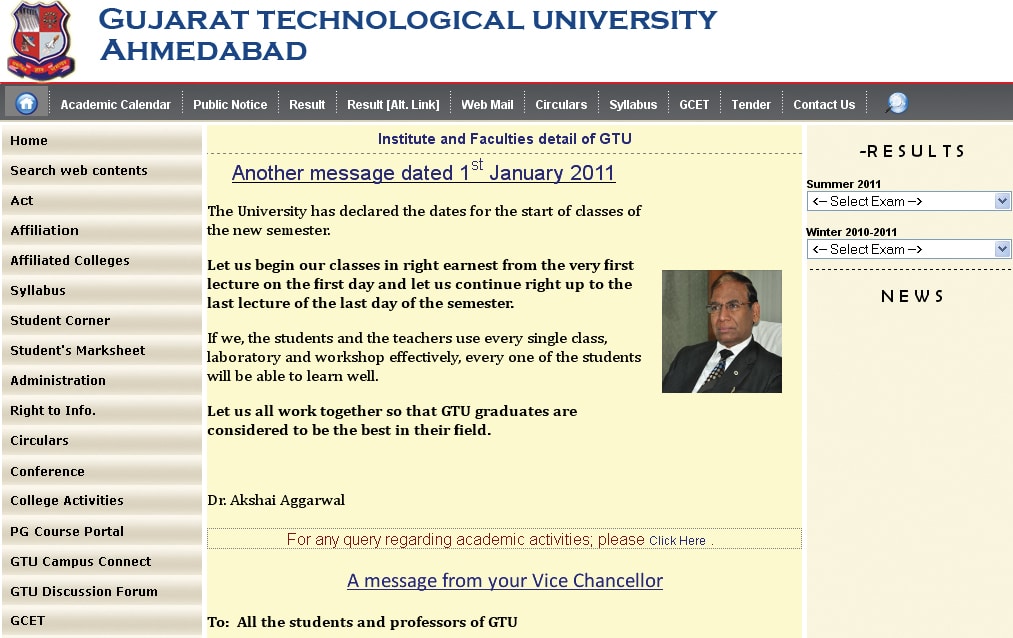
Implementation of IT at Gujarat Technological University

Implementing Agency: Gujarat Technological University
Website: www.www.gtu.ac.in

The Gujarat Technological University (GTU) was setup by the state in 2007 to regulate the affiliation, examination and curriculum development in diverse areas of professional education. To achieve the goal of bringing new digital technology to education, GTU is working on the lines of Industry Define Project (IDP), Faculty Development Project (FDP) and User Define Project (UDP).

Exam paper delivery system at GTU is now paperless. Security is through encryption /decryption technique having three layer password protections, out of which one password is delivered before half an hour of the examination through dedicated mobile SMS service.


Need for the Project

  • To help students develop the knowledge of subjects like science, engineering, technology, management, environment, etc.
  • To create institutes and centers of excellence for imparting state-of-the-art education, training and research. 
  • To create capabilities for development of knowledge, skill and competency at various levels. 
  • To establish close linkage with industry for making teaching, training and research relevant to the needs of the industry at various levels.
Innovation Factor

  • GTU has initiated encrypted examination papers on compact disk first time in the state and used mobile SMS technique to decrypt examination papers. 
  • Automation of pre-exam activities like exam form generation and receipt, hall ticket generation and student exam barcode is initiated. This has been achieved with proper implementation of Information Technology. 
  • GTU has developed its own IT based bar-coded automated system for all kinds of tasks related to the conduction of examinations. 
  • GTU’s examination results are declared on its web-site only. 
  • To improve the teaching learning processes, GTU has taken several ICT Initiatives: there is use of WebEx for remote teaching of VLSI Design and Embedded Computing courses through experts from all over the world. 
  • GTU Wikis (“using collective intelligence for improving Learning Outcomes”) are intended to serve teachers of GTU consortium colleges (PPP colleges) 
  • At a few colleges GTU has provided rooms with 12-15 computers connected to a central server, on which the entire video course-set of IIT Mumbai is mounted.


 Achievements

  • ICT Enabled University Award for e-learning and Manthan Award South Asia for conducting On-line Entrance test for first time in any state in the year-2009.
  • GTU is honoured with GESIA Award for best IT practicing university in 2011.
  • On April 14, 2011, GTU won the best jury Award under in category of Best Interface between Academia – Industry at the World Education Summit 2011, New Delhi for its GTU Innovation Council project. 
  • GTU bags the award for ICT enabled University of the Year in E India 2009.
  • University has started functioning in the year 2008 with engineering and pharmacy institutions (219 approx.) and grown up to 500 plus institutions imparting education in the field of engineering, pharmacy, management, computer science and Hotel Management.

Flourishing Education in Gujarat

Gujarat is at the forefront of India’s economic boom. Some of the largest industrial groups in the country are based in the state. The business friendly attitude of the people has turned the state into a favoured investment destination. The role played by Chief Minister Narendra Modi in taking Gujarat’s economy to dazzling heights is most laudable. Modi is mindful of the fact that the state can retain its pace of growth only if it is home to a citizenry whose knowledge and training are of global standard. Education is the key to the state’s success.

 Gujarat is on the verge of becoming India’s IT and manufacturing hub; now many IT related tools are being used to take education to grassroots levels. Quality education that not only offers knowledge, but also improves the employability of the scholars, is being made available to every cross-section of society. State has taken various initiatives like Gunotsav, SCOPE, GKS and much else to incorporate the ideals of access, equity and excellence in education.

 In order to highlight the fantastic reforms and growth in the state’s education sector, we have decided to bring together a platform that connects all the stake holders. Hence, this year we are organizing 7th eINDIA , India’s Largest event on Information and Communication Technologies, in Gujarat. This is our attempt to create a platform for enlightening discussions on the best ways of developing education in the country.

 Among other things, the current issue of digitalLEARNING, ‘Gujarat Education Edition,’ focuses on the eINDIA 2011. We do our best to shed light on the educational initiatives being undertaken in Gujarat. Starting with the vision of Narendra Modi, the ICT related views of Sri Ravi Saxena, and also the views of the myriad stake holders from industry and academia, we have stitched together a spectrum of opinions for generating this collector’s issue.

 We look forward to your participation in the issue.

LATEST NEWS