Home Blog Page 1317

Schneider Electric to set up

The Bangalore based M.S. Ramaiah Institute of Technology (MSRIT), run by the Gokula foundation, which offers several courses in engineering, and the global electrical major Schneider Electric, the global specialist in energy management, have joined hands to promote 'technical excellence' in the field of electrical, electronics, software and control engineering. The two have signed a MoU today covering 'University partnership for curriculum development'. Through this program MSRIT with technical inputs from Schneider has deployed two courses, namely 'Advanced Industrial Automation and Modern Controls' and 'Energy Management'.

Schneider and MSRIT feel that this will go a long way in developing young engineers who could be productive from day one as they will have enough 'hands on' experience when they leave college. The MOU was signed by Daniel Gheno, VP-Engineering for Schneider Electric and Dr. K. Rajanikanth, Principal, MSRIT at Schneider's R&D facility today. Apart from providing technical knowledge, Schneider will be setting up a modern lab with the state of the art electrical and electronic equipment with associated softwares, covering industrial automation, control systems and power monitoring.  These Schneider manufactured equipments will be given free of cost to MSRIT. The institute on its part will provide the infrastructure and other associated equipment to set up the 'Schneider Centre of Excellence' in its campus.

Said Dr. K. Rajanikanth, Principal, MSRIT, 'It is a great pleasure for us to be associated with Schneider on this University Partnership. It is also a major step forward in the industry- academia partnership which would be beneficial to both industry as well the student community.' 'The faculty from MSRIT underwent week long training at Schneider's R&D facility at Bangalore.  This agreement is timed to last three years, thereby ensuring active participation between industry and academia.' added Dr. Rajanikanth.

ICT in Education

A Core Driver of Globalisation

Switching from manual to CAE is not only about technology.. Switching from manual to CAE is not only about technology—it is also about content and effective instructional practices. The focus is on curriculum and learning, where the curriculum should be redesigned giving equal  importance to use of the educational videos, lab sessions, projects, student driven activity such as power point presentations, and educational games….

The education world has been
greatly infl uenced by rapid development in  information and communication technology  (ICT) and increasing availability of information. Schools and universities have advanced by leaps and bounds when it comes to incorporating technology into the learning environment. Government as well as private organisations like Intel, NIIT and Microsoft is taking enough initiatives to encourage the use of technology in the education system. Schools and universities are using educational tools like Moodle, iCore, Thinking Cap and Microsoft Silverlight which not only helps in delivering classes but also in automating the complete educational system.

As the access to information continues to grow exponentially, educational institutions cannot limit themselves to delivering a prescribed syllabus from teacher to student over a fi xed period of time. Even after sixty years of independence, India is home to 66% literates. Computer Aided Education (CAE) includes but is not limited to multimedia presentations, interactive digital books, video conferencing, educational games, whiteboard and Internet based learning. Individual instructors can use these tools during the knowledge delivery process. For a successful CAE, it is important to have an effective integration of the educational tools and the knowledge delivery process at each level, be it schools, colleges and universities etc along with the involvement of key stakeholders. This calls forth and proposes a “layered approach” to technology aided education system that primarily entails the correct fi t of technology in the teaching process and the initiatives taken by government and private organisations towards technology aided education system.

PRIMARY AND SECONDARY SCHOOL
The ‘ICT in Schools’ scheme, an Indian government initiative dates back to December 2004, which supports computer aided education process and enhances computer knowledge among the secondary school students. 2365 schools were sanctioned under outright purchase and 7200 schools on BOOT model. Andhra Pradesh was the fi rst state in India to offer ICT education to its entire 1.8 million school going children.
COLLEGES AND UNIVERSITIES

With an aim to impart technical education by using technology, the Ministry of Human Resource Development (MHRD), in 2003 had initiated– National Programme for Technology Enhanced Learning (NPTEL) that is a joint initiative by the seven Indian Institute of Technology (IIT) and Indian Institute of Science (IISC) Bangalore. The objective of NPTEL is to enhance the quality of engineering education in the country, along with the focus on developing curriculum based video courses, web based e-courses, digitally taped classroom lectures and additional study materials in every subject possible. Another scheme like e-shiksha initiated by Centre for Development of Advanced Computing (CDAC) is an e-learning portal that supports learning – anytime, anywhere with a multilingual subtitles thus supporting students of various demographics. Some of the other prominent initiatives undertaken by Shreemati Nathibai Damodar Thackersey Women’s University  (SNDT) Pune, the Pay Phone Welfare Association (PPWA), and Indira Gandhi National Open University (IGNOU) have been remarkable and unique in imparting mobile education on music, dance, art and craft, nutrition, public health and AIDS awareness.

PRIVATE SECTOR INITIATIVES
Amongst the private sector initiatives, Intel India has been playing a pertinent role since past ten years with various central and state education bodies in offering programs in higher education, teacher training, informal education and science promotion. The Intel Learn Programme focuses on project based learning enabling the youth aged 8 to 18, to develop critical thinking, problem solving and collaborative learning attitude.

Microsoft is also actively involved in encouraging the use of technology use in learning and education through the “Partner in Learning (PIL)” which is a global initiative that aims to provide a better access to technologies, teacher’s training and use of an innovative method to impart knowledge. Further, Educomp smart class, mathguru, edulearn, iCoreTM (an educational software by iCore ), Thinking Cap, NIIT educational products are some of the key educational products that encourage the use of technology use in teaching in a single integrated solution to all school activities like interactive classroom for teachers, math lab and IT wizard for the students and quick school for the school management.
ROLE TRANSFORMATION
Unlike the traditional education system where an instructor delivered a lecture, technology aided education system has enabled the instructors to become more responsible in the knowledge delivery process and the participation of the students participate in the knowledge gaining process becomes two ways where they too are encouraged to contribute their view point on the topics. With the new defi ned role, the instructor becomes a part of the class and there is a dual sharing of knowledge by both instructor and the student. With the use of ICT, the students no more remain confi ned to the classroom teaching and prescribed books, but rather make an extensive use of the websites, magazine article and newspaper readings and real life examples
LAYERED APPROACH
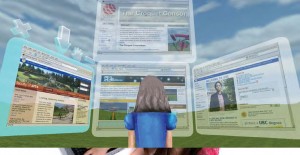
For those who are currently operating on a manual basis but is now moving on to integrate ICT in educational organisation, the proposed architecture (refer to Figure1) outlines the layered approach. Switching from manual to CAE is not only about technology—it is also about content and effective instructional practices. The focus is on curriculum and learning, where the curriculum should be redesigned giving equal importance to use of the educational videos, lab sessions, projects, student driven activity such as Power point presentations, and educational games. Further continuous evaluation should be adapted rather than class tests and exams. Integrating technology in the education system needs planning, analysis (hardware, software, network and administrative support) and timely implementation. Technology integration can also lead to re-engineering of the education, administrative process. Training should be rendered to the instructors as well as the students on the usage of the tool. The success of CAE will depend on the acceptance of the tool by the instructor and the students. Challenges of ICT integration in education system: Absence of a top leadership, proper management and acceptance of the new work environment Improper investigation and monitoring Need of re-engineering before fi nal adoption
WAY AHEAD
Apart from imparting knowledge through Internet and integrating educational tools in the educational process, technology aided education also includes mLearning and Direct to Home (DTH) learning. (For example, Apple encourages mLearning through  TuneU; Digital cable TV operators like Airtel, Tata Sky and Reliance) The system should be alert to the new developments happening in abroad and in India in telecommunication and educational domain. Organisations should adopt available technologies and facilities to develop new product from time to time.
CONCLUSION

IT has helped organisations to think beyond traditional learning method and redefi ne the concept of education. CAE helps students to focus more on knowledge rather than learning.Technology has no doubt opened the gateway to various educational resources but for teaching communities it is important to acknowledge that it is not the silver bullet that will solve all the academic problems, rather the instructors, students and the school management need to join hands to make the difference in the process and improve qualit
y

Just-in-Time

A Pedagogical Shift Integrating e-Tools, e-Resources and e-Knowledge
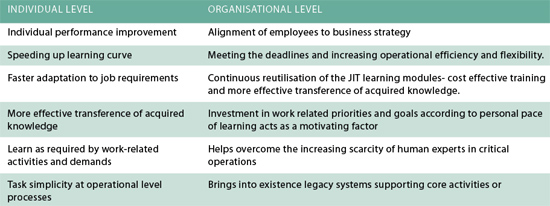

“Just-in-Time” (JIT) is a pedagogical shift towards problem and competence-based learning environments. It's a holistic approach that involves new pedagogical strategies, processes, people and systems to deliver knowledge and skills required by academia and organisations, in a timely and cost-effective manner

Web-based technologies embedded with vast, and easily accessible online content have brought about a metamorphosis in learning paradigms. Community activities such as Blogs, Wikis, and Moodle have effectively leveraged on technological advancements and inter-connectivity, promoting collaborative enhancement of knowledge on a scale never seen before. What's needed today, however, is to map content to context, on the fly.

“Just-in-Time” (JIT) is a pedagogical shift towards problem and competence-based learning environments. It's a holistic approach that involves new pedagogical strategies, processes, people and systems to deliver knowledge and skills required by academia and organisations, in a timely and cost-effective manner. JIT requires a well-knit assemblage of atomic learning assets and runtime creation of coherent learning content that's aligned to learner's needs and preferences.

In a business environment, time is the essence. An organisation therefore, would seek to provide access to right information, at the right time, leveraging on latest technology and systems. Role based performance support, just-in-time, and on “just enough” basis is preferred over conventional linear course based learning pattern.

The granularity and associated self-organising capability of learning object architecture in line with the learner's preferences is the key to JIT learning – a learning system that integrates the e-tools, e-resources and e-knowledge with the learner preferences minimises the gap between the learning and application offering context-oriented help and providing a tie-in to knowledge base of the organisation.

A successful JIT-Learning system needs emphasis on key topics that aids a learner to obtain better insight of underlying concepts and promote reaching plausible solutions appropriately supported with business processes and knowledge domain.

A seamless integration of work skills, system requisite and interaction can aid knowledge acquisition, improve learner's decision making skills in work related tasks, and help resolve expert scalability problem.

Project Name
Just-in-Time Learning – Effective
& Efficient Pedagogy of Future

The Organisation
CIHL, MSIT Division, IIIT-Hyderabad

Key people
Padmaja Naraharisetty, Principal Mentor

Tools facilitating just-in-time learning

  • Virtual conferencing
  • Threaded discussions
  • Electronic resource repository
  • Simulation based learning modules
  • Electronic administrative tool

“The context of operational learning is changing due to a no-time-to-spare pace of today's work environment. Event-based or “just-in-case” learning is no longer adequate; now, employees need knowledge, data and tools integrated into the workflow so that it is available at the moment of need.”

With an aim to gauge the efficacy of different learning interventions and pedagogical constructs (both used in MSIT programme and those popular in  the Industry), the authors conducted two surveys in October 2008 on following sample populations: Internal participants of the MSIT programme and Industry professionals (43% from IT/ITES, 10% from engineering sector, 21% from academics, 26% from other professions). The survey results highlighted that JIT, if suitably encapsulated in a Learning System Design, can enhance and accelerate the learning experience. In a knowledge economy, where learning demands are dynamic, flexible and are required to be delivered at fast pace across distributed geographies, JIT surely provides a focused approach that leverages on technological advancements and reduces cognitive load on the learner. Specifically, a JIT approach would create a learning ecosystem that is: just enough, just for me and just in time.

 The quote from Gloria Gery captures the very relevance and significance of JIT Learning:

“The context of operational learning is changing due to a no-time-to-spare pace of today's work environment. Event-based or “just-in-case” learning is no longer adequate; now, employees need knowledge, data and tools integrated into the workflow so that it is available at the moment of need.”

e-Teaching and e-Learning through Classroom Windows

The neologism 'eLearning' is the technique of Learning through the use of electronic devices where live teaching is facilitated through electronic media extending beyond the reach of the classroom, popularly termed as Class Room Window (CRW). The unique aspect of CRW is the ability to transcend space anywhere

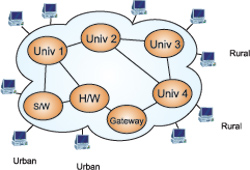
The neologism 'eLearning' is the technique of Learning through the use of electronic devices where live teaching is facilitated through electronic media extending beyond the reach of the classroom, popularly termed as Class Room Window (CRW). The unique aspect of CRW is the ability to transcend space anywhere, whereby the system enables expert lectures of renowned professors of leading colleges and universities to get connected to the rural area students. A CRW is typically a teacher-centred technology that can be created by streaming a live classroom activity from one place to another using the broadband Internet and innovation in ICT.

The CRW facility if extended to universities or colleges, the campus of global Universities, maximises reach of the classroom of renowned colleges, university and resource person globally, by optimising the use of ICT facilities. This provides a gateway to active and live learning facilities effectively than distance learning, learning through podcasts or conventional eLearning. This CRW facility can be extended to provide effective tutorial tables' room for the students after university working hours for additional guidance. The CRW facility can also be applied to form effective university clusters, which will result in resource, cost and time-sharing. These facilities, if extended to the rural colleges, where resources are not easily available, would bridge the digital divide. Instead of podcasting a lecture, another time in a different environment and classroom, the live lecture can be streamed through digital equipments at another classroom. This helps the rural engineering college classroom to log on to another live classroom. A research study conducted on remote classroom concept through tele-lecturing system during the year 1970 reveals that the student's attitudes improved considerably. Further, substantial research on media assisted teaching at the University of North Carolina, showed that such classes were as effective as those taught in traditional environment (Figure 1). 

CRW Tutorial Tables Room provides effective tutorial tables room for the students after university working hours. A CRW tutorial tables' room, is a room with tables that will hold 4 to 5 students through CRW technology, whereby students needing additional coaching meets the Professor at the CRW tutorial room on invitation which can be either a free entry or an entry through payment gateway. After entering the Tutorial tables' room, a student searches for his professor and clicks to sit in one of the chairs of the table where the professor is seated following which the students are then taken into a separate room where the tutorial begins as in the Figure 2.

University Clusters

CRW develops a healthy interaction between the higher education technical institutes, where India would soon be witnessing University Clusters (UC), which means a group of Universities come together to promote resource, time and cost sharing, while optimising the available time and resources, using CRW concepts.
 
Creating a True Cloud

True Cloud computing is Internet-based computing, whereby shared resources, software and information are provided to computers and other devices on-demand, like a public utility. The University clusters in this context can build together one educational cloud exclusively for the CRW implementation. Fostering the state-of-the-art technology at the academic level, to build a healthy interface between the university clusters and the rural colleges is to provide all the information communication technology relevant to an active classroom and the classroom window, through a True cloud using Remote Infrastructure Management technique (Figure 3). 

Benefits and Scalability

  • Enable effective interaction with the peer urban group
  • Brings about new ideas and innovation due to the mix between rural and urban
  • Extend the reach of the classroom of renowned colleges, university and resource person globally, by optimising the use ICT facilities
  • Facilitate podcasts and replay of the lectures at leisure for the students
  • Better evaluation through a regular assessment via software, like, moodle software

Impact and Challenges

The integration of Information and Communication Technologies with broadband Internet has led to an explosion in the use of digital media in higher education both locally and globally. However, frequent emergence of cutting edge technologies in the communication and computer-engineering field and the global e-learning raises hurdles in communication, culture, and technology that must be addressed before successful implementation and effective outcome.
 But in spite of this, CRW has marked the beginning of a new era in today's world of ICT enabling many educationalist, policy makers, industrialists, higher education department, department of science and technology and others to come forward to foster CRW technology.

Some Highlights

  • Transcends space anywhere
  • Provides live classroom atmosphere at remote locations
  • Opportunity to undertake innovative projects and research initiatives by the rural and urban students combined via interactive sessions with the professors from abroad
  • Enable selection of international supervisors on account of its participative interaction ability
  • Planning of frequent meeting between the supervisors and the research scholars
  • Promote active collaboration between universities after signing the memorandum of understanding

iTunes U becomes more popular for students and lifelong learners

iTunes U, the educational side of iTunes by Apple, is going strong. The Open University has hit a milestone, reaching 20 million downloads. iTunes is a proprietary digital media player application, used for playing and organising digital music and video files. Additionally, iTunes can connect to the iTunes Store via the Internet to purchase and download music, music videos, audiobooks, podcasts etc. Apple delivers university lectures through a format called iTunes U. iTunes U brings the power of the iTunes Store to education, making it simple to distribute information to your students and faculty

Web 2.0 Collaboration Tools for Class Rooms

Web 2.0 has revolutionised the education world and brought the world closer. Web 2.0 site allows its users to interact with other users or to change website content, in contrast to non-interactive websites where users are limited to the passive viewing of information that is provided to them

The Internet has undergone a revolution since the 1990s and early 21st century. Earlier, the World Wide Web was mainly used to surf and find information where the information streamed in only one direction. Websites were typically made by people who had mastered HTML (Hyper Text Markup Language) coding and knew FTP (File Transfer Protocol) site management.

However, in 2004 the Internet began to change its appearance and gave birth to new web tools that allowed ordinary people to dynamically work on the web. This enabled people to add and delete the contents to already existing websites and hence websites became more dynamic and information flowed both the ways. People, who did not belong to the programming world were rapidly editing and adding public contents to the web in the form of their own periodicals, podcasts, videos, wikis, photographs, slideshows, auctions, and more.

The second generation of the web had taken birth, named Web 2.0 making websites more attractive and user friendly. As per Wikipedia, Web 2.0 is “commonly associated with web applications that facilitate interactive information sharing, interoperability, user-centered design and collaboration on the World Wide Web”. Examples of Web 2.0 include web-based communities, hosted services, web applications, social-networking sites, video-sharing sites, wikis, blogs, mashups, and folksonomies. A Web 2.0 site allows its users to interact with other users or to change website content, in contrast to non-interactive websites where users are limited to passive viewing of information that is provided to them.”  Web 2.0 technology is also known as the Read/Write or the interactive web, as the users are able to read the content and at the same time able to make changes to the content as per their requirements and hence this serves as a great platform for educational purposes.

Today, teachers are using the Web 2.0 tools to introduce lessons in their classroom. Students are collaborating with other students around the world, creating online content and displaying their work to a global world. Web 2.0 facilitates professional collaboration, networking, critical thinking, collaboration, innovation, creativity, global understanding and multicultural learning. Various tools for collaborative writing and editing, private communication, online conferencing, file sharing, and desktop sharing enable teachers to effectively collaborate with the students beyond school hours thus making optimum use of the technology available.


It has been truly said “Power comes from effectively combining information with technological capacity and the creative capacities of human beings.”     Google Docs

Google Docs is a free service provided by Google to its users. It serves as an excellent application for collaboration where teachers and students can use it to share documents, spreadsheets and presentations. Professionals can too collaborate with their teams and clients in real-time

Skype

Skype is an application that allows making voice calls over the Internet (the technology is called Voice over Internet Protocol

Wi Fi Changing Lives of Many

P. Uma Maheswari (Assistant Professor) &
Dr. S. Arulchelvan (Assistant Professor,
Department of Media Sciences), Anna University Chenna

Anna University Chennai is one of the top most technical institutes in India and has taken several initiatives to enhance teaching learning process; most prominent being the recently introduced Wi-Fi services within the campus
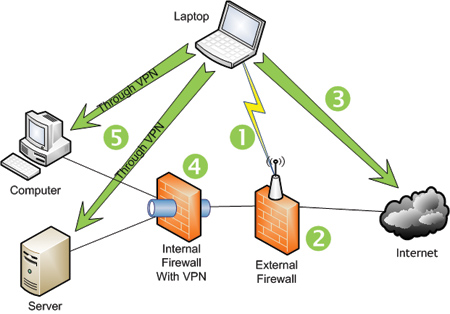

Wi-Fi (Wireless Fidelity) access technologies offer an interesting insight into the changing way in which the Internet is used and impacts our everyday life. With the increase in technology use by students, higher education institutions are investing money into new technologies for college students in order to meet the needs and expectations of this technology oriented generation. Growing popularity of social networking, video sharing, and music streaming, true broadband Wi-Fi access is becoming a necessity to support the new generation of Wi-Fi enabled devices and applications.

Wi-Fi, a play on the older term Hi-Fi, is a wireless networking technology used across the globe. Colleges and universities have been perhaps the earliest and most aggressive adopters of Wi-Fi technology over the past five years. Wi-Fi offers a simple way to provide network connections in hundreds of campus locations that could not be reached cost-effectively with wired Ethernet: classrooms, libraries, administrative offices, and even outdoor areas and athletic facilities.

Anna University, Chennai is one of the top most technical institutes in India and has taken several initiatives to enhance teaching learning process; most prominent being the recently introduced Wi-Fi services within the campus and students from Anna University now will be able to access wireless broadband Internet within the campus. Under this project, the University has invested a huge amount in providing Wi-Fi services to classrooms, hostels and four campus of Anna University namely, College of Engineering, Guindy, Alagappa College of Technology, Madras Institute of Technology and School of Architecture and Planning.

To avail the benefits of Wi-Fi services, the students just need to register their laptops with the Centre before they can access the network freely. With a 26 Mbps capacity, the university network is geared to handle unlimited usage by the students.

Literature Review

It is believed that technologies that facilitate resources can be used effectively to promote lifelong learning, and support learner-centred approaches by being vastly available. However, in spite of its remarkable contribution to humanities as a whole, specifically to developing countries, technology is also creating new gaps within societies as well as between developed and developing countries, particularly through the so-called “digital divide”. Universities have a considerable role to play in bridging these gaps but they must do so within a context that is shifting as we speak (UNESCO, 2001). So, the institutions have to be committed to ensure that technology is used effectively to enhance learning/ teaching processes.

Methodology

The University has introduced a new wireless technology to improve student's life with almost 70% of the campus being now connected to Wi-Fi. In order to find out the usage and impact of the Wi-Fi connectivity, a study was conducted between March and April 2010 covering about 200 students and twenty teachers from various strata of different disciplines of engineering using a self-administered questionnaire and in-depth interview to gather data. The study aimed at giving a deep insight about the impact new technology.

Results

  •  Positive impact of Wi-Fi usage on students learning
  •  Increase in usage of technology, as 40% students have already bought their laptops and 60% planning to buy one
  •  Purpose of usage is primarily for email and reference for the course work
  •  Time spent online has now increased to 12-15 hours per week
  •  Increased interactions among students and faculty, especially for circulating large texts

Wi-Fi offers a simple way to provide network connections in hundreds of campus locations that could not be reached cost-effectively with wired Ethernet: classrooms, libraries, administrative offices, and even outdoor areas and athletic facilities.

The study, though, had a positive impact on students, it also revealed conflicting results where many students spent long hours sending instant messages and on facebook.

However, the in-depth interview with faculty members revealed that they were quite content with the Wi-Fi technology that keep the students in par with the technological advancements happening all round the world and Internet is one medium which has bridged the gap. This service has enabled teachers to upload their lectures and take online classes and the faculty is also accepting online submission of the assignments and are sending notes online to their students.

The findings of the study affirm that Wi-Fi has encouraged students to invest in technology and has enabled them to transfer large quantity of data with the availability of high speed connections.The results of the study support empirically what many professionals have observed to be true: “there is a connection between the extent and ways in which students use technology and their level of development”.

eNOSHA

A One Stop Online Repository System of Learning Objects Classroom Windows

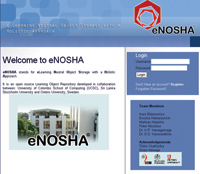
In a country like Sri Lanka, more than 100,000 students per year do not have access to tertiary education. One of the primary reasons being the lack of repository and storage of the e-learning objects and developed content. eNOSHA is a free, open and flexible learning object repository

In a country like Sri Lanka, more than 100,000 students per year do not have any access to tertiary education.  One of the primary reasons being the lack of repository and storage of the e-learning objects and developed content, as around 50 new courses though have been created and stored in the Moodle virtual learning environment, it still lacks adequate structure, metadata or search mechanism.

Addressing this challenge, the discussions in the Europeandiscussions in the European – Sri Lankan eBIT project during 2006 and 2007, paved the way for creating an online system for
storing learning objects, named eNOSHA system by the LOR group in the Swedish – Sri Lankan NeLC project funded by the Swedish International Development Agency (SIDA).
A LOR is a storage and search system for digital learning material for reusing and sharing the content. From the very beginning some of the,
fundamental design ideas were to reuseor develop a LOR that should be free,open and fl exible enough to serve allstakeholders at the UCSC e-LearningCentre.
CHALLENGE
Lack of free and open learning object repositories.
METHODOLOGY
Based on the traditional face-to-face meetings as well as in online distance meetings between UCSC in Sri Lanka, Focus groups with staff from UCSC and the involved Swedish universities, the eNOSHA development is based on a participatory design principle where
the presu mptive users have been iteratively consulted in matters ofusability, user-friendliness, and graphical design. User feedback has been an important factor in creation of the different project sprints and usability tests with scenarios using the new-implemented functionalities.
DESIGNING FOR FLEXIBILITY

eNOSHA is developed keeping in account various needs, like varied curriculum and course structure of different organisations, varied contents, templates supporting bulk uploading so that it can be used in different organisations as per the needs and requirements.
GENERAL DESIGN AND MODULARISATION
eNOSHA is built on an idea about some core modules that can be extended with auxiliary units. The very fact that different universities and organisations have different needs, eNOSHA system in all aspects is so designed that it can be extendible and users should be able
to develop and attach their own modules without affecting the core functionality.
THE METADATA SET
LOM is a huge standard that covers a lot of metadata aspects. Metadata is often defi ned as data about data and is an important tool to categorise objects in LORs and make them searchable. All existing courses in the BIT, eBIT and FIT programmes at UCSC exclusively use digital content following the SCORM standard.
LEARNING OBJECTS  GRANULARITY
A learning object can more specifi cally be defi ned as “any reusable digital resource that is encapsulated in a lesson or assemblage of lessons grouped in units, modules, courses, and even
programmes.” To facilitate reuse and to decrease context dependency a LOR needs to divide courses and course modules into more fi ne-grained units. In the UCSC adapted version of the
eNOSHA system learning objects are divided into four granularity level

Changing IT trends in Andhra Pradesh

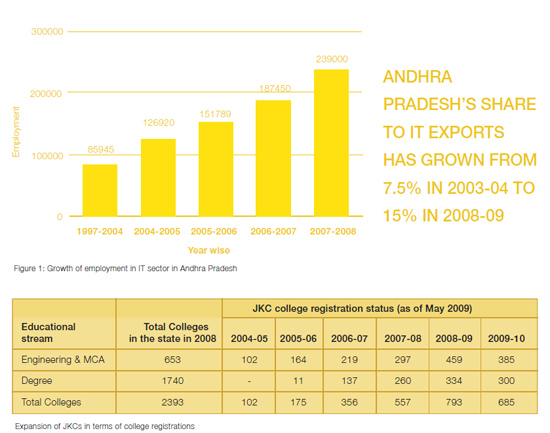
Jawahar Knowledge Centre has helped over 200 engineering colleges in the tier II and III towns of the state increase their employment rate of graduates from 8% to 28%

As a proportion of national GDP, the IT sector revenues have grown from 1.2% in 1998 to an estimated 5.8% in 2009 and it is here in India's IT industry where the state of Andhra Pradesh plays a major role. Its share of IT exports in the country has grown from 7.5 % in 2003-04 to 15 % in 2008-09. The state capital Hyderabad is ranked the number one Indian ITES destination by NASSCOM.

However, the tremendous growth in this knowledge-based business within a short period of time has created the problem of skill-set shortage.

Getting it Right

The state of Andhra Pradesh produces half a million graduates from its colleges and universities every year. However, due to poor awareness of industry grade skills only 10% of general graduates and 25% engineering graduates can be employed in various sectors of industry and amongst them, those who benefited the most are from urban background or students of the premium institutions. As majority of the engineering colleges in private sector are established in Tier II and Tier III towns and rural areas to meet the educational needs of these populations, the students were facing disadvantage of location, lack of soft skills and communication skills required by the industry.

Furthermore, ease of accessibility and affordability of higher education in the state encouraged the socially and economically disadvantaged students to pursue technical education who required additional training and career guidance for competing in the global market. Added to this, in the globalised market, the skills required by a student in engineering college went beyond the technical skills that he acquires through the university curriculum. Therefore, it is important to manage these large number of knowledge workforce coming out of the engineering colleges situated in semi-urban and rural areas and turn them as high quality human resources to cater the market needs. It is realised that for effective employment of the huge number of graduates there needs to be a synergy among the academia, industry and government.

To realise the vision of effective employment, the government of Andhra Pradesh has incorporated the Institute for Electronic Governance (IEG) a non-profit organisation to train young engineers to become knowledge workers through Jawahar Knowledge Centre (JKC) initiative – the main activity of IEG.  JKC aims to offer quality human resources and services to IT and ITES sector by brining synergy among the institutions of government, industry and academia. The initiative has already attracted a large number of engineering students from all over the state, providing them with a world-class infrastructure, the best guidance, content and opportunities to apply their knowledge to challenging problems.
Since its inception in 2004, it has been working closely with major companies both local and global, to impart industry grade skills to the graduates of the colleges.

Industry

SAGE

Automation of Administration of Examination is Now Easy

A System for Automated Governance of Examinations (SAGE) has been developed by the Computer Centre of University of Kerala for complete automation of all stages of the administrative part of examinations.  The procedure for governance of examinations has been thoroughly revamped and simplified, based on a model, which numerically represents all the examination-related events of this century

The efficiency and exactitude in carrying out administrative work associated with administration of examinations hold a University in high esteem.  This is more relevant in the case of Universities that have large number of colleges affiliated to them.  Though many IT firms have come forward with digital solutions for the governance part of University Examinations, most of them have failed to prove well-tailored to the user's requirements.

A System for Automated Governance of Examinations (SAGE) has been developed by the Computer Centre of University of Kerala for complete automation of all stages of the administrative aspect of examinations. The procedure for governance of examinations has been thoroughly revamped and simplified, based on a model, which numerically represents all examination-related events of this century. New procedures for all the stages from course design to issue of degree certificates have been prescribed and digital solutions provided.

Using the new model, the system ensures exactitude and timeliness in examination governance. The contributions of IT during the last two decades have been fully utilised for all stages viz. the realisation of online registration to online delivery of mark sheets. The provision given for recruiting agencies to verify the genuineness of University degrees on Internet and the instantaneous progress reports made available to the students are some of the remarkable features of this system. All the sections of the examination wing have been made “pen less”. Statistically significant observations on awarding internal assessment marks are also made. The system has been in use for the last 5 years for all the major examinations of University of Kerala. The number of grievances coming to the examination sections has been drastically brought down. The labour productivity has increased by nearly 3 times after the installation of this system. In 2009 another project named “SWEET” (System for Web-Enabled Exam Transactions) was successfully implemented. It enabled all communications between affiliated colleges and University office to be “paper less” by this system.

YEAR Intake of Students Number of Employees engaged
Mark lists generated per employee

2006 (after web-enabling) 10000 23 4500
SWEET: Web based on-line facilities

  • Enrolment and creation of student database immediately after admission process
  • Registration to examinations with e-payment facilities
  • Issue of hall tickets and nominal rolls
  •  Entry of attendance data of examinations by college office
  • Entry of internal assessment marks by college office
  • Entry of marks in Centralised Valuation camps by University staff or teachers
  • Delivery of subject- wise results and their changes (This information has been available on websites for years)
  • Delivery of mark lists
  • Submission of applications for revaluation or scrutiny
  • Submission of applications for provisional certificates, degree certificates /official transcripts
  • Delivery of official transcripts
  • Verification of genuineness of degree certificates
  • Victimisation in internal assessment detected scientifically
  • Examinership given to the most appropriate person (as per the subjects taught by the teacher)
  • Improvement in Labour Productivity by 5 times
  • Integration of information with other systems and subsystems
  • Chances of litigation minimised (like unlawful claims for degree certificates)
  • Management Information System to generate strategic information needed for decision-making
  • High benefit-cost ratio (low cost of development, low maintenance charge, reduced travel costs for accessing reliable information)

Weaknesses of the Existing Manual System

  • Incomplete, inconsistent and rapidly varying regulations
  • Delay in scrutiny of results and poor counterfoil management
  • Consequences of delay in announcing revaluation result
  • Difficulty to trace missing marks, attendance details etc.
  • Mark lists conveying bare minimum information
  • Final consolidation of results is difficult
  • Tedious process of results analysis
  • Evaluation of the quality of valuation is difficult
  • Difficulty in assigning duty to the most appropriate teacher
  • Online retrieval of information is difficult
  • Difficulty in correctly implementing decisions regarding moderation
  • Necessity of maintaining different types of application forms
  • Poor management of question paper inventory
  • Inability to ensure quality of question papers


Benefits of SAGE System

  • Improvement in Productivity: timely announcement of the result (within seven days after the evaluation)
  • Any Time Information System (ATI): enabling students to get examination related information on Internet
  • Official transcript and mark lists are available on the Internet
  • Recruiting agencies can verify genuineness of degrees certificates of the candidates
  • Timely announcement of revaluation results (within 45 days)
  • Interactive website to communicate with University (through the University web portal)
  • Information through Interactive Voice Response System (by just entering the registration number on telephone) services through web portal

The System for Automated Governance of Examinations developed for the complete automation of the Examination Wing of Universities has been on a trial run in the University of Kerala. The results have been quite encouraging and the principles of design as a whole can be replicated in other parts of the country as well. The unique aspect of this automated system is that though it makes use of the latest technologies available today, the cost of implementation is considerably low compared to any other system of comparable quality available now. Moreover, as the University owns the source code of the software, any modification in it can be made at any time, without depending on other organisations. This model of IT enabling ensures that new employment opportunities are generated either inside or near the organisation that is modernised.

Vote for Change Agents

The global education sector has been completely transformed by the advent of modern ICT tools. The need of the hour is to find ways in which the strengths of the available and upcoming technologies can be integrated to achieve the country’s objective of “Education for All”. The needs of the beneficiaries need to be identified and the interventions suitably localised to ensure that this goal is reached in the shortest possible time. There is also a need to monitor the how well the money is being spent.

We, at Digital Learning have always aimed at bringing the new developments to the foreground through our magazine, our website and our events. In continuation of our attempt, the digitalLEARNING Awards were instituted to felicitate the most innovative applications of Information and Communication Technologies (ICT) in Education.

This issue of the magazine is dedicated to those individuals and organisations that are making the difference right now. As most of you are aware, June was the month when we had invited all stakeholders to nominate projects and initiatives that they thought makes the difference in ensuring quality education and skills development through ICT.

Overall 170 nominations were received for the digitalLEARNING Awards 2010 under seven different categories. After a preliminary evaluation by an independent jury, the nominations were put up on the eINDIA website for public voting.

We were surprised by your enthusiasm that was demonstrated by the number of votes cast for the eINDIA2010 awards
While we, at Digital Learning are now geared up for this year’s biggest ICT event, wewould like to dedicate this issue of the magazine to the frontrunners of the ICT revolutionwho are working hard to bring quality education for all.

LATEST NEWS