


Home Blog Page 1318

ICT-Enabled Education as a Right to Education: An Imperative

This paper argues that Information Communication Technology (ICT) enabled education should be an integral part of the Right to Education Act (2009) passed by the Parliament of India.  This paper also presents an ethical argument for the formulation of a National Policy that would ensure ICT Enabled Education as a part of Sarva Shiksha Abhiyan (SSA)

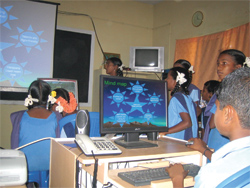
Sarva Shiksha Abhiyan (SSA) or 'Education for All' was a massive programme instituted by the Government of India in 2000-2001 to enroll 205 million children in schools and retain them until they complete primary schooling.  Right to Education (RTE) Act 2009, which ensures education for all children in the age group of 6-14 years, came into effect from April 1, 2010 and SSA is the vehicle to implement the RTE.  Assessment of the SSA by the Joint Review Mission (2009) indicates a considerable increase in the enrollment rate while nearly 2.7 million children drop out of school every year. According to Karin Hulshof, United Nations Children Fund (UNICEF) Representative-India, the RTE would directly benefit about  millions out-of-school children in the age group 6-14 years ensuring quality education; this would also lead to the increase in the economic productivity of the country.   Despite the tremendous success of the SSA, the challenges to the universalisation of primary education are manifold. This paper proposes that an ICT enabled education, as a right to education has the potential to transform the system of education under the SSA and also address key issues such as increasing number of out-of-school children, dearth of qualified teachers and imparting quality education. Children belonging to the economically weaker sections of the society often lack access to quality education at the primary school level and tend to remain as unskilled labourers languishing without any hope or opportunities for upward mobility. Such a situation has major implications for India's economy and socio-political development. In this context, the prospects of ICT enabled education as an integral part of the right to education holds significance particularly as an effective tool of imparting education to the poor and rural children. The computer-aided education could be utilised to facilitate creative teaching and to make the process of learning more informative and interactive. Introduction of ICT enabled education as part of the SSA also has the potential to attract the under-privileged children to school, accelerate the rate of enrolment and retain children in schools. A national policy on ICT enabled education as a right to education assumes greater  significance as the Government of India is intent on preparing the future generations to face the challenges of 'knowledge economy' of the digital world lest the 'digital divide' that creates a chasm between the information rich and the poor widens the socio-economic inequities drastically. An ICT oriented SSA does not aim at creating technocrats for the global economy but would rather harness the potential of the computer aided technology to provide a knowledge platform for those who need it the most, which would enable the development of the marginalised and the deprived sections of the society and the development of the community as a whole.

This article analyses why ICT enabled education should be mandated with the SSA beginning with the under-privileged segments of the Indian society as a moral imperative based on John Rawls' theory of justice. An ICT enabled education becomes a right when viewed from the paradigm of social justice. John Rawls in his Theory of Justice advocates two principles of justice based on rational choice theory to ensure equitable political and social arrangements in a society. The ICT enabled education as a right to education is justified under the 'difference principle' that advocates positive discrimination in favour of the deprived sections of the society.
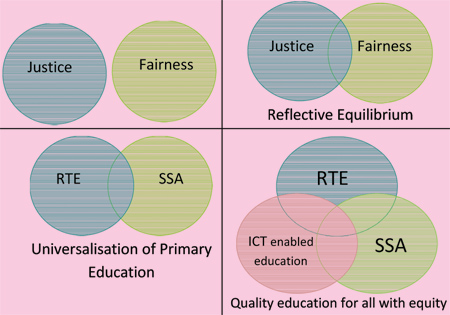
Right to ICT Enabled Education

John Rawls, one of the foremost American political philosophers of the 20th century, advocates two foundational principles of justice for establishing social and political institutions that would ensure equity. The first principle of justice ensures equal civil and political rights while the second one emphasises fair equality of opportunities in the distribution of socio-economic advantages in the society. The 'difference principle', which is part of the second principle, emphasizes the need for the social systems to be advantageous to the less privileged in the society without adversely affecting other segments of the society. Rawls notes that '


Giving an Edge Over English : Vivek Agarwal, LIQVID, India

An MBA from Indian Institute of Management Calcutta, Vivek is also a visiting faculty to the International Management Institute.
 
Committed to exploring how technology can be used to make high quality education and training available to the billions of people at a cost that they can afford and at a place they can reach.

Our vision is to provide effective and enjoyable experiences to learners everywhere. Our ambition is to bring the benefit of education particularly English to hundreds of millions of learners in a high-quality and cost-effective way by leveraging the power of technology.

Can you give our readers a brief description / background about your company?

Liqvid is a company specialising in application of technology to the learning process. We provide customised learning solutions and English language learning solutions to customers around the globe. We have global leaders as our customers and partners.

Our vision is to provide effective and enjoyable experiences to learners everywhere. Our ambition is to bring the benefit of education particularly English to hundreds of millions of learners in a high-quality and cost-effective way by leveraging the power of technology. This will help improve the social fabric of our country as India seeks to take its place among the developed nations of the world.

What are the services and products offered by your company? How do Liqvid’s services and products stand unique from other similar competitors?

Liqvid’s English Edge offering has 3 dimensions on which it is differentiated

Networking for Knowledge : Sam Pitroda, Govt of India, India

The key architect of India’s telecommunication revolution, in an interaction with Ravi Gupta and Pravin Prashant, sam Pitroda talks  about his vision for the Indian education sector

What is your vision for public information infrastructure and innovations in India?

As we move into a growth era, India needs to be globally competitive and needs to innovate. Both the President and the Prime Minister of India have focused on innovations. The President has talked about 2010-20 as a decade of innovations. Today, there is a political will to support innovations in all spheres. Taking this political will forward and translating it into action is a key challenge.

India has been innovating for centuries. However, for the last 100 years or so the country has lost its edge, while a lot of innovations have come from the US in the last 50 years. Today, India needs to create its own models of innovation rather than adopting a US model, as that will not solve the problems of our country. There is also an urgent need to create various development platformsfor homeland security, applications, UID, education, etc. The creation of these platforms is critical to empower millions of people around, and sure, the government is committed to creating this robust, universal, standardised, secure information infrastructure for the people of India.
What kind of innovations will be relevant for India and which should be the focus areas? There is an urgent need to create a broad platform for innovations that focus on the organisation and the system, rather than focusing on materials and  technologies. Another important aspect is to have growth-based innovations that are sustainable, scalable and affordable. The innovations should affect people who are at the bottom of the pyramid, i.e. should be able to change the lives of those millions who are not in the mainstream. It is also  important to create the required ecosystems for innovations like the venture capital,   recognition for young talent, provision of facilities to people, and creation of an innovation environment at our institutions and then identifying the key drivers for innovations.
What can be done to trigger this at a more fundamental level? Traditionally, a few people have controlled information. People at the bottom of the pyramid don’t get thebenefi ts of this information. If information is democratised then opportunities can be given to millions and millions of young people. Looking at the telecom industry, the fi rst phase of the telecom revolution is beginning to end. The second phase is about to begin where the broadband  platform will be provided for all. The major task in the second phase is to take highspeed broadband to 2.5 lakh panchayat members. Fibre will be taken to the  doorsteps of panchayats.
How do you see the education system changing in India with the active play of ICT? The 11th plan is all about education, where the government will be spending 67 billion dollars on education. About Rs 6,000 crore have been approved by the cabinet to build a knowledge network. This network is about connecting 1,500 locations. The programme is about connectivity of the nodes. The schools, all universities and R&D institutes will be connected and scientists will begin to collaborate, and teachers will be able to share the resources. This programme has already been implemented, 15 nodes have been connected and are working.
Within 18 months, all the nodes will be connected and made operational. This will be the mother of all networks. Consolidation of old networks will also be done. The augmentation of
networks will be the key to connecting 2.50 lakh panchayat members. This is the kind of revolution the government is aiming for in three years.
How do you see the digital roadmap for India over the coming fi ve years? Multiple platforms should be set  up, which should not take more than three years. It is important to have the broadband platform, the UID platform,  the GIS platform, the application platform,
the security platform and the payment platform. The job of the government is to provide the platforms and see the larger and the holistic picture. People from various departments have to
come forward and work towards the accomplishment of the goals. On the national GIS plan for the country, the vision is that every bit of the physical asset, each and every building, road and street is mapped.

Velammal Engineering College launches ‘Virtual Instrumentation Centre’

National Instruments today announced that it has established a Centre of Excellence (CoE) in partnership with Velammal Engineering College, Chennai for innovation and creativity in the field of Virtual Instrumentation. This CoE is the first of its kind in the state with a view to improve the quality of engineering education in India and spread the concept of Virtual Instrumentation. The partnership is a part of the initiatives taken by Planet NI (Nurturing Innovation) foundation.

The CoE will introduce latest industrial standard technologies and develop products which can encourage ideation and innovation in the areas of embedded technology among engineering students and technical professionals of the country. The CoE will work on research areas like embedded Industrial Control, Image Processing, Robotic System Design, Measurement & Automation, Wireless Sensor network by encouraging ideation and innovation through projects based on real world applications, access to industry events, educational workshops, and training sessions on NI LabVIEW.

While inaugurating the CoE with M.V. Muthuramalingam, Chairman, Velammal Educational Trust, Jayaram Pillai, Managing Director India, Russia & Arabia, National Instruments said, 'The establishment of the CoE will strengthen our engagement with the academia in the country. This association will help us equip students with the skills required to undertake research and development in the changing technology environment. With this initiative we will be able to contribute to the development of the limited exploratory or research-based education.'

'With acknowledgment of research intensive needs on the part of industry, meeting these needs for the future engineers is an essential part of bridging the academia-industry gap present,' he added.

Virtual instruments provide significant advantages in every stage of the engineering process, from research and design to manufacturing test. Virtual Instrumentation aids all stages of the engineering process, from research and design to manufacturing test. With this initiative the centre will offer candidates an opportunity to work to the highest academic standards and will seek to bridge the gap between the industry & the academia by creating an experiential learning environment for engineering students in the state as well as across India. Planet NI and Velammal Engineering College is committed towards developing quality engineers who can take the country forward with continuous innovations in technology.

MetaMetrics Launches Engaging English Service

Urban governance by IGNOU

New course in rehabilitation psychology and urban governance to create skilled manpower and train professionals have been designed and are soon to be implemented by the Indira Gandhi National Open University. The Post Graduate Diploma in Urban Governance, being launched in collaboration with Mumbai's All India Institute of Local Self Government, will upgrade the skills and knowledge of candidates employed in various urban local bodies and NGOs.

The post graduate diploma in rehabilitation psychology will train students to help people cope up with disability and its effects. It is expected to be beneficial for both field psychologists and fresh graduates willing to pursue a career in psychology.

Oracle partners with ICT Academy

A MoU has been signed between The Oracle Academy and ICT Academy of Tamil Nadu (ICTACT), to support over 400 colleges in Tamil Nadu through the Oracle Academy program. The Oracle Academy is a training program that provides global education institutions with software, curriculum, support, and certification resources that faculty can integrate into their classrooms. All the technical support, software, access to curriculum and faculty professional development to institutions enrolled in the Oracle Academy's Computer Science programmes is to be provided by The Oracle Academy, to benefit 250,000 students across the state within three years.

Currently, more than one million students in 91 countries are enrolled in the Oracle Academy program. In India, currently over 58,000 students from over 350 educational institutions benefit from the Oracle Academy program.

Abu Dabi schools get ADEC recommended International School Infrastructure Standards

A plan has been developed for facilitating development in schools by Abu Dhabi Education Council (ADEC) that includes the construction of new world-class schools and the renovation of existing facilities. This summer, seven schools located in Abu Dhabi and one located in Al Ain, will undergo major infrastructural work. It was reported that H.E Dr. Mugheer Khamis Al Khaili, Director General of ADEC mentioned that schools now created will have classrooms beyond traditional structures and are learning communities that are to have beneficial social, educational and sports activities.

It was explained by Engineer Hamad Al Dhaheri, ADEC's Facilities Management Division Manager, that the project will be managed by Musanada to ensure timely implementation in accordance with the best specifications.

Rolta Partners CBSE to educate students on Geospatial Technologies

Rolta announced that it has signed a formal MOU with Central Board of Secondary Education (CBSE) as the Resource Partner, for providing Geospatial Technology Vocation Course, for XI & XII standard students. Under this MOU Rolta will provide technical assistance, develop and create the curriculum, and also impart advanced training to CBSE teachers across the country. As part of the curriculum for Standards XI and XII, Rolta will provide Rolta Geomatica – one of the worlds best Geospatial Technologies. By undergoing the vocational course on Geospatial technologies, and especially using a product that is in use by thousands of professionals in over 135 countries around the world, Indian students will be able to acquire better understanding of the practical aspect of Geospatial Technologies, while teaching them real-life applications for overcoming real-world challenges.

Potentially there are about 11,000 CBSE schools who may want to introduce this course and Rolta is pleased to commit 11,000 software licenses of Rolta Geomatica. This is a potential donation of INR165 Crores at current license costs, and Rolta will work together with CBSE to provide this at almost no cost. Today, India needs a large number of professionals who are adept at understanding and harnessing Geospatial Technology for successfully designing and implementing nation building programs. This new Vocational Training course in Geospatial Technology is an initiative of the Human Resource Development ministry under the able leadership of Honble Minister Shri Kapil Sibal and the Government of India as a part of its vision for education sector and to provide employment for a large number of youth in the country.

K.K. Singh, Chairman and CEO of Rolta Group of Industries said, 'We are honored and privileged to be a part of the vision for educational reforms in India. By being an integral part of Geospatial Technology Vocational training for CBSE, I am certain that Rolta Geomatica platform will empower students to learn various aspects of Geospatial Technology. I am sure this initiative will go a long way in building up a critical mass that is required for the nation, enabling the country to rise up above the rest.'


FCS Software Solutions inaugurated its International Development Center

FCS Software Solutions Ltd, leading provider of IT services, formally inaugurated its International Development Center in India. Hon'ble Union Minister for Tribal Affairs, Govt. of India, Shri Kantilal Bhuria, inaugurated the state-of-the-art center, which is spread over 25,000 sq feet in the Noida Special Economic Zone to cater to growing global demand. FCS Managing Director Dalip Kumar explained the importance of this IDC. He said, 'by migrating our client's expensive licensed software applications to high quality, highly secure Open Source solutions and technology we reduce their IT spending drastically. Not only this we also end up moving our clients from low availability applications environment to cloud computing linked hosted high availability SaaS application environment. What it also does is that it brings down our client's IT infrastructure budgets because our services are migrating them to fully hosted solutions from our global data center partner network.

World is in a transition phase as the computing power of hand held devices sharply increase more and more corporate users will move from a desktop associated environment to anywhere anytime work culture. We firmly believe that the next wave of productivity enhancement will come from mobile application. The center will house the company's first Center of Excellence in Mobile Technologies.' The facility will initially have 200 people and will grow to 400 people when fully functional. This facility has secure connectivity to company's global network and data center partner network with a host of advanced service offerings. Currently, FCS already has delivery centers in Noida , Gurgaon, Chandigarh and Dehra Dun that are built on company owned properties.

LATEST NEWS