




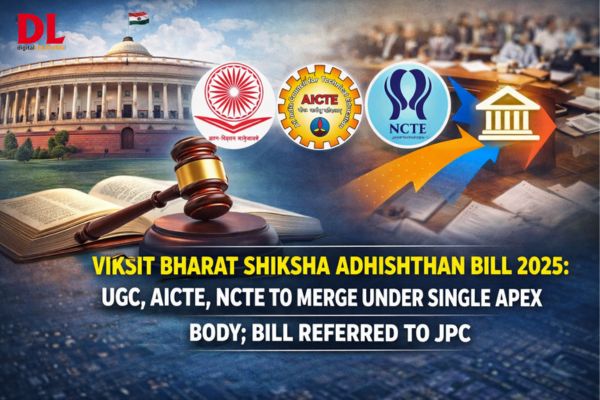
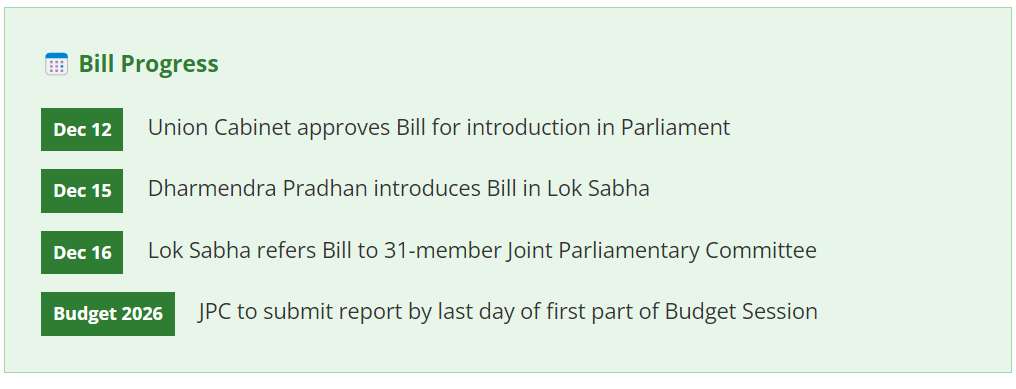
Union Education Minister Dharmendra Pradhan introduced the Viksit Bharat Shiksha Adhishthan Bill, 2025 in Lok Sabha on December 15, marking one of the most significant reforms in higher education governance in recent years. The Bill proposes to replace the University Grants Commission (UGC), All India Council for Technical Education (AICTE), and National Council for Teacher Education (NCTE) with a unified regulatory architecture aligned with the National Education Policy (NEP) 2020.

New Regulatory Architecture
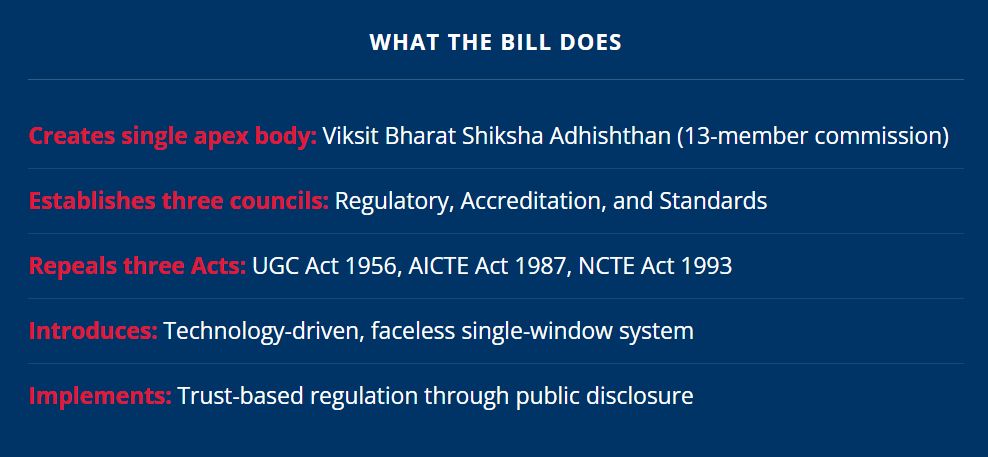
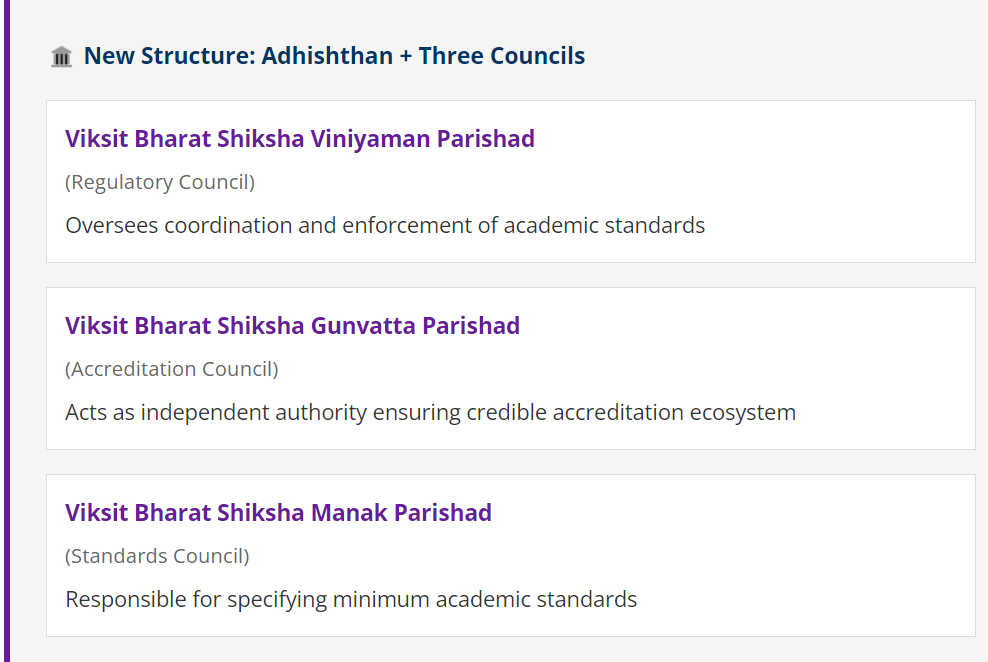
The Bill provides for the establishment of the Viksit Bharat Shiksha Adhishthan as an apex body, along with three independent councils. The apex umbrella body will consist of a chairperson and 12 other members, all appointed by the President of India.
Acts Being Repealed
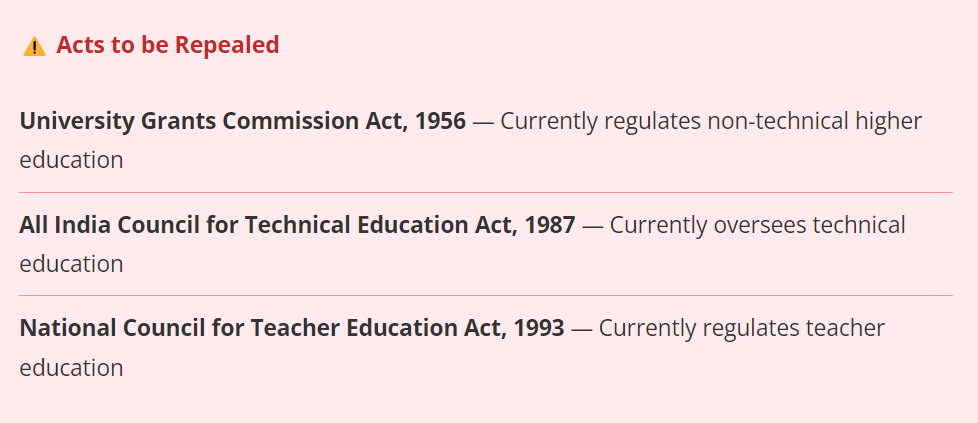
All higher educational institutions under the purview of the Ministry of Education, UGC, AICTE, and NCTE will be brought under the new Viksit Bharat Shiksha Adhishthan for determination of standards. The Council of Architecture (CoA) will function as a Professional Standard Setting Body (PSSB) as envisioned in NEP 2020.
Technology-Driven Regulation
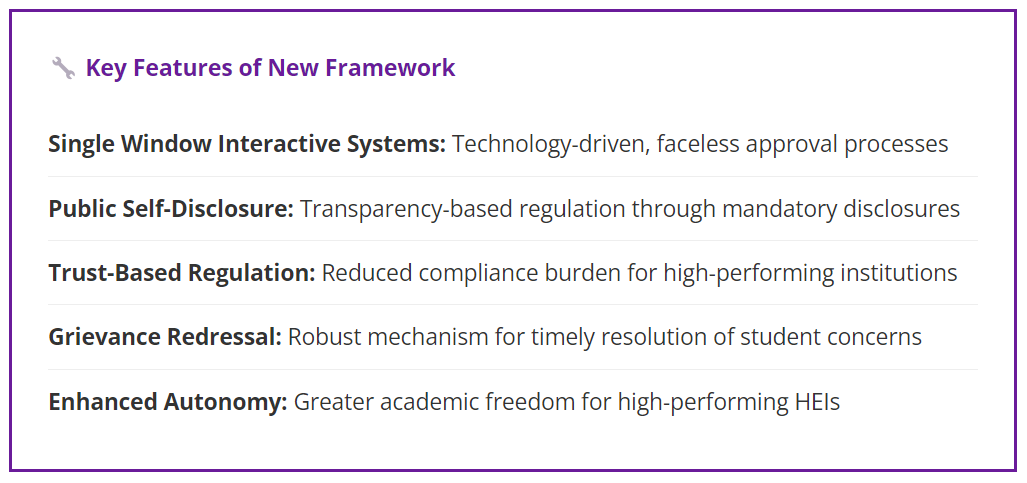
A key feature of the Bill is the introduction of a faceless, technology-driven single-window system for regulation. Higher Educational Institutions will be required to make public disclosures related to governance, finances, academic programmes, infrastructure, and outcomes on a comprehensive digital portal.
Legislative Timeline
Addressing Opposition Concerns
While Opposition members raised objections at the introduction stage, accusing the government of overcentralising education, Minister Pradhan defended the Bill, stating that states would retain similar powers they presently have. “Sovereign authority is vested in the government in every law. This was the case with UGC as well,” Pradhan said at a press conference.
“This Bill aims to eliminate complexities by introducing a unified and streamlined regulatory architecture. The entire regulatory framework will operate through technology-driven, faceless, Single Window Interactive Systems.”
— Ministry of Education
The JPC will comprise 21 MPs from the Lok Sabha and 10 from Rajya Sabha. The proposed committee will deliberate on the Bill’s provisions and submit its recommendations before the Budget Session of 2026.
What Remains Unchanged
Institutions of National Importance (IIMs, IITs, NITs, etc.) will continue to enjoy their existing level of autonomy. Professional courses in medicine, law, and certain other fields are excluded from the Bill and will continue under their existing regulators. The Bill represents a transformation in how India’s higher education sector is governed—moving from fragmented oversight to unified, technology-enabled regulation.