


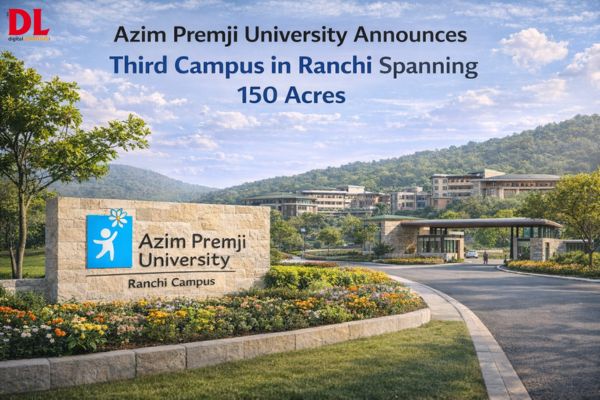
Azim Premji University unveiled plans for its third and largest campus, a 150-acre residential facility in Ranchi’s Itki area, marking a significant expansion into eastern India’s higher education landscape.
Academic operations will commence in July 2026, initially offering two master’s programs in Applied Economics and Development, along with postgraduate diplomas in Local Development, Early Childhood Education, and Educational Assessment. The university will also launch multiple certificate programs in public health, education, and development fields.

Zulfiquar Haider, designated vice-chancellor for the Ranchi campus, emphasized the institution’s focus on addressing regional social and developmental needs while building knowledge and human resources. He highlighted plans to engage meaningfully with Jharkhand’s diverse communities, including indigenous Adivasi populations, respecting their traditions and knowledge systems.
The fully residential campus will feature modern classrooms, laboratories, sports facilities, and housing for students and faculty. Future plans include establishing a teaching hospital and medical college as part of the facility.
Infrastructure development incorporates sustainable design elements including rainwater harvesting systems, water treatment facilities, energy-efficient technologies, and landscaping using native plant species. Construction of the first phase is scheduled for completion by July 2026.
Also Read: Emversity Raises $30 Million in Series A Funding Led by Premji Invest
The Ranchi campus will eventually offer comprehensive programs across multiple disciplines including development studies, education, economics, public health, climate change, and sustainability. Programs are specifically designed to reflect the developmental context of Jharkhand and eastern India, supported by faculty with strong academic credentials and field experience.
The Azim Premji Foundation established all three university campuses as fully philanthropic entities with a social mission to contribute toward building a just, equitable, and sustainable society through education, research, and practice.