


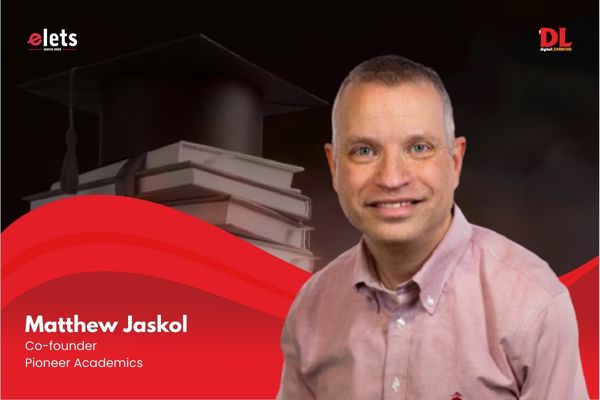
Pioneer Academics stands out as one of the few institutions to establish a comprehensive AI policy framework as early as 2023, addressing the technological shifts reshaping education. This policy empowers professors with structured options: they can prohibit AI entirely, permit it with mandatory student disclosure, or adopt a hybrid model that maintains academic rigor while leveraging AI support. In an exclusive interaction with Kaanchi Chawla of Elets News Network (ENN), Matthew Jaskol, Co-founder of Pioneer Academics, shares his insights on the transformative developments of 2025, the evolving role of artificial intelligence in secondary education, and the institution’s strategic vision for 2026. He discusses the crucial balance between innovation and integrity, the expansion of the Global Problem-Solving Institute (GPSI), and how authentic research remains a vital metric for top-tier college admissions in a rapidly changing landscape. Edited excerpts:
Looking back at 2025, what do you consider the most transformative developments in global secondary education especially in research-based learning that Pioneer Academics champions?

This past year has shaken education in unexpected ways. Artificial intelligence has moved from the margins to the center of the secondary education conversation. Schools and teachers have been figuring out whether AI is a partner, a challenge or both. They are also working through the practical question of how to integrate it in a way that deepens learning rather than turning into an invisible shortcut.
At Pioneer, we have seen the impact firsthand. Since AI tools have become widely used by teenagers, the number of plagiarism cases identified by the Pioneer Research Institute increased more than threefold. What our investigations show is that many students use AI without realizing that it counts as plagiarism at all. At the same time, many of our professor mentors report real value when students are taught to use AI as an assistant while practicing skills like verification, comparison and critique. When done well, this strengthens critical thinking instead of weakening it.
In the research-based learning space, the picture is split. The positive development is the surge in demand among ambitious high school students who see research as a natural next step in their academic growth and a strong signal to colleges. This interest reflects a wider understanding that research is one of the effective ways to develop logic, inquiry and original thinking.
The challenge comes from the fact that the space is still more or less unregulated. A growing number of commercially driven companies now offer loosely structured research experiences mainly for resume building. But real research has a clear process with standards at every stage, which is why meaningful discoveries happen in labs and universities that follow strict oversight. When high school students are paired with graduate students in settings that lack structure, the quality of the experience can vary widely. Since a student’s first encounter with research often shapes how they understand scholarship, this inconsistency can create long-term misconceptions.
This is why Pioneer continues to put so much emphasis on market education. We work to clarify what authentic research requires and what students should expect from a serious academic experience. Our accredited Pioneer Research Program and Global Problem Solving Program follow state and federal guidelines that ensure a truly high-level academic environment. Our Co-curricular Summit gives students and families a chance to learn from experts and from the strongest research-based learning programs in the field. In a year defined by rapid technological change, this focus on clarity and integrity became more important than ever.
What are the top priorities or innovations Pioneer Academics aims to introduce in 2026 to deepen global student engagement and research authenticity?
In 2026, our top priority is expanding the Global Problem-Solving Institute (GPSI), Pioneer’s newest transformational learning experience. GPSI equips today’s scholars and tomorrow’s leaders with innovative tools to tackle the world’s toughest problems.
GPSI is a virtual innovation lab where outstanding high school students collaborate across borders to address complex global challenges. Each team works with peers from similar regional backgrounds, then connects with parallel teams tackling the same issue in different parts of the world. This structure helps students see how a shared global problem behaves across diverse cultures and contexts and deepens their global engagement.
Students receive a unique blend of systems thinking, multi-disciplinary analysis and design thinking, guided by faculty from multiple universities. They also build both independent and team-based solutions, all while experiencing Pioneer’s signature academic rigor.
In 2026, we plan to expand GPSI beyond the current four problem areas so students can explore a wider range of global challenges. Participants will continue to receive objective evaluations that can be shared with colleges, priority consideration for the Pioneer Research Program and, for those who pass, two college credits from the University of North Carolina at Chapel Hill.
Pioneer has long stood for rigorous academic standards in an age of rapid digitization. How is the institution balancing human mentorship with AI-enabled tools for evaluation, research support, and student experience?
Pioneer has always built its programs around strong academic oversight, and that commitment guides how we integrate AI today. Our priority is to protect research authenticity while recognizing that AI has become part of how students learn. As AI makes plagiarism easier to attempt, we are strengthening our detection technologies and continuing to rely on close audits by professors and teaching assistants who review student work for any irregularities.
We place the learning process ahead of the final product. Both students and faculty receive clear expectations on academic ethics, which helps create a shared standard for integrity in a changing landscape.
Pioneer is also one of the few institutions that developed a full AI policy framework as early as 2023. The policy gives professors structured options. They can prohibit AI entirely, allow AI with required disclosure from students or follow a hybrid model that maintains rigor while permitting certain types of AI support. This flexibility respects each professor’s pedagogical approach while keeping Pioneer’s academic standards intact.
Also Read: Bridging the Research Divide: Building India’s Living AI–Blockchain Collaboration Grid
How do you imagine the role of international research programs evolving as universities rethink admissions criteria and look for deeper evidence of student originality and inquiry?
We need to take a quick look at what top college and university admissions have valued by nature. Admissions criteria may evolve as the environment changes, but their core priorities remain the same: academically capable students who are genuinely driven by their interests and who will perform well once they arrive on campus.
This is where international research programs should keep their focus. Today’s rapid growth of research opportunities has created a loosely regulated landscape, where students are enticed to buy recommendation letters or publications and there is no oversight.
Pioneer Academics was founded with clear policies and principles that protect our educational focus, which is why we’ve become a trusted name over the past 14 years since 2012. With fast developments in technologies and shifts in the global environment, we foresee even more changes in top college admissions in the year ahead. Pioneer will remain committed to educating the market and helping families stay aligned with the true core of education.
As global challenges intensify, how does Pioneer plan to support students in pursuing research that contributes meaningfully to society, innovation, and global problem-solving in 2026?
Our focus in 2026 is to strengthen the pathways that connect students’ academic interests with real issues facing the world. Pioneer already gives students the structure and mentorship needed to conduct original research, and we are expanding that model to ensure students can link their work to pressing global challenges in clearer and more practical ways.
We plan to deepen this approach this year by integrating more opportunities for interdisciplinary work, encouraging students to draw insights from multiple fields rather than seeing problems through a single subject lens. Whether students are strengthening or expanding their independent thinking, critical analysis or research ability, they carry those skills with them. These experiences shape how they contribute to their communities and to the world’s ongoing innovation.
For example, Pioneer scholars from Africa who studied water pollution through GPSI later applied their findings to improve water access in their local communities. Another example comes from our U.S. Pioneer researchers who examined food desert challenges. Their analysis helped raise community awareness and encouraged local discussions about access to healthy food.
What Pioneer has accomplished is a shift in how students view the impact of their work. They learn to identify real problems, apply the skills they have developed and make a meaningful difference every day.