



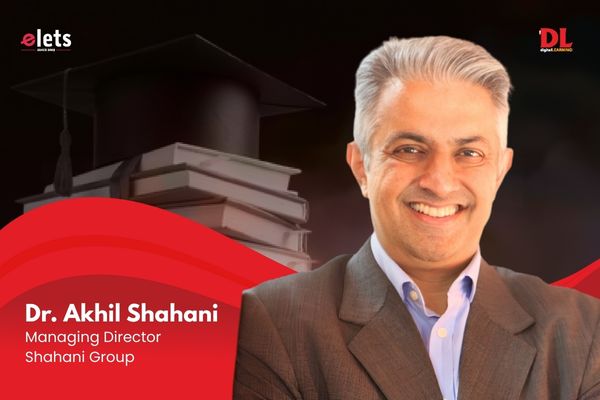
“AI literacy is going to be non-negotiable not just prompting, but using AI to automate tasks, design workflows and speed up decision-making,” shared Dr. Akhil Shahani, Managing Director, Shahani Group, in an exclusive interaction with Kaanchi Chawla of Elets News Network (ENN). He emphasised that institutions must move beyond viewing AI as a supplementary tool and instead embed it into core academic, administrative and governance processes to remain future-ready. According to him, the real impact of AI in education will be realised when leaders focus on responsible adoption, upskilling educators, and aligning technology with learning outcomes rather than treating it as a standalone innovation. Edited excerpts:
Looking back at 2025, what has been the most significant shift you witnessed in higher education and employability training across India?

2025 was the year when higher education finally admitted what industry has been hinting at for a decade: “Don’t show me your degree, show me what you can do on Monday morning.” Employers became far more selective about real competencies, especially in finance, tech & sales roles.. Students also became more direct, they now walk in asking, “Sir, placement kitna assured hai?” And honestly, that clarity is refreshing.
Institutes that survived this shift were those willing to embrace outcome-based learning, blended formats, and micro-credentials. The old model of four classrooms and one PowerPoint no longer cuts it. If anything, 2025 made career ROI the real syllabus.
What emerging digital skill sets do you believe will become non-negotiable for students entering the job market in 2026?
AI literacy is going to be non-negotiable — not just prompting, but using AI to automate tasks, design workflows and speed up decision-making. I’ve seen students who couldn’t draft an email last year now using AI to create full client pitches. Now, with AI pervading all sorts of enterprise systems like CRM, Excel, Project Management etc, they need to know how to use it well across these areas.
Data skills are becoming the new English, every job needs at least basic analytics and dashboards. Add to that cloud skills, cybersecurity fundamentals and global communication abilities. And yes, the ability to collaborate asynchronously with teams in four different time zones without losing your sanity — that’s a digital skill too!
Could you share key milestones achieved by your institutions this year—whether in placement outcomes, partnerships, or digital learning innovations?
This year we’ve doubled down on hybrid learning & establishing offline centres. We’ve partnered with 8 colleges in Mumbai & launched franchise locations in Gujarat & Madhya Pradesh. Along with Thadomal Shahani Centre For Management (TSCFM) which runs our business courses, we launched Thadomal Shahani Institute of Technology (TSIT) to run our technology courses. This expands the bouquet of courses we run in our partner college locations. In addition, we’ve scaled up our inhouse recruitment firm, Ask Talent Services (ATS) to offer our graduates better job opportunities & also offer mid-level placement services for our corporate clients.
AI & Data skills have been rolled out across all our courses to enhance our students’ employability. We’ve partnered with some UK Universities to offer our students pathways to global MBAs through them.
What policy-level reforms or regulatory changes in 2025 do you believe have been most beneficial for skill-focused institutes like Ask.CAREERS?
The National Credit Framework (NCrF) continued to gain traction, making modular learning far more mainstream. For institutes like ours, which thrive on short-cycle, job-ready training, this was a blessing. The government’s encouragement of industry collaboration through apprenticeships, CSR partnerships and practical training also aligned well with our model.
What helped most was the policy push around hybrid and digital learning. The idea that high-quality education can be delivered flexibly without compromising outcomes is something we’ve championed for years. 2025 essentially validated that direction.
With the rise of AI-first job roles, how are you preparing faculty for this next wave of digital transformation?
Frankly, preparing faculty for AI has been quite interesting. Some of our senior professors were initially concerned about how AI helps students cheat on their assignments. However, once they realised it could cut their administration workload and give them creative superpowers, the adoption curve shot up.
We run regular AI training programs for faculty from lesson planning to simulations, content creation and assessment design. Many of them now co-create digital modules with industry mentors. The biggest shift, however, has been mindset: moving from being a “sage on the stage” to a “guide on the side,” helping students use technology to achieve learning outcomes rather than memorise content.
Also Read: India’s New Path to Global Universities
If you had to define 2026 in one theme for the education sector what would it be and why?
For me, the theme of 2026 is “Personalised Employability at Scale.” Students don’t want generic courses anymore; they want personalised pathways that help them achieve specific career goals. And thanks to AI and adaptive learning, we can now deliver that at scale.
As India’s digital economy grows and industry sectors get more sophisticated, employers are expecting job-ready talent, not just degree-holders. 2026 will belong to institutes that combine technology, industry alignment and personalised learning, the ones that can help an ordinary student become an extraordinary professional. That’s the ecosystem we’re building across our institutions.