

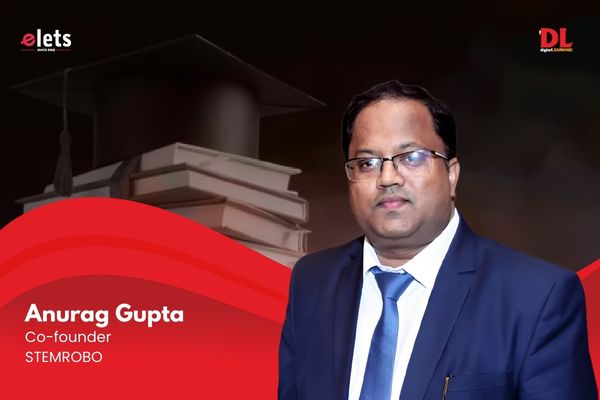
2025 taught us something very important: growth and personalization must go together. As we expanded our labs and launched new products, we saw that every school has different needs, every teacher has a different style, and every child learns at their own speed. This will guide our focus for 2026, shared Anurag Gupta, co-founder of STEMROBO, in an exclusive interview with Kaanchi Chawla of Elets News Network (ENN). Edited excerpts:
What have been the most transformative milestones for STEMROBO last year?

2025 has been a truly incredible year for us as we reaffirmed our purpose at STEMROBO. Every milestone felt less like a business target and more like a real step toward changing how children learn, think, and create.
Our biggest success this year would be the launch of SIL 1.0, that is the STEAM INNOVATION LEAGUE. Here, students from all over the country came together to compete in a competition that showcased their creativity, knowledge, and awareness. Watching these young students present with such pride and confidence was a reminder of what true education looks like.
The next biggest success would be the establishment of our Dubai-registered headquarters, a smart step that will help us grow faster in the Middle East and reach more countries around the world.
And another major highlight of last year would be our collaboration with the Cyient Foundation that sets up Cyient Labs, a state-of-the-art innovation space in 50 schools across Andhra Pradesh, where STEMROBO contributes as the implementation partner. We also expanded ourselves to Narayana Group of Schools, which helped us reach out to more schools.
Last year, we also introduced Screen – Free Coding Kits for the young learners.
Because we feel that at the present when technology and screens are everywhere, the children of the Alpha generation should learn the concepts through hands-on experiences and not only screens.
This will imply a paradigm shift on how the foundational skills of STEM will be introduced in India.
These important key events reflect our vision and mission to encourage students to express their creativity and realize their potential.
What lessons from 2025 will shape your strategic priorities or product roadmap for 2026?
2025 taught us something very important: growth and personalization must go together.
As we expanded our labs and launched new products, we saw that every school has different needs, every teacher has a different style, and every child learns at their own speed. This will guide our focus for 2026.
In 2026, we will work on:
- Improving lab models that can be set up quickly and adjusted for different regions
- Strengthening our screen-free and hands-on learning tools for young children
- Creating more personalized learning paths through activity-based and maker-style learning
Our plan for 2026 is simple. We want to grow widely, but we also want our impact to feel personal and meaningful to every learner.
What role do you see generative AI playing in personalized learning, assessments, and skill-building for students in 2026?
Generative AI will be an important part of learning in 2026. It will help students learn in the way that suits them best, at their own pace.
In 2026, we want to use GenAI to:
- Make learning plans that change for each child based on how well they are doing
- Replace fixed exams with simple, real-time checks that understand how a child is thinking
- Give students easy tips and guidance while they try robotics, coding, AI, and maker activities
Generative AI can also make learning more fair by giving every child personalized help, no matter their background.
2025 saw increased emphasis on NEP 2020 implementation. How has STEMROBO aligned its solutions with NEP goals, especially around experiential learning and skill development?
Our entire approach already matches the core ideas of NEP 2020, which focuses on practical learning, multiple subjects, and preparing students for the future.
In 2025, we supported NEP by:
- Setting up Innovation Labs and Composite Skill Labs that encourage hands-on and inquiry-based learning
- Helping schools through teacher training programs that improve competency-based teaching
- Expanding screen-free and early coding tools so young children can start building basic tech skills
- Bringing AI, robotics, and activity-based learning into classrooms to build important skills like critical thinking, design thinking, problem-solving, and creativity
Our aim is not just to follow NEP. We want every school to truly bring the NEP vision to life inside the classroom.
What new-age skills do you believe Indian students must master by 2026 to stay globally competitive in STEM and AI-driven careers?
By 2026, students will need a mix of technical skills and people-focused skills to do well in a world led by technology.
The most important skills are:
- Understanding AI and basic computational thinking
- Learning by making, designing, and building things
- Screen-free basic coding for young children
- Knowing the basics of robotics and automation
- Reading data and solving problems
- Thinking creatively and from different angles
- Working together and communicating digitally
These skills are no longer optional. They are the new basics that students need to compete and grow in a global world.
Also Read: Redefining Higher Education Through AI, Skills and Employability
What does “future-ready education” mean to you, and how is STEMROBO enabling that future today?
For us, future-ready education means helping students grow confidently in a world where AI, automation, and global teamwork are normal parts of life.
It means:
- Learning by creating, not by memorizing
- Building real-world skills from a young age
- Using technology in a safe, hands-on, and inclusive way
- Supporting teachers so they can guide students in new and innovative ways
We make this possible through our Innovation Labs, Composite Skill Labs, Mini Science Labs, screen-free coding tools, and global programs like SIL.
Our main aim is to turn every classroom into a place where imagination connects with engineering and curiosity connects with future skills.
What is your long-term vision for STEMROBO by 2030, and how do 2025–2026 serve as the foundation for that journey?
Our vision for 2030 is very big and clear :-
We want to take this modern and future-ready education to all parts of India and also grow across the Middle East, Africa, and other global markets.
By 2030, we plan to:
- Build a strong presence in Africa, across our “Africa 2030” plan
- Use our Dubai office as the main center for Middle East and global growth.
- Create a full ecosystem of Innovation Labs, Composite Skill Labs, Mini Science Labs, and screen-free learning tools for young kids.
- Set up strong channel partners and sales teams so that more schools can easily access our innovation programs.
Everything we are doing in 2025–2026, from expanding partnerships to launching new models and products is preparing us for this long-term plan.
Our goal is simple: to help build a generation that doesn’t just use technology, but also creates it, improves it, and makes it meaningful for the world.