




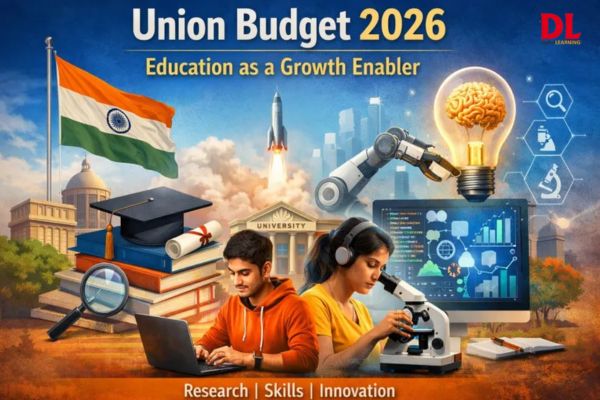
Presenting the Union Budget 2026 in Parliament, Union Minister for Finance and Corporate Affairs Nirmala Sitharaman placed education firmly within the broader employment and services-led growth narrative. Rather than treating education as a standalone social sector, the Budget positions it as a feeder system for jobs across services, healthcare, tourism, design, and technology.
The Ministry of Education has been allocated ₹1,39,285.95 crore for FY27, reflecting an 8.27% increase over the previous year. Of this, school education receives ₹83,561.41 crore, while higher education allocations rise to ₹55,724.54 crore, indicating a sharper focus on post-secondary and skills-linked learning.

Linking Education with Jobs and Enterprise
At the heart of the education reforms is the proposal to establish a High-Powered Education to Employment and Enterprise Standing Committee. The committee will focus on aligning education outcomes with labour market needs, particularly in the services sector, which the government sees as a key driver of India’s long-term growth.
The committee will identify priority sectors for employment and exports, assess the impact of emerging technologies such as artificial intelligence on jobs, and recommend course corrections in skilling and curriculum design. The emphasis, as outlined in the Budget, is on coordination between education, industry and labour rather than the creation of new institutions alone.
Design, Campuses and Industrial Corridors
To address the shortage of trained professionals in specialised fields, the Budget announces the establishment of a new National Institute of Design in eastern India, to be set up through a challenge-based route. The move aims to strengthen regional development while responding to industry demand in the growing design economy.
In another structural intervention, the government will support States in creating five university townships near major industrial and logistics corridors. These townships are envisioned as integrated academic ecosystems housing universities, research institutions, skill centres and residential facilities, reducing the gap between education and employment hubs.
Infrastructure Support for Inclusion in STEM
Recognising persistent barriers faced by women in higher education, particularly in STEM disciplines, the Budget provides for one girls’ hostel in every district, supported through capital assistance and viability gap funding. The initiative is designed to address practical constraints such as long study hours and laboratory access, improving retention rather than relying solely on financial aid.
Boost to Science, Medicine and Tourism Skills
To strengthen advanced science education, the Budget proposes the creation or upgradation of four major telescope facilities, including the National Large Solar Telescope and the Himalayan Chandra Telescope. These investments are aimed at building long-term research and learning capacity in astronomy and astrophysics.
Education is also closely linked to healthcare and tourism in this Budget. A new scheme will support five regional medical hubs, developed in partnership with the private sector. These hubs will integrate healthcare delivery, medical education, research, AYUSH centres, diagnostics and rehabilitation, supporting both job creation and medical tourism.
In hospitality and tourism skilling, the government plans to establish a National Institute of Hospitality by upgrading the National Council for Hotel Management and Catering Technology. Additionally, a pilot programme will upskill 10,000 tourist guides across 20 iconic destinations through a structured 12-week hybrid training module in collaboration with an Indian Institute of Management.
Relief for Overseas Education Expenses
Acknowledging the scale of Indian students pursuing education abroad, the Budget proposes reducing the Tax Collected at Source (TCS) under the Liberalised Remittance Scheme for education and medical purposes from 5% to 2%. While the move does not address the underlying drivers of outward mobility, it reduces the immediate financial burden on families funding overseas education.
What the Budget Signals
Taken together, the education announcements in Budget 2026–27 signal a shift in the government’s role—from expanding access to managing transitions. The focus is now on smoother movement from education to employment, from campuses to industrial corridors, and from degrees to services-led work.
Committees, hubs and institutes, as outlined in the Budget, are tools to enable coordination rather than outcomes in themselves. Their effectiveness will depend on execution and whether they meaningfully reduce uncertainty for students, institutions and employers in the years leading up to 2047.