

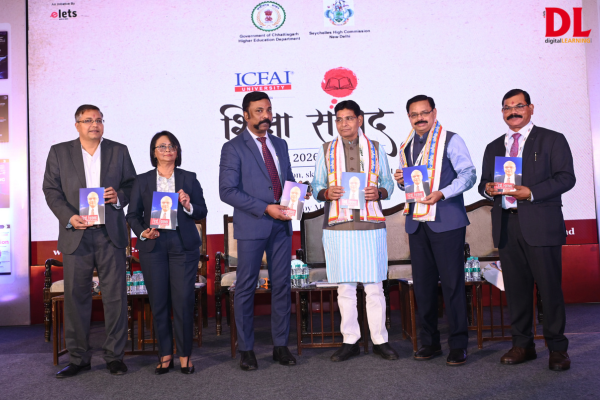
Raipur, Chhattisgarh | 17 February 2026: Shiksha Samvad Chhattisgarh 2026 concluded successfully today at Courtyard by Marriott, Raipur. The programme was organised by the Department of Higher Education, Government of Chhattisgarh, in collaboration with Elets Technomedia, with Digital Learning Magazine as Knowledge Partner. The summit served as a structured platform for deliberation on strengthening higher education, enhancing employability, and aligning skilling initiatives with the state’s socio-economic priorities.
The inaugural session was addressed by Shri Tank Ram Verma, Hon’ble Minister of Higher Education, Chhattisgarh, who underscored that the youth of the state constitute its primary asset and that higher education institutions must be oriented towards equipping them with industry-relevant competencies. He emphasised the need for strengthening institutional capacity, expanding equitable access to quality education, and ensuring curriculum alignment with emerging employment sectors.

Dr. S. Bharathidasan, IAS, Secretary, Higher Education Department, highlighted the ongoing implementation of NEP 2020 in the state and reiterated the Government’s focus on governance reforms, digital integration, academic flexibility, and outcome-based institutional frameworks.
Presenting the Industry Perspective, Mr. Sudhakar Rao, Director, ICFAI Group, highlighted the importance of industry-academia collaboration and outcome-oriented curricula to ensure that graduates are equipped with future-ready skills aligned with market needs.
Offering the International Perspective, H.E. Harisoa Lalatiana Accouche, High Commissioner of Seychelles to India, underscored the importance of global academic partnerships, cross-border collaboration, and shared learning in building resilient higher education systems.
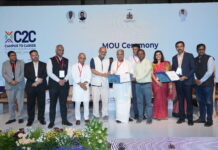
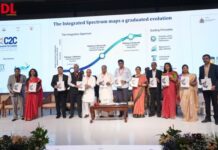
A significant development of the inaugural proceedings was the signing of an MoU between the Higher Education Department, Government of Chhattisgarh, and SWAYAM Plus – IIT Madras, aimed at facilitating integration of industry-aligned online courses, credit-linked certifications, and blended learning models within state institutions. Additionally, an MoU was signed with Lincoln University College (LUC), Malaysia, to promote international academic cooperation, research collaboration, and student and faculty mobility.
Following the inaugural session, the summit featured a structured series of thematic deliberations covering critical dimensions of higher education reform.
Session 1 focused on the implementation of the National Education Policy 2020, examining the gap between policy formulation and on-ground execution. Discussions centred on governance reforms, multidisciplinary frameworks, academic flexibility, and mechanisms such as credit mobility to enhance student progression.
Session 2 addressed institutional governance and policy implementation, with emphasis on regulatory simplification, administrative efficiency, and the adoption of outcome-based education models to strengthen accountability and measurable academic performance.
Session 3 deliberated on digital transformation in higher education, including AI-enabled teaching methodologies, blended learning systems, cybersecurity preparedness, and data-driven academic governance frameworks.
Session 4 examined industry–academia collaboration for employability and skilling, highlighting structured internships, apprenticeship pathways, engagement with sector skill councils, and the development of employability-linked metrics within institutional systems.
Session 5 concentrated on building a knowledge-driven economy through strengthened research ecosystems, innovation and incubation centres, entrepreneurship development, and enhanced industry partnerships to promote commercialisation and applied research outcomes.
Also Read: Growth Must Feel Personal: How STEMROBO Is Redefining Future-Ready Learning for 2026 and Beyond
The summit also included industry presentations by State Bank of India, Axis Bank, and other institutional partners, focusing on strengthening financial inclusion in higher education, expanding education financing frameworks, and building sustainable institutional partnerships. These presentations highlighted the role of financial institutions in supporting access, infrastructure development, and student-centric funding mechanisms.
An Education and Technology Expo was organised concurrently, providing a platform for universities, technology providers, skilling organisations, and financial institutions to showcase digital platforms, innovative learning solutions, and institutional initiatives aligned with emerging academic and industry requirements.
In addition to the previously announced collaborations, several new Memoranda of Understanding (MoUs) were formalised with leading educational institutions to strengthen academic cooperation, capacity building, and institutional development. Notably, one MoU was signed between the Higher Education Department of Chhattisgarh and a university in Brussels, Belgium, marking a significant step toward expanding international academic partnerships.
The event concluded with a comprehensive summary and wrap-up by Dr. S. Bharathidasan, IAS, Secretary, Higher Education Department, Government of Chhattisgarh, and Dr. Santosh Kumar Dewangan, IAS, Commissioner of Higher Education, followed by a Vote of Thanks delivered by Dr. Ravi Gupta, CEO & Editor-in-Chief, Elets Technomedia, marking the formal conclusion of the deliberations on strengthening a future-ready higher education ecosystem in the state.