


Neuroplasticity teaches us a fundamental truth: the brain is not a static entity. It reorganises, adapts, and strengthens itself throughout life in response to experience, repetition, emotion, and meaning. Learning literally reshapes neural pathways, not as an exception, but as a biological constant that accompanies us from childhood through ageing.
In the same way, communication, culture, society, and education are not fixed systems. They evolve continuously, shaped by interaction, context, values, and intentional practice. When education is viewed through the lens of neuroplasticity, learning is no longer reduced to content delivery; it becomes an adaptive, living process.

For educators, facilitators, and parents, understanding this parallel is no longer optional. It is essential.
Neuroplasticity Beyond the Brain
Neuroplasticity is often discussed in strictly biological terms, yet its implications extend far beyond neuroscience. When individuals learn to reinterpret experiences, develop new skills, or overcome limitations, collective behaviors also change. Language evolves. Cultural norms shift. Social expectations are renegotiated. Educational models are questioned, refined, and sometimes replaced.
Learning, therefore, is not simply the acquisition of information. It is a process of neural, emotional, social, and cultural construction. What we teach, how we teach, and the environments we create shape not only minds but societies. Education that ignores this complexity risks becoming mechanical and disconnected from real human development.
Communication as a Plastic Skill
Communication is one of the clearest expressions of neuroplasticity in action. It improves with practice, feedback, emotional safety, and reflection, and it deteriorates under fear, rigidity, and excessive pressure.
Classrooms, homes, and learning communities that foster dialogue, curiosity, and psychological safety actively stimulate cognitive flexibility. Learners feel permitted to make mistakes, ask questions, and experiment, conditions that are essential for durable neural change. By contrast, rigid communication patterns narrow attention and inhibit learning. Adaptive communication expands it.
Culture and Society as Learning Ecosystems
Culture and society function as extended classrooms. They teach continuously through values, rhythms, expectations, and unspoken norms. Some environments reinforce urgency, comparison, and performance pressure; others cultivate meaning, continuity, and lifelong learning.
When educational practices align with how the brain actually learns, through relevance, repetition with variation, emotional engagement, rest, and reflection, the effects extend beyond the classroom. We see more autonomous thinkers, healthier cognitive habits, and communities better prepared to adapt to complexity and change.
Education, therefore, is never neutral. It either reinforces maladaptive patterns or supports sustainable human development.
Education and Techniques That Truly Matter
In an age of information overload, effective education is no longer defined by how much content is delivered or how quickly it is consumed. It is defined by how deeply learning is integrated.
Meaningful educational approaches today must be:
- Brain-aligned, respecting attention spans, memory consolidation, and emotional regulation
- Human-centered, valuing connection and presence over content saturation
- Flexible, allowing adaptation rather than enforcing rigid standardization
- Purpose-driven, connecting learning to life, identity, and wellbeing
These principles apply equally to formal schooling, language learning, parenting, professional development, and lifelong education.
The Role of Teachers, Facilitators, and Parents
Educators and parents are no longer mere transmitters of information. They are neural architects and cultural mediators. Every interaction, a question, a pause, a correction, a moment of listening can either reinforce limiting patterns or open new cognitive pathways.
To keep going on this journey is to understand education as a dynamic process, one that evolves as the brain evolves. It requires presence, adaptability, and the willingness to revise methods when they no longer serve learning.
Also Read: Turning Student Startups into Scalable Businesses
A Conscious Learning Journey
When we honor neuroplasticity, a fundamental shift occurs. We move from teaching faster to teaching deeper; from pressure to presence; from accumulation to integration. Education then becomes what it was always meant to be: a lifelong, conscious, and transformative journey, for individuals and for society as a whole.
Scaling Education Without Losing Its Soul
As education expands through technology and artificial intelligence, a new challenge emerges: how to scale learning without flattening it.
AI offers powerful possibilities, personalisation at scale, adaptive learning paths, immediate feedback, and expanded access. Yet without human-centered and neuroplastic principles, scalability risks prioritizing efficiency over depth, automation over relationship, and speed over meaning.
The brain does not learn through volume alone. It learns through relevance, emotion, rhythm, and relationship. No algorithm can replace curiosity, trust, or the subtle attunement between educator and learner.
The future of education is not a choice between human intelligence and artificial intelligence, but a conscious integration of both. AI should support educators, not replace them; amplify learning, not standardize it; create space for reflection, not accelerate exhaustion.
To scale education responsibly is to protect what makes learning transformative: connection, adaptability, and respect for the brain’s natural capacity to change. When technology follows these principles and educators remain at the center as guides and facilitators, learning can expand without losing its depth, its purpose, or its humanity.
That is how we keep going on this journey — evolving with the tools of the future while remaining grounded in what truly shapes minds, cultures, and societies.
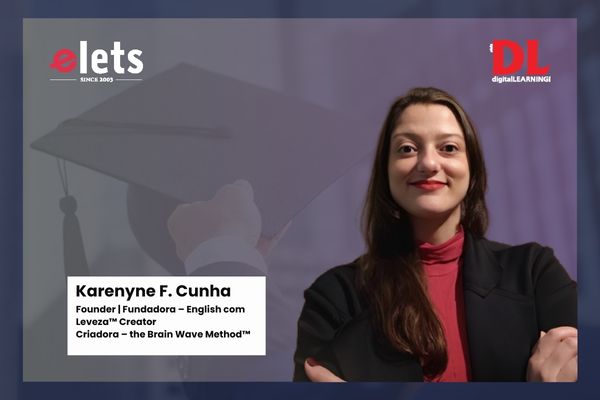
Views expressed by Karenyne F. Cunha, Founder | Fundadora – English com Leveza™, Creator | Criadora – the Brain Wave Method™