
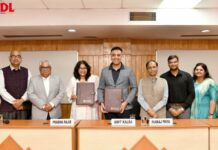
Defense Minister A.K. Antony on Sunday promised that the issue of high fees charged by Sainik Schools, the chain of institutions run by the defense ministry, will be looked into. “I can't give you any assurances right now but I assure you that the issue would be seriously looked into and we will do everything possible to see what can be done,” Antony said after inaugurating the golden jubilee celebrations of the Sainik School here. Antony also heard the grievances of some parents representatives on the matter. Currently, the monthly fees of a Sainik School student is above Rs.5,000. A student receiving full scholarship too has to shell out about Rs.2,500 every month. Only pupils from the reserved categories are exempt from paying fees. Speaking to the sources on condition of anonymity, an alumnus of the school said the Sainik Schools were charging high fees because the pension of the retired teachers was being funded from the students' fee payments. “The state government shells out around Rs.2 crore every year and that is used for the upkeep of the school infrastructure, scholarships and dietary expenses. The defense ministry gives only half of what the state government gives. “Around 15 years back, a full scholarship holder could have studied without paying any monthly fees, but today he has to shell out Rs.2,500,” the alumnus said.
VC appointments in Maharashtra challenged in court
A faculty of the Central India Institute of Mass Communication, Nagpur, has filed a public interest litigation against the state government of Maharashtra urging the court to scan the recent vice-chancellors' appointments in Maharashtra. Sunil Mishra has pointed out that as oppose to the University Grants Commission Act, 1956 guidelines the state government amended the VC selection criteria in 2009. The concept of keeping a central body on the selection panel is completely removed. His petition is against the state government, the governor – who is chancellor of all state universities – and all newly-appointed vice-chancellors. “It is clear that the process of selection for appointment of a vice-chancellor is within the ambit of the University Grants Commission,” he said. Mishra stated that the state's new rule of selecting VCs “was done in contravention of UGC Act, 1956, by deleting a UGC nominee as per Section 7.4.0 (ii) intentionally and with total disregard to the power of the UGC and act of Parliament”. He said the selection of vice-chancellors used to be done with great care and circumspection, observed by search committees appointed by chancellors of universities. Later, the post was given to bureaucrats, judges and top-ranking police officers, he said. “This became alarming,” he said.
New pre-matric scholarship scheme for SC, ST students announced
Union finance minister Pranab Mukherjee, while presenting the Union Budget for 2011-12, has announced that specific allocations are being earmarked towards Scheduled Castes Sub-Plan and Tribal Sub-Plan for the first time in the Budget for 2011-12. Referring to the allocation for primitive tribal groups, the Finance Minister announced that it is being increased from Rs.185 crore in 2010-11 to Rs.244 crore in 2011-12. Emphasizing that empowerment flows from education, the Finance Minister said that a new pre-matric scholarship scheme will be introduced in 2011-12 for needy students belonging to the scheduled castes and scheduled tribes studying in classes ninth and tenth. Pranab Mukherjee pointed out that the new scheme would benefit about 40 lakh scheduled caste and scheduled tribe students.
Teachers demand pay hike in Manipur
In Manipur, hundreds of teachers are protesting against the non-implementation of the sixth pay commission. The teachers in the state are demanding hike in their salaries. The teachers who have gathered under the banner of the Federation of College Teachers Associations of Manipur (FECTAM) called for a review of the cabinet decision of November 4, 2010. FECTAM President L. Randhoni Devi said both experienced and new teachers are being paid peanuts. The teachers have also gathered under the banner of the Council of Teachers' Association and (COTA) suspended classes over a demand for implementation of recommendations made by the Sixth Central Pay Commission. Agitating teachers in the state have launched a relay hunger strike since January. The two month long strike has affected the normal functioning of various schools across the state.
IGNOU launches programme to reach out to underprivileged
The Indira Gandhi National Open University (IGNOU) has developed a new programme called Ability Development and Inclusive Programme in order to make education more accessible for the underprivileged. The programme by IGNOU is aimed at reaching those who are not much aware about the various courses that are offered by the university the distance learning as well as on campus. The university is also considering plans to tie up with non-governmental organizations that work with the underprivileged to make them aware of the opportunities for them that are provided by the university. IGNOU Regional Director K.D. Prasad said, “The fee that students have to pay for our annual course is only Rs.1,700. Even though it is very affordable, people are not aware about these courses. We are targeting these people so that they have access and the opportunity to pursue higher education.” He further added that the university will be conducting monthly open house sessions to provide information to prospective students about various courses that are offered by the university and their course content. He also said that the university had plans to begin a career counseling unit at the Young Men's Christian Association (YMCA) centre on Jai Singh Road. A problem that had been faced by students pursuing various courses from the university was late declaration of results. However, the university had, this year, announced the results of around 3 lakh students within 45 days when earlier it had taken around two to three months.
IIT-Kharagpur challenges liar tag to registrar by CIC
The Indian Institute of Technology Kharagpur has filed a writ petition against the Central Information Commission's order that describes the IIT registrar as a liar. The top technical institution has accused the top monitoring commission of the RTI Act of not seeking its view before dubbing registrar TK Ghoshal a liar. According to the CIC order released on February 2011, Ghoshal has provided misleading information to IIT Kharagpur computer science professor Rajeev Kumar. The commission issued a show-cause notice asking why disciplinary action was not taken against the registrar. Information Commissioner Shailesh Gandhi in his judgment had also ordered the IIT to provide security to Kumar. The professor has alledged that he has been threatened by top IIT officials for exposing a series of scams and irregularities at the institute. However, Prof Kumar has alleged that within hours of the CIC hours personal details of his son was circulated and his son's safety was being compromised. The IIT challenge to the CIC comes soon after Kumar challenged exaggerated laptop procurement rates which the Institute had listed, as was first reported by HT on February 6. The IIT has since told the HRD ministry that it is putting on hold the purchase of laptops based on the exaggerated rate list.
Jamia Millia Islamia to flag off cycle rally
The Jamia Millia Islamia will flag off its annual cycle rally from the Indo-Pak border on Monday that will reach the capital on March 8, a statement here said. The university organizes the rally on a specific theme every year. It was Pushkar-Ajmer-Delhi journey last year. “This year, around 21 students and 7 members of the university propose to travel from the Indo-Pak border to Delhi as (part of) Aman Caravan. The students shall be flagged off by the Border Security Force at the Indo-Pak border (Attari) on February 28, 2011 after the beating retreat ceremony,” a university statement said on Friday. The students will cover several historical, cultural and religious landmarks on their journey to Delhi. “The theme of the rally is 'Peace and Universal Brotherhood'. The rally is expected to be received March 8 by the Delhi Commissioner of Police B.K. Gupta, MP Sandeep Dixit, former Indian cricket team captain Mansoor Ali Khan Pataudi and Olympian Zafar Iqbal,” the statement added.
Four more Indian students freed of radio tags in US
US authorities have removed radio tags of four more Indian students of the sham Tri Valley University (TVU) in California closed on charges of immigration visa fraud last month. So far radio tags of 11 of the 18 Indian students who were forced to wear the monitor anklets have been removed by the US Immigration and Custom Enforcement (ICE). Officials at the Indian consulate in San Francisco expect ICE to remove radio tags of all the 15 students who had sought its legal help in the matter. The fate of the three others is not known as they preferred to go through their own independent lawyers. The Indian consulate worked with the South Asian Bar Association (SABA) in this regard. The consulate has now asked ICE to take off the Notice to Appear (NTA) because as long as these notices are out, deportation proceedings can be held against a person. ICE has said it's only a procedural matter and will be done soon. “ICE has committed that they would no longer be issuing NTAs. They are not sending people to the houses of the students. They are talking to them on phone,” an official said. Some 1,555 TVU students, 90 percent of them from India, mostly Andhra Pradesh, face the prospect of deportation unless they can get admission in another institution to retain their student visa status.
Jamia’s minority status won’t make it a madrassa – VC
Minority status for Jamia Millia Islamia will not change the secular nature of the 90-year-old university, says Vice Chancellor Najeeb Jung. “This is not going to change the secularist nature of the university. It is not fair to think that the minority status given to the institution will lead to ghettoization in any form,” Jung said in an interview. “In fact, this will be a boost to Muslim education in the country. It is not in any way going to make us a mullah or madrassa form of educational institution,” Jung added, referring to speculation in political and university circles. The university board is in the process of studying the judgment by the National Commission for Minority Educational Institutions (NCMEI) that granted it “minority institution” status. “The university has always had a commitment to national goals of social justice and secular ideals. It will continue to uphold these in the future too,” Jung asserted, adding the authorities were working out the modalities of its implementation. NCMEI on Tuesday granted “minority institution” status to Jamia Millia Islamia, giving it the right to reserve up to 50 percent of seats for Muslims. “Jamia students should not be worried about the integrity and status of the institute. We will be consistent on the quality, and the minority status will be an advantage for us in the days to come,” Jung explained. “I haven't seen any communal or political disturbance happening in the campus in the last few days. And I had told my students to embrace the judgment whatever way it comes,” he added. The university also held a meeting of the governing body, announcing the status formally. “We have just got the judgment and announced it. Now the decision lies with the human resource and development (HRD) ministry to finally give a nod to the judgment,” Jung said. The university currently has 22.5 percent reservation for Scheduled Castes/Scheduled Tribes, 25 percent quota for students from the Jamia school irrespective of religion and three percent quota for the physically handicapped. The NCMEI judgment put to end the almost five-year-long case on a petition filed by the Jamia Students' Union, the Jamia Old Boys' Association and the Jamia Teachers' Association in 2006 contending the university was a minority institution and not obliged to implement any other quota following the government decision to implement 27 percent reservation for other backward classes (OBCs) in the university. The Confederation of Muslim Educational Institutions of India was an intervening party while the vice chancellor of the university, the human resource development ministry and the minority affairs ministry were the respondents.
NCTE develops code of professional ethics for teachers
The National Council for Teacher Education (NCTE) has developed a Code of Professional Ethics for school teachers on the recommendations of a Committee constituted for the purpose under the Chairmanship of Prof. A.K. Sharma, former Director, NCERT. This information was given by the Minister of State for Human Resource Development D. Purandeswari in a written reply to a question in the Rajya Sabha today. The code provides a framework of principles that would guide teachers in discharging their obligations towards students, parents and other stakeholders. The code will be implemented in collaboration with the associations and federations of school teachers.