



Home Blog Page 1508

Grooming Children To Fit Into Zero Conflict Society : Nidhi Sirohi, Kothari International School, Noida

Nidhi Sirohi
Principal, Kothari International School, Noida

“We first try and judge a child’s capability and interest and then build upon it to enhance their creativity and critical thinking”

What is your vision of quality education at Kothari International School?

Our philosophy is to groom the children in such a way that they are equipped to pursue a future of their choice once they are out of the school. The most important thing is to have balanced well groomed children who can fit into a zero conflict society.

Please tell us about the curriculum and pedagogy followed in your school.

Although we follow the Central Board of Secondary Education curriculum, we have an international child centric approach. Our classes are in tune with the modern pedagogical approaches, which involve a lot of group activities and research. We believe every child has an inherent talent, which needs to be identified. We first try and judge a child’s capability and interest and then build upon it to enhance their creativity and critical thinking.

What major hurdles or challenges did you encounter while integrating ICT in your school?

Today’s children are in sync with technology as they are constantly in touch with it at school or home. But as far as teachers are concerned, sometimes we encounter resistance to technology integration. So we make it a point to recruit those teachers who are familiar with IT. Initially when we introduced IT in our school, our teachers felt a little restricted. But once they got used to it, they realised its potential of enhancing the teaching and learning process. For example, its visual impact helps the students to assimilate concepts faster.

Of course, everything has a positive and negative side to it. With abundant information available in today’s world, a major challenge that we face is making the children use it in a constructive manner. Otherwise children mostly use computers for games or chatting or visiting social sites like Orkut, Facebook etc.

What initiatives have been taken up by your school for integrating ICT in your system?

We are a new school and this is our third year of running. Technology is an integral part of our entire curriculum and lesson plan. We use videoconferencing and LCD projectors for aiding our classes. In the course of next three months, IT will be completely integrated into our school system. Right from interactions between parents and teachers to making day to day lesson plans, all will be possible on this single software, which is in the design phase. For instance, if a child faces any difficulty at home with any assignments, she can immediately log onto the website with the help of a password and seek assistance. For this, we are developing our own software with professional help.

How do you build teachers capacity in rendering technology mediated education?

We have regular training programmes in our schools where our teachers are trained by professionals from the field. Teachers also share best practices  among themselves. For example, a teacher shares her experience, which may have aided her teaching, with her peers. So training happens both horizontally and vertically.

Can a public/private partnership give a boost to technology integration school education?

A PPP model has its own pros and cons. A balance of public/private partnership is certainly beneficial. But then it is essential to keep in mind that the arrangement has to be flexible enough to allow room for customisation later to incorporate the needs of the class.

What are your future initiatives for integrating ICT in your School in the coming years?

We want to expose each and every child, starting from the primary classes to technology.  For this we are in the process of equipping our school with smart boards, learning software and other technology tools.

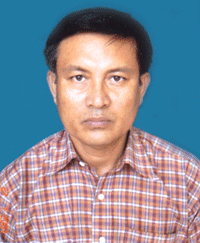
Imparting Modern Education With Values And Awareness : N Dhiren Singh, Jawahar Navodaya Vidyalaya, Khumbong, Imphal, Manipur

N Dhiren Singh
Principal, Jawahar Navodaya Vidyalaya, Khumbong, Imphal, Manipur

“It is mandatory for every teacher to use some element of ICT in classroom. A register is maintained to record the ICT based classes taken by teachers”


What is your vision for quality education in JNV Khumbong Imphal?

The vision of our school is to impart quality modern education along with inculcation of values, environment awareness, and physical education, to students predominantly from rural areas and to aid their physical, mental, and spiritual growth. Our JNVs also strive to serve as focal points in each district for improvement in quality of school education in general through sharing of experiences and facilities.

Please tell us about the curriculum and learning methodology followed in the school.

Our school follows the NCERT curriculum and is affiliated to CBSE. The learning activity of the Vidyalaya is highly integrated to ICT. Teachers use Power Point presentations, animated multimedia presentations, etc. to deliver their lectures. Internet is also used by teachers to retrieve various subject related topics. It is mandatory for every teacher to use some element of ICT in classroom. A register is maintained to record the ICT based classes taken by teachers.

Our students make their project work using Microsoft Word and Power Point, download various subject related topics, sample papers, fill online forms for many competitive examinations using Internet.

What are the initiatives taken up by your school for integrating ICT in education?

The school has provided enough infrastructure, procured various educational CDs, made arragement for conducting ICT classes in two different rooms with LCD projectors and computers. We also have the EDUSAT facilty for interacting with different educational institutes, organisations, experts, etc. Teachers make projects using Power Point presentations, make every teacher take class using ICT at least once/twice a week. Students are also allowed to use computers and Internet twice a week for every class i.e., from VI to XII.

What are the major challenges as far as integration of ICT?

Some of the challenges faced by our school while implementing the ICT programmes/projects are:

  • Frequent power cut and load shedding hampers smooth use of ICT. We try our best to solve the problem by using a generator of 25KVA and 15 KVA stand by generator.

  • Maintenance of hardware components like UPS, CPU Monitor, etc. is another problem as it is difficult to purchase such hardware components.

  • Misuse of technology by students is yet another challenge. Students want to use computers for entertainment rather than as a learning tool. 

How do you build teachers` capacity in rendering technology mediated education?

Our school have given training to almost all the teachers through Microsoft programmes. Knowledge of the teachers is further enhanced with the use of Internet, as they can draw new concepts, ideas and detailed material on their topics, which enhance their teaching. This further helps them in their professional growth while producing  good results in examinations.

How do you see Public- Private Partnership for enhancing proper use of technologies in school education?

Both the sectors need to be aware of the various uses of technology in school education and its importance, so that they in turn can venture to improve or enhance this field to give quality education to our students.

What are the future initiatives/plans for integrating ICT in school education?

For bringing about an effective integration of ICT in education, we should try and enhance the knowledge in the domain for both teachers and students by interacting with differents firms, organisations, experts, etc. There is also a need to update our ICT technologies as far as possible to improve teaching learning process.

Unleashing Unlimited Potential : Rajeev Katyal, Microsoft

Rajeev Katyal
Director Education, Microsoft

“Microsoft`s vision for education in the 21st century is driven by the shared belief that the use of technology in education will help remove limitations, foster innovation, and enable students and teachers to achieve their fullest potential”

Please take us briefly through Microsoft`s engagement with the education community in India?

Microsoft has a long-term partnership with India which goes back to 1990 when we set up operations in the country. We believe that technology offers new educational possibilities that can help empower both teachers and students everywhere. Under the Unlimited Potential effort, Microsoft India is focused on long-term investments for facilitating relevant, affordable access to technology in areas which are aligned to India`s priorities

Helping Children Become Lifelong Learners : Sita Umamaheshwaran, PSBB Millennium School,Chennai, India


Sita Umamaheshwaran
Principal, PSBB Millennium School, Chennai

Our curriculum follows the principle of subject integration with  topics lending to each other irrespective of the Subject

What is your vision for quality education in PSBB Millennium School?

We firmly believe that as an institution dedicated to the cause of education, we must passionately help children to  recognise their true potential and shape them into confident, responsible, and multifaceted individuals; Become lifelong learners and globally competitive citizens with firm rooting in Indian values; and inculcate in them the need to achieve human excellence.

Please tell us about the curriculum and learning methodology followed in your school.

The PSBB Millennium School follows the curriculum guidelines and syllabus laid down by the Central Board of Secondary Education (CBSE). Our syllabus is built on a rich foundation of reading, writing, and arithmetic, which is then layered with history, science, music, geography, and the arts to ensure there are no gaps in instruction. Our curriculum follows the principle of subject integration with topics lending to each other irrespective of the Subject. This develops higher order thinking skills and promotes content mastery.

What initiatives have been undertaken by your school for integrating ICT in school education?

Ever since its inception four years ago, ICT has played a major role in our school. The Smart Class modules are used for set induction, driving home of a concept to give greater clarity, and as an instant quiz for gathering the level of assimilation among children.  This instant feedback helps her either proceed further or stop for another strengthening of the concept.  This also saves time for the teacher as they do not have to wait for the evaluation exam at a later date.

What major challenges did you come across in integrating ICT in your school?

Initially, in any institution the first year of implementation is always the toughest.  The institution needs not only the complete support of the management, but also a conviction of the teachers actually using the technology. Untrained teachers need to be given specific training and a lot of hand-holding.

How do you build teachers` capacity in rendering technology mediated education?

Initially the teachers have to be taken through the entire process of going through the methodology of using technology mediated education. This is done at our School through a series of workshops by Educomp Solutions especially designed to equip the teachers with the knowledge of handling the modules and making them comfortable. The next stage is to help them plan their lessons.  Ultimately it is the teachers creativity and interest that helps her graduate from a good teacher to an effective teacher.

How would you rate the role of Public  Private Partnership in enhancing proper use of technologies in school education?

Considering the fact that public schools or government schools are actually trying to come forward in making the teaching learning process as effective as is being done in the private sector, it would be really nice if companies came forward to help the government run schools and train the government teachers.  Once this is in place the great divide will become narrower and children will have the opportunity to shine and excel no matter what background they come from.

What are the future initiatives/plans for integrating ICT in school education in the coming years?

The PSBB Millennium is already three steps ahead of other institutions as we have done away with the chalk and talk method.  Interactive-Digiboards and LCD projectors complement what the teachers teach.  The inclusion of One-on-One (O3) computing where every child from Class 3 to 7 has been given Intel`s CMPC (Classmate PC) has made the classroom even more exciting and also helped in inculcating a sense of confidence. Going forward we intend to make classroom learning a more vivid experience, proving that the world has indeed shrunk and that seamless learning can happen anywhere.

Education pitch at Pravasi Bharatiya Divas

The state department in an effort to capitalise the growing interest of NRIs in India at Pravasi Bharatiya Divas to be held in Chennai by the Ministry of External Affairs for the overseas Indian community.

The department will showcase its schools through an online database and invite NRIs to enter a public-private partnership with any individual school to support its development and activities. The government plans to launch a comprehensive web portal to execute this venture and give donors accountability as funds would not go into a common donation pool and transparency would be maintained. The assistance can be on varied forms including school infrastructure, academic resources or accessories for extra-curricular activities. They could assist students by providing specific learning modules and financial endowments, innovative classroom techniques.

Most donors will be encouraged to contribute because such investments yield tax benefits in most countries.

Edexcel plans expansion in India

Edexcel is expanding in India after spending 12 years in the education and training sector in the country. The expansion includes regional presence with new offices in Kolkata, Bangalore, Chennai and Mumbai and diversisfication into products offering skill based modules.

The estimated cost of the expansion is Rs 10 crore, it has already made in-roads into Indian academic space by representing vocational streams. It has partnered with Aptech and IGNOU for offering diploma programmes and is currently in talks with Educomp Solutions, Everon Systems and Reliance Retail to bring in curriculum and teacher-student material for quality control. Currently, almost 25,000 students have registered themselves for various Edexcel programmes.
 
Future plans includes entering the soft skills space by offering 60 small modules on communication, interviewing skills and behaviour.

States announce shift to NCERT curriculum

The government run schools of 12 states will now teach NCERT textbooks to benefit students and bring uniformity in taught curriculum across India.

The States are Goa, Andhra Pradesh, Sikkim, Uttarakhand, Himachal Pradesh, Delhi, Jharkhand, Bihar, Chhattisgarh, Haryana,Kerala and Punjab. Current statistics reveal 31.3 per cent of the senior secondary level students across India follow NCERT books whereas the National
Curriculum Framework (NCF) 2005 mandates to bring uniformity in course curriculum across boards and improve the quality of education.

IIT gets ready for the Entrepreneurship Summit

So you have made a start but dont know where to get the funding, head for IIT Mumbai.

Investor Pitch is a call to all budding entrepreneurs to a unique platform to showcase their products and services at the being organised by the Entrepreneurship Cell (E-Cell) of IIT Bombay. The Entrepreneurship Summit, an E-Cell initiative, will bring together aspiring and successful entrepreneurs, startups, venture capitalists and academicians on a common platform. A distinguished panel of venture capitalist firms including Seedfund, Nexus India Capital, Ojas Ventures, Waygate Capital, Milagrow Ventures, Indian Angel Network etc will provide a platform to grab a funding upto Rs 5 crores.

So put that business plan in shape and head for Investor Pitch! Log on http://esummit.ecell.in/

Delhi plans Rs 196 crores for inclusive education

The Education minister has announced the updgradation of 200 selected government schools for infrastructure facilities and also 63 government schools will be upgraded to the secondary level.

The state with an average per school allocation of Rs 60-70 lakh aims to improve drinking water, toilet, electricity and having green boards in all classrooms. The directorate of education (DoE) has engaged the Delhi State Industrial and Infrastructure Development Corporation (DSIIDC) and the Public Works Department (PWD) for this upgradation, under which additional rooms will be constructed.

The effort aims to build schools that are inclusive and bring down the out-of-school ratio of students, the Department of Education informs that 24 government schools in Delhi will be turned into 'model schools' implementing policies regarding the mainstreaming of children with special needs on the Building As a Learning Aid (Bala) model. The schools will be equipped with labs for the
hearing-impaired, braille books etc with trained teachers from the Rehabilitation Council of India.

Schools forced to extend winter break

It is biting cold and parents have to send their little children to school early in the morning. It's not a very happy thought for most parents.  And with many schools in the city reopening on Monday, parents have already hit the panic button. Acting on their concern, DPS is the first to extend its winter vacations for the primary classes. DPS East of Kailash and DPS Vasant Vihar, which were to reopen on Monday, will now open a week later on December 12. 'We have extended the vacations for our two junior schools because of the cold conditions. This decision is for the students aged between four and ten years. Parents are also concerned about it. So I have written to the chairperson of the DPS management committee to allow us to extend the holidays for the middle classes also,' said Shyama Chona, principal, DPS R K Puram.

Many other schools like Springdales, Apeejay, Pitampura, Modern, Barakhamba Road and government schools are still reopening on Monday. Gyan Bharti, Saket will reopen on Decemebr 7. Few schools like Tagore International, Vasant Vihar, VV DAV School in Vikaspuri will anyway open for students again on December 12. With thick fog and mercury dipping further, parents feel that schools should continue with their vacations for some more days. However, the government is planning to wait and watch before taking a decision. 'We will wait for another day to see if the cold conditions get any worse. We will then decide if the schools need to be closed for longer or not,' said Arvinder Singh Lovely, state education minister.

LATEST NEWS