




Home Blog Page 1518

Radicalising Education Through ICTs

Communication technologies popularly known as ICTs are being increasingly linked to education. Integrating technologies with the educational system is a major challenge of pedagogy today.

Creating a Professional ID

Saswati Paik

ID Specialist
saswati.paik@gmail.com

Need to Design Instruction

Do we remember all our teachers who have ever taught us? Do we have sweet memories of all the classes we have attended during our student days? I am sure, you all will say ‘No’. Most of us remember only few teachers for reasons like their innovative teaching or their affectionate behaviour.

There are numerous factors which are responsible for the popularity of a teacher. Ideally a teacher is supposed to prepare him/herself for any class as per the requirement of his/her students. Since the ability to grasp a subject varies from one student to another, teachers have to explore the best way to enhance the teaching-learning process in the class.

A good teacher should necessarily have the following qualities: (i) good communication skill, (ii) analytical bent of mind to understand the requirements of the students, (iii) passion for teaching, and (iv) knowledge about the subject. All these qualities are so important and inter-linked that it is difficult to rank them as per their priorities.

Students, on the other hand, come from different family backgrounds and may have different mental make-up. Moreover, their learning capacity also varies. All these factors have a bearing on the impact various teaching aids have on students. But an effective teacher is one who formulates the design of the teaching process and follows some ways to get a better or best response from her/his students. Here lies the importance of ‘Instructional Design’ or ID as it is popularly called. Although the process followed by teachers cannot be defined as ID in present context, the origin of the concept lies somewhere in the teaching-learning process, which was once not accompanied by Computer Based Learning (CBT) or Web-Based Learning (WBT).

Why Instructional Design?

Following the IT boom, the past few decades has seen a change in the mode of learning. It has now become multi-faceted. With the change in the source of knowledge, the mode of knowledge transfer has also evolved. These days knowledge is not just confined to books or the traditional classroom-based teaching-learning process, it is easily accessible both online and offline through various media. People can easily avail web-based training programmes, learn through computer games and also attend interactive sessions from remote locations. With this shift in trends, the requirements of the teaching-learning process has changed with the courses concentrating more on learners’ requirements.

In such a situation, people with a passion for teaching, good communication skills and the ability to visualise best practices in learning, can look for a booming career in the field of ID. ID can be defined as both the art and science of designing instructions for learners, these instructions aiming at maximum knowledge transfer. It can be applied in game-based training for students, professional trainings and also interactive sessions on general knowledge.

Introducing ID as a Professional Course

An ideal ID course needs to cover the following areas: (i) Basics of learning that include various learning theories; (ii) Fundamentals of effective communication; (iii) Concept of Educational Psychology and implication of Educational Psychology in ID; (iv) Basic principles and tools of ID; (v) Concept of e-Learning and e-Learning authoring tools; (vi) Description of some ID models. All these elements can build up a professional course in colleges and universities.

Moreover, organisations having experienced content developers and professional Instructional Designers can initiate short-term professional courses for experienced professionals looking forward to join the e-Learning sector.

As per the standard requirement of IT industries working in the field of e-Learning, it is essential for willing ID professionals to achieve mainly three qualities: (i) basic understanding about learning theories and idea about CBT, WBT, Instructor Led Training (ILT), (ii) knowledge about basics of ID and e-Learning and (iii) mainly good communication skills. Usually, the ID professionals gain maximum knowledge on the job, handling various projects for different target audiences.

The origin of the ID concept lies somewhere in the teaching-learning process itself which was once not accompanied by Computer Based Learning (CBT) or Web-Based Learning (WBT)

ID as a Profession in India

ID is a process that analyses learning needs and promotes a delivery mechanism to meet those needs. A new age Instructional Designer should have some basic qualities like an ideal teacher. She/he also needs to have an open mind on constantly updating oneself to learn what are the latest trends in e-Learning tools and practices. The courses a designer designs, in any organisation, are made for a target audience already set by the organisation or onsite client. Therefore, a designer need to be flexible in terms of visualisation, knowledge update, and also inclination towards the subject assigned. Subjects, contents and mode of approach may vary with the nature of target audience. Sometimes they have to prepare learning instructions based on the contents provided, but at times they may also have to play the role of content developers as well. Therefore, big companies often look out for ‘Content Developers-cum-Instructional Designers’ rather than simply designers.

In India, the job market for trained instructional designers is booming. Earlier, there were very few institutes, not more than four or five, offering training in ID. Lately, new institutes offering ID training have mushroomed. Many of these institutes are actually run by companies that are in the business of e-Learning. Since a large part of global e-Learning projects are outsourced to India, these companies are in demand and so constantly hone the skills of their designers.

Unfortunately, the scope of ID has not been explored to the maximum. Students are pressurised into taking up engineering or medical streams to ensure a bright future. There is a need to change the mindset as far as Arts and Humanities streams are concerned.

The potential of this field cannot be fully realised unless more and more institutions and universities come forth to explore it. There is also a need for collaboration with foreign universities to generate an interest in ID among young people to adopt it as a career option.With every e-Learning company screaming for Instructional Designers, a trained designer can look forward to bright prospects and grow to be a manager and eventually a consultant, ten years down the line.

Overcoming Barriers Through Technology

In today’s fast paced world, a person with disability is confronted with the barriers of mindset, infrastructure, education, and technology. The Techshare conference was conceived by the Royal National Institute for the Blind (RNIB) with the objective of breaking these  barriers and including people with disabilities into the mainstream.


The first Techshare India conference was organised in New Delhi in February this year to explore the entire gamut of assistive technology and also build bridges betweeen the government, private sector, and ngos on one hand and the disabled 60 million Indians on the other. In an effort to scale up the level of the conference, a Techshare roadshow was organised in Banglaore in August and in Mumbai on November 4.

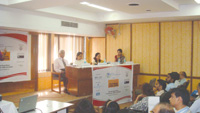
Held on the premises of Ali Yavar Jung National Institute for the Hearing Handicapped, the day-long conference-cum-roadshow in Mumbai emphasised on the need to integrate persons with disabilities into the mainstream using assistive technologies while also implementing accessibility standards  and laws. It also highlighted the role of Ngos, private sector and educational institutions in making education and infrastructure accessible for PwDs to make them global citizens.

Creating An Inclusive Environment

Inaugurating the conference, Supriya Sule, Member of Parliament, Rajya Sabha, said, ‘Every citizen of India is a global citizen and has every right to education and basic accessible infrastructure.  We have to spread awareness and be sensitive to the needs of differently abled people and create an all-inclusive environment.’

‘It is imperative that assistive and accessible technologies are made available to PwDs in order to create an inclusive environment for them,’ urged Shilpi Kapoor, Managing Director, BarrierBreak Technologies, which hosted the event along with RNIB, UK. She emphasised on the commercial opportunity that the growing market of assistive technology represents and highlighted the need for business houses and the government to play a larger role in it. With the UN Convention on the Rights of Persons with Disabilities in place, it is important for India to look at the implementation of these laws to create an inclusive society, Kapoor added.

As part of the inaugural programme, a ‘My Story’ session was held where people narrated their experiences of leading a norml life. Visually impaired Dharmarajan Iyer, works with the Forward Market Commission as a Deputy Director, and uses assistive technologies like the screen reader to perform his day-to-day tasks. Mobility impaired Jasmina Khanna is a software tester with Rheal Software Pvt Ltd. Suffering from cerebral palsy, she uses rack ball and Windows accessibility tools and settings such as Sticky Keys etc. Both believe that technology, if used efficiently, can make a huge difference in the lives of people with disabilities and make them a part of the mainstream society.

After the inaugural keynote, the sessions were divided into three parallel tracks, namely The Road Ahead – Envision the AccessibilityRoad Map, Making a Difference, and Bridging the Digital Divide. Among others who gave presentations included prominant people like Shilpi Kapoor, Elizabeth Kurian (Sight Savers International), Nina Screwvalla (Tata Consultancy Services), Sachin Verma (AccessAbility), Vickram Cishna (Radiophony), Dipendra Manocha (DAISY Forum of India) and Ketna mehta (Nina Foundation).

Experiential Lab

The main highlight of the event was the experiential lab that provided an opportunity to experience how people with disabilities lead an independent life. Some of the products exhibited at the lab included ergonomic keyboard and mice, Supernova – a powerful screen reader-cum-screen magnifier, Compact + – portable magnifier that helps people with low vision, Accessible Flash Games, and tools for children with learning disabilities

Intel Asia Academic Forum 2008 – Empowering 21st Century Workforce

Ashutosh Chadha

Director
Strategic Education Initiatives (Asia Pacific), Intel

Kowledge is the currency of today’s global economy and to thrive, today’s students must do more than acquire facts and data – they must use information to become innovators of knowledge. With growing international competition and outsourcing more commonplace, this, coupled with the current US economic crisis, is providing developing economies in Asia with the opportunity to become more competitive and even outpace the rest of the world.

Ironically however one of the key problems being faced in addressing this is not just related to the shortage of skilled staff but ensuring that students are trained in areas and topics which align well with industry requirements.  A case in point is for example India – Nasscom, which represents India’s software companies, has estimated that there could be a shortfall of 500,000 IT professionals by 2010. While Indian engineering schools award around 200,000 diplomas each year, and produce around 250,000 graduates, only half are employable by the IT industry. Employees have learnt to switch jobs for better pay, and salaries are going up by 10-15% a year. Furthermore, with competitors in other parts of the world starting to emerge, India increasingly needs to keep abreast of technological changes and trends.

The question thus is : how will India and other countries in the region ensure that its workforce is  equipped with the skills and knowledge to thrive in today’s global economy?

To develop global workforce and to improve employability and entrepreneurship in students, effective partnership among the community, industry, governments and academia is essential. Communities and industries should provide needs and requisite technical skills. Governments should help provide relevant regulatory and implementation frameworks and the academia to help bridge this divide and ensure the necessary change. This is the bed rock to developing an effective talent ecosystem.

Above all effective collaboration and regular communication among these stakeholders will help ensure these practices become a reality and  a pipeline of competitive workforce can be nurtured. Intel corporation, a top IT industry partner to over 36 key universities and governments in Asia Pacific region, has been regularly  working with policy makers and professors focusing on faculty development, research and curriculum in order to hone the quality of local talent. The annual Intel Asia Academic Forum is one such platform to help facilitate collaboration between industry and academia on advancement of technology and innovation.

The 5th Intel Asia Academic Forum took place in Taiwan in Oct 2008. With a theme of ‘Powering the Future: Technology Innovation for a Better World’ the forum brought together over 150 delegates from universities from eight countries in Asia.

At the Forum, Intel shared details of its technology roadmap, business and research developments at three tracks: ‘Technology & Manufacturing’, ‘Systems and Architecture’ and ‘Software for Multi-core’.  The executive Vice President of Industrial Technology Research Institute (ITRI) from Taiwan government, Dr. Chih-Kung Lee, delivered a keynote on The Next Social Paradigm Based on A Proposed Coexistence of Virtual and Reality. Nine Intel Fellows and selected professors shared their insights and discussed trends in technology and manufacturing, software, architecture and IT systems. The forum also held a multi-core in-depth training workshop which equipped faculties with latest technologies and content for them to develop related curriculum in the region. Additionally this year saw the institution of  an ‘Outstanding Research Award’ which was a recognition by peers given to faculty with some of the best research projects.

With its Higher Education Program, Intel has been striving to work with other industries and agencies to make a difference for developing the global workforce. By working with local universities in countries, Intel helps support research curriculum development as well as closer industry-academia linkages

Giving ICT an Asian Perspective

The Asia Pacific region presents a picture of contrast when it comes to developmental stages of different countries. On the one hand it has countries like Australia, Japan and the Republic of Korea, which have comparatively mature economies, competitive ICT infrastructure and solid human resource base. On the other hand there are countries like Bangladesh, Vietnam, Laos, Cambodia, that face daunting challenges.

Recently held eAsia 2008 presented key policy makers, managers and academicians with an overview of these differences, while highlighting challenges and opportunities that countries face in effective utilisation of ICT.

The eAsia report in this issue points towards the need for Asia to take a lead in new growth areas, while facilitating multi-stakeholder participation to overcome various roadblocks.

The Asia Knowledge Forum, launched at the event, represents a fruition of an endeavour to assist the Asian countries in mobilising best practices and knowledge on integrating technology in education.

The commentary section spells out need for radicalising education through ICTs. The author, who is an IGNOU joint director, emphasises on the utility and subjective appropriateness of technology. Various modes of technology can be an answer to a heterogenous society with variable levels of socio-economic development.

We also present Indonesia’s tryst with integration of ICT in the higher education sector, and the constraints it faces. There is also an interview of Dr Binod Agrawal, who pioneered use of qualitative methods for communications research during the world famous Satellite Instructional Television Experiment (SITE) of ISRO. SITE proved beyond doubt that the gap between urban and rural India can be neutralised through information technology.

As 2008 goes by, we wish our readers a happy New Year! We will see you next year with our 3rd anniversary issue, which will carry a perspective of all stakeholders on ICT in education.

e-tickets for Univ examinations

System for Web Enabled Examination Transaction developed by Kerala University Computer has made exams process easier for administrators through facilty of e-tickets centre had already modified its portal for facilitating online registration to University.

Around 50,000 passwords had already been issued. Teachers can use the site to enter attendance data and mark
details. University staff can use the site for entering data generated at centralised valuation camps. This will reduce the time needed for publication of results.

LearnPort bags award for innovation

Following last year's “Best Launch” of a learning management system (LMS), the Michigan LearnPort(R) professional development (PD) portal for educators received the “Most Innovative Use” award at Meridian Knowledge Solutions, LLC, 2008 Users Conference in Chantilly, Virginia recently.
 
Michigan LearnPort's LMS works in collaboration with Michigan Department of Education gives Michigan educators a forum to reinforce learning, participate in discussion groups, create knowledge banks and share knowledge with other educators. The portal has over 36,000 educators registered.

Adobe awards announced

Adobe announces entries for the ninth annual Adobe Design Achievement Awards (ADAA).

The competition held in partnership with the International Council of Graphic Design Associations (Icograda)honors the best student graphic designers, photographers, illustrators, animators, digital filmmakers, developers and computer artists from accredited higher education institutions worldwide. The Adobe Design Achievement Awards are open to three media categories: Interactive Media, Motion Media, and Traditional Media.

Submissions will be accepted online through June 5, 2009. Go ahead and log on to 2009 Adobe Design Achievement Awards: www.ADAAentry.com.

GU shifts to semester system

Gujarat University keeping the current trend of other Universities felt the semester system is the need of the hour to make our students more competent in the outside world.

All Following a unanimous approval from faculty heads the institution aims to launch the semester system by the next academic year, a shift from the current annual mode of examinations.

Before the change of the academic system, the University will work about the new syllabus, examination format, internal and external marks, work load on students, increase in the number of papers and availability faculty members.

Australia plans 2 billion for digital education

Australian Government will invest US$807million for digital education revolution on-costs under the the National Education Agreement and National Partnerships will reform education in this country and deliver education excellence in all schools to ensure every Australian child receives a world class education.

1,500 of Australia's poorest schools will be handed more than one billion dollars over the next five years, as part of a program to tackle inequality in the education system. The Council of Australian Governments will deliver critical transparency measures in a four year $42..4 billion National Education Agreement from 1 January next year.

In addition, the Australian Government will deliver a National Partnership on Teacher Quality worth US$550 million, a National Partnership on Literacy & Numeracy worth US$540 million and a National Partnership on Low SES School Communities worth US$1.1 billion over five years.

Prime Minister Kevin Rudd said that the new spending package including ICT in education agreed yesterday by the Council of Australian Governments would generate 133,000 jobs over four to five years.

LATEST NEWS