Home Blog Page 1530

Fast-tracking learning through ICT in public schools

Stephen Ogungbulugbe is a teacher at the Ikota Primary School, Lekki. Now he does not need to labour hard to pass new information to his students. He does not also need to draw sketches on the chalkboard each time he has to teach his pupils subjects including integrated science, social studies and geography again. He does this at the press of a button to the excitement of his students, with the help of an Information Communication and Technology-driven interactive learning device.

In addition, there are other ICT-driven interactive learning devices that have been designed to facilitate learning among students that are being introduced into the nation's school system. These include the star board, an interactive learning device used in place of the traditional chalkboards and lap tops (note books), an educational device introduced into the Nigerian educational market by Omatek Computers.

Cyberlearning for digital natives in 2015

At last week's annual Educause conference in the US, Borgman outlined what learning might look like in 2015; trends would include pervasive high-bandwidth wireless networks; cloud-based processing; and fast-growing repositories of digital information, including a rising tide of data from networked sensors and information analysis tools. Have your say!Almost hidden by a boxy lectern, researcher and author Christine Borgman stood before a couple hundred college and university education IT professionals and gave them the Vision Thing. At last week's annual Educause conference in the US, Borgman outlined what learning might look like in 2015, just seven years from now, if educators, teachers, researchers and policy makers systematically leverage emerging technology trends. Those trends include pervasive high-bandwidth wireless networks; cloud-based processing; and fast-growing repositories of digital information, including a rising tide of data from networked sensors and information analysis tools.

Her presentation was based on the recently released report by the US National Science Foundation's Task Force on Cyberlearning, which Borgman chaired. The report, 'Fostering Learning in the Networked World: The Cyberlearning Opportunity and Challenge' is available online. Borgman is professor and presidential chair of information studies at the UCLA Graduate School of Education & Information Studies, and a researcher with the university's Center for Embedded Networked Sensing, which develops wireless sensing systems and explores their impact on a range of scientific and social issues. Her latest book, from MIT Press, is Scholarship in the Digital Age: Information, Infrastructure, and the Internet.

‘Creationism’ as valid as ‘Evolution’ say Teachers

The poll also disclosed that pupils in almost a third of schools already learn about the controversial divine explanation of the universe, with even science teachers thinking it has a place in classrooms. Almost all of those questioned by Teachers TV, a satellite television channel, agreed that children with strong religious beliefs would feel excluded from science lessons if their views were ignored. The findings support the views of the Rev Professor Michael Reiss, who lost his job as director of education at the Royal Society, Britain's prestigious scientific academy, after calling for creationism to be included in school science lessons.

The ordained Church of England minister said that the idea that the Earth was made by God 10,000 years ago should be discussed if students raise it, because 'banging on' about natural selection would not lead evangelical Christians or Muslims to change their views. But he was forced to step down after his views were denounced as 'dangerous' and 'outrageous' by two Nobel laureates and the Royal Society claimed he had damaged its reputation.

Court: Cut-off marks no bar to admissions, in the same school

A student who passes the class X examination cannot be denied admission to the higher secondary class in the same school merely because he fails to get the cut-off marks, The Supreme Court has held. A Bench consisting of Justices R.V. Raveendran and Aftab Alam said, 'It would be quite unreasonable and unjust to throw out a student from the school because he failed to get the cut-off marks in the class X examination. After all, the school must share at least some responsibility for the poor performance of its student and should help him in trying to do better in the next class. The school may, of course, give him the stream/course that appears most suitable for him on the basis of the prescribed cut-off marks.'

Writing the judgment, Justice Alam noted, 'Once a student is given admission to any educational institution the same continues class after class until he leaves the school. It is difficult to accept that after a student passes his tenth class public examination his admission to the 11th standard would be a fresh admission or re-admission.'

Meerut Varsity Postpones B.Ed Examinations

Meerut University has indefinitely postponed B.Ed examinations slated to begin from November 7. The decision was taken in an emergency meeting of the examination committee of the university. A positive outcome of the decision could be that thousands of students of the management seats, who stand debarred from the examination, might be allowed to take the examination now, whenever it happens. Whereas, it is a set back for students who campaigned for months to have the examination conducted at an early date.

Meanwhile, the apex court has agreed to hear the case in which the management quota students have been debarred from taking the examination. The case will be heard by a bench presided over by Justice B.N. Agrarwal. On Monday, a bench presided by the Chief Justice had refused to hear the case. Arguing from the university side, advocates Nagender Rai and S. Mishra had pleaded in the court of Justice B.N. Agarwal and Justice G.S. Singhori that private institutions had admitted management quota students without conducting an entrance test and thus this admission was illegal.

BSF to accelerate ICT spending Technology focus

The Building Schools for the Future (BSF) programme will accelerate education spending on ICT, according to research by Kable. Investment in new technology for secondary schools has grown faster than any other part of the state education sector over the past three years and this is set to continue, the research says. Investment in new technology for secondary schools has grown faster than any other part of the state education sector over the past three years and this is set to continue, the research says. Overall, it predicts an annual growth rate of 5.3% for schools IT expenditure over the next three years, from

Nokia announces education service for rural India

Nokia announced the latest Nokia Life Tools application, targeted to rural phone end-users consumers. The service will be piloted in India before the year ends and then to other parts of Asia and Africa by early next year.

Life Tools is specially designed for the local markets and will offer education services alongwith agricultural information. Education and English language, on the other hand, are springboards for a number of small town and rural youth to move into the employment market. Nokia, through services in agriculture and education, will fulfil these opportunities for the Indian population Knowing that Internet coverage in rural parts remains a problem for most emerging markets, access to Life Tools will be the in the form of SMS [short message service] or texting.

The education service of Nokia Life Tools entails to give students a decisive advantage by boosting their English language and local, national and international general knowledge. Language lessons, quizzes on English words and phrases, and the general knowledge information were designed to give students an edge. In future, the education service will also come with information on higher education and career guidance and tips, exam preparation, quizzes and access to exam results.

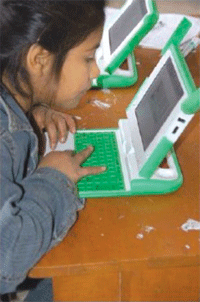
One Laptop Per Child in India :Fostering Learning Learning : Satish Jha, One Laptop per Child (OLPC) India, India

The US

Digital Divide Data: Cultivating Human Capital in Cambodia and Laos : Mai Siriphongphanh, Digital Divide Data

Digital Divide Data is the product of the collaborative entrepreneurial efforts of Mai Siriphongphanh and Jeremy Hockenstein. Though from dramatically different backgrounds, Mai and Jeremy are united in their passion for effecting social change through DDD.

Growing up as a young Laotian woman in a traditional family, Mai challenged the status quo all her life. She survived the country’s oppressive communist regime of the 70s and 80s, and pursued education defying her father. Later on, she moved to Australia to attend business school, hoping to cultivate skills that she could bring back to Laos to alleviate its poverty. In business school, she encountered the theory of social enterprise, and identified the model as what Laos needed to jumpstart its economy.

Upon her return to Vientiane, Mai sought out Jeremy and DDD, then in its embryonic stages in Cambodia and looking to open an office in Laos. Mai recognised this nascent model as the perfect platform through which to effect the change she knew was needed.

Jeremy too shared the same inspiration: he saw the potential for social enterprise as a tool to cultivate the human capital in Cambodia and Laos. From his childhood in Montreal as the son of a Holocaust survivor, through his education at Harvard and MIT Sloan and his work with McKinsey, Jeremy looked for a way to apply his business management skills to a meaningful cause. On a vacation to Angkor Wat, he was struck by the juxtaposition of internet cafes and English schools with the devastating poverty on the streets. With the eye of a business analyst, he recognised that the region had the same surplus of inexpensive labour that made India and China outsourcing stars, but none of their access to the global market. Jeremy felt that this work could be the heart of a social enterprise which would help southeast Asians break their cycle of poverty.

Taking a significant risk, Jeremy left a lucrative career as a consultant to establish DDD in 2001.When Mai joined Jeremy at DDD, she took this spirit of leadership even further by strengthening DDD’s social mission to focus on human development. She refined DDD’s social enterprise model, re-innovating it as a mechanism for training a new corps of leaders. By weaving personal development and leadership training into DDD’s mission, Mai and Jeremy have created a sustainable social enterprise that serves as a vehicle for human resource development.

In an interview with Digital Learning, Mai traces the vision of DDD, its activities and how it is successfully bringing about a transformation among the youth in Cambodia and Laos.

Please introduce us to the core idea of Digital Divide Data. What was the vision and objective behind its establishment?

Digital Divide Data (DDD) bridges the divide that separates young people from opportunity in Cambodia and Laos by providing disadvantaged youth with the education and training they need to deliver world-class, competitively priced IT services to global clients and acquire the essential business skills that help them break the cycle of poverty.  We are an innovative, internationally acclaimed non-profit organisation that operates with a strong business model and has already generated more than US$ 2.5 million in revenues. Our focus on economic sustainability allows us to reinvest our profits in social and economic programmes that deliver lasting change for our employees and their communities. Over the past seven years, we have trained more than 1000 people with marketable skills, and more than 200 of our staff have graduated from entry-level jobs to employment opportunities that earn them six times the average income in Cambodia.

What challenges did DDD initially encounter in the days following its set-up?

Our most challenges are how to move away from commodity work such as basic double entry to a higher-value work with high quality but can still be done by low-skilled people and how to develop and upgrade our local managers’ skills and knowledge to support our ongoing success and expansion.

The other challenge is how to set up sustainable sales function in the US and Europe.

In the last seven years since DDD started functioning, what are the changes that it has brought about in the lives of people associated or working with it?

In the past seven years DDD has been delivering the essential education, an invaluable first-job experience in the global economy, essential income, and management training that equips our staff with marketable skills.  The most important element of the DDD model – the empowerment of individuals and the shaping of leaders – is the hardest to quantify. What we have instead are stories: Naleak came to DDD’s Phnom Penh office disheartened; born disabled. She had only two fingers on each hand, barring her from better-paying office jobs. At DDD, she learned to challenge what others told her about the confines of her disability. She received the same training and attention as each of her peers, and within months became the fastest typist in the Phnom Penh office.

Heng grew up in relatives’ homes in Phnom Penh. Her father, a cigarette smuggler, was shot and paralysed when she was only 13, forcing her to skip school in order to sell bread in the market. Unable to afford university tuition, Heng sold rice to support her family until a friend told her about DDD. She worked at DDD for two years, developing technical skills and simultaneously earning her bachelor’s degree in computer science, one of the only women in her field. She now works as a master trainer of teachers in Cambodia, passing on her expertise to others. Every one of our employees has a story like these. While DDD’s figures point to our success, it’s in these private triumphs that we take the most pride.

Apart from employment, what kind of training is provided to these youths?

DDD recruits disadvantaged and disabled youth in Cambodia and Laos lacking educational or employment opportunities. By focusing on young, ambitious individuals from the poorest and most underserved segments of the population – orphans, rural migrants, formerly trafficked women and the disabled – DDD aims to maximise its social impact. Prior to their employment at DDD, young disadvantaged group join the DDD programme for 3-8 months to develop basic computer and English skills; they improve their typing speed and accuracy, are schooled in commonly applicable software, develop problem-solving skills, and practice their skills on closely simulated DDD jobs. Upon completion of the training period, students who meet DDD’s standards are hired to join the organisation as entry-level employees.

These employees split their days between on-site training and further education. They work six hours a day on actual client projects, closely mentored by experienced managers. To simultaneously foster these individuals’ broader potential as leaders, all employees are required to attend regular internal training workshops that focus on personal development and career management. Employees spend the rest of their days at school, earning their degrees in three to four years. This educati


Tech access to students

Providing students access to technical software, Microsoft on Wednesday unveiled 'DreamSpark,' a software giveaway for over 10 million qualified students in the country. DreamSpark will give students access to the latest Microsoft developer and designer tools at no charge to 'unlock' their creative potential. Launching the project at the Indian Institute of Technology, Delhi, Microsoft Corp Chairman Bill Gates said, 'We want to do everything we can to equip the new generation of technology leaders with the knowledge and tools they need to harness the magic of software to improve lives, solve problems and catalyse economic growth.'

'Microsoft DreamSpark provides professional level tools that we hope will inspire students like you to explore the power of software and encourage you to forge the next wave of software-driven breakthroughs,' he told the students. The software will be available online on www.dreamsparkindia.com and in offline format through DVDs distributed by programme partners NIIT, Aptech and Hughes Net Fusion Centres. The project was announced by Gates in February. It is estimated that up to 35 million students will be able to access these software titles free of charge through this programme. Union Minister of State for Human Resource Development D. Purandeswari said though both India and China were of special interest to Microsoft owing to their market potential, India was unique because of other reasons. The Minister said Microsoft would provide the link to DreamSpark website from Sakshat portal.

LATEST NEWS