Globally, the education sector has seen a shift from black boards to white boards with marker pens over the decades. But a much more powerful change in the last decade has been the emergence of class  rooms without walls, with the rise in internet connectivity and the phenomena of online learning or e-Learning. Though this model has become something like a norm in the developed parts of the world, Europe and United States, countries in other parts of the world are just about making a foray into this new realm of possibilities. In this article we look at Malaysia’s tryst with e-Learning as an alternative to traditional teaching techniques at the school level
In Malaysia, e-Learning is largely used only for distance learning programmes at the university level or twinning programmes offered by private colleges along with foreign institutions. The need for integrating ICT in education to prepare Malaysian students for a fast evolving knowledge based economy finds mention in the Vision 2020 document, which was announced by then Prime Minister Tun mahathir Mohamad in 1991. As a result of this, computers and broadband access was introduced in schools.
The very first reference to e-Learning was made way back in 1999 in the government Multimedia Super Corridor (MSC Malaysia) blueprint for Smart School Flagship Application. The blueprint talked about e-Education initiatives in other countries, particularly New Zealand.
In a benchmark study conducted in 2003, New Zealand was identified as one of the countries whose ICT-led education was closest to Malaysia’s educational system. Taking a cue, the Malaysian government has worked towards leveraging the power of technology to lay a foundation for a new era of ‘anyone, anywhere and anytime learning’. Supporting national policies have been formulated from time to time to emphasise the government commitment on strengthening ICT in education.
State e-Learning initiatives
Among the major inititatives undertaken by the Malaysian government to boost e-Learning include projects like Malaysian Smart School, MySchoolNet, Penang e-Learning Community Project, and K-Perak e-Learning Cluster Project.
Malaysian Smart School
In order to reinvent the country’s educational system and enable students to become lifelong, self-paced and self-directed learners, the Malaysian Smart School was launched in 1997as part of the MSC. To capitalise on cutting-edge technologies and jumpstart its deployment in schools, a group of pilot schools was picked up in 1999 that would serve as the nucleus for the eventual nationwide roll-out of the concept.
The pilot project test-bedded the Smart School Integrated Solution, which comprised the following components:
-
Browser-based teaching-learning materials (and related print materials) for Bahasa Melayu, English language, Science and Mathematics;
-
Computerised Smart School Management system;
-
Smart School technology infrastructure involving the use of IT and non-IT equipment; Local Area Networks for the pilot schools, and a virtual private network that connects the pilot schools; and
-
Support services in the form of a centralised Help Desk, and country-wide service centres to provide maintenance and support.

The project ended in December 2002, with 88 networked schools throughout the country, 1494 courseware titles for Bahasa Melayu, English language, Science, Mathematics, a computerised and integrated Smart School Management System, a Help Desk, and a Data Centre, and trained administrators, teachers and IT coordinators from all the pilot schools.
A Smart School Qualification Standard (SSQS) was introduced in 2006 to measure the use of ICTs at the 88 smart schools. The schools were graded on their ICT strengths and given a star rating from one to five stars.
By 2010, the project is to be extended to all 9000 schools in the country under the Smart School Integrated Solution (SSIS).
Penang e-Learning Community Project
The Penang e-Learning Community Project (SIPI) was initiated in 1997. Managed primarily by the Science University of Malaysia, this state-initiated project spearheaded the development of web presence, web-based services and collaborative web-based tools for the purpose of providing necessary information to the educational community in Penang state. The project provides services like web hosting, email, and electronic discussions, and the website hosts the homepages of around 100 schools.
MySchoolNet
MySchoolNet website was set up by the Ministry of Education to provide links to educational information nationwide. The key feature of the website is the interactivity that it offers Malaysian school students to communicate with students in other countries.
K-Perak e-Learning Cluster (KPEC) project
Launched in March 2007, the three-month pilot KPEC project was designed to provide professional development for teachers and build e-learning capability in a cluster of five selected schools in the state of Perak. The aim was to enhance the capabilities of teacher and equip them with such skills as to integrate ICT in teaching at both primary and secondary levels.
The initiative, managed by New Zealand-based Innovation New Zealand Education (iNZed) group, offers both face-to-face capacity building and online support to bridge the digital divide. In-school facilitators provide ICT training to teachers at five Malaysian schools and also provided professional development for identified teachers from the selected schools (‘mentor teachers’). Teaching and learning content is made available to teachers through the project website, which features an interactive forum.
Through this capacity building process, teachers are guided in creating ‘virtual field trips’, which emphasise student participation and collaboration both between the cluster schools and with schools in New Zealand.
Under the initiative, an assessment rubric has also been developed which is used to measure the achievements under the programme.
In its quest to turn Malaysia into a scientific, progressive and developed nation by 2020, there have also been endeavours from the government to use e-Learning to foster an interest in science as a subject among students. Through a remote or virtual laboratory, master teachers can reach the entire school population in Malaysia and provide students an opportunity to acquire scientific knowledge and skills and also practice them.
Malaysian Grid for Learning
The Malaysian Grid for Learning (MyGfL) is another national initiative undertaken by MIMOS Berhad to provide systems and tools to enable and support e-Learning activities for life-long learning and also bring together all relevant players (learners, enablers and providers) to participate in the overall e-learning value chain and be part of the national learning grid. The MyGfL also strove to develop e-Learning standards to ensure conformance and adoption of best practices in e-learning content and systems and also encourage sharing and development of local/indigenous content. Cikgu.net is one example of projects under MyGfl, which is maintained by Jaring, a subsidiary of MIMOS Berhad.
Launched in March 2000, Cikgu.Net is an education portal with contents in Bahasa Melayu. The portal has attracted thousands of registered users and some 120,000 visitors. Using Malay language as a teaching medium, the portal has managed to establish a firm compatibility between itself and the country’s educational system. The strong backing it has received from Sultan Idris Teaching University (UPSI), Pearson Education Malaysia, Dewan Bahasa dan Pustaka (Malaysian Institute of Language and Literature) as well as other large organisations has made Cikgu an important contributor to Malaysia’s education sector.
Role of private sector in fostering e-Learning
 The entry of private sector has also given a huge impetus to e-Learning in Malaysian schools. Although a strong push from the Ministry of Education has been a significant element in the country’s e-Learning initiatives, the design and development of these initiatives has been carried out through a collaboration of private corporations. This has ensured that every primary and secondary schools are provided with similar infrastructure and services, thus enabling a greater sharing of the e-Learning content created by the teachers and students across Malaysia.
Smart Utusan Education Portal
 The Smart Utusan Education Portal has been set up by Utusan Melayu Berhad. This educational gateway attracts an average of six million visitors every month and contains teaching and learning material for all levels of school education. Within the portal, students can get access to the past year’s national examination questions; and teachers can view interesting teaching plans for mathematics and science subjects. There is also an interactive forum for visitors to share their thoughts and cyber chat, try the e-laboratory or play games. Schools can also publish their web ages.
National Education Blueprint 2006-2010
Transforming Education
The emphasis of the National Education Blueprint 2006-2010 this year has been on new initiatives to prepare a platform for the transformation of education in 2010. These include implementing pilot projects at the preschool and primary school level; a national assessment system; and technical and vocational education.
 The blueprint has announced about a new curriculum at primary school-level which would be introduced in 2010 to make it more holistic and less examination-oriented for pupils. The new curriculum will be based on six key areas which were communication, spiritual attitude and values, humanitarianism, literacy in science and technology, physical and personal development. The emphasis in Years One and Two would be on ensuring that pupils master reading, writing and arithmetic. Reasoning skills, scientific and ICT knowledge, and nurturing creativity would also be stressed. In Years Three, Four, Five and Six, the emphasis would be on acquiring more complex skills and knowledge.
As of June this year, 2,263 preschool classes have been set up to benefit 56,575 pupils. In line with the plan to have preschool classes at each national school, another 704 preschool classes will be opened in 2009.
The ministry will also transform technical and vocational education to make it more relevant and attractive to students.
Six strategies have been introduced, which include introducing a skills stream for those in Form One, strengthening the technical and vocational curriculum, increasing the involvement of professional bodies and industry and adding five new vocational schools in the five economic corridors.A new assessment system has been piloted in 50 primary schools since June this year. The main aim of the transformation was to make learning fun and to move away from an examination-oriented environment.
Of the 17,356 development projects planned for the five-year period of the Blueprint, 4,280 projects have been completed and another 5,026 are in the process of being constructed.
Of the 320 action plans drawn up, 235 (or 73.43%) have achieved their targets.There are now three core sectors ‘Policy and Education Development, Education Operations and Professional Development’ after the restructuring which has already taken effect.
Under the Blueprint, the Government has increased promotional opportunities for teachers and improved training programmes. A total of 32,234 promotional posts for graduate and non-graduate teachers for the whole country have been created for 2009. Based on projection, there is also a need for an additional 13,297 teaching posts for secondary schools and 19,807 for primary schools until 2012. As of June this year, 9,503 posts have been approved for secondary schools while the remaining posts will be requested through next year’s budget expenditure.
Cluster schools have been defined in the Blueprint as excellent schools within an existing grouping, and each is supposed to be a role model for other schools.
The schools can apply for funding of up to RM500,000 to carry out various projects, and must also identify niche areas (curriculum and non-curriculum) that they want to focus on.
In.trique Learning Module
In.trique is a complementary school-based learning experience which provides users complete learning control and solutions to improve learning capabilities and scores. The programmes offered conform to the syllabus set by the MOE and cover the following subjects: Bahasa Melayu, English, Mathematics, Science, Mandarin language, Mathematics and Science in Mandarin, and Geography.
Edubestari.com
Offered by Prism Vision NetworksCorp, Edubestari.com was one of the first portals to cater to the needs of both the teaching as well as learning community. Its conducive and interactive learning environment offers up-to-date learning material, which is in line with MOE’s syllabus. The advantages of Edubestari.com include a virtual learning and monitoring system, easy access of material for children, one stop centre for entire information on educational materials for students, and integration point for teachers, parents and students.
Intel’s World Ahead Initiative Intel Corp and the IT wing of the Education ministry – Bahagian Teknologi Pendidikan (BTP) – have been working together to improve e-learning in schools nationwide. This partnership, which comes under the chipmaker’s World Ahead Initiative, involves the implementation of the 1:1 (one-to-one) e-learning model where students are each given a specially-designed RM 1,050 notebook computer called Classmate. Under the programme, which was kickstarted in April last year, 10 urban and rural schools in peninsular Malaysia are participating. The programme will be monitored by officials from BTP every three to six months to see whether the students are receiving any benefit from the computers. The project will run for three years, during which BTP and
Intel will look at the impact of computers on students.
Malaysia is the third country in the world to implement this e-Learning model, the other two being Nigeria and Brazil.
Challenges like infrastructure, content and teacher education pose real problems in effective use of e-Learning in schools and so it can rightly be called in its infancy stage
Challenges and Issues Involved
Although the lure of Internet based learning is undeniable, rapid changes in the sector require that educational institutions in Malaysia review their technological status from time to time. Challenges like infrastructure, content and teacher education pose real problems in effective use of e-Learning in schools and so it can rightly be called in its infancy stage.
 Even though the government is giving priority to Broadband connectivity and PC penetration to ensure maximum reach of Internet, financial constraints and geographical locations have made it difficult for many schools to access high speed bandwidth. Hence prioritising infrastructure rollout and its upgradation is essential in aiding successful implementation of e-Learning.
Online content poses another basic building block for e-Learning as students must be able to access library materials, newspapers, relevant educational information and much more online in the native language as well as English. Availability of rich online content makes informal Internet learning possible and contributes to structured e-learning programmes run by schools. By keeping censorship and regulation to a minimum, the Malaysian government has considerably supported the creation and dissemination of content and also encouraged schools, libraries and industry players to increase online content.
e-Learning is a natural way to make teachers focus on active pedagogies and interactivities and thereby profit from the whole range of new multimedia possibilities. However, content developers must be aware that the medium itself is no guarantee for a fascinating result.
It is also important to have both a vision on the objectives of e-Learning packages that are to be produced and clear views on technical standards and computational resources of the students. Not all contents are suitable for e-Learning. In addition, the construction of interactive graphs and complex animations is time consuming and costly, and should hence be efficient over in-class lectures.
Regular training programmes for teachers and school administrators need to be held to update them on teaching methods and IT competencies. Moreover, instructional methods that work for students sitting in a science laboratory may not reach students at the far end of a cable line. Measures also need to be taken to address the reluctance of students and teachers to use new technologies as this would lead to wasting of investment. Teachers also need to be trained in the creation of electronic teaching materials.
Conclusion
Malaysia’s vision of achieving fully developed nation status by 2020 and of becoming a competitive player in the global knowledge-based economy has made integration of ICT an absolute necessity. Although the government recognizes e-Learning as a wondrous tool
in improving education and ensuring our students’ competitiveness in the era of globalisation, future developments call for more coordinated efforts from the government agencies and industry players.The content development industry needs to bring in more creative innovations to keep pace with new trends and fast changing technology







 LearnHub.com, an online social learning network, has announced the launch of free CAT community on their website. Learnhub.com is a centralised online education destination for teachers and learners, launched by Canada based e-Learning company Savvica Inc in which Indian education content providers Educomp Solutions has a majority stake.
 Global talent development corporation NIIT has launched a spectrum of products and solutions for next generation schools under its ‘NIIT eGuru’, in collaboration with Intel and Microsoft. The solutions comprises interactive classrooms for teachers, ‘Math Lab’, and ‘IT Wizard’ for students, and an ERP solution for school management ‘Quick School’.
 Scientists at the Watson Research Centre of IBM in Cambridge, Massachusetts, have created an experimental website ‘Many Eyes’ (www.many-eyes.com), where users can upload the data they want to visualise, then try sophisticated tools to generate interactive displays. These might range from maps of relationships in the New Testament to display of the comparative frequency of words used in poltical speeches.
 A Silicon Valley company is claiming a major victory in its efforts to sell computers to schools that might otherwise be enticed by low-cost laptops such as the green-and-white XO from One Laptop Per Child or Intel’s Classmate PC. NComputing Inc. has announced it would be providing computers in 5,000 schools in Andhra Pradesh. The deal is expected to benefit 1.8 million students in the state due to the special software they use. .
 John Wiley & Sons Inc. and the University of Texas at Austin have announced a partnership in a pilot project to license Wiley’s digital learning materials to students directly via the University. The materials include WileyPLUS, an integrated suite of teaching and learning resources, featuring an online version of the textbook, homework management tools, an online gradebook, interactive tutorials and simulations, as well as image libraries. The primary goals of this pilot are to improve the teaching and learning experience for students and faculty, while reducing the costs to students.
 Sources said Takshila Management Services proposes to build three schools in Hoshiarpur (Punjab), Ahmednagar (Maharashtra) and Gaya (Bihar) to be ready for the coming academic fiscal by June 2009. The company has also intended to set up further 25 schools over the next couple of fiscals.
 Malaysia has made significant progress in the education field over the years and earned international respect for successfully establishing a commendable education model, UNESCO Director-General Koichiro Matsuura said. ‘We are happy that there has been very good progress in the area of education in Malaysia and the strong leadership of the minister (Education Minister Datuk Seri Hishammuddin Tun Hussein)’ he said.
 Quistor, a provider of hosted and fully managed eLearning Solutions for regional and global institutions, has opened its first Asian office in Kuala Lumpur, Malaysia in a bid to further expand its sales operations in the Asia Pacific region, and support new customers.
 A Malaysian firm will be cooperating with one of Saudi Arabia’s largest conglomerates to set up a university in the oil-rich nation. The university will be a branch of the newly-established Asia e-University (AeU), a Kuala Lumpur-based collaborative university ratified by the 30 Asia Cooperation Dialogue countries.
 College affordability will be the focus of five public hearings across Pennsylvania. The Higher Education Council under Pennsylvania State Board of Education said it is seeking testimony from students, parents, college officials and others about the challenges of paying for rising college costs. The council also wanted to know how students might be able to obtain a degree without taking on massive debt. Officials say Pennsylvania college students graduate with an average of almost US$ 23,000 in student loan debt.
 America’s Harvard University topped the list of top 200 universities of the world by Times Higher Education-QS University Rankings, followed by Yale University from US. Universities of Cambridge and Oxford from the UK were ranked third and fourth. In addition, nine institutions from Asia, including three based in Hong Kong, were included in top 50. British universities slipped down the ranking with Cambridge and Oxford losing ground to Harvard and Yale. India’s two Indian Institutes of Technology (IIT Delhi and Mumbai) have been ranked 154 and 174, respecti-vely in the list. On the other hand, China has as many five universities in top 200.
 An increasing proportion of higher education funding in South Africa was being spent on science, engineering and technology, with the improvement of education remaining a medium-term spending priority, according to the National Treasury’s Medium Term Budget Policy Statement.

 University Grants Commission has accepted the report of its Pay Review Committee after making some minor changes in its recommendations. Acknowledging that Readers in colleges/universities could have got a better deal, UGC made some changes in the pay band. It also emphasised that after the pay hike, universities will have to ensure high teaching standards. The recommendations will now be sent to the Ministry of HRD, which will consult the Finance Ministry before accepting the recommendations.
  The Ministry of Human Resource Development has redesigned the National Literacy Mission (NLM) to infuse new enthusiasm into it and check the declining rate of literacy. The restructured programme will be known as 'Lok Talim'. Taking inspiration from Mahatma Gandhi's 'Nai Talim', the new name represents India's composite culture as it is a combination of Hindi and Urdu words.
 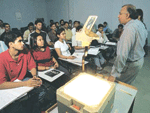 Following the DU Academic Council's decision to obtain the views of teachers before introducing semesters at undergraduate level, teachers in colleges are weighing the viability of such a system. Though many see hurdles in the system and an increased workload, some do agree that semesters will have more benefits for students if the university provides sufficient logistical support. S K Chawdhury, who teaches English at Shri Ram College of Commerce, explained that 'a semester system is desirable as it would help integrate DU with other places making exchange programmes with foreign universities possible'.
  The Indira Gandhi National Open University's Distance Education Programme 'Sarva Sikshya Abhiyan (DEP-SSA) will hold workshops for master trainers in communicative English from October 16 till February 18 next year. Workshops are being held at Kerala, Delhi, Hyderabad, Bhubaneshwar and Bangalore. The DEP-SSA training module has been designed for resource persons who will tutor basic teachers and trainers working at the grassroot level.
  The strategy to work hard for internal exams and score high marks has backfired for many Delhi University students. In a move meant to bring parity among colleges, the university has moderated the internal assessment marks of its students. So students in top-rung colleges like Sri Ram College of Commerce, Lady Sri Ram, Jesus and Mary College and St Stephen's have lost marks.
 The IITs at Kanpur and Mumbai have been running such a course for a long time, but the response was tepid. 'The nuclear sector was confined to government set-ups such as the Department of Atomic Energy, where salaries were measly. But with the sector opening up to private participation, we expect the demand to rise,' said Professor Sanjay Dhande, director, IIT Kanpur.