Home Blog Page 1545

IIT and Sun Microsystems alliance for skill training in Africa

Sun Microsystems has announced a partnership with Asia's leading technology training provider NIIT that will support
the development of talent in Africa.

Skills have been highlighted as a major area of focus for development by African governments.The programmes will include Sun Learning Services training material around Solaris and Java integrated into the curricula for students.

The roll out will initially occur at 30 training centres in Nigeria, targeting several thousand students with the aim to get them to Sun certifications level.The first scholarship programme in Nigeria saw a huge response where 70 000 applicants participated. NIIT's global alliance with Sun has enabled its courses and the latest curriculum in Sun's technologies to thousands of Nigerian students through our NIIT centers located across the length and breadth of this vast African continent.

The partnerships will be part of a successful talent transformation in the region as the two global leaders combine forces to deliver quality training to students to meet the demand for skilled force in Africa.

Education divide widens across states

PHD chambers analysis reports a 2% drop in cumulative expenditure of states on educational services. The analysis reveals the difference between low spenders and high spenders are four times and significantly the gap is widening rapidly, overtime.

A decline in fund flow in education sector is leading to a deterioration of infrastructure at the primary and secondary level in the states.As a result, Indian households are compelled to spend 1.4% of GDP on private education as compared to 0.7% in OECD countries, leading to education deprivation essentially among the poor.

The cumulative expenditure of states on educational services as a percentage of total expenditure has dropped from 20% in 1995-96 to around 18% in 2007-08, according to an analysis made by PHD Chamber. The other major finding of the PHD Chamber analysis is that the inter-state differences in per capita education spending across states is widening per capita fund flow to education, in 2005-06, varied from Rs.483 in UP and Rs.487 in Bihar to Rs.1034 in Maharashtra and Kerala and Rs.1777 in Himachal Pradesh.

There is inadequacy of government schools, especially in the rural areas and acute shortage of trained and motivated teachers.Ironically there is a moderate to steep fall in education spending even among high growth states with strong pro-reform credentials. For instance, the Southern states of Tamil Nadu and Karnataka, which have in the past done relatively well in the development of educational facilities for the public, are showing signs of fatigue. Similarly, in Kerala, which has so far recorded the highest literacy level in the country, there is a decline in overall investment in education.

It is appaling to observe that the state governments continue to spend more on non merit subsidies (water, power, administrative expenses) rather than utilizing available funds for asset creation and maintenance of existing facilities in the area of education.

IGNOU launches mobile services

News and information relating to IGNOU for its students will now be SMS away.The first level of mobile services will start
in next 15 days with info about its courses such as exam dates, updating personal details etc.

The project has three levels. The first level will be started within 15 days wherein  bulk messages will be send to millions of students enrolled with IGNOU containing information about various courses, subjects and also about this SMS service. The second level will involve enabling the students to send SMSes to the university to get information on various courses, subjects, related projects, examination and its results. In the third level, the students will be able to update their personal details in their profiles, like address, phone number etc, directly through the software designed by us.

This is the first time an educational institution is adopting mobile-enabled services to its students.This will connect IGNOU to remotest areas in the country and extend its reach to other countries.

IPPTN Malaysia: Facilitating ‘Living nationality’ Interview: Prof. Morshidi Sirat, Director, IPPTN

The National Higher Education Research Institute (IPPTN) was set up by the    National Council  for Higher Education in August 1997  as a platform for        research and policy making to convert Malaysian public and private universities as centres of excellence.  Keeping this thrust in mind, IPPTN set about identifying issues and critical challenges related to higher  education to help develop institutions of higher learning in Malaysia. It has  also conducted various research to help formulate issues and strategies to develop institutions of higher learning. It plays a proactive role in identifying issues in the implementation of the National Higher Education Policy, and acts as a research coordinating body as well as resource centre on higher education issues.
Apart from these objectives, an Action Plan 2006-2010 was formulated to conduct research on higher education  n the context of current changes and  hallenges; establish networks with overseas research organisations and organise and participate in international conferences and workshops; lead training activities in higher education policy research, particularly involving CLMV countries (Cambodia, Lao PDR, Myanmar and Vietnam); and act as a centre for information dissemination and research output on higher education through publications. Few of the research undertaken by IPPTN include: Study on the Academic Promotion Process in Malaysian Public Universities, Study on the Changing State-Higher Education Institutions Relationship, Towards  Ideopolis Kuala Lumpur: Capitalising on Higher Education for the Development of Globalising City-Region, Project on Quality Assurance and International
University Rankings in the Asia Pacifi c, and Strategic Roadmap for the
Private Higher Education in Malaysia (Proposal) Since 2007, IPPTN has also been acting as the Secretariat for Ministry of Higher Education’s think tank group while its Director Prof Morshidi Sirat chairs the think tank group.
Prof Sirat took over as the Director in April 2002 and chairs various regional and national committees on higher education policy directions. His research interests include comparative international higher education, construction of national and regional knowledge spaces, and governance in higher education institutions. Prof Sirat has co-ordinated numerous research on Malaysia’s higher  ducation institutions and system such as Changing Academic Profession in Malaysia; Futures of Higher Education in Malaysia; Models for Universities
in Malaysia; etc. He also undertakes consultancy for international agencies like UNESCO, World Bank, specifi cally in the area of international higher education. He is also on the Editorial Advisory Board of Higher Education Policy Journal of the IAU. In a interview with Digital Learning, Prof Sirat sheds light on the
activities of IPPTN, higher education landscape in Malaysia and issues 16 October 2008 | www.digitalLearning.in IPPTN has conducted several major studies and subsequently recommended olicy solutions to problems such as  cost  of living for students in higher education institutions, graduate unemployment, ethnic polarisation, and quality of faculty in private higher education institutions Malaysia’s higher education institutions, internationalisation and international education issues, and curriculum development. Besides organising regional workshops, and carrying out  trategic  olicy studies and preparing policy papers, IPPTN organised the  Global  Higher Education Forum 2007.  More than 350 education leaders,  scholars,   nd policy makers from 43  countries came together to reflect and analyse   hallenges in higher education  and also ways to improve its quality.   From  2006 onwards, IPPTN has also  begun to look closely at Malaysia’s  higher   ducation system and pursuing  a global and regional comparative  perspective.   wo most important studies  completed by the body includes ‘Future  of Higher   ducation in Malaysia’, and  ‘Model for Universities in Malaysia’.

What factors led to the setting up of
the IPPTN?
In pursuance of its objectives of creating excellence in higher education and making Malaysia a regional higher education hub, the National Council for Higher Education under the Ministry of Higher Education felt there was a need for setting up a higher education research institute. As such the National Higher Education Research Institute (IPPTN) was set up at the Universiti Sains Malaysia, Penang, in August 1997under the aegis of the Ministry .

What have been the contributions of IPPTN to development of Malaysia’s higher education?
Between 1997 and 2004 IPPTN has conducted several major studies, investigated and subsequently recommended policy solutions to problems such as cost of living for students in higher education institutions, graduate unemployment, ethnic polarisation, and quality of faculty in private higher education institutions. Other studies conducted by the body revolve around issues of industrial training, competitiveness of

What steps   ave   een taken by IPPTN to the development of curriculum? 
At IPPTN, we are  rimarily concerned with education curricula and workplace  literacy. A study was undertaken on this issue and another study on social skills and work values  in the medical education is now nearing completion.

Tell us about the higher education policy research under the IPPTN. As far as higher education policyresearch is concerned, there are six main thrust areas of IPPTN:
Curriculum development and preparation of an entry-level workforce; Governance of  ublic universities; Changing condition for academic work career; Growth and development and transnational higher education services; Higher   education and regional engagement; and Higher education system. Please comment on the changing landscape of higher education, regionally and globally. Matured and developing higher education systems have reacteddifferently to the processes and societal transformations noted globally. In  oththe systems, we observed the following major developments in higher  education: Expansion in higher education (with massification in the developing higher education system); Differentiation or segmentation of higher education as a response to the differentiating demand for higher education by offering course programmes beyond the mainstream; Greater flexibility, i.e. a multiplication of study options; Quality orientation; and Standardisation.As a result of the above, the landscape of global, regional and national higher education is in constant change, and the following challenges are likely tobecome characteristic trends in higher education in many countries: •
• shaping the knowledge society, generating employability, integrating the  imension of sustainability,internationality, quality orientation and  ompetitiveness, development and use of new forms of teaching and learning.
‘Living internationality’ is already becoming a reality in the context of the EU and is expected to be necessary in Asia in the future. The rise of neoliberalism ideology and new public management (NPM) approach is making future  cenario of higher education more complex.

How much of focus is there on  cience  and technology in Malaysia?
The level of focus on Science and Technology in Malaysian higher   education system is very high, both in terms of allocation of resources (national development plans) and relevant policies/regulations.

What according to you is the role of private universities and distance education in making Malaysia a regional higher education hub?
The role of private and trans-national   providers is very important. Both conventional and increasingly nonconventional modes of delivery are important in positioning Malaysia  as a regional higher education hub. Necessary quality assurance framework has been put in place to regulate and monitor this sector and non-traditional mode of delivery. In the private sector, there is no quota for international students in their undergraduate programmes. Notably,there is excess capacity among private providers in courses such as IT, business and management.


Mobile Teacher Project launched in Bahrain

The Government of Bahrain has launched a mobile teacher project to assist blind students at public schools. Under the project, teachers of the Saudi-Bahraini Institute for the Blind regularly visit blind students to look into their needs and inform their teachers about how to deal with these students.

An integration programme of blind students in public schools started years ago at the secondary level. However, the programme was expanded three years ago to integrate blind students at every level of the education system. The mobile teachers who are familiar with the learning abilities of blind students visit their schools to teach them some courses. All textbooks for blind students had been printed in Braille and these students had also been trained on movement techniques to facilitate their movement at schools. All students were provided with speaking laptops to avoid them from being excluded from the ministry's IT and e-learning initiatives.


Program could turn Arkansas’ school buses into classrooms

A pilot program that has transformed school buses into mobile virtual classrooms in one Arkansas school district is worth expanding across the state. The Aspirnaut Initiative, launched in April 2007 in the Sheridan School District, equips students with laptop computers and iPods and allows them to take online math and science courses while traveling to and from school.

The program seeks to address the growing need for people entering the work force with knowledge of the so-called STEM subjects – science, technology, engineering and math. A 2007 study evaluating the academic proficiency of 15-year-olds from 30 countries ranked the U.S. 21st in science and 25th in math. According to the estimation, around $2 million in the first year and $1.5 million in each of the second and third years, the program could be expanded at the rate of 2,000 students per year. The money would be divided equally between Arkansas' four congressional districts. To date, students in the pilot program have completed 14 semesters of study in addition to their regular course load. The students are given headphones which help them tune out noise from other students on the bus who are not in the program. The non-participating students are offered iPods to give them something to occupy their time quietly.

Portuguese Government partners Microsoft to launch Magellan Learning Suite

The government of Portugal has partnered with Microsoft Corp to accelerate technology adoption in education with the international launch of the Microsoft Magellan Learning Suite.

In support of the Portuguese government's “e-Escolinhas” program, Microsoft has developed a comprehensive suite of software, training, content, services and support for the Magellan, an affordable portable computer for primary and junior high school students made in Portugal. The launch of the Microsoft Magellan Learning Suite draws on the involvement and expertise of the Portuguese government and the technology industry, including Carlos Zorrinho, coordinator of the Technological Plan in Portugal, a far-reaching initiative by the government to provide Portuguese citizens with the latest technology to support their participation in a knowledge-based economy. In addition to efforts to bring cost-effective computing solutions to students and teachers around the world, Microsoft offers a host of technology-based education solutions, programs and products through its Partnerships for Technology Access (PTA) and Partners in Learning initiative. PTA has served over 1.5 million citizens in similar public-private partnerships worldwide. Earlier this year, Microsoft renewed its worldwide commitment to Partners in Learning, through Microsoft Unlimited Potential, with an additional five-year in vestment of $235.5 million (U.S.) that aims to triple the impact of there sources and training that already has touched the lives of more than 680,000students, teachers and education policy-makers in Portugal since its launch in 2004.


IPPTN Malaysia Facilitating

The National Higher Education Research Institute (IPPTN) was set up by the National Council for Higher Education in August 1997 as a platform for research and policy making to convert Malaysian public and private universities as centres of excellence.
Keeping this thrust in mind, IPPTN set about identifying issues and critical challenges related to higher education to help develop institutions of higher learning in Malaysia. It has also conducted various research to help formulate issues and strategies to develop institutions of higher learning. It plays a proactive role in identifying issues in the implementation of the National Higher Education Policy, and acts as a research coordinating body as well as resource centre on higher education issues.

Apart from these objectives, an Action Plan 2006-2010 was formulated to conduct research on higher education in the context of current changes and challenges; establish networks with overseas research organisations and organise and participate in international conferences and workshops; lead training activities in higher education policy research, particularly involving CLMV countries (Cambodia, Lao PDR, Myanmar and Vietnam); and act as a centre for information dissemination and research output on higher education through publications.

Few of the research undertaken by IPPTN include: Study on the Academic Promotion Process in Malaysian Public Universities, Study on the Changing State-Higher Education Institutions Relationship, Towards Ideopolis Kuala Lumpur: Capitalising on Higher Education for the Development of Globalising City-Region, Project on Quality Assurance and International University Rankings in the Asia Pacific, and Strategic Roadmap for the Private Higher Education in Malaysia (Proposal)

Since 2007, IPPTN has also been acting as the Secretariat for Ministry of Higher Education’s think tank group while its Director Prof Morshidi Sirat chairs the think tank group.

Prof Sirat took over as the Director in April 2002 and chairs various regional and national  committees on higher education policy directions. His research interests include comparative international higher education, construction of national and regional knowledge spaces, and governance in higher education institutions. 

Prof Sirat has co-ordinated numerous  research on Malaysia’s higher education institutions and system such as  Changing Academic Profession in Malaysia; Futures of Higher Education in Malaysia; Models for Universities in Malaysia;  etc. He also undertakes consultancy for international agencies like UNESCO, World Bank, specifically in the area of international higher education.  He is also on the Editorial Advisory Board of Higher Education Policy Journal of the IAU.

In a interview with Digital Learning, Prof Sirat sheds light on the activities of IPPTN, higher education landscape in Malaysia and issues

What factors led to the setting up of the IPPTN?

In pursuance of its objectives of creating excellence in higher education and making Malaysia a regional higher education hub,  the National Council for Higher Education under the Ministry of Higher Education felt there was a need for setting up a higher education research institute. As such the National Higher Education Research Institute (IPPTN) was set up at the Universiti Sains Malaysia, Penang, in August 1997under the aegis of the Ministry .

What have been the contributions of IPPTN to development of Malaysia’s higher education?

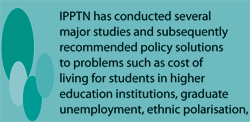
Between 1997 and 2004 IPPTN has conducted several major studies, investigated and subsequently recommended policy solutions to problems such as cost of living for students in higher education institutions, graduate unemployment, ethnic polarisation, and quality of faculty in private higher education institutions.  Other studies conducted by the body revolve around issues of industrial training, competitiveness of Malaysia’s higher education institutions, internationalisation and international education issues, and curriculum development. Besides organising regional workshops, and carrying out strategic policy studies and preparing policy papers, IPPTN organised the Global Higher Education Forum 2007. More than 350 education leaders, scholars, and policy makers from 43 countries came together to reflect and analyse challenges in higher education and also ways to improve its quality.

From 2006 onwards, IPPTN has also begun to look closely at Malaysia’s higher education system and pursuing a global and regional comparative perspective. Two most important studies completed by the body includes ‘Future of Higher Education in Malaysia’, and ‘Model for Universities in Malaysia’.


What steps have been taken by IPPTN to the development of curriculum?

At IPPTN, we are primarily concerned with education curricula and workplace literacy. A study was undertaken on this issue and another study on social skills and work values in the medical education is now nearing completion.

Tell us about the higher education policy research under the IPPTN.
As far as higher education policy research is concerned, there are six main thrust areas of IPPTN:

  • Curriculum development and preparation of an entry-level workforce;
  • Governance of public universities;
  • Changing condition for academic work career;
  • Growth and development and transnational higher education services;
  • Higher education and regional engagement; and
  • Higher education system.

Please comment on the changing landscape of higher education, regionally and globally.

Matured and developing higher education systems have reacted differently to the processes and societal transformations noted globally. In both the systems, we observed the following major developments in higher education:

Expansion in higher education (with massification in the developing higher education system); Differentiation or segmentation of higher education  as a response to  the differentiating demand for higher education by offering course programmes beyond the mainstream;
Greater flexibility, i.e. a multiplication of study options; Quality orientation; and  Standardisation.

As a result of the above, the landscape of global, regional and national higher education is in constant change, and the following challenges are likely to become characteristic trends in higher education in many countries:

shaping the knowledge socie

Room to Read : Crafting New Educational Solutions : Erin Ganju, Room to Read

Erin Ganju is the co-founder and chief operating officer of Room to Read. She has been instrumental in creating the scalable approach the organisation employs to create flexible, adaptable programming to meet the diverse needs of each of its partner communities. She manages the design of Room to Read’s programmes as well as its launches into new regions. She also oversees more than 250 employees and operations worldwide, including the Programmes, Development, Finance and Human Resources departments.

Erin has spent extensive time working and living overseas in Hong Kong, Singapore, Indonesia and Vietnam. Prior to joining Room to Read in 2001, Erin held high-ranking positions with Dejima Inc., e-Commerce infrastructure provider Network Commerce, leading consumer products company Unilever N.V., and international investment bank Goldman, Sachs & Co. She holds a combined bachelor’s and master’s in International Relations and Economics from The Johns Hopkins University in Washington, D.C.

In an interview with Digital Learning, Erin shares with our readers the challenges and issues involved in community development through education.

Please shed some light on the education scenario in Asian and SE Asian countries with regard to rural communities. What are the challenges involved for Room to Read ?

To give a brief overview, some of the challenges with the educational systems in Asia include the lack of adequate school facilities, shortage of quality teachers, lack of books and teaching materials, challenges with relevancy of the curriculum particularly for a rural child, and the high drop out rates for students in secondary schools, especially among girls.

Room to Read began working with rural communities in Nepal in 2000 to build schools and establish libraries. The organisation’s geographic reach expanded rapidly as significant needs and opportunities were identified in Vietnam, Cambodia, India, Laos, Sri Lanka, Zambia and South Africa.  Our holistic approach now includes building schools, establishing libraries, publishing children’s literature in local languages, providing long term scholarships for girls, and establishing computer labs.

How far is the SE Asian region from attaining the goals of EFA by 2015?

Overall, few countries have achieved or are close to achieving the EFA goals. Pre-primary enrollment has steadily increased and progress towards universal primary education has been made, but the challenge of expanding pre-primary education remains especially great in countries like Cambodia and Laos.  In almost all countries in the region there are still major gender disparities and disparities due to wealth and ethnicity.

Please elaborate on the major programmes of Room to Read in Asia and SE Asia.

Room to Read has developed a holistic, multi-pronged approach to help children in the developing world gain the lifelong gift of education. The approach includes the following programmes:

Inspiring Next-Gen Innovators at Early Age : Tom Joseph, Asia Pacific Education Programmes

Tom Joseph is the Director of Asia Pacific Education Programmes for Autodesk, Inc and leads a team that is focused on introducing Autodesk’s 3D Design products to the next generation of architects, engineers and designers.  Previously, Joseph was the Senior Manager for the Asia Pacific education and marketing team. Joseph started his career as designer with Thyssen Krupp

LATEST NEWS