

Home Blog Page 1549

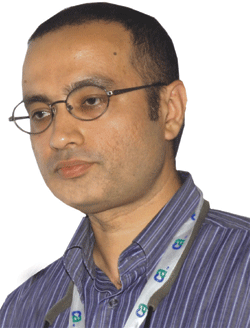
Reinventing Education With Real Life Experiences : Ashish Rajpal, Managing Director-iDiscoveri

Having lived in France, India, Russia and the US, Ashish Rajpal, Managing Director, iDiscoveri, blends a successful track record at Fortune-500 companies with a passion for education. A co-founder, he has an MBA from XLRI and an Ed.M (Mind, Brain and Education) from Harvard University. Drawing upon his inter-disciplinary background in education, management and cognitive psychology, Rajpal has done innovative work in the areas of school curriculum, teacher education, leadership, and creativity.

In an interview with Ashish Rajpal, Digital Learning gets a peep into the social enterprise called iDiscoveri

Please tell us about your journey from the management to education sector. How did iDiscoveri come into being?

I started my career in Procter & Gamble in India and then moved to Russia and finally France, where I was the Worldwide Marketing Director for Groupe Danone. While my career was taking off in the corporate world, my attention was gradually turning towards education, entrepreneurship and India. My two young children led me to understand that each child is created different; yet the schooling we receive does not necessarily cater to those differences. I studied the works of leading educationists like Howard Gardner, John Dewey and Sri Aurobindo. I realised that each child has an innate potential that can be unleashed if the educational experience was connected to real life. I wanted to invest the rest of my life creating and scaling up a quality educational programme that can reach a large number of children. I took a break from work to study at the Harvard Graduate School of Education and then returned to India in 2002 to lead iDiscoveri.

iDiscoveri was co-founded in 1996 by me and a group of classmates from XLRI Jamshedpur. We started off as a small adventure-based summer programme called Youreka

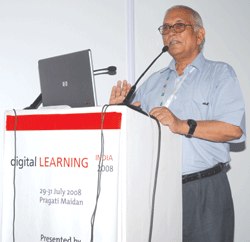
A Model for Innovation : K K Dhawan, Mira Model School, India

A teacher of Physics and Director, Mira Model School, K K Dhawan has about 45 years of teaching and administrative experience in India and overseas. While teaching in Nigeria in 1978, he came across the first Sinclair computer and knew at that time that technology was going to revolutionise teaching and learning. In the 90s when he joined Mira Model School, he started using computers in his classroom. He also held a workshop where hands on experience of technology to Physics teachers was given, under the aegis of National Progressive Schools Conference in 1993. Subsequently, he established a separate department of Learning Through Computer in the school and also made many modules for teaching science and mathematics. This innovation won the school many awards from Intel, Government of India, British Council, etc. At present Dhawan has tuned his energies into promoting the concept of globalised education, which is a new dimension of technology.


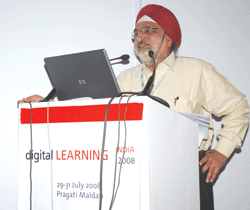
Digital Learning shares with readers Dhawan’s passion for innovation in education.


Please trace the journey of Mira Model School towards ICT integration.

In 1999, in the name of  computer education, students would be told about terms like hardware, floppy, CPU, monitor and RAM. I felt that we should go further than than that and so asked the teachers to integrate computers in classrooms to make it more interesting.  In 2000 we bagged the national award for the best presentation on integrating technology in curriculum hosted by Intel. This was a major inspiration which thrust our school on the path of ICT. Our school also participated in the competition held by the Ministry of Information and Technology on excellence in computer education in the year 2003 and were the second runners up. In 2005, we introduced the concept of globalised education in our school and in the last two years, we have successfully established regular interactions between our students and those of British schools. We also have Smart  Classrooms.

How did you go about implementing HeyMath. What has been the response of the children?

We introduced HeyMath in class 6 as an experiment to see the response of children. With its visual effects, students found it quite interesting. So we held an orientation programme on this  for parents of middle school students. Initially only few parents and students came forward, but I am hopeful that more students will come into the fold once sufficient interest is generated. There is also an option of evaluating the performance of children with the help of feedback given by the website. The website monitors how the students are using the software and whether assignments are being done. I thought introducing this would be a small and innovative step towards changing the whole concept of teaching Maths and would also help eliminate boredom among teachers and students.

Do you think that collaboration with foreign institutions is something that is inevitable and good for Indian schools?

Earlier it was difficult to imagine this type of collaboration. But today technology has given birth to a new slogan – ‘kar lo duniya mutthi mein’ (you can hold the world in your palm). Imagine the power technology has given to our children; they can now interact with their peers  from around the  world and exchange their work.
My school uses a special software Super School++, which has been provided to us by the British Council. In the wide wild world of internet, this software  gives children and teachers a safe corridor to interact. Each user has an email and also web pages where they can upload notes on various topics  for others to see. All this has been possible because of technology. Technology has brought all of us so near; it has transformed the world into a small village.

What are the major challenges in implementing ICT in schools?
To implement ICT in schools, one needs to be aware of various technology available and how to go about its implementation. We need to address the fear among teachers in accepting technology. While introducing technology, one needs to keep in mind the three T’s – technology, teaching and technique. Content, infrastructure and delivery system are the three basic requirements for introducing technology, but the most important thing is the willingness to do it. The biggest challenge is bringing ICT to schools in rural areas and government schools in urban areas.

The inertia among teachers to use technology aids is another challenge and we need to look at ways of breaking it. I believe that the technology wave is here to stay and we have to accept it for our
own good.

Jamia opens Urdu medium school for girls

In order to promote education among Muslim women, Jamia Millia Islamia has opened a senior secondary school exclusively for girls. The Jamia Girls Senior Secondary School will cater particularly to those sections that seek education through Urdu medium.

The vice chancellor also announced that 10% seats would be reserved for students belonging to poorer sections of society. ‘The school will hold lessons for classes IX to XII. Class IX will have four sections, three offering education in humanities and one in science stream. There will be around 25 students in each section. In class XI, students will be taught sciences and computers only. The new school will employ 16 new teachers trained in Urdu medium.’

Mumbai convent schools to bring down class strength

The Archdiocesan Board of Education (ABE), Mumbai has decided to bring down the class strength to 45-50 students per class, after repeated complaints from teachers about the deteriorating teaching quality. About 150 schools are governed by the ABE.

‘With more than 75 students in a class, the quality of teaching is gravely affected. Teachers also complain of not being able to give proper attention to students. At the end of the day, students are the sufferers,’ said Gregory Lobo, Secretary of ABE. Once approved, the new rule will be implemented from the next academic year. The authorities are also working on reducing the school fees. At present, students have to pay Rs.10 per month and in unaided schools, around Rs.350-400 per month.

Green Clubs planned in 250 schools in TN

Hailing Tamil Nadu for the successful implementation of the National Green Club (NGC) programme in schools since its inception in 2001, Udayasankar, Deputy Director (Environment Education), Ministry of Environ-ment and Forest, said, ‘As many as 7,500 clubs will be started in 250 schools per district across Tamil Nadu in the current financial year.’ Udayasankar said that in each school around 40 students would be enrolled in the NGC and they would be trained

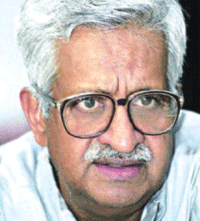
Sensible Use of Technology Imperative for Improving Education in India : Dr B S Bhatia, Former Director- Development and Educational Communication, India

India has a history of more than 30 years of satellite broadcast. The satellite revolution started in 1975 under the aegis of Ahmedabad-based Development and Educational Communication Unit (DECU) of Indian Space Research Organisation (ISRO) with the Satellite Instructional Television Experiment (SITE) project. Digital Learning walked through the years of satellite broadcast with Dr B S Bhatia, former director DECU, as he shared his experiences and the future of digital communication at eINDIA2008 held in New Delhi.
Please comment on the changes in the technology landscape over the years in India. How has it impacted the education sector?

Technology has evolved substantially in the past four decades. e-Learning actually started with radio broadcasting of programmes, then came television. We started with issuance of learning license for broadcasting educational programmes for schools. Then with SITE experiment came the satellite television. This was primarily aimed at school children in rural areas and we installed televisions in about 2000 schools. However, its infrastructure demanded a huge set up and this technology was expensive for that period. But with computers becoming an in-built component of the working environment the production cost of learning material has come down drastically. The satellite technology demanded a huge studio set up with equipments, but today anyone with basic computer skills
can create learning material for classrooms. The whole scenario has changed from the technology point of view.

Technology brings with it issues of access and quality. If we get down to school level, although computer availability has increased across the country, Internet connectivity is yet to reach many areas. Moreover, the computer aided educational programmes available freely are either not monitored or evaluated. Plus we need to focus on capacity building activities. On one hand teachers need to be trained in using ICT effectively in classrooms and on the other we also need to evaluate the content reaching schools.

India has made great technological advances, which needs to be sensibly put in place for improving education at the grassroots level. EDUSAT was one such attempt to provide computer network in schools and colleges and thereby introduce ICT in education. The next phase of technology wave will see wireless technology for schools.  Educational bodies like National Council of Educational  Research and Training and the University Grants Commission have started work in this direction.

What kind of technology does the education sector need. Is it one single technology or a blend?

It has to be a blend of technologies. For example, college students have access to mobiles and Wi-Fi connectivity, whereas the technology environment in schools mostly involves computer labs and ICT enabled teachers. The blend of technology used also varies with the audience. For example, both the community radio and campus radio can serve as a platform for interaction amongst college students.
At a time when a plethora of content is being pushed into schools by the market forces, do you think there is need for some standard on the quality of learning material?  

With computer penetration increasing in schools, the space for computer-based content has increased. Apart from computer-based content, there are also many players for television content across the country.

As there is lack of quality benchmarks for e-content, some companies just copy textbooks and make CDs. Hence, we are working on standards for quality content to ensure that only quality content reaches schools. A working group on Quality Content Assessment has been formed with the active support of Commonwealth Educational Media Centre for Asia (CEMCA) to look into the process of production and standardisation of e-content. We believe quality benchmark can be assured by following a level of period testing. So first we are talking of assessment, this will be followed by grading and finally certification. We aim to bring in a mechanism for production of quality e-content, prescribing to quality benchmarks.

With Technology Comes New Opportunities : Dr V S Ramamurthy, Chairman- Board of Governors, IIT Delhi, India

Currently the Chairman, Board of Governors, IIT Delhi, Dr V S Ramamurthy has held several positions in his long and distinguished career with a reputation of serving his responsibilities with great dedication and professionalism. He was the Scientific Officer, Nuclear Physics Division, Bhabha Atomic Research Centre, Bombay from 1964-1982 and Head, Fission Physics Section, BARC Bombay from 1982-1989. From 1989-1995, he was the Director, Institute of Physics, Bhubaneshwar. From 1995, he served the Government of India for a period of ten years as Secretary, Department of Science and Technology.
In an interview with Digital Learning on the sidelines of eINDIA2008, Dr Ramamurthy shares his views on issues related to education.


Is the current policy landscape suited for innovation in India’s higher education sector?

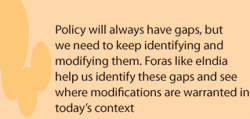
Policies are in place because they were relevant at one time. But over a period of time they become irrelevant and outdated. When a certain policy is not allowing you to function effectively in today’s context, we need to modify that policy. For that consultations are carried out and a revised version is brought out. But by the time the whole process is completed, a new change occurs resulting in the revised version also becoming outdated. Policy has to be a dynamic document; it cannot be a static. It will always have gaps, but we need to keep identifying and modifying them. Foras like eIndia help us identify these gaps and see where modifications are warranted in today’s context.

Do you think policy reforms have addressed the need of the education sector?

It is difficult to say yes.

The e-Learning sector has seen fast paced developments in the last few years. How have they impacted the education scenario?

With new technology comes new opportunities. The Internet offers us an opportunity to move information anytime, anywhere. On one hand, we need to see how to make use of this technology for educating a person residing in a village or a rural area. On the other hand, we are living in a technology-driven world where nobody is out of its purview. So familiarity with technology is necessary to take full advantage of it. Today technology touches every field, like healthcare, agriculture, education, etc. This implies that everybody needs to be exposed to technology skills along with education. For accomplishing this task, we need to have teachers, resources and infrastructure. But its not possible to create them overnight. Now is the time to start grooming teachers.  A teacher is today’s student. Moreover, education is no longer related to schools and colleges. In this fast paced world, we have to constantly keep ourselves updated to keep pace with our competitors. And it may not be possible to go back to the university due to time or age constraints.  So we need education in the office,  at home. It has to be any time, any place, affordable and accessible. Internet can make this possible. The challenge is to make use of technology effectively.

Do you think IT can give a boost to teaching as a profession?

Career options are based on one’s interest and flair and also the remuneration offered by the profession. In today’s environment the teaching profession needs support and incentives from the government. A teachers’ salary should be matched to the scale that a student gets once he/she gets employment in an MNC or a public sector. For example, if a student joins Infosys, he gets five times the salary of the teacher. It’s a complex game of employment and financial incentives. The issue can be resolved with focus.

What do you think of the importance given to education sector in the 11th Five Year Plan, vis-a-vis expenditure and projects for school and higher education.

I am very glad that ample emphasis has been given to education in the 11th Plan and lot of investment planning has been made for the sector. It will take some time till we see the actual impact on the ground.

There are three levels of teaching; first is general education where everyone has basic knowledge and soft skills up to class 12. General education does not generate knowledge or address the requirements of the technologically-driven industry. Hence the need for the next level of professional education where people have problem solving skills. All college education – technical and non-technical –  translates  into professional education. Unfortunately today a large section of people who enter colleges do not get professional education. The third level is that of knowledge generators. While the gradual progression from general education to R&D is seamless, they are distinctly different and their strategies have to be different. There are lots of weaknesses in the system. Today most of the landscape is driven by the market. But we need to go beyond the market and the government should take initiative in this regard.


Slowly innovation is being recognised as an integral part of education. Entrepreneurship and innovation will convert knowledge into real economic benefits. I have always pushed for and believed in that.

MBD Alchemie to launch e-learning portal in India

MBD Alchemie, an online education academy of   MBD Group is launching an e-learning project in India is an endeavour to become India's mass education offering through dissemination of high quality standardized content across the country. The site is now transitioning itself from being a purely online academy to becoming a knowledge portal.

MBD Alchemie was launched in 2007 with an initial investment of Rs. 20 crore to create a simple Graphic User Interface (GUI) and an excellent Proprietary Learning Management System (LMS) to act as the perfect front-end and backend for the delivery of its content. Today, the company has invested another Rs. 50 crore to transform into a knowledge portal.  

The first phase (online academy) was to introduce the courses for students of class 10th & 12th of Central Board of Secondary Education (CBSE) and for AIEEE and AIPMT preparation. New course on IIT-JEE, STATE CETs, State Boards (Xth and XIIth), are in the pipeline and will be launched very soon. It is coming up with State Boards of Punjab, Gujarat, Maharashtra and Karnatka. Once the knowledge portal is launched, the curriculum would be available in the respective regional languages as well.  

A MBD group spokesman said that with distinctive features like personalized coaching including self paced learning mechanism, self test tool, extensive self-education, online problem solving facility; MBD Alchemie is highly interactive and the instructional interface is very simple. 

MBD Alchemie has recently announced its strategic partnership with IBM to launch its definitive knowledge portal. The emphasis is on creating an e-learning atmosphere that is targeted at all, and not limited to students of academics only.   The focus will be on offering something to anybody seeking knowledge, be it formal education or learning on any topic.

This portal will provide formal academic learning to the students enabling them to take tests and also to the teachers to provide content and training to the students. It will help parents to gather reports of their wards performance along with the facility to discuss with their mentors areas of improvement. The portal is designed for institutions and authors to collaborate to put the best content and an infrastructure to track every student's performance. It also provides different stake holders the ability to get their employees certified in different vocations.

Microsoft India selected for corporate excellence

As many as eleven finalists, including Microsoft India, have been selected for the Secretary of States prestigious 2008 Award for Corporate Excellence (ACE). The pool was from 61 nominations submitted by US ambassadors around the world.

“ACE finalists are international business leaders who recognise the vital role that US businesses play abroad as good corporate citizens” The State Department has said.

Microsoft India has been in the finalists' list for empowering small and medium enterprises, promoting economic development, and strengthening innovation through strategic product development, including improved technology for HIV/AIDS and TB diagnosis”.

Another corporation is Virtusa in Sri Lanka for providing the country with an effective disaster recovery system that is widely used throughout the region, and for providing widespread IT skills training.

The Secretary has awarded ACE since 1999 to recognise US businesses for advancing good corporate citizenship, innovation, and democratic principles.

The Secretary of State will announce the 2008 ACE winners during a award ceremony at the State Department on November sixth.

eJeevika IIT-M training villagers for employment

A venture of the Indian Institute Technology, Madras, or IIT-M, is training villagers for employment in retail, business process outsourcing and security services, in an attempt to bridge the urban-rural divide.

EJeevika's business model is simple: it identifies entrepreneurs through village council heads, non-profits and self-help groups and offers them a franchise.

The entrepreneur invests some Rs50,000 on a couple of personal computers, a broadband Internet connection and power back-up.
The franchisees then identify potential candidates who are then trained by eJeevika according to the requirements of its clients.
For now, eJeevika has developed training modules for security services, retail and business process outsourcing and would develop modules for other sectors depending on client requirements.
Villagers who wish to be trained register with eJeevika's website after which the company conducts an online interview in the presence of its client. Once the client gives a go-ahead sign, the candidate pays a fee and undergoes online training. Mishra says the fee is “nominal,” without elaborating. The candidate then has to clear online tests, interviews and a final face-to-face interview with the client. The entire process takes around a month, said Mishra.
The firm has successfully piloted its model in Cuddalore and Tiruvallur districts of Tamil Nadu, she said. EJeevika trained and placed some 100 candidates with the help of a network of 20 franchisees in a few retailers and security services firms. Mishra declined to name clients citing business confidentiality.
“This is what we need at the moment. There is a shortage of labour supply. There are talks about inclusive growth and here is a good example of inclusiveness,” said Rajesh Sukumaran, investment manager for Singapore-based angel investment fund Mercatus Capital's India operations.
With a nine-member team backing her, Mishra plans to train and find jobs for some 200,000 people in the next couple of years through a network of around 1,000 franchisees in the rural districts of India.
“We will handhold the franchisee owner to help him set up the centre. What we are looking for is that he should be dedicated, besides being computer literate and a local guy,” Mishra said.
EJeevika has a mix of field workers and technical staff. It also has tied up with corporate human resources experts who help improvize on training content to make it relevant to villagers.
“India requires innovations like these,” said Ravi Narayan, managing director at Mentor Partners, that works closely with start-ups. “IT (information technology) as a business model has become pass

Guruvar Awards

At a time when teachers have been demanding better pay packages in order to attract and retain talent in the profession, this could come as some good news. A private trust has announced rewards worth Rs.2 crore for teachers which honour the “Best Teacher” with a whopping Rs.51 lakh.

Varkey GEMS Foundation, a trust instituted by the owners of GEMS Education, announced the award programme for teachers

Wired classrooms could be the next big thing

Today's classrooms are increasingly available through several channels

Central university in each state by 2012

The University Grants Commission (UGC), which maintains standards for university education in India, is formulating the National University Act for the establishment of 30 central universities in the country.

During the 11th Five-year plan (2007-12), the government proposes to establish one central university in each state (where it does not have one) and provide assistance for establishing one college in each district with a low Gross Enrolment Ratio in higher education.

The financial requirement for these universities is estimated at Rs 4,800 crore during the 11th Plan period. Currently, around 20 per cent of the budgeted expenditure on higher education is met by the central government.

Functioning of these central universities will be modelled on the lines of the New Delhi-based Jawaharlal Nehru University. The government is planning to have world-class standards for the central universities, which would be located in or near selected large cities.

The universities will be multidisciplinary with a national and international faculty pool. A common entrance test is also being planned. However, any decision regarding the universities concerned will be taken after they are up and running.

Bringing an ordinance in place is a necessary condition to facilitate the formation of these universities. Establishment of these central universities in the above states is subject to state governments offering adequate land at suitable locations and free of cost. Each state government concerned is being requested to offer land accordingly, says a professor familiar with the development.

In three states, the existing state universities will be taken over by the central government and converted into central universities. These three universities are

LATEST NEWS