Home Blog Page 1565

Distance learning degrees valid for Government jobs


All distance learning degrees awarded with recognition from distance education Council (DEC) are valid degrees for applying and obtaining central government jobs, the Indira Gandhi National Open University (IGNOU).

“The government issued a notification in 1995 stating that all qualifications awarded through distance education by the universities stand automatically recognised for the purpose of employment to posts and services under the central government, provided it has been approved by the distance education Council,” IGNOU Vice Chancellor V.N. Rajasekharran Pillai said.

Pillai's comment has come at a time when thousands of degree certificates awarded by the University of Madras and other Tamil Nadu varsities through the distance education programme for over a decade have been declared invalid for government jobs.

“Let me clarify that all universities need to get DEC approval before starting any distance education programme and awarding degrees. Without DEC approval, the degree has no value,” declared Pillai who is also the chairman of DEC.

Several vice chancellors of state open universities under the DEC were in Delhi to deliberate on distance education system in the country.

Pillai said the DEC has decided not to insist on territorial jurisdiction to be followed by institutions or varsities in offering programmes through distance and on-line modes.

Times of India launches ‘Teach India’ campaign

The 'Times of India' brings you a chance to give back what you've learnt, calling upon educated Indians like us to help teach underprivilged children though the “Teach India” campaign.

“Teach India” is an initiative by 'The Times of India' to help provide an equal opportunity for education to underprivileged children.

The aim of “Teach India” is to provide a platform to educated Indians to provide assistance in basic education to the unprivileged children.

“Teach India” will connect educated individuals with the specialist education providers.

'The Times of India' has tied up with select NGOs in the field of education in multiple cities across India.

Participants have to devote just 2 hours a day to teach underprivileged children, either in a formal environment or even informal teaching like story telling.

Graduates in UK enjoying higher salaries

New figures have shown that youngsters graduating from university in United Kingdom  are earning an average salary of

Vocational Education Board to be setup in UP

To give Uttar Pradesh a spiffy image and capitalise on the sheer number of its huge population, the state government, along with its partners, the industry and the Confederation of Indian Industry (CII), has chalked out a plan to enhance the employability of its youth through skill. For this, the government is giving final shape to the proposal for setting up of a separate board for vocational education. This board will work on the lines of any other educational board as far as developing a curriculum, conducting examinations and maintaining the standard of the training is concerned. 'The proposal is being given shape and once the elections are over, we hope to get it cleared by the cabinet,' said Alok Ranjan, principal secretary, vocational training & technical education, government of UP.

Stating that skill development should be in proportion to the population of a state, Ranjan said UP's share in the national population is 17 % and this should reflect in the skill development of our population. Taking part in a round-table discussion on enhancing employability through skill development and knowledge economy, industrial development commissioner, VK Sharma said, 'Skills and knowledge are the driving forces of economic growth and social development for any country.' He added that the potential target group for skill development comprises all those in the labour force, including those entering the labour market for the first time (12.8 million annually), those employed in the organised sector (26 million) and those working in the unorganised sector (433 million) in 2004-05. The current capacity of the skill development programmes is 3.1 million. The objective of the session, organised by CII, was to help the industry to be able to share its concerns for trained manpower in diverse disciplines, and the academia. Ranjan requested industry members to consider forming Vocational Training Providers (VTPs) at their respective industry units to enhance skill development.

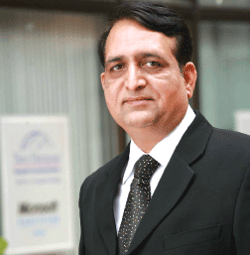
Looking Beyond the IT Horizon : Ajay Sharma, CEO- New Horizons India Ltd

As the President and CEO of New Horizons India Ltd, Ajay Sharma is responsible for managing the company’s India operations and establishing it as a leading IT Training company in the region. With over 25 years of experience in the industry, Sharma has held senior managerial positions and been part of the Shriram Group of companies since 1979.

In an interview with Digital Learning, Sharma sheds light on the educational scenario in India and the constructive role that New Horizons India is playing to enhance the educational experience.

Please share with us the growth trajectory of New Horizons India Ltd.

As the name suggests, New Horizons India is a joint venture of the Shriram Group with New Horizons Worldwide. Operational since 2002, it is engaged in the business of knowledge delivery through acquiring, creating, developing, managing, and licensing knowledge in the areas of IT, applied learning, technology services and supplementary education. The company has 15 offices all over the country and employs over 700 people. We continue to report 100% growth in our business chart for the fifth year,  ending March 2009. I am very confident of meeting the target rate. As the paid figure goes up, I do not see any tiredness coming in the system. We are now 750 people compared to some 300 people when we met last. There is growth in revenue, number of cities and in terms of offering. The external environment is very conducive. Addressing the need, executing the plans well and doing what you see is coming your way is the key to larger size and larger contribution.

What do you mean by external environment?

External environment means the macro economic situation of the country. Here I am specifically refering to the education sector. The demography of the country is very unique compared to the West. About 70%  of our population is below 35 years of age and 20% is below 15 in contrast to the United States and Europe where 70% of their population is on the wrong side of the age. In the next 3-5 years the world will face a shortage among the working class.

India, on the other hand, faces a piquant situation. The education system is producing educated people but there is significant difference between a metro educated person and a city or rural educated person in terms of their personality, communication abilities and level of knowledge. There is lack of skilled human capital and industries need skills, be it core skills, multi skills, hard or soft skills. New Horizons is in the right business at the right time and with the right vision.

Tell us about ‘New Horizons Computer Learning Centre’.

New Horizons Computer Learning Centre is the global brand under which all training centres of New Horizons across the globe function. It has franchises in 60 countries, 250 locations, 2,400 instructors, three million students and revenue of US$400 million. It goes far beyond IT training and concentrates on an entire gamut of soft skills like leadership to supply chain management and customisation management. We are currently working on two domains

Constructivism – Emerging Model of Pedagogy : Robert B Kozma, independent consultant- government, multi-lateral agencies

Robert B Kozma has worked as an independent consultant with government, multi-lateral agencies and commercial clients on policies, programmes and solutions that connect use of technology with education reforms. Some of the leading projects that he has been associated with include the Millenium Villages Project in Africa, World Links Arab Region Programme in Jordan, Evaluation of National Technology Master Plan for Singapore. He has also lent his expert skills to initiatives in Egypt, Chile, Thailand and agencies like UNESCO, Ford Foundation, besides corporate clients like OECD, CISCO, Intel, etc.

Dr. Kozma has made valuable academic contribution to the field of technology and its application in education.

In an interview with Digital Learning, Dr Kozma speaks on various aspects of ICT in education, its key role, R&D, ICT literacy, policies, etc.

What key role does ICT play in education?

Information and Communication Technology (ICT) has two primary roles in terms of its application in education. One of its role is to support the existing education system by increasing access and providing additional resources to allow greater efficiency for education processes. By and large, education hasn’t experienced the kind of transformation that businesses have witnessed. For example, if you look at technology in business, it has really changed the way things are done. India is a very good example of how businesses can outsource a lot of back office services and thereby reduce costs.

The second role of ICT in education is to facilitate a transformation in the teaching processes. Technology has enabled many countries to move towards service economy and provide knowledge services. It has changed the way these high-end knowledge workers work. In schools ICT can support a shift towards knowledge workers by developing knowledge skills like information gathering and analyses, problem solving, collaborating, etc. These are the 21st century skills.

Today classroom lectures are given with Power Point presentations and students solve problems on computers instead of books, there are ways the computer can make that model more efficient and extend access. Countries have to consider which model they want to pursue – whether to support education to improve access and increase efficiency or use ICTs to develop 21st century knowledge service/skills.

Tell us about the latest model in the area of technology-pedagogy?

The emerging model of pedagogy is called constructivism, where students learn through a process in which they actively engage in, manage and play a large role in determining what they are going to learn and how and also assessing whether they are doing well or what they need to do to improve. This process grooms the child for lifelong learning. And it fits with increased dynamism in the economy where jobs come and go, creates new ideas and innovations to build an efficient knowledge workforce. This approach to learning connects with the second role of ICT in education as it prepares the students to be knowledge workers with 21st century skills. ICT has an important role to play in this model by supporting education to enable students to be lifelong learners.

In what ways can ICT literacy be incorporated in teacher training programmes?

ICT literacy, also known as ‘Information literacy’ or 21st century skills, refers to use of technology in information gathering, data analyzing, report writing , creating models, ideas and innovations. Using technology for these activities require different type of skills.

Often, teacher training or student programmes are geared towards ICT literacy and a certificate is awarded to support the technology competency standards. But this process is still underdeveloped and involves basic understanding and use of technology in classroom teaching. UNESCO also provides a set of standards that government agencies and private sector can use in designing training modules for teachers.

The emerging model of pedagogy is called constructivism, where students learn through a process in which they actively engage in, manage and play a large role in determining what they are going to learn and how and also assessing whether they are doing well or what they need to do to improve

The other teacher training module focuses on the constructivist notion of learning and knowledge workers. So a country can opt for a training model that supports their goal of education. The key is that ICT policy be aligned with other policies, such as accessibility to education. When it is aligned, the resultant educational reforms will focus on 21st century skills. The educational reforms will have implications on curriculum, assessment, which can be then aligned with components of ICT policy.India seems to be taking the construc-tivist approach. The government needs to do some rethinking on the 11th Five Year Plan and use ICT to approach the goals of education.

What role do you foresee for Research & Development in ICT in education?

Research and development plays an important role in ICT, but simply doing research is not enough. Many studies do not connect with the classrooms as it is done in labs with small groups of children merely to prove a theory.

The aim should be to establish a more integral relationship between the research and classrooms. Researchers need to ask teachers about the problems faced while implementing technology. They need to adopt the problem solving approach where there is collaboration with teachers for solutions. Teachers also need to actively engage themselves in research where they try out new ideas and innovative ways of education delivery.

Take the case of Singapore, the government there is doing high end theoretical research on the technological pay-off investments in ICT in schools have given. It is a field based research involving various organisations rather than the traditional research centre associated with the university.

With technology coming into classrooms, what is the role of teachers.

Teachers are the source of knowledge which is delivered to students, while students are seen as passive listeners. This is the role most school teachers engage in. The use of technology can provide teachers with a new role in which students are more actively involved in designing new products and solving problems by engaging in self-learning. The teacher hence requires a deeper understanding of not just the subject but also the process by which students learn and how to use technology to do that. The teachers here are model learners or guides. For instance they not only know Chemistry as a subject, but also the ways to learn it. So the teacher sets certain criteria to support the students in acquiring knowledge as learners. This is a fundamental shift and requires support and direction for participation.

What are the major mistakes countries make in adoption of ICT in education policy?

First we have to ask what role will ICT play in education, then identify the best way of re-sourcing teachers into the classrooms. Technology and infrastructure are just models of delivery to achieve the educational goals. There is an implicit assumption that putting technology in schools will make a difference, but it is actually an alignment of policies and programmes that matters. This is one of the major mistakes that most of the countries have made.

NCERT missive to Goa education board chief

The NCERT has shot off a letter to the Goa Education Board chief demanding an explanation on why History and Hindi textbooks for class 10 were withdrawn.

Chairman, Board of Secondary and Higher Secondary Education of Goa, Bhaskar Naik had last week said that the decision to withdraw the NCERT book was taken in view of '24 mistakes' and objections raised on a picture of a French Commander shown smoking.

In its letter, NCERT spokesman Bishnu Charan Patro termed as totally false, baseless and misleading Naik's remarks about mistakes.

He also contested Naik's claim that the NCERT had admitted to the book containing the mistakes in an affidavit before Delhi High Court.

'NCERT has never filed any affidavit in any court nor has it ever admitted any mistake in relation to the said history textbook for class 10 titled 'India and the Contemporary World-II,' he said.

Naik was asked to give the specific reasons behind the withdrawal of the History and Hindi textbooks and furnish all the details point by point with documents relating to NCERT's reported 'admission' of mistakes.

About objections on the picture of General Henry Navarre, Supreme Commander of French Armies in the History book, the NCERT spokesman said it is a 'historical' photograph given in the context of the chapter on the nationalist movement in Indo-China and had nothing to do with smoking nor has it anything to do with encouraging students to smoke.

'Modern technology cannot be used to erase the cigarrette from the photo which would be considered as distortion of historical facts,' he said.

When contacted in Goa, Naik said he has not received the NCERT communication and would not comment without going through the contents.

iQ Academy launches statewide virtual school

iQ Academy Washington announced the launch of its online school for all Washington students in grades 7-12, and is now enrolling students for the 2008-09 school year. 

This unique education option provides a high-quality, tuition-free education, small group instruction and one-on-one feedback from certified teachers — all conducted online using a laptop provided by the school.  Students can excel at their own pace and work with Washington-certified teachers who are specially trained in online instruction.  Students will receive individualised attention and participate in dynamic student discussions online.

'We are very excited to take our online school statewide in partnership with KC Distance Learning,' said Michele DeShaw, Coordinator of Alternative Education at Evergreen Public Schools. 'We will now be able to bring the Evergreen Public Schools' long tradition of academic excellence to many more students in Washington.'

iQ Academy Washington is a division of KC Distance Learning, Inc, and operates as a programme of the Evergreen Public School District. 

'Any student living in Washington can take advantage of this online education option,' said Lisa McClure, Director of iQ Academy, 'including previously homeschooled students, athletes, performers and others with special needs, as well as students seeking Advanced Placement courses or electives unavailable in their local school district. iQ Academy is focused on
providing Washington students the highest quality education to provide a solid foundation for pursuing their passions and future goals.'

iQ Academy Washington's award-winning curriculum offers core courses such as English and math, along with extensive Advanced Placement classes.  Unique curriculum offerings — such as virtual science labs and a wide-range of world language courses for everything from Spanish to Mandarin Chinese — provide students with unparalleled educational opportunities.

'Our extensive and unique curriculum provides students access to a complete set of standards-based, media-rich courses and offers opportunities that may be unavailable in a traditional school setting,' said McClure.  Once enrolled, students receive textbooks as required for their courses, a monthly Internet stipend and optional use of a laptop computer.  As in traditional public schools, these learning tools are provided to students at no cost for
as long as they are enrolled in iQ Academy Washington.

Innovation: Mindspark: Digital Adaptive Learning Solution for Kids

Suchismita Srinivas

Vice President
Adaptive Learning Solutions, Educational Initiatives Pvt. Ltd.
suchi@ei-india.co

Educational Initiatives, a private limited company, has developed a learning programme to allow students to engage in enhancing their understanding of different subjects through a series of interactive content, replete with rich animation and visuals, within the comfort of home by using their PC.

This learning programme, called Mindspark, allows students to construct his or her own learning pace. It is an interactive system, where the student is not learning passively by listening to someone or viewing ready-made solutions, but by answering questions of increasing complexity levels.

At the heart of Mindspark is the theory that students learn best when they control the pace of learning. There have been several successful experiments worldwide on this. Mindspark is a genesis of various such experiments.

A key advantage of Mindspark is the fact that it successfully harnesses the power of new technologies to bolster learning. An intelligent computer system uses a complex adaptive logic to decide what problem to serve up to a student next, based on his response to the current problem and problems answered earlier. The system is also able to identify when a student needs help to understand a concept, and proceeds to give her explanations that will help her move ahead.

Foundational Principles of Mindspark

  • Every child learns at her own pace – there is no “ideal” learning rate for a given age group
  • Effective learning takes place if the material presents a challenge that is just above the cognitive level of the student
  • Frequent exposure to appropriate learning material enhances learning
  • Learning through drill alone – without understanding – is not learning
  • Though individual variations exist, there are universal patterns in learning

Key Features

Focus on understanding

One of the most unique features of the Mindspark programme is its focus on understanding and analytical thinking. This is one of the key factors that really distinguishes the Mindspark programme from any other learning programme. For instance, most Maths learning programmes available today use games to create learning. But the quality of learning being aimed at is suspect, since the focus is entirely on procedural fluency – with a lot of drill in +, -, × and ÷, rather than conceptual understanding or application. But today, what any student really needs to move ahead in life is real understanding, and analytical abilities – and that is what the Mindspark programme aims to foster.

Adaptive logic

Mindspark has a built in adaptive logic that allows a student to move at her own pace. This complex logic determines where to take the student after each question – based on her answer to the current one, and also taking into account how she has answered previous questions on that concept.

Typically, a student would select a topic, and start with fundamental questions based on the topic. This is to ascertain that the student has a strong grounding in the topic. A student with a deeper understanding of that topic automatically moves ahead quickly to more advanced levels, while those who need to spend more time on the basics will be served up more questions of the basic level. This feature also ensures that the child does not have trouble in higher classes due to a problem with the basics.

An intelligent computer system uses a complex adaptive logic to decide what problem to serve up to a student next, based on his response to the current problem and problems answered earlier

In Mindspark, the topics are not encumbered with artificial barriers like classes and grade levels. This allows a student strong in a content area to go to advanced problems in that, while a less confident student might get remedial questions from a more basic level. For instance, for a student currently in grade 8 who has not had a strong foundation in Algebra, the system will automatically serve up fundamental algebra questions that would help him clear his basics. On the other hand, a student who is gifted could even attempt advanced problems and topics beyond the prescribed curriculum for her grade level.

Addressing common errors and misconceptions

Many students have misunderstanding of basic concepts that they carry forward from an early age. It is important to identify those and help the child overcome them. Most often, a child does not try to clear these misconceptions due to a lack of opportunity or fear of embarrassment. Research through detailed student assessments provides insights on exactly where students are likely to have difficulties, and why. Mindspark questions are designed on the basis of detailed classroom studies and research in student learning – to specifically target common student errors and misconceptions.

In-depth explanations

Whenever a student goes wrong in a particular type of question, a detailed, concept based explanation is provided for it. Often, the explanations are visual or animated rather than just textual, to facilitate quick grasping. This system of providing explanations allows the student to revisit the concept, and quickly figure out how to tackle subsequent problems on the concept.

Finely graded questions

A special feature of the Mindspark programme is the way in which the questions are graded. The extremely fine gradation of questions allows the system to make sure that a child is truly thorough with a subconcept, before moving on to the next. Also, it helps in pinpointing exactly where the child is having difficulties.

A question from Basic Algebra, to develop the ability to observe and generalize patterns – an important, but often ignored skill to be developed in Algebra

Child friendly features

In addition to the innovative use of visuals and animations to motivate students and foster learning, the programme makes use of other child friendly motivating techniques to encourage students. One of those features is a system of reward points using ‘Sparky’ – the animated light bulb, the Mindspark icon. Sparkies are awarded based on how consistently well the student is doing.

Detailed feedback and reports

In order to help parents and educators track a student’s progress at any time, Mindspark has a system of providing detailed weekly reports. For a parent, the report provides details of how her kid is doing in different topics and concepts. For a teacher, the report not only provides a summary of the progress made by her class, but also details of how each student is progressing different topics and concepts.

The Mindspark advantage

In a real classroom situation, the challenges a teacher faces are manifold. While classroom teaching has its own place, it is near impossible for her to focus on the learning of each individual child – plus our current examination-based assessment system also does not help provide that focused attention.  Mindspark works as a complement to regular classroom teaching and exams by helping each child learn and work on the concept in an self-paced, interactive manner.

Suchismita Srinivas is a graduate in Maths and in Education from Delhi University and also has a Diploma in Child Guidance from IGNOU. Her passion for Maths led her to teaching assignments at primary and secondary levels in various schools for over 14 years. Her main motive was to help children develop a long term interest in the subject. At Educational Initiatives Pvt Ltd, based in Mumbai, she leads the Digital Adaptive Learning content development team


Curtain Raiser eINDIA2008 Setting the Agenda

In recent years, countries including India have responded to the global need to constantly upgrade the ICT skills and adaptability of human trends with more knowledge expansion that can support an accelerated spread of new technologies in the whole system. However, counties are still in different stages of this integration, coping with challenges of infrastructure and implementation. And bringing all those to limelight in order to initiate the action phase is what the eINDIA2008 is getting ready to do.


The Curtain Raiser happened on 30 May with the ‘Meeting of the Program Advisory Board’ of eINDIA2008 Conference at the India Islamic Cultural Centre, New Delhi was organised by the Centre for Science, Development and Media Studies. The meeting aimed to engage the Programme Advisory Board members to discuss and set the agenda for the eINDIA2008 Conference and Exhibition scheduled for 29-31 July 2008, at Pragati Maidan, New Delhi.

Along with CSDMS, the 4th annual eINDIA conference is Co-organised by the Ministry of Communications & IT and Ministry of HRD, Government of India, and also by UN GAID. The conference is framed around seven development themes and technology verticals, like Education, Governance, Health, Agriculture, Telecentres, Municipal, and mobile services.

Held as an evening programme, at the India Islamic Cultural Centre, New Delhi, the meeting drew participation by 25 delegates, comprising members of the Programme Advisory Board, who are the key resource persons from government, representatives from supporting partners and institutional partners, senior executives and leaders from the IT industry and members of the presenting publications of eINDIA2008. It was chaired by R Chandrasekhar, Additional Secretary, Department of IT, Ministry of IT, Government of India.

The programme started with the welcome note by the Chairman of the Program Advisory Board, R Chandrashekhar who laid emphasis on the overriding importance for creating enabling opportunity to encourage new paradigms and intellectual networks through platforms like that to be provided by eINDIA2008.

The opening remark was followed by a presentation by Jayalaxmi Chittoor of CSDMS. Jayalaxmi explained the objectives of the conference; starting from the capturing through sharing and dissemination efforts, she elaborated on the objectives for each of the seven Conference tracks under eINDIA2008 namely- eGov, Digital Learning, Indian Telecentre Forum, eHealth, eAgriculture, Municipal IT, and mServe.

Dr Ravi Gupta, the Executive Director of CSDMS and the Convener of eINDIA2008 also added to the presentation, announced the eINDIA2008 awards. As an attempt to recognise the efforts of the community of practitioners, eINDIA awards, earlier known as i4d awards, will be conferred in different categories, like- ‘Best Government initiative of the year’, ‘Best NGO initiative of the year’, and ‘Best Policy initiative of the year’. Awards will also be given in all verticals of eINDIA2008, for ‘Best ICT enabled farming of the year’, ‘Best ICT enabled Govt Department of the year’, ‘Best ICT enabled School of the year’, ‘Best ICT enabled University of the year’, ‘Best ICT enabled Hospital of the year’, ‘Best innovations at the Grassroots Telecentres’, ‘Best innovative Mobile service provider of the year’, and ‘Best ICT enabled Municipal of the year’.

An open floor discussion followed soon after the presentation, wherein the members and representatives of the Programme Advisory Board were invited by the session moderator, the Chairman himself, to give remarks and suggestions. The discussion that followed touched upon the key issues of each of the thematic areas and relevance of these issues for discussion in the conference. A good number of valuable inputs did come in, laced with words of inspiration and intent of providing support to the conference.

Concluded with suggestions, views and new ideas, it was not the end of the show, just left the members to hold their breath for the real show to begin- eINDIA2008 this July.

LATEST NEWS