Home Blog Page 1572

India attracting Thai, Nepalese students

Thai and Nepalese students prefer Indian educational institutions as they provide quality education at low cost, according to Vivek Shukla, Marketing & Projects head of Afairs, which organises education fairs in India and abroad.

'We act as a bridge between Indian institutions and Thai and Nepalese students,' Shukla said on the sidelines of a press meet to inaugurate an admission fair for under- and post-graduate courses on June 7.

Around 65 Indian institutions are participating in the event.

Thai and Nepalese students come to India not only for post- or under-graduate programmes, but also for primary education.

Thailand and Nepal have limited quality educational institutions. So there is a huge gap between demand and supply that India is helping to fill.

Around 17,000 under- and post-graduate students from Thailand and 10,000 from Nepal come to India each year, Shukla said. 'But these numbers are expected to rise by 12-15%,' he said.

He said most Thai and Nepalese students prefer humanities and engineering.

As far as primary education is concerned, around 2000 Thai students get admitted to Indian boarding and international schools each year.

The students from both countries target mainly schools and colleges in north and south India.

'We organise one education fair in Thailand and one in Nepal each year to disseminate information on Indian institutions,' Shukla said.

We Believe in Right Devices, Right Curriculum and Right Training : Anoop Gupta, Corporate Vice Presiden-Microsoft Unlimited Potential Group

As part of its commitment to delivering accessible technology and transforming education for citizens across the Asia Pacific region, Microsoft Corp Chairman Bill Gates announced some new programmes and partnerships at the Government Leaders Forum – Asia (GLF Asia) in Jakarta, Indonesia recently.

The programmes include new education tools for people with special needs, extension of a skill development and certification programme available through internet cafes in Philippines, further progress of its K-12 programme Partners in Learning, and expansion of Microsoft Innovation Centers in Indonesia.

In an interview with Digital Learning, Anoop Gupta, Corporate Vice President, Microsoft Unlimited Potential Group, Education Product Group, Technology Policy and Strategy talks about Microsoft’s new initiatives unveiled by Chairman Gates.

Tell us about your role in the Unlimited Potential Group.

As Corporate Vice President, Unlimited Potential Group of Microsoft, my responsibility spans education worldwide, product solutions, strategies and new business models for spreading the reach of technology.

Our group is committed to making technology more affordable, relevant and accessible for the five billion people around the world untouched by technology and thereby help bridge the Digital Divide.

By working with governments, inter-governmental organisations, ngos and industry players, Microsoft hopes to attain its first major milestone, of reaching the next one billion people who have been untouched by the benefits of technology, by 2015.

It is a great opportunity to address the need for education, which is the fundamental pillar for people to move ahead. The job requires lot of creativity, innovation and is very fulfilling as a mission.

How does Microsoft plan to further its commitment on delivering accessible technology?

Microsoft believes that technology can play an important role in enabling access to quality education for everyone.  Access has two dimensions: access to education itself and accessibility for people with special needs. We are very excited about our new partnerships with New Zealand-based Weta Workshop and Australian software developer

Northern Territory Institute for Community Education and Development (NTICED). Weta is an Oscar winning animation studio that has done animation for major movies like Lord
of the Rings.

The focus of these partnerships is to develop resources and tools based on Partners in Learning Curriculum that will be available on a portal delivering audio, written text, images and video through rich animation-based content. This will help the estimated 10% of the world’s population living with special needs acquire skills and knowledge through technology.

Please share with us details of the e-Learning initiative in Philippines.

An important concept that drives us is that learning is a life-long endeavour and not something that you can do only up to the age of 18 or 21. Although computer literacy has become a vital workplace skill in today’s knowledge-based economy, millions of people worldwide still lack this skill. We are looking at Internet cafes as  a venue for delivering basic IT education in Philippines.

Under this innovative programme, 16 IT courses, free certif-ications through Microsoft IT Academy Learning Portal and free ‘digital literacy’ courses will be made available in more than 169 iCafes owned by local internet cafe operator Netopia.

Although questions have been raised about internet cafes being used for gaming and entertainment, we believe cafes are a compelling way in which education gets delivered. We are really excited as this will allow millions of people first time access to some of the best skill sets developed by Microsoft.

Chairman Gates announced the expansion of Microsoft Innovation Centres (MICs) in Indonesia. What are Innovation Centres and how do they function?

MICs help develop local software economies through partnerships with universities around the world. Since the first Innovation Center in 2006, a network of 110 centers in 60 countries, including more than 30 across 13 countries in Asia Pacific, have come up. These centers offer software development courses, business skills and employment programmes for students; fosters software quality certification and technology labs; and support the Microsoft Imagine Cup, the world’s largest student software development competition.
In Indonesia, we are collaborating with Pelita Harapan University, Jakarta, to open a new Innovation Center. This is apart from the four centers already running there in partnerships with leading universities.

Imagine Cup is an important aspect of  MIC. The Bandung Institute of Technology Innovation Center has for the last three years fielded the winning team representing Indonesia. This years winning entry, Team Butterfly, showed how technology can help promote environmental cause by creating a tool that allows people to report environmental abuse to government.

The finals are to be held in Paris in July where more than 42,000 students from across the Asia-Pacific region have registered for the competition.

Partners in Learning initiative by Microsoft has been in operation for the past five years. Would you like to share some of its high points and future plans?

Partners in Learning is our flagship K-12 education initiative. This year marks a special landmark for us. We have touched an estimated hundred million students and four million teachers globally through this programme! We take a holistic view on how we believe ICT in education will have a true impact in education learning and that means right devices, right curriculum and right training for the teachers and students.

Earlier this year, we announced a recommitment of USD235.5 million to the programme, which will bring Microsoft’s total 10-year investment to nearly USD500 million. This will enable the programme to significantly expand its impact by reaching more students and teachers around the world in the next five years.

One such example is Korea’s Ubiquitous Learning

(U-Learning) project, developed in collaboration with the Korean Ministry of Education, Science and Technology. Using technological tools like Tablet PCs and mobile devices, students access, share and present content; while school curriculum has also been digitised. Starting with nine schools, the programme has since expanded to 20 and the government aims to fully digitise all curriculum by 2020.

What is the Peer-to-Peer coaching model?

This concept is based on the premise that  teachers look to their colleagues first when they need assistance in  integrating technology into their classrooms. By training teachers to serve as coaches for colleagues, they are able to assist their peers develop necessary skills to integrate technology into classroom

Bringing Knowledge Based Decision Making in to Industry : Kalyanaraman Srinivasan, founder-GlobalScholar.com

Kalyanaraman Srinivasan, popularly known as Kal Raman, is the Indian born CEO and founder of  GlobalScholar.com. He hopes to establish the on-line education platform for teachers, parents, and students in India. Hailing from a remote village in Tamil Nadu with no electricity or running water, the entrepreneur has hopes and dreams of making education easily accessible in India. With the mission to `empower the world to learn`, Kal shares his experiences and journey with Digital Learning.

When and how did your journey towards the path of empowering through education begin?

It started with my life. I was born in a family of five children and our father passed away when I was 15 years old. Our mother brought us up with a pension of  INR.420 per   month. We lived in a house with no electricity or running water in remote village in Tamil Nadu (Mannar kovil). Our mother made sure we got educated. I am who I am today because of my education (God`s grace played the crucial role with good people helping me along the way). So, this concept of empowering through education is very personal and
believable for me.

Could you give us a business overview in terms of the service, product, revenue and performance?

Our business is to empower the teachers, students, parents, and administrators with tools to improve the student outcome. These tools could be used in the class room to manage everyday curriculum, test student progress towards objectives, inform parents/administrators about the student progress etc. These tools can be used to provide supplemental corrective or enrichment education in a 1:1 or 1: many set up also. We also provide information about educational institutions, news, games etc. Our goal is to empower people in the educational value chain with user friendly cutting edge technology. We look at revenues and profits as output variables, but we focus on only one input variable which is `customer experience, one customer at a time`.

In what ways will this concept of an on-line education platform enhance the teaching and learning experience?

These tools will facilitate discipline in teaching and learning. As you know `discipline breeds creativity`. The advantage of providing technology based tools is that we can provide personalised teaching and learning experience for every teacher and student.

How in your opinion will this service change the way educational programmes are currently delivered?

For the first time ever, the educational fraternity will get access to real time and actionable information to impact the student outcome. Multi-national businesses have such infrastructure today to make critical business decisions, but education as an industry is behind in terms of `knowledge based decision making`. We are trying to make the education industry which inculcates knowledge in individuals to have these knowledge based decision making tools. This will empower everyone in the value chain and the final output will be an `improved student learning outcome`.

What makes GlobalScholar different from other on-line services?

GlobalScholar is the first company which is attempting to put end-to-end `knowledge based decision making` in to the knowledge industry. Various successful companies solve problems in the niches but we are the first ones to build a huge infrastructure to provide end-to-end infrastructure to solve the problem holistically. Be it in a classroom, off the classroom, information on educational institutions, sharing relevant news/happenings etc we try to customise the information for the teacher and student. We are also the first company, which is trying to be neutral to content, grade, country, language, etc. This is a huge undertaking which requires passion, commitment, and relentless execution. This dream may take years or even decades to realise, but we are patient
and focused.

How do you rate GlobalScholar in the international market? How has the product fared in the on-line Indian market? In terms of market penetration and acceptance, where do you see GlobalScholar?

Our name suggests the fact that we want to be global. With no marketing, we are ranked highly in terms of traffic in many countries like the USA and India (Alexa ratings). User acceptance will be dictated by the market and technology trends in various countries. We try to think global and act local. For example, we are aware of the low Internet penetration in India (but a high wireless adoption), so we will tailor our solutions accordingly. Everywhere in the world the customers want great customer experience at cheaper prices and that expectation is constant irrespective of the geographical location and we will work towards meeting that expectation. The results will take care of themselves.

In terms of the US, I believe education will be a hot sector. Currently, the big business sectors are technology, media, energy, etc.  Education is not yet a blue chip sector. For the US (and any other country) to maintain a robust economy and remain a player in the global business field, there needs to be a solid educational foundation.

Which level of education is GlobalScholar currently covering- secondary, higher secondary, etc.?

We stand for life-long learning. From K through college and beyond.

Multi-national businesses have such infrastructure today to make critical business decisions, but education as an industry is laking in terms of

Cabinet gives approval to Fulbright programme

The Union Cabinet gave its approval to an agreement that will double the number of scholars exchanged with the United States of America under the Fulbright Educational exchange programme.

It has also rechristened the programme to Fulbright-Jawaharlal Nehru Scholarships and Grants.

Officials said the agreement provides for the creation of the 'US India Educational Foundation' awarding 'Fulbright Jawaharlal Nehru Scholarships and Grants'. Initially about 240 students from India and a similar number from the USA will be sponsored annually under the programme.

The scholarships are given with financial contribution by the Government of India. The Cabinet's approval to the revised draft agreement would also provide equal participation of Government of India in policy and decision-making on the exchange of Indian and US scholars through equal participation in the board of the US-India Education Foundation.

Officials said that the move would serve Government of India's objectives of supporting and encouraging Indian studies, research, instruction and other educational activities for US citizens and nationals in India and Indian citizens and nationals in US schools. 'The progamme encourages exchanges between American academics and Indian universities. Host institutions and organisations on both sides would have the opportunity to develop the desired linkages,' officials said.

The Fulbright programme is also intended to support (with support to research and capacity building), the India-US bilateral initiatives of 2005-06 in agriculture, clean energy, climate change, science and technology, global issues of common concern etc, they said.

Dental faculties launch e-learning initiative

The four dental faculties of the Royal Colleges in England, Edinburgh and Glasgow have got together to provide an e-learning service to dentists in training.

The project will encompass dentistry's general professional training (GPT) foundation curriculum and is funded by the Department of Health.

It's one of several initiatives in different specialties that make up its e-Learning for Healthcare (e-LfH) initiative and it's the first time that the dental faculties have collaborated in this way, representing a 'major step forward for dentistry in the UK'.

The e-LfH project will enable the faculties to develop e-learning to support the GPT curriculum and provide the necessary information for candidates preparing for the MJDF and MFDS examinations.

The program will be available UK-wide and is free to all NHS trainees and anyone with an NHS contract.

It will have a structured, educational format with assessment exercises that will be accessible from the faculties' websites.

The content will also be suitable for continuing professional development and revalidation purposes, both for dentists and dental care professionals.

Paul Brunton, Professor of Restorative Dentistry at Leeds, an Edinburgh Fellow and Board member of the Faculty of General Dental Practice (UK), has been appointed Clinical Lead for the project.

His immediate task is to recruit a team of module editors and content authors
and to oversee the division of the GPT curriculum into learning modules.
 

Private schools face textbook shortage

It has been a week since schools reopened, but thousands of students of private unaided schools following the State syllabus are yet to get their textbooks.

Running futilely from one bookstore to another, they are greeted with 'come tomorrow' responses. Textbooks, it appears, are just not available in the market. Confirming this is Chandrika Vishwanath of Sujata Enterprises, a sub-dealer of textbooks in Kammanahalli.

'Only one or two text books of each standard in primary or higher primary levels are available while most of the core subjects of high school classes are not available.' Also in short supply are CBSE books distributed by NCERT, although ICSE books are available.

Some wholesale book dealers attributed the non-availability to the Education department's instruction to publishing contractors to fulfil the free supply demand of Government schools on priority. The publishers had printed and distributed free supply copies and only after finishing this recently did they start printing the sale copies, said Yogendranath of Sri Rama Stores. 'The situation this year is 100% worse compared to previous years. About 90% of text books are not available,'he said.

Deepak, distribution representative of the Belgaum-based Omega Publishers, a unit entrusted along with 11 others to print and distribute the textbooks, had this to say:

'As per the orders received in February 2008, our firm has completed supply of 15 lakh books in seven items (subjects) for free supply category. We have started printing sale copies 15 days ago. Already two of the items (subjects) assigned to us are released to the market and the remaining five will be released within one week.' When contacted, State Text Books Society Managing Director Eshwaraiah claimed that 95 per cent of text books' requirement at Government and aided private schools had been satisfied with 3,50,15,576 free books already supplied. 'This amounts to 95% of the total demand of free supply. The publishers have almost finished printing of sale copies also and the rest of students in private unaided institutions can get books within the next 3 to 10 days.'  He said that books, as and when provided by the printers was also being kept on sale at the counter set up near Bangalore Rural DDPI's office at Mysore Bank Circle in Bangalore.

He attributed the delay to an employees' strike at Tumkur Government Press from March to May 2007. The delay in calling and awarding printing contracts, and the extra work thrust on contractors to distribute the textbooks to each BEO instead of district offices were also cited as reasons for the situation.

Ekal Vidyalaya

Although the Ekal Vidyalaya Foundation of India (EVFI) was registered as charitable trust in 1999, the concept has been in practice for over a decade. Inspired by the philosophy of Swami Vivekananda, a group of young educationists  began work among the primitive tribes in Jharkhand in 1986. They refined the concept of the ‘one-teacher-one school’ amongst the tribes of Gumla (125 km away from Ranchi, Jharkhand), Two years later, similar schools were set-up in 60 villages near Dhanbad.

By 1995-1996, there were 1200 schools being run in Jharkhand. Jharkhand’s experiment with this non-formal education concept was extraordinary. Overall literacy rates, including youth literacy, in Jharkand doubled. Furthermore, during the same time, health workers noticed a sharp decline in diseases caused by non-hygienic practices, witchcraft, and alcoholism.

Inspired by the success of the Jharkand experiment, organisations from all over the country have joined the Ekal Vidyalaya movement in the last decade. The EVFI now serves as the umbrella organisation for various ngos that run the one-teacher schools in their respective areas.

Ajay Singh, Secretary General of EVFI,  speaks to Digital Learning on the novel concept of Ekal Vidyalaya and challenges strewn in the path of educating tribal and rural India.

Please describe the concept of Ekal Vidyalaya.

Ekal Vidyalaya was started in 1986 in tribal areas of what is now known as Jharkhand by a group of educationists, in the backdrop of high illiteracy in the country and a huge demand for capital and infrastructure to address the need for education.

As an answer to these twin-challenges, the group came up with world’s lowest cost model school system, based on the concept of ‘One teacher, One school, One village’. The Ekal Vidyalaya movement seeks the participation of village folk in all its processes – creation of the school, selection of teacher, and adaptation of the curriculum and schedule. It also recruits local people to coordinate training and other project-related issues at the levels of subcluster (10 school unit), cluster (30 school unit), subarea (90 school unit) and area (270 school unit). The involvement of local people at every level is based on a commitment to education and an eagerness to help advance their own community.

This non-formal school concept also goes beyond the traditional image of a school and tackles structural limitations. The main element in a school is learning and teaching and not a building and its infrastructure. Its important to have adequate infrastructural support, but the lack of it doesn’t have to impose constraints on the learning element.

In the last decade, Ekal Vidyalaya concept has grown from 1200 schools in Jharkhand to a nation-wide movement of over 24,006 teachers, approximately 5,000 voluntary workers, 20 field organisations (scattered in 20 states), and eight support agencies.

How does the Ekal Vidyalaya system address the needs of a village population?

The village plays a significant role in the Ekal Vidyalaya process. A survey of the village is first undertaken to gauge its interest and subsequently a committee is formed in the village to oversee  the school. The committee nominates two potential teachers and also helps the Ekal Vidyalaya team with other logistics. It is also responsible for addressing any issues that may arise during the school year.

The Ekal system has an element of flexibility unlike a traditional school. For villagers, the first priority is livelihood. So a farmer’s son, who has to graze the cattle, should be allowed to do so and then attend classes. Similarly if there is a festival or a wedding celebration in the village, people attend that and then come for the classes. This goes a long way in preventing conflict between education and work and introduces an element of balance.

We also impart professional training in agriculture, vermiculture, etc. Our focus area is on basic education, health education, economic development education, and empowerment education that includes empowering rural people to take care of themselves and their district and make them aware of their rights.

What criteria is followed while recruiting teachers?

For being eligible for the post of teacher, the person should have atleast studied till class 10 and belong to the same village or the neighbouring one. This is to ensure that overhead costs are minimised. When we start forming Ekal schools, we conduct a survey of at least 10 villages and form a group of ten teachers. These teachers are then given training  for a week on various issues on education and schooling. We train them about the curriculum they have to teach and the methodology to be followed. The curriculum is also assessed regularly.

What are the salient features of the syllabus?

The syllabus comprises three Rs, that is reading, writing and arithmetic. Moreover, the importance of local languages is stressed upon. We also include topics like environment awareness, our civic duties, country’s ethos, etc. We also give a lot of stress to the local content.

What is the government’s role in this venture?

We don’t take any assistance from the government as the process is time consuming. Most of our funding comes from industrialists and individuals. We have a chapter in the United States with 2,500 donors. In Hong Kong, we have about 1,000 donors.

Are there any standards being adhered to in terms of certification, assessment, courses, etc?

Our education is informal and students are taught till class 3. There are no standards that apply at this basic level of education. Our aim is to prepare these children for regular school. This is like a period of transition which allows the students to familiarise themselves with the process of schooling and then join regular schools like Sarva Shiksha Abhiyan.

At times, regular schools are far off from villages, and children are too young to travel alone. By the time they are capable of travelling on their own, they have missed out on many years of initial learning.

Therefore our concept of one school, one village, one teacher solves that problem and prepares the children for regular schooling.

How does EVFI ensure accountability?

Our website is extremely comprehensive and explanatory.

The exact location of Ekal schools all over the country are given in a map on the website. Other information like number of students, teachers, etc are also available on the website. So our donor in the US just needs to log in for whatever information is required. This system helps ensure accountability as all the information is available on the website. 

Another special feature of our organisation is that we use only about 5-6% of our funding in administrative expenses. Thus more than 90% of our funding goes into the actual cause of imparting education. Our senior level officials don’t depend on the organisation, even for their official expenditure. Moreover, in our organisation, we practice what we preach. You will see our officials out on the field before asking others to do so.

Ha

Amity University:Responding to Growing Demand of Trained Work Force : Dr Raj Singh, Pro Vice Chancellor-Amity University, India

The Ritnand Balved Education Foundation started its foray into education with the Amity International School in 1991. Soon it branched into higher education to set up Amity University, the country’s first private university.

Amity University now serves over 50,000 students across 22 campuses spread all over India and has a faculty of over 2500 members. It has also established over INR 50 crore worth scholarships and fellowships, which has benefitted over thousands of students.

Amity has always been at the forefront of technology and education and has launched programmes like cyber laws, bio-informatics and nano-technology among other professional courses.

Dr Raj Singh, Pro Vice Chancellor, Amity University shares some valuable insights on the state of higher education in India.

What new initiatives have been under-taken by Amity University to cater to the current demands of job market?

Unlike traditional programmes taught by government universities, Amity University provides professional programmes in higher education. Globalisation and Privatisation have opened up new avenues and numerous new jobs for which we require new specialized courses and training. For example, our MBA courses are not only into functional Specialisation, but also Sectoral like the Insurance, Telecom, Biotechnology, Rural Marketing and Retail Management.

We are the first university in India to have a unique programme in urban agriculture and food business. The programme focuses on bio-technology and soil systems. You will find 30 cropping sequences in our organic farm which has yielded very good results. This assumes a lot of relevance in the background of global food shortage.

Amity has also been pro-active in the field of research in science and technology. An Institute of Nano Technology and Research was set up launching the first M Tech programme in the field. Since the course requires a lot of research work, we have partnership with companies having best labs. We have also got sponsorships from government and multinational agencies for around 30 projects.

Please shed some light on collaborative research with other agencies. In what ways have students benefitted from it?

Currently, projects to the tune of INR 20 crore are underway, which are sponsored by the Departments of Biotechnology, Science and Technology, DRDO, and other multinational agencies. Some are exclusively under our faculty members, while others are in joint collaboration with these agencies. In the initial phase, a project report is prepared by the faculty and submitted to the concerned department. Then comes the evaluation phase where there is discussion and debate. If the project gets approved funds are released, which is used for funding equipments for research, hiring researchers, etc. Once the project is over these facilities remain with the institution. So its a win-win situation for us. Moreover, involvement of faculty members in research means that students naturally get drawn into it. This is a unique way of involving potential students into research.

Tell us about the fellowships awarded by the university.

In order to give a thrust to research, our foundation has instituted 100 fellowships worth INR 4 crore  for research scholars. We also have separate scholarship schemes to encourage meritorious students from different disciplines. These scholarships broadly fall under following categories:

  • A student who does exceedingly well during admission process is given 50-100 % admission fee waiver.
  • Students who perform well in their study programme are offered merit-based scholarships.
  • Merit-cum-means scholarship are given to support students from economically weaker sections.
  • There is also a scholarship to recognise extraordinary performance in a field, like sports or science and technology, etc. For example, we have given 75% fee waiver for one of our girl students who represented India at NASA. We also plan to fund her further studies.

Amity is the only institution in the country to have an Academic Staff college where we undertake staff development activities. We believe quality education comes with development of faculty

What is your response to growing criticism of privatisation of education?

Globalisation and opening up of the economy has led to an increase in the demand for trained workforce, but the government universities have not been able to respond to this adequately. On the other hand, private  educational institutions have played a phenomenal role in rising up to the needs of the emerging job market. In my view, the role of private educational institutions will grow because they are dynamic and  have faster decision making processes as compared with government universities.

In the same way, the entry of foreign universities is imminent and cannot be wished away. But if we are to take them head on, we need to be competent. Today, India is a net importer of higher education. More than two lakh students go to the US and the UK. The US earns more foreign exchange in education than in  IT. This is not a good situation. India was once known the world over as a centre for higher education. Unless we get that glory back, India will continue to be an importer of education. There is a heavy demand for education here. For example, out of the 1.5 lakh MBAs and four lakh engineers who pass out every year, not more than 50% are employed. So the demand for quality education is very high and needs focus.

Please elaborate on the steps taken by Amity towards ensuring quality education.

Lot of initiatives are under way in enhancing the quality of education. Ours is the only campus in the country to be certified in the environment system. We have also been certified with the ISO 9000-14001 Quality Award by AQSR, USA. This certification provides a uniform framework where we realign all our systems and that definitely helps in imparting quality education.

We also have a specialised department for quality assurance and enhancement and is headed by a senior academician. Apart from UGC, Amity is the only institution in the country to have an Academic Staff college where we undertake staff development activities. We believe quality education comes with development of faculty. So we train potential students at the institutional level, who then take up faculty positions at Amity.

Tell us about the role of private partnerships in curriculum enhancement.

When you look at any product, there is a core to it. Next is the knowledge augmented product. During the two year course, can the institution provide you with opportunities that will enhance and augment your qualifications? Amity provides its students with additional courses, either free or at nominal cost, as optional courses. For example, IT students can avail of a networking programme through the university’s tie-up with IT companies and also with EMC2 which is into data storage technology.

What initiatives have been taken by Amity for giving a thrust to ICT?

EMC2 also conducts training programme foprogramme for the faculty. Currently 25 faculty members from Amity and 15 from other institutions in the country are being given training. Seventy Amity students are also a part of the training. We have also teamed up with the British Standards Institution (BSI), which is the largest quality certification institution in the world. The BSI is offering packaged courses at very nominal cost like certification in information security management systems, food safety management system, business continuity system, etc. Apart from the students, a faculty member is also sponsored for the courses. At the end of the 40 hour course, students get a certification from the BSI. This unique initiative has received tremendous response and till now 700 students have participated. IT giants like Oracle and Infosys have also joined hands with us, helping students become conversant with the latest technology in the market.

What other measures have been taken for integrating ICT in university functioning?
Amity strives for integrating ICT in its day-to-day affairs. The university campus is wi-fi enabled and laptops are given to all management, post graduate and IT students. This has helped generate interest in ICT and its application. The second advantage is that students can access any information at any point of time. The second initiative is the Amity Centre for eLearning ,which is implementing the Pan African eLearning Project. Under the project the university will impart training in English language to people in African countries. We have also developed a student friendly Intranet, Amazon, where the students and parents can constantly interact with teachers and the management. They can post their requests, complaints and grievances, which are then looked into by the concerned departments. Latest news, programmes,
results and even the attendance of students are put up on the intranet so that the parents can log in and gather information about their children

B R Ambedkar Open University:Bringing Education to Student

B R Ambedkar Open University was the first open university to be set up in India. Initially known as Andhra Pradesh Open University, its establishment was an affirmative action on the part of the state government for providing opportunities of higher education to all sections of society. In 1983, the university stated functioning with a modest enrolment of 6,321 students and 22 study centres. Over the years, it has grown in stature and now has student strength of 1,56,806 and 200 study centres.

Prof O R Reddy, who took over as the Vice Chancellor of the university in November 2007, brings with him over 27 years of distinguished teaching experience. Holding a PhD in Special education, he has held academic positions such as Chairman, Board of Studies (PG) and Dean, Faculty of Education at Andhra University. Prof Reddy has also served on several expert committees like Recurring-Organisation of B.Ed curriculum in Andhra Pradesh under the aegis of APSCHE, External Evaluation Committee of the Janasala programmes under the central Ministry of Human Resource Development.

Digital Learning interviews Prof Reddy on BRAOU’s contribution in the field of higher education.

How is the BRAOU motto ‘Education at your doorstep’ being translated into reality?

Unlike formal institutions which require students to regularly attend classes at the college/university, open university offers a learner flexibility in terms of studying from home. Thus education is reached to the doorstep. BRAOU is also unique as it offers higher education opportunities to socially disadvantaged and geographically isolated sections of society. The university lays special focus on potential students like housewives, farmers, skilled and unskilled labourers, jawans, etc who are otherwise unable to acquire new skills and higher qualifications. And the figures speak for themselves. In the academic year 1983-84, the student strength of the university was 6,321. In 2007-08 the student strength reached 1,56,806.

What steps have been taken by the university to integrate ICT in its education framework?

BRAOU is one of the first open learning institutions to make use of interactive satellite-based technologies for providing support to its students. In 1999, the university started telecasting lessons through the Doordarshan regional channels. On Sundays, we also conduct interactive teleconferencing on the regional channels for our students. We also have airtime on the radio network through which we impart lessons and radio phone-in programmes for students.

We have integrated ICT in our administrative services as well. Students can avail of online banking to pay admission and other fees. The exam schedules are prepared on computerised Date Sheets and a student data base is also prepared. Students have easy access to university information through the LAN network all throughout the year.

Since separate units were created for student services and examination branches, there is increased accuracy and speed in the processing of admission and examination data.

How does BRAOU ensure equal access to socially disadvantaged groups, women and persons with disabilities?

To meet the changing individual and social needs of all sections of society, BRAOU strives to provide education to all sections of society through its wide network of 200 study centres spread over the entire state. Scholarships are extended to eligible students as per norms. The university has a significant contribution in liberalising higher education in the state by ensuring equal access to those communities for which education was hitherto inaccessible. A huge majority of learners from the Backward Castes (37.46%), Scheduled Castes (22%) Scheduled Tribes (7.37%) and women (34.22%) have been brought into the mainstream through education. The university has brought in a silent revolution in the last twenty five years.

Current enrollment of students with disability in our university is 3227 at the undergraduate level and 89 at the postgraduate level. We are planning to supply materials for students with visual impairment in Braille. Apart from this BRAOU has signed an agreement with the Rehabilitation Council of India to offer B.Ed (Special Education) programme from this academic year.

 A huge majority of learners from the Backward Castes (37.46%), Scheduled Castes (22%) Scheduled Tribes (7.37%) and women (34.22%) have been brought into the mainstream through education

Of the 200 study centres of the university, seven are exclusively for women. Why?

BRAOU recognises that women have always been denied opportunities for education due to social and cultural restrictions. Therefore, exclusive centres have been set up for women to provide them equal educational opportunities. It also helps counter the notion that women cannot aspire for higher education. Apart from functioning as study centres, these also give special care and attention to their needs by offering women counselling and opportunities to overcome individual inhibitions.

What role does GRADE play in curriculum designing and improving quality of teaching?

Since 1998, 1000 prisoners have enrolled for undergraduate and postgraduate programmes. Education has a positive impact on life-term prisoners and help them develop a purpose in life. Some of them become counsellors and teach other inmates

The G. Ram Reddy Academy of Research in Distance Education (GRADE) was set up in 2001 to develop systemic research in Open and Distance Learning (ODL). Studies in open and distance learning have shown that research in system development can be used for strengthening and streamlining the system and practices. Another main thrust of GRADE is human capital formation for ODL.

The development and effectiveness of the ODL system depends on quality assurance processes in place in its various subsystems. The Quality Assurance Cell was therefore established as a nodal agency to promote quality assurance.

GRADE has identified important areas in the functioning of ODL  and has developed performance indicators and performance ensuring measures for the same. These performance indicators are published as a series for information dissemination to benefit various functionaries in this system.  The academy also organises periodic interactive workshops on research methodology in distance education.

What has BRAOU’s experience been vis-a-vis its initiatives for prisoners?

Through its study centres for prisoners, BRAOU is serving the cause of social rehabilitation by taking education to the doorstep of the prisons. Since 1998, 1000 prisoners have enrolled for undergraduate and postgraduate programmes. Education has a positive impact on life-term prisoners and help them develop a purpose in life. Some of them become counsellors and teach other inmates.

In March this year, 37 prisoners from the central prisons of curlapally, Rajahmundry and Warangal received their degree and diploma certificates in a convocation ceremony.

Plans are also underway to widen the university’s reach by setting
up more study centres in district level jails too.

In your view how does short-term vocational and certif

ILLL Fostering 3D Learning : Life-Long, Wide, and Deep, Institute of Live Long Learning- Delhi University, India

ILLL Fostering

From a modest beginning with three colleges, two faculties and 750 students, Delhi University has now acquired the stature of being the largest central University in India with 79 colleges, 14 faculties and an expansive student body of 3,70,000 students. To maintain its high standards in teaching and research, the University is constantly involved in undertaking several new initiatives to enhance the quality of content and its delivery.

However, this endeavour is strewn with several challenges such as designing of courses, development of learning material, learner centric delivery of the material, setting up advanced laboratories for science courses, and continuous evaluation, upgradation and modernisation of syllabi. With an aim to tackle some of these challenges and encourage a dynamic and collaborative learning environment, the Institute of Lifelong Learning (ILLL)  was setup in 2007.

The major goals of ILLL are development of e-Learning material (print, multi-media and web based), faculty development, creating innovative delivery methods like Self Instructional Mode (SIM) and Distance Learning in order to encourage self reliance among students, and most importantly, encourage research which seems to be flagging in our country.  The institute also plans to conduct research in curricula development.

The University also has a Centre for Professional Development in Higher Education (CPDHE), which undertakes orientation programmes and refresher courses for fresh university teachers. The CPDHE is being merged with ILLL.

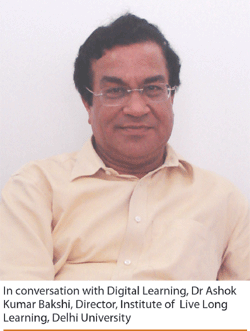
Dr Ashok K Bakhshi is the Director of  the ILLL as well as CPDHE. A  professor of Physical Chemistry in the University, he holds the Sir Shankar Lal Chair of Chemistry since 1996. A double gold medalist, he has authored, individually and in partnerships, more than 100 research and education articles, three books and one patent.

Dr Bakhshi is the recipient of several awards and academic honours. He is also on the editorial boards of reputed scientific journals and has been associated with various academic bodies like CBSE, NCERT, CSIR, UGC, etc.

How did the concept of ILLL evolve and what are the main objectives?
The concept of Lifelong Learning is very vast. It is three-dimensional – life long, wide and deep in nature – and cannot be quantified or captured. The term implies that it is never too soon or too late to learn; one should always be open to new ideas and learning. It is a form of pedagogy and involves digital learning, e-Learning, distance learning, etc. The concept was created in 2007 with the following objectives in mind Development of e-Learning material Backup material for classroom teaching Development and designing of courses for professional development of faculty Continuous evaluation, upgradation and modernisation of syllabi and setting up of advanced laboratories for different courses

How is the institute achieving the objective of development of e-Learning material ?
The development of e-Learning material will be done in two stages – one by producing reading material in print  orm; and second, creating e-Learning material to be uploaded on the ILLL portal. Apart from the text, web links,video snippets, virtual labs, etc. will also be included. Education comes in two forms – one is formal learning through the traditional classroom model and the second is open learning. We are trying to develop material for both the models. In DU, Open Learning is currently limited to humanities and arts subjects and we are involved in the task of preparing instruction material in a student-friendly  simplistic langua e. We believe e-Learning is going to alter the face of higher education in the coming years. Preparing for elearning is, therefore , preparing for future.

What are the other initiatives that have been introduced?
There is also a plan to train teachers in ICT at the undergraduate level
• • for which we are developing course  material for B.Ed and B.El.Ed courses in
collaboration with the Central Institute of Education. Knowledge of ICT technologies is crucial in providing the  uch needed impetus for e-learning in
the country.

What are the steps taken in order to enhance the quality of teachers?
Our faculty development programme focuses on the need to constantly update the teachers. There are many UGC sponsored refresher and orientation courses  or the purpose. ILLL is also working on starting faculty development programmes on specialised topics n various disciplines. A teacher undergoing the development programme can choose the topic of his/her discipline. The course content includes current features as well as new developments in the subjects. Our initial plan is to cover every teacher once in four years. Later on, the frequency of the training will be increased.

How does this content enhancelearning for students?
Syllabi throughout the colleges are uniform, but our content comprising the reading and e-learning material proves to be a value addition for the students. For example, if a teacher is taking a class on Thermo-dynamics, the students
can access our portal and gather mo e information on the topic. So here, we
are supplementing the traditional form of learning, a process that is known as Blended Learning.

Does this material go beyond the university level?What other courses have been introduced?
Right now we are focussed on producing e-learning material for the university courses. We are also introducing some new courses like Foundations of Banking in collaboration with ICICI Bank, the course content for which will be designed by them. We also have other courses like English Language Proficiency, which is a short term course designed to help those who are weak in English. Other courses that have been proposed are in Academic Administration, Information Literacy and Research Methodologies. As we emphasise on the teaching and
learning element, the development of e-learning material is our central focus. Since a teacher is always limited by  time constraints, e-learning content can supplement the traditional mode of teaching, with additional features.

How does ILLL develop the content?
What kind of technology is required for the purpose? Our e-learning content is being developed in two stages. We are developing various programmes and reading material from our syllabi  prepared by experts for the students. This creates uniformity and is like a benchmark for the university students as well as faculty members. The second step would be to enhance this reading material through ICT. We add audio-visual and other such productive features, lending the course vitality and value addition. In order to disseminate such rich content we need a higher bandwidth. A similar project called Sakshat has  been undertaken by the Ministry of Human Resource Management, Government of India, with which I am associated as the Chairman of the Content Advisory Committee for Chemistry. Sakshat for the +2 level takes NCERT text books as the base for further supplementing the course. We are also working on developing laboratory manuals for experiments in science courses. This manual will be supplemented by live recording of experiments which will be uploaded on the ILLL portal.

When will this project beaccomplished?

It is going to be a gradual process. But we hope to introduce the content for this year’s batch of fi rst year students.  Is this content accessible to the public? What are the challenges? Our portal has been inaugurated but it is not in the public domain yet. Once the material has been uploaded, we will provide connectivity to all the colleges so that students can make ample use of this facility. There are technical challenges involved in providing this kind of connectivity, but we will have to tackle them. One reason why research suffers in our country is because of lack of clarity of content, and that is what ILLL strives to achieve and enhance. The course material in classes 11 and 12 are extremely heavy for a fresh entrant in the fi eld, resulting in very few students
opting for pure science subjects later. This affects future research and this is one reason our country is lagging in research. The exam oriented approach needs to be modifi ed by making the syllabi light to give students more time
to grasp it thoroughly.

What are the challenges faced byteachers?
Faculty development is a crucial element in ILLL. The competency of the teacher needs to be regularly upgraded throughout his or her professional
career. The present day economy is a knowledge economy and things are changing constantly. Therefore, teaching needs to be dynamic and teachers should update themselves with the latest developments. The main aim is to introduce dynamism and an urge to learn, not invoke unhealthy competition or pressure. How does one encourage teachers? From my experience as a teacher, I can say one way to foster encouragement among teachers is for the Government to recognize the importance of teaching. In my opinion there is a lot of emphasis on research and there are several awards for excellence in research. However, there are no government recognised awards for excellence in teaching. As a matter of fact, there is hardly any mechanism to evaluate the quality of teaching being imparted to students. One cannot be oblivious of the fact that once the  quality of teaching improves, the quality of research will automatically improve. Giving recognition to teaching could be a very crucial motivational factor for teachers to engage in research and innovation in teaching.

What new innovations have been introduced at ILLL?
We are going to introduce a scheme where lectures of a competent teacher can be taken across colleges. Once a competent teacher is identifi ed, his or her lectures can be recorded and uploaded for students across the University, which is the main aim of e-learning. There should also be a proper coordination between school education and higher education. The college should pick up from where the school has left, rather than being repetitive.

What do you think is the main problem with our Indian education system?
The main problem that faces our students, especially when they enter the fi eld of higher education, is the lack of ability to implement what they have learnt in school. In school they might have acquired 95%, but when they go to IIT or abroad, they fare poorly because they are not taught to think out of the box or beyond the syllabi.


LATEST NEWS