


Home Blog Page 1573

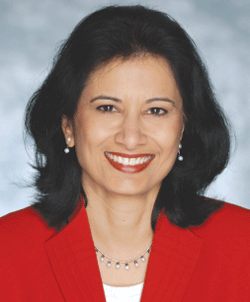
Leading the Success From Farrukhabad to Houston : Dr. Renu Khator, President- University of Houston, India

In an interview with Digital Learning, Dr Renu Khator talks about her first 100 days on the academic post as the President of the University of Houston and Chancellor of the UH system

India born Dr. Renu Khator created history as she stepped in as the President of the University of Houston, USA, and Chancellor, UH System earlier this year. She is the first foreign-born to take charge as the president of one of North America’s largest educational institution and only the second woman to hold this prestigious seat in its history.

The story of Dr Khator is an inspiration for millions of foreign students who land up on the shores of America every year to pursue their dreams. Hailing from Farrukhabad, Uttar Pradesh, she came to the US after marriage to Suresh Khator, doctoral student at Purdue University.

After earning a doctorate in Political Science, she started teaching and was also involved in the university  administration. In 2004, she was named provost of the USF, making her the second most powerful administrator there.

Dr Khator held the job for close to four years, during which she helped raise millions for research.

Her success made her a hot property in academic circles. In 2007, she received the offer from Houston University, which she ended up taking.

In her capacity as chancellor, Dr Khator oversees a system with an annual operating budget that exceeds US$1 billion and serves more than 57,000 students. The second most ethnically diverse urban research university in the country, Houston offers more than 300 undergraduate and graduate programs and awards 7,000 degrees each year.

In 2007, she and her husband were awarded the prestigious Hind Rattan (Jewel of India), given to non-resident Indians for their outstanding contributions in their field. The United States Citizenship and Immigration Services included her among its 2006 Outstanding Americans by Choice awardees. Dr Khator has also received the Distinguished Alumnus Award from Purdue University’s College of Liberal Arts and the Outstanding Educator Award from the American Foundation for Greek Language and Culture for Enhancing Hellenic studies.

Tell us about your first hundred days as the President of the University of Houston and Chancellor of the UH system. What are your goals for the future?

The first 100 days have been absolutely fantastic. Houston as a city has been very open, welcoming and embracing. The University of Houston has been more than what I had imagined it to be in terms of its potential and opportunities. Even before I joined the university, I had some idea of what lies ahead of the University of Houston, but I did not want to be pretentious; therefore, I invited the community to share their views about what should be the goal for the University of Houston. I received 12,000 suggestions, leading to two major themes: (1) the University of Houston should become a top-tier research university; and (2) it should remain true to its mission of providing access and success to its students. These two are consistent with what I had thought of and these will become our primary goals.

How does the India Desk, that you have launched, intend to reach out to the Indian students on the campus?

India’s biggest challenge is lack of talented and qualified faculty. A total shift in paradigm – from regulatory approach to academic freedom approach – may be necessary to create a more conducive environment for talented people to go into the academia

We want Indian students to feel welcomed. Moreover, we want to make sure that they can cut through the bureaucratic red tape and get answers quickly and seamlessly. Hopefully, by next year, the India Desk will be working fully.

Teaching and Research

Professor of Government & International Affairs, University of South Florida (1995-1997)

Associate Professor of Government & International Affairs, University of South Florida (1991-1995)

Visiting Fellow in the Department of Public and Social Administration, City Polytechnic of Hong Kong (August 1989-June 1990)

Assistant Professor of Political Science at the University of South Florida (1987-1991)

Visiting Assistant Professor of Political Science at the University of South Florida (1985-1987)

According to the Congress-authored 2002 National Assessment of Educational Progress, only 10% of American college students are prepared to compete in the global economy. What are your views on it?

I tend to agree. The US Congress is aware of it and wants to expose 1 million students to other countries’ cultures by sending them to study abroad. There are other initiatives as well. We will be focusing on preparing students for the global economy at the University of Houston.

What major differences do you find between the American higher education system and the Indian system?

Both have their own strengths. The Indian system is theory-rich and more specialised while the American system is application-oriented and more comprehensive (every science and engineering student also has to take two years of liberal arts). I was fortunate to have been trained under both the systems and I appreciate them both.

Please tell us your views on privatisation of higher education system in India. Is Public-Private Partnership a better option?

I believe that public-private partnership is the most desirable option. If the private sector (which is the primary beneficiary of graduates) joins help with the public sector, it creates a synergy that is necessary in today’s competitive environment.

What is India’s place in the global higher education scenario? What keeps India back from becoming a popular destination for higher education?

India has an enormous pent-up demand for higher education from its own population. The latest Five Year Plan, I believe, calls for 1,500 additional universities and colleges. Its biggest challenge is lack of talented and qualified faculty. A total shift in paradigm


Indian teacher in maths big league

Original research in mathematics is rare in India but a schoolteacher inspired by the legendary Srinivasa Ramanujam has won accolades for extending two complex theorems of geometry by his sheer grit and genius.

Shri Ram Gupta's contribution is now being appreciated not only by NCERT, HRD ministry and Limca Book of Records but also by the American Mathematical Society.

Otherwise, Gupta, 59, had been happily teaching at a Kendriya Vidyalaya in Jhansi for over three decades. The teacher's works on Menelaus' theorem and cyclic polygons theorem have led to their extension to bring about approximate generalisations. A theorem is good when its applicability is universal and he always felt there was something amiss in both postulates.

'For 10 years or so, I'd think about these theorems day and night. I felt there was something amiss. This doubt prompted me to keep exploring. I was successful in generalising them for higher geometric shapes,' Gupta told TOI after he had made a presentation of his second theorem at NCERT on June 3.

Submitted to the American Mathematical Society on July 24 last year, the work was acknowledged by it as “extension” of Menelaus' and cyclic quadrilateral theorems. The citation by Limca Book says that Gupta 'developed original theorems and registered them with the ministry of HRD on April 12, 2005'.

For his second theorem, the teacher even coined a new phrase

IIT Bombay bans foreign internships

In a move to retain engineering talent in India, one of the country's premier engineering schools has barred its undergraduates from doing research and internships abroad.

Starting in July, undergraduates at the Indian Institute of Technology (IIT) – Bombay must work for an Indian company or research institution as part of their mandatory internship if they want to earn academic credit, Business Standard reports.

'This move should help the students and the country,' Ashok Misra, Director, IIT Bombay, was quoted as saying. 'We want our students to see the excitement of engineering companies in India. We want our industry to see our exciting students.'

More than 60% of undergraduates at the institute opt for foreign research and work internships

PMO wants greater private participation in education

Even though the share of private sector in higher education is already more than 60%, the Prime Minsiters Office (PMO) feels it's not enough. It has asked the Human Resource Ministry to prepare a comprehensive legislation to encourage private investment in the sector.

A PMO missive on the issue came two weeks ago but HRD sources said the ministry is yet to start working on it. Sources said the PMO's desire to have an overarching legislation, almost like a single window clearance, is in tune with the privatisation theme of the 11th Plan.

Questions are also being raised as to how a comprehensive legislation would help since education is part of the concurrent list. Very few states would agree for a uniform legislation.

Already, there is a feeling that the government should first push for the OBC reservation Bill in unaided institutions instead of proposing a comprehensive legislation giving them more freedom.

Even without a legislation during the the 10th Plan, the share of private unaided higher education institutions increased from 42.6% in 2001 to 63.21% in 2006.

Their share of enrolments also increased from 32.89% to 51.53% in the same period. The 11th Plan document also says that 'this trend is likely to continue and therefore, it is reasonable to expect that about half of incremental enrolement targeted for higher education will come from private providers.'

India’s Business schools need an upgrade: Study

Business education is booming in India, but the bulk of rank-and-file programmes in the country suffer from outdated textbooks, professors who don't keep up with economic trends, and narrow curriculums, according to a recently released report by an Indian business group.

The Business Barometer study was issued last month by the Associated Chambers of Commerce & Industry of India (Assocham). It found that beyond the top 30 institutions, most business school professors and lecturers in India's business schools are ignorant of the world's major economic trends and key developments. Few read business publications.

The study's author, Jyoti Bhutani, called the findings “shocking,” adding that Indian businesses are finding it difficult to get top-quality graduates. She said there is “a huge gap” between the pay packages offered to grads of top Indian business schools and those provided to grads of the lesser institutions.

Faculty Not Up to Par

The survey was done to assess the faculty's grasp on practical subject matter and general economic awareness at India's various MBA schools. The business school market in India has exploded in the past few years, with more than 1,600 business schools offering undergraduate business and MBA programs. But their academic standards remain uneven: No single, independent regulator oversees the universities and colleges. As a result, the quality of many faculty members falls short, leaving students with a degree that is 'devoid of any real value,' said Bhutani, assistant Director of Assocham's research bureau.

'While the top B-schools of India are increasingly getting recognised internationally, the remaining thousands of management institutes in the country have dismal standards of faculty,' Bhutani said via e-mail.

The study found that only 6% of the 258 faculty members she surveyed read any business newspaper on a regular basis, with steady readership of business magazines 'negligible.' As a result, teachers are often unaware of key economic developments in India and the world. For example, 89% of the teachers did not know what India's gross domestic product growth rate was in 2006-07. Almost 92% weren't aware that the country's foreign exchange reserves have surpassed US$300 billion. The study found that 91% of lecturers teaching a Business Environment class called did not know how to read financial documents, and 90% did not know that the U.S. might be in recession.

Additionally, most of the case studies or examples discussed in class are outdated because the library books used by lecturers are old. Many of the books are written by authors outside India, and teachers use case studies that lack Indian content.
A Patchwork of Certifying Agencies

'As the teachers themselves are ill-informed, even the students remain unaware of real-world developments,' Bhutani said. 'It has a direct bearing on the employability of the students.'

Adding to the problem is a patchwork of more than a dozen accreditation agencies in India. The National Knowledge Commission, which serves as an advisory group to India's Prime Minister, criticised existing Indian regulators and accreditation bodies in a 2006 report.

'There are several instances where an engineering college or a business school is approved, promptly, in a small house of a metropolitan suburb without the requisite teachers, infrastructure, or facilities, but established universities experience difficulties in obtaining similar approvals,' the commission wrote in the report.

M S Shyamsundar, deputy adviser for the government-run National Assessment & Accreditation Council, said his agency had accredited about 15 business schools, all of which adhered to his agency's strict criteria and guidelines. He acknowledged that the academic quality of business schools varies widely throughout the country. 'I think we have different shades of quality institutions, ranging from very mediocre to very good,' Shyamsundar said in a telephone interview.

Accreditation Must Be Improved

He said he hopes more business schools will come forward for accreditation in the next few years, a step that will go a long way to improve the reputation of these management institutions. 'Quality is one of the pressing concerns,' he said. 'This is why we are asking them to come forward for accreditation. Once they do this, the schools can know their strengths and weaknesses.'

John Fernandes, President of the US-based Association to Advance Collegiate Schools of Business International (AACSB), said his agency is working with four or five of the top Indian business schools that are seeking AACSB accreditation. Most are members of the “elite” business school cadre in India, known as India Institute of Managements. None of the top Indian business schools has accreditation from AACSB, one of the leading business school accrediting agencies.

Setting a high standard for Indian business schools by satisfying a quality accrediting agency is an important step for Indian business schools, said Assocham's Bhutani. An improved accreditation process would have a ripple effect on all Indian business schools, he continued, forcing them to improve the quality of teachers, materials, and professional development. 

Microsoft India renews its education investment

Microsoft India has announced an investment renewal of US$20 million in the education space over the next five years. The company has also renewed its commitment to the India chapter of 'Partners in Learning' – its global educational program, which allows students, teachers, and institutions to reach their full potential.

In the next phase of 'Partners in Learning' in India, Microsoft will aim to address national education priorities by partnering with governments and introducing a focus on three core programs: Innovative Teachers, Innovative Students, and Innovative Schools.

Announcing the program expansion, Jean-Philippe Courtois, President, Microsoft, said, 'We believe that investing in education is the most effective way to help young people achieve their potential. India, with its wealth of human capital, can achieve a great deal – not just for itself, but for the world at large – if the intelligence and potential of its youth is harnessed. Through Partners in Learning, we aim to encourage the use of technology in the classroom to make learning exciting and relevant for the 21st century.'

'Partners in Learning' is vital education initiative under Microsoft's Unlimited Potential, the company's global effort to creating sustained social and economic opportunity for everyone. The other efforts that look at transforming education in India include investments in institutions, teachers, and students.

As a direct investment to improve the employability quotient of students, Microsoft India has also trained faculty members to teach advanced industry technologies – indirectly reaching more than 80 per cent of all engineering students. The company has also created a platform for faculty to share and adopt best practices from professors around the globe.

2nd shifts in engineering colleges for polytechnic courses

The All-India Council for Technical Education (AICTE) has instructed states on conducting 'second shifts' in engineering colleges for polytechnic courses.

'The scheme aims to use the infrastructure of engineering colleges, whose use comes to an end by around 3 or 4 pm,' R A Yadav, Chairman, AICTE, said at a seminar on technical education in Chennai.

Putting the infrastructure to good use, it would also help in increasing the number of students taking to polytechnic education and thus match up to the number of engineering graduates passing out.

'Roughly, there are three engineering students to a polytechnic student, while in practise, it should be the other way around,' he added.

While the average enrolment rate of students into technical courses in the country stood at 9%, Yadav said the Eleventh Plan envisaged an increased rate of 15%. 

Corporate training moves from desktops to mobiles

If you thought training modules by e-learning companies can only be delivered online, think again. Anil Chhikara, President, 24×7 Learning, an e-learning player, claims that the company has already started delivering its modules through podcasts and mobiles.

'The younger generation wants a more collaborative and interactive interface to learn, something they can carry in their iPods and mobiles,' he says.

The growth in the e-training market is also pushing Muralidhar Rao, COO and President, NIS Sparta

CBSE ties up with Fortis, Apollo to produce paramedics

The Central Board of Secondary Education (CBSE), in collaboration with tertiary care hospitals like Fortis, Apollo and Wockhardt, is introducing a new course in schools for those interested in a career as paramedics.

'Looking at the shortage of manpower in the medical field, the CBSE has decided to commence a two-year full time healthcare sciences course from the new academic session,' said Shashi Bhushan, head of the Department of Vocational Education at CBSE.

'Students can opt for this course after Class 10 in board- affiliated schools. It would be a joint certification by the CBSE and the Federation of Indian Chambers of Commerce and Industry (FICCI),' Bhushan told IANS.

The two-year course will have five subjects, including one language and another academic elective like biology.

The other three subjects are healthcare delivery system, hospital organisation and services, medical equipment and technology (one paper); anatomy and physiology; and food, nutrition and dietics.

After Class 10, students can opt for this special course instead of science, commerce and arts. They will be regular Class 11 and 12 students.

Bhushan said the CBSE students would get trained at major hospitals like Fortis, Max, Apollo, Wockhardt and other such tertiary care hospitals affiliated to FICCI.

'Apart from their regular classroom teaching, these students will spend seven weeks every year at top hospitals to get a hands-on experience. They will assist doctors and senior nurses and pick up the fine nuances of the healthcare services,' he said.

'The aim is to facilitate the upward mobility of our students and prepare them as skilled individuals.'

Paramedics are a group of health professionals who help doctors in basic life support system, emergency care and do sundry hospital jobs like helping in the operation theatre and being a part of the ambulance service.

CBSE officials said they are also in talks with the Nursing Council of India and the Pharmacy Council of India on giving preference to students at the graduation level.

Bhushan said nearly 50 schools, mainly in cities where big hospitals are located, are taking up the course this year. Gradually more schools will adopt the course.

Asked if the current teachers in the CBSE can handle the course, he said: 'We are going to train our biology teachers to tackle the special course.'

'Our board is in talks with the Academy of Hospital Administration (AHA), a private body comprising senior doctors, to train teachers,' he added.

Highlighting the problems of the Indian healthcare sector, the Planning Commission has said the country faces a shortage of about 600,000 doctors, one million nurses, 200,000 dental surgeons and a large number of paramedical staff.

Students get web-based planning and time management service

Studiolo Systems has gone into beta testing with StudyRails.com, a Web application intended to help students improve their academic performance by optimizing their study habits. StudyRails provides step-by-step, personalized study plans, e-mail and cell phone study reminders and the blocking of social networking Web sites, software and games during study time.

'Students today manage their social lives via text messaging and online social networks, yet they still manage their homework via paper and pencil assignment books,' said Joshua Loewenstein, founder of StudyRails. 'With StudyRails, it's easy for students to automatically plan and update their study schedules, text in new assignments via cell phone and gain control of online distractions such as YouTube and Facebook during study time. Students in our pilot programs have found StudyRails to be extremely helpful for staying on track with their assignments.'

StudyRails, which costs US$9.95 a month, provides a study plan to help students stay on track with their homework assignments. As students add information, such as new assignments, the program automatically recreates their study schedules to reflect the change. The service sends e-mail and cell phone reminders when it's time to study so students know what they should be doing in the present moment. It blocks online content during study time to prevent distractions. It replaces traditional paper and pencil assignment books; students text new assignments to StudyRails via their cell phone or add them from any Internet-connected computer.

'Students with good study skills have a great advantage,' said Ann Helmus founder of Neuropsychology & Education, a private pediatric neuropsychology practice in Newton, MA. 'By being able to plan, initiate, and follow through with their homework assignments they are much more likely to achieve academic success. StudyRails is exciting because it provides a promising new approach for students to the challenge of managing their homework.'

LATEST NEWS