Home Blog Page 1629

Top Tools for Getting Kids Smart in Classroom

Today’s kids are hardwired in a fundamentally different way than most of the adults who teach them. Every child from high school on down grew up immersed in a world of technology. None have known a world without visual computing. Other items within easy daily reach include a Radio, a Television, DVD, and various cell phones. Yet the typical school reflects little or none of this technology. There is an enormous disparity between the world in which the students live and their life in the formalised educational environment of the classroom.

What technology do they use outside of school that would be good for the classroom also? Why? How would that work? Here’s how we can make students crazy about technology.

Laptop Computer

They contain components that are similar to their desktop counterparts and perform the same functions, but are miniaturized and optimised for mobile use and efficient power consumption.

This is an obvious selection, but the need may further be felt for the heavy books, paper, folders, and pencils were eliminated, if all had laptops. It would have been easier too for students to come out with new editions of texts, if the book publishers put all this material online, and the students carry laptops.

Bluetooth

This wireless-connectivity standard provides a way to exchange information between electronic devices such as mobile phones, laptops, PCs, printers, digital cameras, and video game consoles over a secure short-range radio frequency. Install it on the school’s technologies so students can send information from cameras and cell phones onto school computers.

Cell Phone

Its an essential item for staying in touch. It’s also a great device for the classroom, as for example, the new interactive services allow students to create and flip through electronic flash cards displayed on their cell phone. Other uses can be to call a parent whose child has just excelled in class, or simply use the phone’s notification feature to ring as a reminder to study for a test.

Digital Camera

Use it to photograph what’s written on the whiteboard (such as a list of vocabulary words or a homework assignment) that may be too laborious to copy by hand!

Nintendo DS

This addictive handheld game console has several brain-building programmes/games. Brain Age (www.brainage.com) – in which you are asked to do simple equations quickly or divide words into syllables, as well as various other learning games – is useful. Such games are great for critical-thinking skills.

Video Camera

Tape the class, study it later. Or, better still, post it to school’s Web site for other students to download.

Flash Drive

An excellent way of carrying an enormous amount of information home — without the shoulder pain associated with overloaded backpacks. A drive costs very less and can store hundreds or thousands of items.

Universal Remote

Teachers have separate remote control units for their classroom television, DVD player, projector, camera, and VCR – why not have one for all, just like at home? They could control everything with it, making life a lot easier.

Webcam

With these handy items, students can talk to kids across the world – and they’re cheap and easy to install.

iPod

These portable media players can help to listen to books, instead of reading them (a different learning experience entirely), or catching up on the world of podcasts.

Sims

The range of artificial environments – from SimCity games to Second Life and beyond – boggles the mind and provides myriad possibilities for social interaction and group learning.

ICT Usage in 1000 Schools of India

Vivek Bharadwaj

Special Secretary
Deparment of IT, Government of West Bengal
vivekbharadwaj@hotmail.com

The access to ICT facilities whether by students or by teachers is of great concern in India. Less than six computers per school and one computer for seventy two students is the average here

One of the major objectives of the study was to show the relationship between technology use and changes in teaching and learning process, as well as educational curricular improvements.

In view of the large size of the country and the fact that the number of primary and secondary schools run into hundreds of thousands, two representative States were selected – Gujarat in Western India and Karnataka in South India. Again two Districts in two different areas of the States were selected for the Pilot project. Schools in the capital cities of the two States were also surveyed to reflect the different stages of development in the use of ICT in teaching and learning.

The survey used multistage random sampling and the sample unit was the school. This methodology produced the following sample size:

  • Number of schools : 1000.
  • Number of teachers : 6239.
  • Number of students : 35,547.

The survey took place in the early part of 2004. Out of the 1,000 schools surveyed, 500 each were in the States of Gujarat in the West and Karnataka in the South of the Country. Out of these 500 schools, 200 each were in the Districts of Patan and Surendranagar in Gujarat and Bellary and Mandya in Karnataka. 100 schools each were also assessed in the capital cities of Ahmedabad in Gujarat and Bangalore in Karnataka. In Gujarat the ratio of the number of urban schools to rural ones was 26:65.8 and in Karnataka it was 37.6:53.6.

A majority of the schools surveyed in both the States were Government or Public Schools. Out of the 1,000 schools, 602 (60.2%) were Government Schools and 398 (39.8%) were Private Schools. Out of the total 1,000 schools 49.7% were primary and 51.3% were secondary. The total number of students enrolled in these 1,000 schools were 2,24,018. Out of these 1,21,029 were in Gujarat and 1,02,989 were in Karnataka.

Observations and Recommendations

Though computers came to Indian classrooms in the year 1984-85, the level of adoption of modern technology in the teaching and learning process has been limited and uneven. Possibly there has been no comprehensive study or survey on the use of Information and Communication Technology (ICT) in schools in India. This study is an attempt not only to provide a snap-shot of the situation on the ground but also for providing a road map. The report was prepared by Vivek Bharadwaj (vivekbharadwaj@hotmail.com), now the Special Secretary, Deparment of IT, Government of West Bengal, who was serving as a Director, Ministry of HRD while undertaking the study.

1. The first major finding of the survey is that the use of ICT in Education is very limited in the country whether measured by the number of schools having an ICT Department or Unit (20.4%), the availability of a budget in schools for its implementation (6.5%), the number of teachers trained at ICT, the per capital availability of hardware and so on and so forth.

2. The access to ICT facilities whether by students or by teachers was of great concern. In the 200 schools surveyed in Surendranagar there were only two Multi-media Projectors, three PDAs and four Scanners. Even in Ahmedabad there were only 589 Desktop Computers reported in 100 schools. This means less than six computers per school and one computer for 72 students on an average. There is thus a great need for increasing the availability of various ICT tools.

3. While there is a relatively better availability of older technologies like the TVs or RCPs, newer technological products like Multi-media Projectors, Laptops and PDAs, which make learning more student-centric, were scarce. In the 200 schools in Mandya, for example there was not a single Multi-media Projector, LCD Projector, Scanner or a PDA. The survey found that the abundance of different technologies was directly related to their vintage. Older equipment like TVs, RCPs and Desktop Computers were more abundant than Multi-media Projectors and Hand-held Computers.

4. As the increased availability of these technologies in the country would take time, it would be a sensible strategy to concentrate on utilising traditional media like the radio and the television. These technologies also have an edge over Desktops or Laptops as more students can utilize them at any given time. As mentioned earlier, in Gujarat schools it was the TV and then the RCPs, which were available in maximum numbers.

5. The hypothesis that even where ICT tools were available there was low level of integration in education was validated as both Principals and teachers stated that ICT tools were most used for teaching ICT as a subject. In Gujarat, teachers stated that ICT was used most for teaching computers as a subject and then for sciences. In Karnataka, computer classes were the second most important subject for which ICT was used. There was little utilization of these tools in Social Science and Music in Gujarat and in Music and Art in Karnataka. Principals reported that they were used least for teaching the local language. The maximum percentage of respondents who stated that one subject for which computers were always used was ICT – both in Gujarat (8.2%) and in Karnataka (11.8%).

6. The lack of Internet connectivity came-up starkly and repeatedly during the survey. This had its own impact on the various uses to which ICT could be put to by both the teachers and students. Only 8.6% of the teachers in Gujarat and 8.8% of the teachers in Karnataka had access to the Internet, whether at school or outside.

As far as students were concerned, only 4.2% students stated that they had access to the Internet in Gujarat. This number was 12.8% in Karnataka. In Gujarat 79% of the students surveyed could not e-Mail and 78.3% could not browse. In Karnataka an even larger percentage (87.3%) could not e-Mail and 89.5% could not browse. The frequency of use of Internet for surfing websites in schools, for example were instructive. 55.4% of the students surveyed in Gujarat stated that they had never surfed the Internet. The proportion of students who surfed the Net daily was 0.1%.

There was only a marginal difference in the usage of ICT tools when assessed according to the type of school-Private or Government-that the student attended. In Gujarat Private School students used ICT marginally more than Government School students for all purposes except for communication. In Karnataka Private Schools used ICT marginally more than Government Schools for communication, creation and functional purposes. Government School students used ICT more to find, acquire and use information.

7. While a relatively larger number of schools had an ICT Department or Unit a much lesser number had an ICT Coordinator to make the entire process effective. The number of schools which had an ICT Master Plan in place was even less. 20.4% of the total number of schools surveyed had an ICT Department or Unit. It is well known that without trained personnel the hardware is of little use. It was found that only 13.7% of the schools had an ICT Coordinator which was as mentioned earlier less than the number of schools which had an ICT Department. Purchase of hardware, training of teachers, procurement of educational content, scheduling of classes etc. all have to be part of a master plan to ensure maximum benefits. Very few schools had an ICT Master Plan in place, in fact only 7.8%. This comprised 11% of schools in Karnataka and 4.6% in Gujarat.

 There has been steady but slow progress in the availability of ICT facilities for students in the country. An assessment of the length of time that computers had been with schools was made during the course of the survey. It was found that only a miniscule percentage of schools had computers 8 years back. These were also more noticeable in the urban areas which clearly points to the fact that computers first became accessible in towns. The maximum percentage of schools in Gujarat have acquired computers in the last 1-2 years while it was 2-4 years for Karnataka. The case of rural Karnataka is instructive. While 8 years back there was no computers in any school, now about 18% have computers and the maximum number of computers were acquired in the last 2-4 years.

A possible lack of communication in propagating the components of the ICT policy framework to the schools was discerned. Less than 30% of the schools in Gujarat claimed to be implementing the regional policy on ICT. Surprisingly many more Private Schools claimed the same than Government Schools!

The focus of implementation of the Policy on ICT in Education differed in the two States. While in Gujarat the emphasis seemed to be on training teachers on ICT and then on using ICT in the management and administration of the school, in Karnataka using ICT for teaching specific subjects was most important and then was the training of teachers.

An assessment was made of the level of expertise in the use of various software tools and applications. These ranged from simple ones like Word Processing, Power Point, Internet Browsing to Programme and Project Management. Teachers from Gujarat consistently reported better expertise at these applications than those from Karnataka. Interestingly, however teachers from both the States were best at Word Processing and then at Presentation tools. In Gujarat they were least acquainted with Project Management and in Karnataka with web-page designing. In general the level of expertise was quite low. The expertise at even basic activities like E-mailing and Internet Browsing was fairly low primarily because of the lack of Internet access in schools. The major difference in the level of expertise remained between teachers from Ahmedabad and Surendranagar and those from Bangalore and Mandya. It was found that there was practically no expertise in higher order skills like web-page designing or data base management.
Students were questioned on the level of expertise acquired by them in using ICT tools. These skills were divided into basic, intermediate and advanced. Less than 20% students surveyed in Gujarat assessed themselves as excellent or very good in the basic use of ICT tools. Only word processing got more than 20% responses. The situation was worse in Karnataka where in general only 5-10% assessed themselves excellent or very good at these simple skills. Again, only word processing was relatively better. As stated earlier, there was in general low level of expertise. The conclusion that ICT tools are mostly being used for making presentation or documents but not for developing critical thinking is inescapable.
The declining levels of community participation in education came out clearly during the survey in both the urban and rural areas of the two States surveyed. ICT tools were least used for communicating with parents!
The location of computers is an important determinant of access to technology by the students. If Desktops are confined to the office or TVs to the residence of the Principal, these technologies would have no impact on the teaching-learning process. An assessment was made of the location of computers in schools. In Gujarat, location of computers in classrooms and in a computer laboratory was evenly distributed. In Karnataka computers were pre-dominantly located in Laboratories. Some were housed in the library also. The maximum number of computers in laboratories were in Bangalore. None of the respondents ticked both classroom and the laboratory as the location of computers in Gujarat.
Students were also queried during the survey whether they possessed mobile phones, hand-held/PDA, E-mail addresses or a personal website/web-page. 5.9% of the total number of students surveyed in Gujarat had a mobile phone. This figure reached a high of 14.1% in Ahmedabad. Karnataka students had the maximum number of E-mail addresses. The district of Mandya in Karnataka surprisingly had the maximum number of E-mail addresses!
There was only a marginal difference in the usage of ICT tools when assessed according to the type of school-Private or Government-that the student attended. In Gujarat Private School students used ICT marginally more than Government School students for all purposes except for communication. In Karnataka Private Schools used ICT marginally more than Government Schools for communication, creation and functional purposes. Government School students used ICT more to find, acquire and use information. While Private School students in Gujarat had 4 times more access to the Internet compared to their Government School peers, it was the reverse in Karnataka where 16.6% of Government School students had access to the Internet compared to 5.6% Private School students. Surprisingly, the percentage of students who used e-Mails as a means of communication was marginally better in Government Schools in Gujarat and a little better for Government Schools in Karnataka.

Access of Government School students to ICT tools outside
school was in general low. The access of Private School students to such devices was comparably better and pre-dominantly at home
which implied a better socio-economic condition. This was true for both Gujarat and Karnataka.

Access to government school students to ICT tools outside schools is in genral low. The access of private school students to such devices is comparably better

The data was compared between Government and Private Schools to assess the effectiveness of the different school systems. In Karnataka, while Private School students were better than their Government counter-parts in Word Processing, Spread Sheet, Graphics, Web Designing and Chatting, the Government School students were better at Presentation Tools, e-Mailing and Internet Browsing. Similarly, while Private School students in Gujarat were better at Word Processing, Spread Sheets, Presentation Tools and Graphics, their Government counter-parts were better at E-mailing, Internet Browsing, Web Designing and Chatting. The results were therefore mixed.

Government School students liked to draw and paint most and play games next. It was the other way round for Private School students in Gujarat where 49.8% ranked playing games as their favourite activity using computers! In Karnataka also there was similarity in the choices with Gujarat where most of the Government School students liked to draw and paint most and play games next. The favoured activities of Private School students were the reverse to that of Government School students in Karnataka but same as that of private school students in Gujarat.

While there was no difference in the mode of offering ICT courses or ICT based activities between Private and Government Schools in Karnataka as most offered them first as a separate and then integrated with other subjects, the emphasis on integrating technology was however apparent. The maximum number of hours spent on integrating ICT with other subjects was in Government Schools in Karnataka.

One of the assumptions of the study was that most of the ICT facilities are confined to boys and that the girl child is at a disadvantage. What the study revealed was an eye-opener. There were no gender differences discernable. In Gujarat more girls (55.8%) are using computers compared to boys (38.8%) and their numbers are also growing faster. This is apparent in Karnataka also specially in the last 2 years.

The access of girl students is much more to Desktop Computers in Gujarat. Data suggests that it is marginally more than boys for TVs, RCPs and even Lap-tops, CD Writers, Scanners and Computer Speakers. In Karnataka, the access of girl students to various ICT tools in schools is marginally more than boys to TVs, RCPs, Desktops, Computer Speakers, Scanners and CD Writers. Comparing girls in Karnataka with their counter-parts in Gujarat, one finds that RCPs, Desktop Computers and Computer Speakers are more accessible to girls in Karnataka. However, the availability of TVs to girls in Gujarat schools is more. Girl students in Gujarat had a distinctly better access to ICT tools for doing schoolwork. While this was also true for Karnataka the difference with boys was not as pronounced. Girls had better access to the Internet in both Gujarat and Karnataka and it was best for Karnataka girl students where 4 times more girls than the number of boys claimed to be able to access the Net on a daily basis.

While it was difficult to come to the conclusion as to which among the two States was better in terms of access, utilisation and effectiveness of ICT tools, what did come across repeatedly during the analysis was the fact that Gujarat had substantial disparities between its urban and rural areas and Private and Government Schools. For example, when students from the two States were questioned about their access to ICT tools for doing class-work, these ranged from 41.5% in the affirmative in Ahmedabad to 9.1% in the affirmative in Surendra Nagar. Access was more evenly distributed between the capital and the Districts in Karnataka.

Similarly in Gujarat access to ICT tools was maximum for Private School students at 28.3%. Only 4.7% of Government School children had such facilities. In Karnataka, fortunately there was no digital divide discernable between the Private School and Government School students. As mentioned earlier Government School students in Karnataka had better access to the Internet. Overall too there was better availability of access to the Internet in Karnataka than in Gujarat. The responses of students to once a month and once a week usage was much better in the Districts of Bellary and Mandya compared to the Districts in Gujarat.

The number of students who had a mobile phone was 10 times more in Private Schools in Gujarat when compared to Government Schools. None of the Government School students had a PDA or an e-mail address or a personal website. In Karnataka the differences were not so stark. In fact, the number of e-Mail IDs were more in Government Schools than in private ones!


asia

ICT sector not growing up to the mark in Bangladesh

According to finding in a survey conducted by Jobs IRIS Bangladesh, the ICT sector has grown approximately 22 per cent in the past two years, while the mobile phone sector alone has witnessed 180 per cent growth for the last one year.

The poor growth in ICT re-emphasises the continued necessity of a highly skilled human resource pool in the ICT sector in the country. ICT graduates are not gaining the skills required by the private sector.  The ICT topics taught widely do not always align with the needs and priorities of private sector. Students learn the requisite theoretical and technical skills but not how and where to apply them.

At present, there are over 40 universities and 60 colleges offering ICT courses at the Bachelors and Masters levels in the country.

Malaysia To Support International Dialogues On Education
Malaysia has pledged its full support for international dialogues seeking to pursue the global commitment of “Education For All” (EFA).

Outlining its vision in vying for a seat in the 58-member Unesco Executive Board, Malaysia hopes to contribute its experience and expertise to Unesco, which has been mandated by the United Nations to coordinate international efforts to achieve the EFA by the year 2015.

Apart from identifying best practices and benchmarks, Malaysia is also prepared to share its knowledge in teacher training, curriculum development and the use of information and communications technology (ICT) to increase access to quality teaching. Malaysia will also contribute inputs in improving access to students in rural and remote areas and in facilitating regional linkages and cooperation in areas like educational research and development and in the dissemination and sharing of information.

High school education in Philippines via the Web
The Commission on Information and Communications Technology (CICT) in Philippines says it is making progress towards its goal of making public high school education completely accessible over the Internet.

A project by the commission called “e-eskwela” (electronic school) aims to digitise the entire high school curriculum as an alternative to taking it in the normal classroom setting. Of the total 80 modules (20 for each year of high school), around 40 have been digitised and made available online. The e-eskwela project is part of a larger ICT for Basic Education project that attempts to develop e-Learning components for primary and secondary public school education.

Teachers question Chinese firm’s role in Cyber-Ed deal
What does a Chinese company that manufactures X-ray machines and other state-of-the-art airport security equipment got to do with the government’s Cyber Education Project (CEP)? Militant teachers in Philippines raised the question as they asked the Department of Education to explain the details of the memorandum of agreement with China covering the $460-million CEP.

The agreement requires the DepEd to team up for the project with Tsinghua Tongfang Nuctech Company (Nuctech), a Chinese company that has “no expertise in satellite-based distance learning. The DepEd has repeatedly said the CEP will be undertaken in partnership with the Beijing-based Tsinghua University, which is recognized for its expertise in the use of ICT for distance education. But the memorandum was signed not by Tsinghua but by the chairman of Nuctech.

The CEP aims to fill the gaps in the education system by using satellite technology to deliver key learning concepts and other educational services to every school in the country through TV screens.

COA finds P329-M textbooks unused
Some P329 million worth of textbooks, information and communication technology (ICT) products, computers and instructional materials are lying around in the offices of school officials or in stockrooms, destroyed by molds, according to the Commission on Audit (COA) in Philippines.

In its 2006 audit report on the Department of Education, the COA disclosed that 2.5 million copies of textbooks or instructional materials costing around P186.96 million have remained undistributed for reasons ranging from oversupply, deficiency in contents to scarcity of funds, and vehicles for delivery.

The COA report also highlighted the P138.84 million worth of computers which were either reported missing or underutilised due to lack of technical resources and facilities to operate the computers. The ICT packages worth P115 million was being used for administrative purposes instead. Each package consisted of 349 units of computers, compact discs (CDs), workbooks and teacher’s manuals as aids of instruction for English, Math and Science for elementary schools, and English, Chemistry and Geography for high school.

The DepEd justified this by saying that the computer supplier did not provide the teachers training to operate the computers. It also said that most of the CDs could not be installed.

Mark Your Calendar: November 2007

november

13th Annual Sloan-C International Conference on Online Learning
7 – 9 November, 2007
Orlando, Florida, United States
http://www.aln.ucf.edu

International Conference on Teaching and Learning (ICTL 2007)
15 – 16 November, 2007
Putrajaya, Malaysia, Malaysia
http://ictl.intimal.edu.my
International Education Summit
16 – 17 November, 2007
cincinnati, OHIO, United States
http://www.globalcincinnati.org

Teaching in Public – The Future of HE
21 – 23 November, 2007 
Cardiff, Wales, United Kingdom
http://c-sap.bham.ac.uk

International Conference on Universal Quality Schol Education
21-23 November, 2007
New Delhi, India
http://www.etma-india.org/uqse_2007.htm

ICODL 2007 – 4th Intl. Conference on Open and Distance Learning 
23 – 25 November, 2007
Athens, Attiki, Greece
http://artemis.eap.gr/icodl2007/

december

Regional Conference on Quality in Higher Education
10 – 11 December, 2007
Kuala Lumpur, Malaysia
http://qamu.um.edu.my/conf2007/

11th UNESCO-APEID International Conference: Reinventing Higher Education: Toward Participatory and Sustainable Development
12 – 14 December, 2007
Bangkok, Thailand
http://www.unescobkk.org/index.php?id=6257

School Education, Pluralism and Marginality: Comparative Perspectives
14 – 16 December, 2007
India Intl. Centre,  New Delhi, India
http://deshkalindia.com

january

e-Learning Excellence in the Middle East 2008: Define. Design. Deliver
14 – 17 January, 2008
dubai, Dubai, United Arab Emirates
http://elexforum.etqm.ae/

Responding to Change – Flexibility in the Delivery of Language Programmes
7 – 11 January 2008
Hong Kong, Thailand
http://lc.ust.hk/~centre/conf2008

february

International Research Conference
27 to 29 February 2008
Iloilo City, Philippines
http://www.wvsu.edu.ph

iLearning Forum Paris 2008
4 to 5 February 2008
Paris, France
http://www.ilearningforum.eu

march

The 2008 International Conference on e-Education
27 to 29 March 2008
Bangkok, Thailand, Thailand
http://www.e-case.org/e-Education2008/

Intl. Conference on Quality Enhancement in Educational Communication
29 to 30 March 2008
Tiruchirappalli, Tamil Nadu, India
http://bdu.ac.in

International Conference Of Educational Technology ICOET2008
3 to 5 March 2008
Muscat, The Capital, Oman
Website: http://www.icoet,.com

Microsoft contest on HPC
Microsoft is launching a regional contest and engagement around High Performance Computing (HPC) with Engineering colleges and Universities.

Background
Once the exclusive domain of a handful of well-funded companies, supercomputing is increasingly becoming accessible, scalable and affordable to companies of all sizes, budgets and needs. Microsoft launched its first HPC offering last year and is bullish about its prospects in a US$10 billion market. Academic and research institutions in Asia have significant experience in High Performance computing and this programme is designed to expand on that by encouraging the students and the faculties to orient efforts in the direction of parallel programming and building applications, middleware and projects based on this concept.

Programme
This project will initially run at the key science universities in Thailand, Indonesia, Australia, Malaysia and Korea. Students will be introduced to the programme through information displayed at their university and by their lecturers. They can then go online to find out more about this programme and register their interest to participate.

The offer will vary slightly country-to-country however, students will be offered an MSDNAA license for only USD$1 per node (minimum 4 nodes) and if their project is chosen as a winner they will be rewarded with a prize (which will vary by dollar value per country).

The research projects could focus on, but are not limited to – Digital content creation, Animation, Science & Engineering, Finance, Geology, Medicine, Mining, Computational applications for development, Oil and gas exploration or any other field of research involving extensive computational calculations.

Education in an Wireless Environment and Beyond

Pathways embodies Howard Gardner’s pioneering learning model called multiple pathways to learning, that Pathways world school incorporates  to ensure that every student’s talents are developed to the full. Designed for anywhere-anytime learning, Pathways envisions a learning community of motivated students and staff engaged in active learning through the best use of modern technology. Based at the outskirts of Delhi, the school is well equipped with the 21st Century educational technologies.  Pathways sees each of its secondary school students to carry a laptop round the clock, providing them with a twenty four hour monitored access to Internet.
To effectively meet the challenges of the 21st Century, Pathways world school equips itself with the latest ICTs with all Secondary School students have access to laptops, that is linked by campus-wide radio-networking. Pathways picked up the concept of a ‘notebook cart’ that has 10-30 wireless notebooks moving to the classrooms. The use of hard-wired or desktop computers has been reduced to the minimum and the school server maintains a broadband connection throughout the round the clock and 365 days of the year, giving each student continuous but monitored access via the school’s intranet to the resources of the Internet. This restricted access to Internet resources is to put check on students downloading materials that has least importance to education.

The concerns of parents regarding their children’s progress are also well taken care of. The school is shortly going to computerise the reporting system, enabling the parents to track their children’s progress on the Internet.

Technology for anytime, anywhere learning
Pathways profoundly believes that learning should not be time bound. As such, at Pathways all the students can  have the monitored access of information via the school’s intranet to the resources of the Internet even when out of class hours.

With the universal access to IT and other technological support, students can learn ‘Anywhere-Anytime’. This means that they can refer any doubts and questions to the teacher share them with other students. Thus resulting in a learning community, where students and teachers can share and collaborate to benefit from each other.

At Pathways ICTs and other related technologies have crucial place to thrust the acquisition of information and education.  The Science laboratories, for instance, are specially equipped for computer simulation of dangerous experiments. Numerous relevant ICT tools are available and relied on to efficiently impart learning. This is complemented with the access to a Design Technology Studio, in which each student can work on their individual projects with external experts’ support.

Library and Media Centre at Pathways
The Library-Media Centre at Pathways has a Distance-Learning Studio for access to quality teaching and learning materials from various prestigious universities both from India and the UK. In addition, Pathways is developing an extensive CD Rom library and there are Reprographics Centres in each academic building that will be open even in the evenings.

Learning Style and Methodology
In sync with this philosophy that a variety of learning methodologies need to be incorporated according to the suitability in various circumstances, Pathways implements  a variety of teaching models like ‘Student Centred Learning’, ‘Multiple Intelligences Theory’, and ‘Project Based Learning’ to equip the students for the 21st Century.

This international K-12 school in India, partnered with IBM Global Services – Integrated Technology Services and provides a sophisticated IT network that would support the school’s goal of nurturing “multiple intelligences” and prepare its students for top-tier universities.

The school offers the International Baccalaureate (IB) programme up to Class X and the International Baccalaureate Diploma programme for the Class XI and XII students. The IB degree is a gateway for the Indian students to the best universities in the world. The students equipped with this degree need not clear the foundation course to enter a foreign university.

IBM Global Services – Integrated Technology Services

Pathways partnered with IBM Global Services – Integrated Technology Services to install landline and mobile access networks using Cisco switches. Then IBM designed the landline and mobile-access networks to support the school’s existing user  demand and
provide network scalability. IBM installed Cisco 3750 switches to support classroom Internet access and used Cisco 1200 Series switches running the Cisco Aironet solution to provide wireless computer access to students across the school’s campus.

IBM provided supply, integration and support services for the solution. The IBM Integrated Technology Services team also helped the school migrate its existing network to the new scalable network infrastructure and extend the network to a new building. Pathways students now have seamless Internet access across their campus. The students benefit from the wide open campus and use the wireless network to increase their learning potential.

Pathways deems that technology is only a means to an end and therefore assists its students to equip themselves with such talents that enables them to fulfill their fullest potentials in social, intellectual, academic, sporting or cultural, to inculcate a feeling in them that every one of them is good at one thing or the other.  

MONDIALOGO DAY Celebrated at Springdales School, Pusa Road
10th October 2007, students of Springdales School Pusa Road celebrated a “Mondialogo Day” as a part of Mondialogo School Contest. The school tried to showcase integration of technology through film making skills, with a social cause. The contest, initiated by Daimler Chrysler and UNESCO in 2003 is one of world’s largest global contest on international dialogue. Simmi Kher, the IT Coordinator along with her team coordinated the event. The photo showss the Winning Team Blue Bells School with the trophy.

Most creative school

team from SMK USJ 12 beat 58 others from three schools to emerge winner of the TM eSchool LCMS Content Creation Competition recently.

Led by teacher Shirley Tan, the team received RM3,000, a plaque and certificates of participation. The other two schools which took part were SMK Seksyen 11, Shah Alam and Methodist Boys’ School, Kuala Lumpur (MBSKL). The second and third prizes were won by teams from MBSKL who won RM2,000 and RM1,000 respectively.

The objective of the competition was to increase the usage of the LCMS application by exposing students and teachers to the advantages of using this e-Learning tool. LCMS was introduced through the TM eSchool project, which was launched in April. To take part, the groups were required to create e-Learning content based on any subject of their choice from the school syllabus using LCMS. The theme of the competition was 50th Merdeka celebrations.

School heads meet to improve education

Nearly 70 heads of schools from across the Asia-Pacific region came together recently to discuss innovations in education. Hosted by the Global Indian Foundation (GIF), the two-day conference marked the fifth foundation day of the Global Indian International Schools (GIIS).

Ashok Ganguly, chairman, Central Board of Secondary Education (CBSE), G Balasubramanium, former director (academics), CBSE, and C S Dharmadhikari, vice-president, GIF, were among the Indian delegates present for the meet. During his address, Ganguly stressed on making CBSE-affiliated schools global in their outlook and upgrade their curriculum to international standards.

Principals from Thailand, Middle East, Japan, Malaysia, New Zealand and India also shared their experience in school education.

Designing a Business Model to Help Students Learn Math

Dr. Gaurav Bhatnagar

Sr. Vice President
Digital Products and Solutions Group, Educomp Solutions Ltd.

Data from the Central Board of Secondary Education (CBSE) suggests that the maximum number of failures in board exams is in Mathematics. Why Mathematics? What’s the solution?

It’s not that everyone is bad at mathematics. If we assume there are a billion students, the top 5% of them can be considered to be good at math. So there are 50 million students who are good at math. What makes them good? Let’s explore the secrets of good students.

We listed the strategies good students follow that enable them to be good at math and therefore enjoy it. These secrets helped us to design businesses and products that make life easier for students to learn math. Finally, we came up with a website www.mathguru.com that helps thousands of students to master in mathematics.

How to study math

The 3 secrets of a good student
Secret #1. Do all the problems.
Secret #2. Spend as much time as possible on a problem before giving up.
Secret #3. Write down all the solutions neatly.

The student who acts upon these secrets is bound to do very well in every exam. In addition, students will suddenly find themselves liking math-another secret is that most people who do well in exams tend to love math.

A business model to help students do well in math
As we have seen, all it takes for a student to do well in math is to do all the problems. But there is no student who always gets the right answer. And the wrong answer always makes the student feel bad.

Students hate math, because they do not get the right answer. The contra-positive of this statement is: If students get the right answer every time, they will love math.

Students feel really bad when they turn to the back of the book and find that they have got the wrong answer. And if this happens most of the time, students begin losing confidence in their ability to do math problems, and end up hating the subject.

So the key issue in designing a business to help students do well in math is to help them overcome this issue of feeling bad on getting the wrong answer. If one looks at all the current business models, all of them involve helping a student deal with this issue and to encourage them in doing more problems.

For example, the popular Kumon system (made in Japan and now popular all over the world) is about a series of problem sets that are graded from easy to hard and have to be done by students in a specific time. A test decides the level of the student, and the first problem sets are based on what the student knows. After lots of practice, students begin doing better in math in school.

Mathguru.com

The three secrets of good students are useful pointers to understand the business scenario.
The website mathguru.com is an example of a business designed to help students when they get stuck on math problems. This site is meant for CBSE students from Grade 6 to 12th. Each problem of the standard NCERT book is addressed.

When a customer (a student in class 6-12) gets stuck on a problem in the NCERT book, he/she can log on to mathguru.com and browse to the relevant question. On clicking a problem, a video file plays which shows a teacher explaining a problem step-by-step. The student sees the solution being written on a piece of paper, and hears the teacher explaining the solution.

At present there are nearly 10000 solutions on the site.

The website www.mathguru.com has helped students solve problems, understand math and thus helped them do better at school. In less than 2 years, mathguru.com has become the standard must-have tool for many students.

We have seen how the secrets of good math students can be used to design products. The success of mathguru.com suggests that Internet based businesses can be an exciting new way to help students learn

Education, Unplugged: Schools Make Cable-Free Connections

Russell Fortmeyer
Colorado, USA
russell_fortmeyer@mcgraw-hill.com

Few observers doubted that the wireless-technology revolution would have an impact on K-12 education, but when third graders start turning in homework using personal digital assistants, we know we’ve made a significant leap from the era of chalk and blackboard.

The days are long gone when computers were rare objects in schools, rolled around on carts from classroom to classroom. Now, the most wired schools hand out laptops or PDAs to students, assign homework online, and facilitate classroom presentations using PowerPoint. Ironically, the freedom offered by the move of instruction into wireless cyberspace doesn’t solve the sometimes daunting problems of real space — upgrading the design of network-ready classrooms, installing communications closets for servers, and, even in the burgeoning wireless age, creating the pathways needed for cabling systems.

Robert Bogan, a consultant with Technology Plus, in Aurora, Colorado, considers finding those pathways the most difficult aspect of retrofitting older schools with new cables and network systems. In many schools, concrete-block walls pose particular difficulties, because architects typically dislike surface-mounted conduit and block walls can’t be opened like wall board can. That obstacle can be remediated to some degree-or at least minimised-by routing computer networks and cable-television, security, voice, and audiovisual systems on a single category-six (CAT 6) cable, because each system’s unit acts as its own Internet address. (CAT 6 cable, an industry standard, is the typical cabling for network connections for computers and servers.)

Bogan says, however, that full integration can be a tough sell with school districts accustomed to keeping systems separate. And wireless technology, though it gives students and teachers vastly increased flexibility, isn’t a cure-all for interior upgrades in buildings with block walls, Bogan points out. “Even with a wireless data system,” he says, “you still need a cable for all those other systems.”

Taking Stock of the New

Bogan installed both wireless and hard-wired systems at the Denver School of Science and Technology, where technology is showcased rather than hidden, with exposed cable trays in the open ceilings and a glass-enclosed server room. “Having both systems is more expensive,” he says, “but you have to provide wireless, because everyone uses it.” In addition, for high schools offering courses that depend on bandwidth-hogging software, such as AutoDesk’s AutoCAD, hard-wired networks are mandatory. More common in schools are classrooms where computers are used mainly for accessing the Internet, which is easily accommodated on a wireless network.

In new school construction, it’s easier to accommodate leading-edge technology, as was the case in Denver. But often, consultants such as Bogan find themselves cramming server racks into unused custodial closets or carving out extra space in administrative offices.
Reusing existing cable is rarely an option, according to Bogan, because gauging length, quality, and condition is more time consuming (and more expensive) than pulling new wire. New closets need additional cooling to handle electronics-generated heat loads, as well as electrical receptacles. Upgrading a school’s electrical power system to meet the needs of the computer age can present space issues, as well as high costs for service size increases, transformers, and panel boards.

Giving a laptop to each student is easier than ensuring each classroom has the electrical capacity to power them; one advantage of issuing PDAs is that multiple units can be recharged at one receptacle plug. Some schools have even provided dedicated closets intended just for recharging laptops.

The firewall factor

Portable technology, however, brings its own security problems. Mario Sanchez, a technology consultant with Los Angeles-based EQ International (part of RTKL Architects), says that as schools establish virtual private networks (VPNs) to allow students’ laptops to access school networks from home, care should be given to implement appropriate security measures through smart cards or thumbprint identification to ensure that only students use the computers.

“You can install software to automatically lock down a laptop if a student stops attending school,” Sanchez adds. In the case of encryption software, automatically updated Internet filtering, and stronger firewalls, he says, the concerns that outsiders might access wireless networks or students could download inappropriate material are considerably diminished.

Security concerns about power outages and emergencies also exist. Sanchez says rack-mounted, uninterruptible power sources are commonly sufficient to allow only for server shutdown, not for continuous network use. Schools typically provide power backup exclusively for telecommunications systems.

Server backup, however, is less of a problem. The drop in digital storage costs has made the idea of backing up a student’s entire academic career less far-fetched than it once would have been. And Sanchez wonders why anyone would bother with a CD-ROM anymore, when server-based storage provides security and continuity between grades. “Managing, searching, and distributing it is the hard part,” he says.

Small devices in the big picture

School-technology administrators say infrastructure upgrades, though necessary for aging buildings, are useless without a comprehensive e-learning plan. That approach can mean anything from curricular changes in specific subjects to offering a high school diploma program solely via Web site. For example, introducing PDAs into a science lab means students can connect them to probes for testing phenomena such as a river’s pH level.

The Littleton Public Schools, in Littleton, Colorado, implemented a Web-based learning program to help students with special circumstances complete their high school coursework. Using the Blackboard K-12 Starter Edition, well-known platform software from a company called Blackboard, the Littleton school district offers a wide selection of classes students access online or at a computer lab set up at the city’s Arapahoe Community College. Course content is provided by Class.com, but the district could eventually use its own class materials.

Blackboard’s pilot programme can be expanded to offer professional-development courses for teachers, a common feature for other districts. Blackboard has been implemented in nearly 1,200 K-12 schools, many of which rely on the Internet for offering specialised classes for students in isolated locations.

Students in some Alaskan school districts, for example, can access Advanced Placement courses through Blackboard without resorting to the previous vogue in distance learning, which relied on expensive and complicated teleconferencing facilities and instructor availability. And, with Blackboard, like other Web-based programmes, assessment is instant and can be shared with a wider community of teachers, parents, administrators, and fellow students.

Although the district helped pay for its programme by partnering with the local community college, schools can apply for a grant for such initiatives through the U.S. Department of Education’s Star Schools programme, begun in 2000. The programme, which requires a matching-funds commitment from schools, encourages them to develop distance-learning programs and offers funding for equipment, facilities, coursework, and support staff.

Smart phones, smart kids

Technology consultants and administrators almost uniformly point to so-called smart phones as the next wave in education. Like Palm’s Treo and other such devices, these phones would allow students total connectivity while combining nearly every function they might normally use: phone service, email, and the Internet.

Some school administrators already rely on smart phones to augment their work: If a principal catches a student wandering the halls during class, a quick name check on a smart phone — one Internet enabled and connected to the school’s student database — could pull up the student’s photograph, class schedule, and tardiness record and a parent’s email address; cutting class now has its digital risks.

These phones can be a boon to teachers and parents as well — assignments can be assessed on Palms instantaneously, and results can be emailed or provided on demand in a Web portal to parents — not to mention the kids themselves. “A Palm gives students the ability to access learning technology at times and in places unavailable before,” says Eric Johnson, a director at Palm, in Sunnyvale, California. “And handhelds mean all students can have access to the same kind of tool.”

Plugging schools in to the information age


In the past decade, the easy access to nearly any piece of information imaginable has become an expected part of our daily life. We’ve been Googled and YouTubed and iPodded so completely that such names have seared into our cerebral cortex, even becoming verbs. Don’t we face  questions like “Did you Google it”?

Even after so much fever with the technology advancement, what happens with our schools? Not much. They continued to plod on gamely, passing out paper-based textbook after paper-based textbook, keeping their rooms and halls nearly free of the technology saturating the students’ lives.

Imagine watching the visuals of world history while flipping through the pages of your book. The Computer Aided Learning programme under Sarva Shiksha Abhiyan programme of Government of India, the Smart Class programme launched by e-Learning companies in India promises all this and much more. There is a shift in the schooling process required now, as these programmes for the digital classrooms have been designed for interactive learning. Schools which support students’ learning and thinking skills with programmes, infrastructure, tools, teachers and management aided by information and communication technologies automatically enable children to acquire abilities of constructing knowledge from available information. These abilities are crucial to a learning society.
ICT is not about the computers or the educational CDs or the Internet or the specific device or medium we use. It is really about a different process that we deploy for the purpose of enhancing the quality of education. It is about providing alternative learning experiences to the children who currently do not have options other than text book as a learning tool.

In the environment of ICT usage in K-12 segment, the skills and abilities will lead to a perceptible shift from didactic classroom teaching to participatory, decentralised, interactive group learning, traditional learning environment to a climate that encourages exploration, problem-solving and decision-making.

There are many who are fortunate to be able to use new technologies in schools. Sadly there is still a very large digital divide in our country. According to one study which is featured in the cover story of this issue- while there is a relatively better availability of older technologies like the TVs or RCPs, in Indian schools; newer technological products like Multi-media Projectors, Laptops and PDAs, which make learning more student-centric, are scarce.

Schools should not shun the seemingly endless variety of technology options available for integrating to the classroom scenarios, but should instead see them as new sources of inspiration for their teaching learning affairs. The major constraining factor being the change of mindset of all stakeholders, keeping track of technology change and ensuring one is on the right path. Let’s hope it is not too late. We use technology for entertainment. Let’s now hear it for academic progress, and innovation, in schools. Let’s hear and see it for teachers, for students, for schools, as its time to see technology all around, in meaningful ways.

Use Modern Tools!

The two day international conference of the E-9 countries on Information Communication Technology (ICT) for literacy ended on October 5, 2007 with a call to universalise literacy. Minister of Human Resource Development, Arjun Singh inaugurated the Conference at Bangalore. The Objectives of the Conference are to increasing awareness about use of ICT for promoting literacy, sharing best practices of utilising ICT for Literacy, and exploring collaborations with private sector on ICT for Literacy.

The conference was jointly organised by the Union Government and UNESCO under the auspices of the National Literacy Mission. Those participating in the meet include Bangladesh, Brazil, China, Egypt, Indonesia, Mexico, Nigeria and Pakistan.

Speakers at the inaugural session included Wipro chairman Azim Premji; Chief Secretary P.B. Mahishi and Representative and Director of UNESCO, New Delhi, Minja Yang.  The plenary session took note of the significance of ICT in several fields especially in delivering and improving literacy services in the emerging economies. The need for which has been recognised as being crucial to the successful reduction of illiteracy worldwide where over 771 million adults were still illiterate out of which 304 million were in South Asian Countries.

The Conference was structured into five Sessions. During the first session ‘Sharing of Country Experiences in ICT for Literacy/Education’, each participating country circulated a brief country paper outlining the present status of literacy in their country, the extent of the problem faced, recent efforts made, etc., indicating the role played by ICT in helping in the eradication of illiteracy, specific innovations and lessons learnt.
The following session ‘Successful Cases in Asia, ICT for Literacy and Education’  included presentations by UNESCO as well as organisations involved in implementation of ICT-based literacy programmes.

The session on ‘Other Successful Initiatives’ focused on other ICT-related literacy initiatives that have worked successfully in India and elsewhere, including both government and non-governmental projects.

The session ‘Collaboration with Private Sector’ looked at initiatives taken by private partners, and explored the manner in which some of these strategies for social and educational development can be taken forward in the E-9 countries.

During the Group discussion session, participants broke up into three groups, and charted the 10 recommendations including the decentralisation of ICT programmes.  The charter document felt that locally – relevant context specific and flexible content for literacy can be delivered at low cost to cover the literacy programme in places that is most needed.

The charter also appealed to the governments to increase incremental investment in ICT for literacy. The charter also stated that there has to be greater bilateral and multi-lateral cooperation between the countries, so that successful initiatives and best practices in one country may be replicated and delivered to beneficiaries elsewhere. The participating countries in this network have to establish a close network of E9 Focal Points as well as other focal points for adult literacy and elementary education, on the lines of similar, pre-existing knowledge sharing networks, to facilitate the speedy and efficient dissemination of information between the E9 countries.

Acknowledging the importance of civil society organisations and the private sector in modern-day development, the charter recommended the deepening and augmentation of existing partnerships with these groups so that government efforts may be supplemented and enhanced to deliver literacy services to last-mile recipients, with a particular emphasis on girls, women, those from the most deprived sections of society and those residing in scattered and hard to reach areas of each country.

Connecting, Combining, and Collaborating Learning

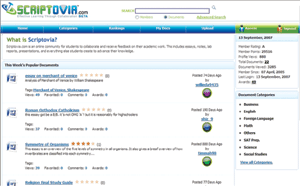
Scriptovia.com is a next generation Web 2.0 networking site that allows users to share, collaborate, and learn more efficiently in a virtual environment. Users interact collectively by posting their own school work to be critiqued and used as resources by other students. Members can also interact by reading and critiquing posted work as a source of learning and inspiration. 

Self-referenced as the “YouTube” of academic papers, Scriptovia.com hopes to find its place in the Internet community among giants such as Facebook and YouTube by allowing for hundreds and thousands of user-generated content to continuously be available to students taking similar courses all over the world.  All paper uploads to the website are converted to html, indexed, and made available to the wider audience through search engines such as Google and Yahoo. 

This document conversion allows Scriptovia.com to attract its primary audience, English speaking high school students, who are referred by search engines and drawn into the site to read specific paper topics. The hope is that these users become regular members by seeing the benefits of Scriptovia.com's emphasis on learning and collaboration as important skills to develop in an increasingly globalised and technological society. Collaboration is encouraged through the use of member profiles, and message, comment and ranking features, among other tools available. 

Collaboration is an important feature for the website.  Scriptovia describes learning as “all about making connections, and building on what others have discovered or learned.”  Along these lines, Scriptovia hopes that with access to its online resources and network of users, regular members can practice working together, develop useful contacts and supporters, share knowledge with others, “combine existing ideas in new ways”, and “look at old information from fresh perspectives”.  Scriptovia, however, draws a fine line between collaboration and plagiarism.

Scriptovia on Plagiarism

A major concern for the website is plagiarism, which is strictly prohibited.   Plagiarism is a concern that is hardly limited to Scriptovia.com and its user-generated and reviewed content. Plagiarism has been a concern ever since students were assigned schoolwork and schools developed an honor system. While Scriptovia puts thousands of resources at the hands of millions of students, some of whom May be unscrupulous users, technology has made it easier to catch plagiarists.


In many ways, Scriptovia's learning community is also geared toward educating the populace about plagiarism.  Scriptovia devotes an entire web page as part of its discourse on plagiarism, and it is mostly student's own responsibility to make sure that they utilize their resources responsibly.  Although cheating has always existed, the advent of new technology makes it easier to catch those who cheat. Questionable papers can be investigated by concerned teachers through the same search engines that students use.  Additionally, Scriptovia.com works with all the major anti-plagiarism services, will ban users reported by teachers to be plagiarizing, and utilizes moderators to help oversee the web community.

Scriptovia's roots
Scriptovia.com came about through Aseem Badshah, 18, a rising sophomore at the University of Washington who on the surface seems to be a regular college student.  Badshah, however, is also the founder, president, and driving force behind Scriptovia.com.  Perhaps most remarkable is how Badshah, while still only a teenager, has been able to dream up the concept of a revolutionary educational resource such as Scriptovia.com where others have not. 

When asked, Badshah reveals that the concept of Scriptovia was born during a reflection on his experiences as a junior in high school. In an interview, Badshah stated pointedly that “as a junior in high school it was pretty apparent that what is happening in our schools are not really relevant to what students are doing.  The goal of the site is to bring students out of isolation, where there are thousands of students trying to do the same thing. With Scriptovia, students can build on top of each other, have a conversation, and practice skills important to the 21st Century including collaboration and communication.”

With that in mind, Scriptovia.com has come about to help students access previously decentralised and inaccessible resources from fellow students online in a positive, cost-effective, and meaningful way. Scriptovia.com is free for its users, and unabashedly promotes lifestyle aspects that are universally important, especially in India, which include collaboration, access to information, and the acquisition of knowledge.
 
Scriptovia's relationship with India
e-Learning is an increasingly important force in Indian IT, and has been continuously featured in this publication. What Scriptovia.com has to offer that most other firms have neglected are its free features that include most of the capabilities found on social networking and other Web 2.0 sites, but with an emphasis on education, collaboration and learning. These features include document viewing, sharing, member profiles, Facebook integration, document tagging, categorisation, messaging, notifications, and rankings and awards, to name a few. 

Students benefit with collaborative and academic resources that help them excel academically. Users can view other similar essays to see how they are structured, get referred to useful resources, brainstorm topic ideas, find study guides and compare data.  Students who upload documents receive extra recognition from the public for their work through rankings, referrals, and rewards. Their documents also get additional feedback from members at large, useful for papers which could be spruced up before being turned in or just to extend the learning experience beyond what the teachers provide. 

In addition to providing these services to India, India serves as a vital market to Scriptovia because India is an English speaking country, a leader in information technology, and it is well known that education is an important aspect of Indian culture.  Indians are increasingly thinking globally, and India will help Scriptovia encapsulate the global culture and give its users the invaluable globally connected learning experience they seek. Scriptovia ultimately seeks to empower students, both within India and throughout the world.

What Scriptovia.com has to offer that most others have neglected are its free features that include most of the capabilities found on social networking and other Web 2.0 sites, but with an emphasis on education, collaboration and learning

Helping the educational landscape to evolve

It is an unfortunate fact that most classrooms haven't changed much over the years. In addition, many classes can not afford to constantly update their textbooks and learning material. In this manner, poorer schools are disadvantaged over those who can afford updated material. Furthermore, schools whose classroom materials haven't changed much since the technological breakthrough of the chalkboard are disadvantaged over schools that are kept up-to-date with technological progress. Top schools, not to mention top universities and corporations, are kept high performing through their emphasis in being up-to-date with the latest learning tools and through their collaboration with people and programs around the world.

But not everyone can afford to buy the latest computer programmes, hire tutors, and take other measures to stay up-to-date with what is available to increase student productivity. That is why the conception of a free-to-use web 2.0 academic networking site is so important for students around the world. In addition to providing a place where students can access learning material, papers, and collaborate with top students from around the world, Scriptovia.com helps students embrace 21st Century Internet technology where many current professionals already network, communicate, and conduct business online. Scriptovia is a cheap, nay; Scriptovia.com is a free way for students to increase their educational boundaries and allow their learning tools to evolve with the times.

Not only do students benefit by using Scriptovia, but on the other side of the equation students benefit by contributing their academic paperwork to Scriptovia as well.  For example, take the student who has spent hours on a detailed paper titled Scarlet Letter, which is a real paper on Scriptovia. In this paper, “Hawthorne uses a stark contrast between his portrayals of Hester and Dimmesdale to better solidify his indictment of extreme religious views.” Ordinarily, the most thoughtful academic paper will receive at most 20 minutes of attention from a teacher. By posting a meaningful essay online, students will feel better about helping others (why do people spend so much time editing Wikipedia if not for contributing to the general knowledge?), but they will get the personal benefit of recognition, high rankings in a global community, perhaps a few awards, and potentially some detailed feedback that will help them become better writers in the future. As the famous saying goes, “A rising tide lifts all boats.”

One of a kind

Ultimately, most current related Web 2.0 networking websites are building networks for social rather than professional and academically productive reasons.  Scriptovia, unlike many of these similar websites, will help build networks for these professional and academic purposes. Members who upload papers will collaborate with those users looking for ideas and receive the benefit of personal critiques, suggestions, rankings, and recognition for simply writing a useful paper. Other users who are looking for ideas and a source of inspiration can come to Scriptovia.com and sort through documents by subject matter and other search features. Users can continuously message and communicate with each other in order to further exchange ideas and inspiration. Its major draw will continue to be its content (academic papers authored by students), which is unavailable anywhere else.

Most significantly, Scriptovia.com represents a shift in websites by meshing social networking with information sharing. Communication and collaboration are growing to become ever-more important and necessary skills in a rapidly integrating global economy. Scriptovia.com offers a breath of fresh air in offering services to students that fulfill both their needs to complete and develop their schoolwork and pursuit of greater learning, and yet also caters to their interests in interacting with and learning from their peers on a global scale.   

LATEST NEWS