E-learning company offers course for medicos
MEdRC EduTech, a Hyderabad (India) based e-learning company has signed up a Memorandum of Understanding with Mediciti Institute of Medical Sciences and Hospital in order to provide e-learning solutions for MBBS students who want to be doctors.
MEdRC EduTech is planning to tie up with 20 more colleges, including colleges from Pune to provide these solutions by August 2007. MEdRC EduTech has also designed a solution for the five-year MBBS course on the basis of guidelines of the Medical Council of India (MCI), consisting of 6,000 lectures.
Oracle accelerates for SMBs
 Oracle has launched a portfolio of over 80 industry-specific’ application solutions to address the needs of companies in 30 industry segments including industrial manufacturing, retail, life sciences, engineering, construction, professional services, financial services, government, education and health care.
The company worked with 50 partners to design, package and price the new products. The move is a part of Oracle’s global Accelerate programme to meet diverse IT requirements of SMBs by combining partner expertise with Oracle’s applications and technology solutions.
India Inc doing its bit of social service
Corporate Social Responsibility (CSR), the commitment of businesses to contribute to sustainable economic development by working with employees, their families, the local community and the society at large has gathered an interesting momentum in last two decades. While the origins of CSR activities can be traced back to the early 1930s, the concept of CSR interventions began to take proper shape only from the 1960s.
A survey on CSR Monitor 2001: Global Public opinion on the changing role of companies, conducted by Environics International, which interviewed around 1,000 people from both developed and developing countries like USA, Canada, Mexico, Britain, France, Germany, Japan, India, Russia and Nigeria, revealed that:
A recent study by Nottingham University Business School, covering seven developing countries in Asia (including India, Indonesia, Malaysia, Philippines, Singapore, South Korea and Thailand) to assess the state of CSR interventions in these countries, revealed that although India is poorer than the other countries covered under the study and had the lowest GNP per capita among the countries, it ranked number one in terms of CSR penetration. About 72% of India’s top 50 companies undertake CSR initiatives supported by well-defined CSR policies. Countries like South Korea (52%), Thailand (42%) and Singapore (38%) were behind India in CSR penetration levels.
Most CSR interventions have been targeted at sectors like health & education, with interventions ranging from adoption of public health facilities by corporates, supplementing existing government programmes like the midday meal programme, assessing & improving learning outcomes in primary education through teacher training, leveraging ICT for improving learning outcomes, etc.
TIS and BT break new ground in child protection training
The global e-learning producer, Tata Interactive Systems, and BT, one of the UK’s largest providers of learning services to government are collaborating to produce a five module programme to enable those working within ‘children’s services’ to understand such concepts as the basics of child protection, how to identify a child at risk and how to develop the skills needed to help each child.
With input from a number of councils, the child protection e-learning modules have been designed by Tata Interactive Systems (TIS) and are delivered by BT’s Flexible Learning service, which provides managed learning services to over 600,000 public sector learners in the UK. The modules comprise of Safeguarding Young People and Children, a ‘basic’ awareness level module, which is intended for all local authority employees.
Mysore gets first IT-finishing School
Mysore will be getting its first IT-Finishing School shortly. New 12-month course by Raman International Institute of Information Technology, PG Diploma in Software Programming, is aimed at producing graduates who are trained up in soft-skills and technical skills.
India produces nearly 4,00,000 engineers every year, but only one in four is employable. Lakhs of graduates come out every year, but only 10% of them are fit to be employed in the IT sector. The trend is that software companies today look for fresh graduates who are trained up in industry culture, and are well-versed with soft-skills and communication skills, along with technical knowledge. The students who want to get trained up in soft-skills and technical skills now have this option, with the new course to be launched by Raman International Institute of Information Technology (www.riit.com).
The course is accredited at the professional level, with the certification from University of Mysore (UOM). Graduate with any degree can apply to the course, and selection will be done through entrance test.
The course is divided into four sections – Foundation track, Tech-track, Project track and Internship track, all with duration of 3 months each. Bank loan facilities are made available by RiiiT to students with financial difficulties. Laptops are provided for every student. The Faculty with corporate exposure helps in shaping the soft-skills of students.
MSC Software Provides Global University Program
 MSC.Software Corp., a leading provider of enterprise simulation solutions to include simulation software and services, has detailed its Global University Programme, a multi-dimensional offering to complement introductions of MSC.Software’s SimEnterprise solutions.
The MSC.Software University Programme provides software bundles as well as curriculum development and teaching assistance and an online community to make principles and theory understandable, enjoyable and relevant for engineering students.
Available as an online resource at http://www.mscsoftware.com/university/ and with online forums at http://forums.mscsoftware.com/universities/, the program delivers gold-standard software and resources for today’s engineering institutions.
Auralog: Innovation for language learning
GurukulOnline Learning Solutions has now tied up with Auralog, leaders in foreign language learning solutions, to offer their entire range of learning solutions on an e-learning platform.
Auralog, the first multimedia publisher in the world to apply speech-recognition technology to language learning software, and publisher of the award-winning language software TELL ME MORE, is now the global leader in its field. Equally effective for the beginning learner or the advanced speaker, TELL ME MORE promotes advancement at all stages of language learning. Auralog’s language learning methods are recognised the world over, and its products are utilised in 65 countries in Asia, Australia, Europe, Latin America and the Middle East. Some of the languages offered: French, German, Spanish, Dutch, Italian, American English, and British English.
Microsoft and Unesco recognise creative use of technology in education
Unesco and Microsoft have joined forces to recognise and reward teachers from Europe, West Asia and Africa for new uses of Information and Communications Technology (ICT) at the Innovative Teachers Forum 2007 taking place at Unesco Headquarters and the Louvre Museum in Paris.
The Innovative Teachers Forum supports the 2015 UN Millennium Development Goals (MDGs) for literacy and digital inclusion by helping to build a global community of educators that share ideas, classroom practices using ICT, and above all a common passion for learning. The 200 participants from 40 countries qualified for the event in national competitions that were held to recognise innovative teaching. Teachers’ initiatives range from incorporating the internet and online courses in curricula, to interactive classroom exercises, through the use of blogs and digital portals for teachers, students and parents for interactive coursework, evaluation, feedback and dialogue.
The Innovative Teachers Programme is part of Microsoft’s worldwide Partners in Learning initiative.
BT launches partnership with UNICEF
BT, one of the world’s leading providers of communications solutions and services operating in 170 countries launched a three-year global development partnership with UNICEF which will include investing $3 million into bringing education, technology and communications skills to children from poor socio-economic backgrounds in South Africa, Brazil and China.
In the first year, the BT and UNICEF partnership will reach over 18,000 children in some of the most economically deprived communities in South Africa. In addition to installing 250 computers, 150 head teachers and administrators will also be trained in effective school management and leadership skills.
This partnership builds on three community initiatives that BT is currently involved with in India. Through the Katha Information Technology and e-Commerce School (KITES), more than 9,000 children have already been equipped.



 What one needs for creating Technology Based Higher Education (TBHE) -environment in Higher Educational Institutions (HEI) are necessary logistics like multimedia projectors, computers, Internet connectivity with necessary bandwidth, skilled e-content development group, technology-friendly HEI administration, adaptability of the learners to TBHE environment, etc. In Bangladesh, many of these conditions do not persist at a satisfactory level. Besides, it is difficult for a particular HEI to incorporate all of them. Feeling the requirement of an implementation-friendly framework for TBHE, the authors propose a framework for promoting TBHE-environment in HEIs of Bangladesh, perhaps suitable for other developing nations also. The methodology of the framework was incepted from the National ICT Policy of Bangladesh and the feedback of the expert-group working on ICT and Higher Education in Bangladesh. For this, the authors used the data of the survey conducted by the Expert Group responsible for preparing report on “Strategic Planning for ICT in Higher Education”, of which one of the authors is an expert member. The TBHE-environment for dissemination of information in limited form in most of the public universities in Bangladesh. However, a few private universities are promoting TBHE-environment exists for authentic delivery of learning-contents in electronic form through web and other media. The authors studied their approaches and compared it with the proposed framework.
 Within an HEI, the successful establishment of TBHE environment largely depends not only on the friendly administration and fund, but also on an approved framework. The framework helps in streamlining the quality of education, research and other services provided by various HEIs and eventually increases their competitiveness. Based on the learners’ needs (regular or distant), the framework helps the HEIs in designing their learning system, which is crucial for the development of the TBHE environment. Development of massive and costly system May not be useful due to socio-economic and cultural background of the learners. The framework can help HEIs in this regard.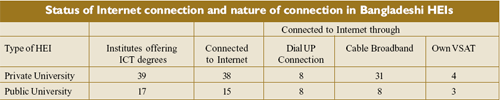




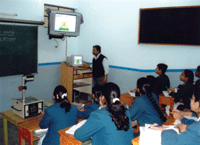 In keeping pace with the latest trends, Rukmini Devi Public School in Delhi, India has been steadily adopting and implementing the latest technological developments not only for the betterment of its students, but also for enhancing the teaching process. As a learning resource, ICT is used for accessing contextual and referential information beyond the textbook and library, through the Internet and Intranet. Students acquire wide and in-depth conceptual understanding through audiovisual presentations on a regular basis. To further enhance skills to comprehend, analyse and interpret the information gathered, students are allotted IT projects for which they actively construct knowledge by exploring information through various ICTs, interacting with simulation and finally presenting their projects for evaluation. Similarly group project work promotes collaborative learning amongst school students and their contemporaries across global boundaries and caters to an understanding of complex issues belonging to different realms.
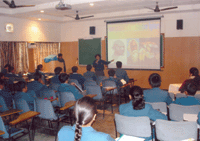 Learning being an eternal process, ICT has opened up several avenues to enrich and update teaching competence of the school faculty. They are able to train themselves in new pedagogical practices and are motivated to share perspectives through video conferencing, websites and other ICT inspired vistas. The school marked its imprint in 1998 on the Internet through its interactive website 'www.rdpschool.com'. It developed further adding up new sections and now has features to support a virtual school. At a micro level teachers are able to structure effective lesson plans after browsing through model teaching resources available on websites which brings a novelty to their teaching and takes them closer to their objectives.
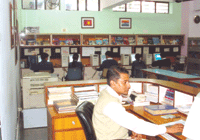 Besides this, ICT is also being used in the school for ensuring efficiency and accuracy at all levels of administrative work. Statistical data is collected and managed with more precision for planning purposes in various departments like examination, accounts and the library which aids in monitoring results, assessing needs, allocating resources, etc in optimum time with no error.
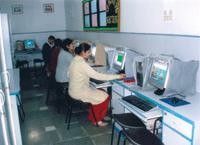 Basic ICT skills are developed among the Rukminians from a young age itself by giving them initial training through multimedia and audio-visual labs. The skills are further polished in senior classes, where they are given knowledge of networking, progra-mming, latest application software and operating systems essential to them under expert guidance.
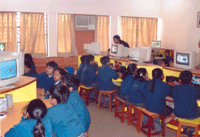 The school has a history of conducting several successful Multi cultural education programmes for enhancing children's understanding and appreciation for the world and its people. These exchange programmes, collaborative projects and other such activities are the efforts of the school to promote internationalism in school curriculum, which are facilitated by various ICT tools like e-mails, videoconferencing etc. In year 2006, British Council, India has recognised the incorporation of the international dimension in RDPS curriculum, by accrediting it with the 'International School Award'.
 The ITN Asia Pacific hopes to work with educators within the region as well as outside of the region to provide interesting content and information that will be used by teachers and schools. Registration is free and open to all in order to be part of the network.
 Leading processor maker Intel will soon introduce 'Classmate', a portable computer for children priced between INR 9,000-11,000, in India under its World Ahead programme, aimed at adding a billion new global computer users.