

Home Blog Page 1695

News India

INDIA

5,000 e-learning kiosks to come up in villages
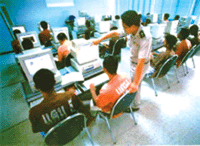
More than 5,000 kiosks to impart computer literacy will come up in villages across India by the end of 2007.

Shakeel Ahmad, minister of state for communications and information technology, said the project would cost about INR30 billion. These kiosks will be set up in local panchayats for training villagers on information communications technology. The trained villagers will help train others in their village.

Foundation of IIIT in Bhubaneswar by President of India

The President of India, APJ Abdul Kalam has laid the foundation stone of the 25-acre campus of International Institute of Information Technology (IIIT) at Bhubaneswar in Orissa.

The IIIT would come up as a world class institute. It would have a vision to contribute to the IT world by focusing on education and research, entrepreneurship and innovation. The Institute will be run as a registered not-for-profit society, funded jointly by the Government of Orissa and the IT industry.

IGNOU in Kochi proposes computer literacy programme

The regional centre of Indira Gandhi National Open University (IGNOU) in Kochi has proposed a State-level computer literacy programme in Kerala.

The programme is proposed for 50 senior secondary schools. In first phase, the project will be implemented in five districts and the schools identified for the project will act as admission-cum-information centres of the university. IGNOU has already started negotiations with the State Government of Kerala for providing MCA programme to high school teachers who are engaged as resource persons in IT@School project. The regional centre would set up placement centres, these will help the candidates to secure a job before passing out of the university.


FOGSI launches satellite based education programme medical colleges

The Federation of Obstetric and Gynaecological Societies of India has collaborated with the Indian Space Research Organisation for the satellite based education programme for medical students.

Indian Space Research Organisation has launched the satellite based education programme for medical students and doctors to update their latest information. FOGSI has launched satellite based education programme for doctors and medical students in over 100 municipal and government medical colleges of the country. Initially, Cosme Farma Laboratories Limited (CFLL) will install satellite dishes with technical support from ISRO. FOGSI doctors will develop the course content and distributed live through satellite to over 100 municipal and government medical colleges of India. The satellite centres would be launched in medical colleges of Jaipur, Jammu, Gorakhpur, Patna, Guntur, Manipal, Vadodara and Goa.

Jharkhand government promotes computer education

The Jharkhand government has rolled out a computer education and computer-aided education programme to down link based education at the local level. The programme would be covered in 440 schools across the 22 district of the Jharkhand.

The Jharkhand Education Project Council (JEPC) and the Jharkhand Agency for Promotion of Information Technology (JAPIT) are jointly implementing the project as a part of e-Governance initiative. Core Projects and Technologies Ltd. (CPTL) will provide technology support to the project. The project would be implemented in the duration of five years on a build-own-operate-transfer (BOOT) basis. CPTL will develop the software of the project. The project would be based on Child Tracking System (CTS) modules, which will compile all information of children up to 14 years. Each school would be mapped on the Geographic Information System (GIS). Another project is also in the pipeline, which would be based on audio and video technologies. The government is planning to introduce video surveillance system. These projects would be backed by ISRO and IGNOU and would be integrated with the CTS module. CPTL will provide dotnet, Microsoft, Java eApps, Oracle based products. Even the company is also talking with other State Governments like Maharashtra, Orissa and Chhatisgrah for similar projects.

Manpower shortage a major challenge for ICT

The government is ready to initiate changes in the education system to boost the skills of students in the field of information and communication technology (ICT) to overcome an expected shortage of around 500,000 skilled workers in the next few years, says Jainder Singh, secretary, department of information technology.

This he said after releasing a report titled, ‘Making the Connection: India’s digital future’, which is based on a study conducted by Accenture in collaboration with the Confederation of Indian Industry (CII). The study, based on a survey of more than 200 top business executives across India highlights the fact that ICT is growing to play a major role in expansion of low-income markers in near future. About 88 percent of the survey respondents consider ICT to be a major driver of the current and future development. A similar number said that the increased usage of ICT would be a major determinant in overcoming disparities between the rich and poor.

Indian SSA experiences shared at Cairo

The Minister of State for Human Resource Development D. Purandeswari has suggested in Education For All (EFA) meeting at Cairo that other countries can learn from the successful Indian experience in implementing schemes like Sarva Shiksha Abhiyaan, Mid Day Meal, Education Guarantee Scheme (EGS) centres for hard to reach target groups and the National Literacy Mission.

Purandeswari led a high level delegation in the 6th High Level Group Meeting on Education for All (EFA), in Cairo, Egypt, 14-16 November 2006. She also elaborated on the innovative resource mobilisation methods for achieving the goal of EFA while referring to the educational cess and the Prarambhik Siksha Kosh being adopted by the Government of India. The Minister also spoke about the special intervention regarding the Indian girls in terms of free uniform, text books and also special schools, for girls belonging to disadvantaged sections of society.

CBSE to begin satellite education in India

Central Board of Secondary Education (CBSE) has decided to launch a satellite education programme in schools across the country from next year. An initiative of the vocational education

department, CBSE, specific lessons would be transmitted through satellite from various regional offices of the board under the programme.

While NCERT is developing the curriculum, ISRO would help use modern space technology for promotion of education and training. To be propagated through Edusat, the satellite education wing run by ISRO, ministry of human resource development and Indira Gandhi National Open University, the programme would begin through teachers’ training programmes and later reach classrooms.

The programme would be managed by six regional offices of CBSE located in Allahabad, Guwahati, Chennai, Chandigarh and Ajmer. Schools in Jharkhand would come under the Allahabad centre.

National testing standards to help quality of education

An Approach Paper of the Planning Commission says that a set of national testing standards and a chain of institutions that test and evaluate children would help monitor and improve quality of learning. Noting that just 28 per cent An Approach Paper of the Planning Commission says that a set of national testing standards and a chain of institutions that test and evaluate children would help monitor and  improve quality of learning. Noting that just 28 per cent of schools had electricity in 2005 and only 40 per  cent of primary school teachers were graduates and 30 per cent had not  even completed higher secondary, it says, for a large proportion of  children, school is an ill-lit classroom with more than one class being taught  together by some who may not have  completed her own schooling. Monitoring these aspects would need  to correlate such facts with learning skills to identify where the real problems lie – pre-school, teachers,  state governments, design of Sarva Shiksha Abhiyan or the assumed   equirements for universal education, the report says.  On the Secondary Education front,  the report says that the 11th Plan  must aim to progressively raise the minimum level of education to high  school or Class X level. Observing that extension of secondary education in  ural areas  posed a special challenge since secondary schools cannot be set up in every village, the report said the  present trend of combining upper primary with secondary school  education may need to be strengthened. CS course to go online from  2007  To make the Company Secretary (CS) course widely accessible it will be  offered online from next year. Currently, the course is offered  through classroom teaching and via post. Once the course is web-based,  students can access the course at their desktops at their own convenience, according to the  sources of Institute of Company Secretaries of India (ICSI). The institute has started providing the  study material on CD. Plans are to  start the programme by early next year. In the first phase, the institute  will offer the foundation course.  
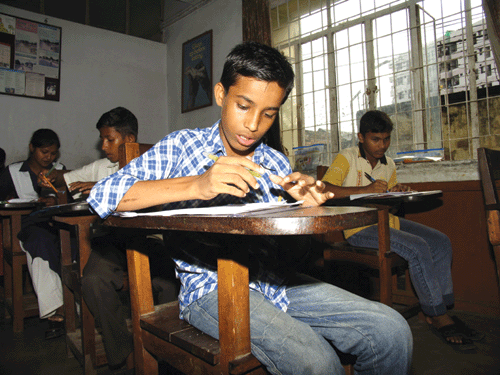
Towards an ICT-Literate Bangladesh

Current status of IT education in Bangladesh

Formal education in computers was first started in 1984 with the foundation of Computer Science and Engineering Department in Bangladesh University of Engineering and Technology. ICT education thereafter gradually extended to the bachelor’s degree, higher secondary and secondary school levels. In Bangladesh, there are about 83,796 primary level institutions, 5,694 and 15,748 junior and secondary level institutions respectively, 2,339 higher secondary and degree colleges and more than 1,000 ICT training centers.

At this time Bangladesh has more than 10 public and 54 private universities, 4 BITs and some (almost 50) national university-affiliated postgraduate institutes and colleges, which are offering courses related to computer science and information technology. Some other institutions have also initiated research programmes in IT-related fields. These include machine learning, pattern recognition, speech recognition, automatic translation, computational algorithm, VLSI and 3- D vision. Consi-derable research work has been done in the use of Bengali in computers.

The government formulated a National Education policy in the cabinet, which was endorsed by Parliament. In this Policy, introduction of ICT education at the primary and junior secondary level has not been included in the implementation period of 2010. A majority of schools in the country cannot afford to buy computers for their students. Though a small number of city-based schools

150 million people, literacy rate of 62.5 percent, and the challenge is how to become a learning society! ICT revolution imposes particular challenges on education systems in Bangladesh. These challenges reduce to three broad areas. The first has to do with participation in the information society, the second considers how ICT impacts on access, cost effectiveness and quality of education, while the third is to do with the way that ICT changes the education process. However, ICT is contributing to ever-increasing inequalities in Bangladesh through the so-called “digital divide” that splits the Bangladesh between those who are “ICT-literate” and the majority who are not. This article suggests a way of increasing ICT literate people. It also gives an outcome of a research on the means of providing ICT access to a large number of people at the grass root level in Bangladesh every year. The operational structures of the ICT education in school level are outlined.

have very limited computer laboratory facilities, yet they fail to make their students familiar with Internet, e-mail and related technology because of the lack of nationwide telecommunication infrastructure and Internet facilities. In addition, the teachers at the school levels lack the minimum level of training on IT. Secondary and higher secondary Education Board incorporated IT education in to curriculum.

Some IT Institutions (such as APTECH Ltd, BJIT, ECIT, DIIT, Genetic School of Computing, IBCS Primax, IBM ACE, IIT Bd Ltd, Infinity IT, NIIT) offer the IT diploma courses to all level students in some category of IT.

Government has reduced the usage charge of Internet services for both dial-up and leased line to encourage the people to use more Internet. Government is also encouraging private ISP’s, universities and educational and research institutions, software exporters and corporate offices to lease Internet access at a very reasonable price. Bangladesh has signed the consortium of SEAME- WE-4 to lay the submarine cable in order to have connectivity with the Information Super Highway. The price of ICT equipments has been falling sharply due to ICT-friendly taxation measures taken by the government with a view to play positive impact for enhancing ICT capabilities of the country. Bangladesh Telecom Regulatory Commission (BTRC) has been formed to take appropriate measure, which will help to create conducive atmosphere for ICT investment and contribute to narrow the digital divide. Government is committed to provide ICT education and training to its people and ensure affordable access to computers and the Internet facilities.

In order to facilitate the computer education in the Secondary and Higher Secondary level, the Government has undertaken a programme to provide computers and other accessories to about 15000 (Fifteen thousand) institutions of rural areas in its first phase. Other institutions will be brought under this programme in the subsequent phase.

Necessity of IT education in school level

Students should learn the basic concepts of IT, identify further study paths based on individual ability, gain knowledge on related employment opportunities, discover the importance of IT in national development and become aware of the technologies’ social, ethical and safety issues. Poverty will be reduced through a “social venture capital fund” for social and rural development. The school level students make a large part of the country’s total population. Students from the local communities who generally learn computer skills rapidly could be trained to serve as information intermediaries for the older generation.

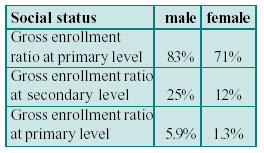
The drop out rate of our country is very high at the school level which is understood from the following table:

If we fail to include the basic IT education in school level, we will miss to face the ICT challenge, which is playing worldwide. By using the Internet the students can be practiced the foreign language as a communicative vehicle. They will be getting a good use of multimedia. There will be spreading and exchanging knowledge and culture. With the introduction of BTTB’s mobile telephone along with private operators, rural telecommunication infrastructure will also be developed and the rural people will be able to get the facilities of ICT. Government is playing very positive role to expand Internet services throughout the country. What we need now is a large workforce or human resource who are familiar with computers and aware of the necessity of IT in our life. The compulsory IT education in school can play the major role in taking ICTs to the doorsteps of the general community.

Suggested steps

Application of computers in industry, business, communication, and education and in every other sphere of life demands the extensive introduction of computer education at grass root level. The Integration of IT education or computer education with the formal curriculum in school education can play a major role in meeting this requirement.

The strategic plans or steps to be taken for extending IT education in school level May be as follows:

Curriculum development
Currently the students of primary, junior secondary and secondary schools can know a very little about computer through their existing syllabus. So a sustainable and enhanced IT literacy should be incorporated with our general education through designing a new curriculum for school level. Recently the government has formulated a national policy to introduce ICT education at the primary and junior secondary level, which should be included in the implementation period. Computer science was introduced as an optional subject for secondary level students from the beginning of 1994, and about 150 schools were permitted to start up the subject. Many more schools have shown interest, and the quantitative expansion of ICT education at the secondary level is phenomenal.

Trainer development
A national college for IT education can be established for teachers training. Or the teacher training college should incorporate compulsory computer literacy in their curriculum that they currently provide. Some IT education resource centres may be set up to facilitate  teacher training. Innovative means of training like mobile laboratories may be provided.

Evaluation system
To get the best quality of proposed education system there  should be an authorised evaluation team who will try to find the best  way to make IT education easier and interesting to the children. They  may incorporate some extra curricular activities related to ICT. A group of IT professional will work in  this team. Bangladesh seeks to build an ICTdriven nation comprised of a knowledge- ased society. To meet this overall vision, the nation must  develop a country-wide ICT infrastructure to give all Bangladeshis  access to information. This will empower citizens, enhance democratic values and promote sustainable   conomic development. By the   implementation of the above steps discussed, the school level students can understand the cultural similarities and differences from their point of view; they can interact to the other students from other schools. The parents and local communities who are not ICT literate can share the knowledge through their children’s  experience. Technological development will give the  competencies as critical thinking, decision- making, handling of dynamic situations, working as a team member, communicating effectively to the children. 

Instructional Design Making Effective E-learning


The entire process of development of e-learning content brings together a group of people with different competencies. The  rocess can be considered as The people–process–product continuum or P3 model. For example, people involved in the e-learning  evelopment process can be Instructional Designers, graphics designers, project managers and quality assurance managers. The product can be a well-designed e-learning module and the process can be any  tandard process like Dick and Carey Model. The P3 model is a  olistic approach to course development and helps in not only creating very high-quality e-learning content, but also in delivery and maintenance of the course. This article is an attempt at envisaging the entire development process in a modular approach.


Broadly the e-learning development process can be  divided into two major phases:   (a) Development, and ( delivery and maintenance. Suitable content is developed in the first phase and the same is delivered using an appropriate   medium in the second phase. A typical   e-learning process has planning,   design,    dvelopment, evaluation,    delivery and maintenance stages.   The Iterative Process of E-Learning   Based on the size and scope of the   project, the number of individuals   involved in various stages of an elearning    project may vary. Some roles   and responsibilities may overlap, as   many e-learning tasks are interrelated   and interdependent. A large-sized elearning   project requires the   involvement of various individuals. In  a small or medium-sized e-learning   project some individuals will be able   to perform multiple roles. When an elearning   course is completely   designed, developed, taught and  managed by a single individual, the   same individual has performed the   role of content expert, instructional   designer, programmer, graphic artist,     project manager, etc. This article has    tried to identify various roles and   responsibilities involved in the elearning   development process.   Sometimes there is a need for an   instructional designer to explain the   learning part of the project. The   instructional designer is generally    involved during the entire content    development process, and once the 

module is created, it is the responsibility  of technical support to ensure   delivery of the module and also take  care of a few of the quality issues.   Stages of the e-learning process A typical e-learning content development cycle contains the following stages: Planning, Design, Production, Evaluation, Delivery and maintenance, Instruction, and Marketing Planning stage During this stage a team consisting of project manager, instructional designer and the director worktogether and develop a project plan after a thorough analysis of the audience profile and user requirements. They analyse various aspects of people, process  and   products involved in the e-learning development initiative. This plan must  be pedagogically and financially  sound and should guide the entire elearning  team (production, evaluation,  delivery, maintenance, instructional  and support services) to engage in  their respectively assigned activities.   The planning team must consider the  various learning models and   strategies before working out the   entire plan. It is just not enough to    make the plans pedagogically sound;  they must be financially sound too.  The team needs to work out the timeframe   for every activity of the project,  with possible breakdown time and   buffer time to take care of exigencies.    The end product of the e-learning   planning process is a sound    elearning project plan,   whichprovides guidance during various   stages of the e-learning process.     Design stage The output from the planning stage, which is a plan document, is available at this stage for reference. People involved in this stage are instructional and graphics designers, interface designers, technology experts, and evaluation, quality and R&D personnel. The R&D person is responsible for reviewing course content for pedagogical soundness and selection of the appropriate delivery medium. He must be aware of limitations and capabilities of every medium and also the latest development in the area. Care must be taken to ensure the content is created using Aviation Industry Computer-based Training Committee (AICC or Sharable Content Object Reference Model (SCORM)     compliant if needed. Instructional  Designers play an important role, but their role is usually overlooked. The instructional designer designs the complete environment in which learning can take place. S/he conceptualises the e-learning strategy and methodologies based on the background of the audience. The design team must also communicate with developers about the action  scripts. The output product at this stage is the storyboard.

Production stage
At the production stage the production team creates the e-learning course from the storyboard put together at the design stage. The  production team creates all the required details independently and  integrates them in the course module.  It creates all the necessary links and makes the navigation smooth. The production coordinator leads the elearning  production process. All  members must put their modules in a central server so that security issues are also taken care of. All members  must follow the same naming convention for each module. Every day team members can work on the module (s) and store it back on the server when they leave. This  facilitates checking of the content  independent of members. Once the course is created and quality check of  the content is performed, it should be pilot tested. Once the project manager  collects all the comments from the pilot test team members, he can discuss them with the instructional  designer and necessary changes can be incorporated with the help of the development team. The product of the production process, then, is course material ready for pilot testing.

Evaluation stage
Evaluation is done at every stage of the entire life cycle, and feedback is incorporated in the product. Basically, there are two types of evaluations, formative and summative. Formative evaluation is conducted during the development stage and is iterative in nature. Summative evaluation is conducted at the end of the development when all the  components are integrated into a fullfledged  course. All the assessments are checked with respect to the learning objects, for  their relevance and appropriateness. The overall look and feel of the course is very important and clients are very  particular about it. Finally, the learning expert has to satisfy that the  learner will learn from the course. The  course is also evaluated for conforming to AICC, SCORM or other  standards.

Delivery and maintenance
After the content has been created, the focus shifts to delivery. The  driving force behind e-learning is that  the course content (or the module) must be available at any time from  anywhere to the learner. The content material may include audio, graphics,  simulations, assessments, videos, reading material and other features.  The delivery and maintenance (D&M) team plays a pivotal part during this  stage. The team has to first load the content either on the server or on the  learning management system (LMS) and test every bit of it, including  simulation and navigation. The team must also take into account the size of  the module andspeed of access, etc.  In most cases, an LMS may be used for delivery of the module. There is a  need to check the SCORM, AICC and other standards once the course is loaded here. The e-learning module  must be available to the learner any time. The learner must have the  control to leave the course and come back to it as many times as she wants.  Overall, the D&M team is responsible  for ongoing updating and monitoring of the e-learning environment,   ncluding security measures for access control and information  confidentiality. 

Instruction stage
The instruction team is the core of  good e-learning content development cycle. At the course instruction stage,  instructional and support services staff (ISS) are the people involved in  delivering the instructional product. E-Learning environment  Once the content is ready the course may be offered either through a portal or in standalone mode. The  expectation of the learner is that they  must be provided with a good learning environment and uninterrupted learning time. It is  necessary to see to it that the correct  courses are received by students who  register for a particular course. The Internet and availability of good  bandwidth gives organisations one  ore medium for delivery of learning  content. This is attracting both academic and non-academic  institutions to seriously consider elearning. The E-learning P3 model provides a  comprehensive picture of the elearning process and helps identify  the roles and responsibilities for the design, development, evaluation, implementation and management of all  e-learning and blended learning materials and systems.  

A Telco &lsquo:Broadbanding&rsquo: Education in Philippines

In the Philippines, while lack of classrooms and textbooks are still problems, the use of Information and Communications Technology (ICT) in education has been widely recognised as a means to improve teaching. However, the high costs of PCs and putting up access facilities plus the necessary training supports are factors in holding back the growth of Internet usage in many schools all over the country. But in recent years, there have been a number of various initiatives from the government and the private sector to address these barriers.

Uptake for mobile services, specifically text messaging services, has been pervasive throughout the country. Mobile penetration has grown quickly and is now estimated to have reached 40% or 35 million subscribers by early 2006, from only 2.7 million mobile subscribers in 1999.

However, percentage of Internet users was still at 9.1 % of the population or about 7,820,000 in March 2005. In the education sector, one computer can be shared by 111 high school students

News Corporate

Projects

Malaysia beckons investment from India

Malaysia's Multimedia Development Corporation or MDeC will open its first representative office in Bangalore, India.

The Malaysian representative office in Bangalore will not only facilitate business and investment between India and Malaysia in the areas of information and communication technology (ICT), but will also be a resource point for Indian students interested in studying in Malaysia and vice-versa. The main industry areas in which MDeC will concentrate on in Bangalore and India are- creative multimedia e-learning content, outsourcing and shared services, hardware design, software development, support and services, and Internet-based businesses.

The opening of the Indian representative office in Bangalore is the first step in ushering Indian companies to be a part of Multimedia Super Corridor (MSC), Malaysia which is a Malaysian national initia-tive and acts as a strategic vehicle to achieve the country's goal to be a developed nation by the year 2020. MDeC will also look at expanding to other cities in India in days to come.

Intel to donate 10,000 PCs to India

Intel Corporation, the world's largest semiconductor company announced its plan to donate 10,000 full-function personal computers to state governments and teacher training institutes in India under its 'Intel Teach' programme.

Under the programme, the microprocessor giant will train one million teachers on the application of technology to improve classroom learning. While announcing the company's plan to expand its education and digital healthcare programmes in India, Craig Barrett, chairman, Intel said, “By 2008, Intel plans to donate 10,000 full-function PCs to state governments and teacher training institutions, as well as train one million teachers on the applica-tion of technology to improve class-room learning.” All donated PCs will be equipped with Internet connecti-vity, education content supported by the government, and software applications provided by Microsoft.

IBM technology May improve language skills

As Indian call centres have thrived in the past decade, helping U.S. companies cut costs and creating hundreds of thousands of jobs, they have faced a seemingly insurmoun-table problem: Most Indian employees speak heavily accented English. Now IBM's India Research Lab says it has a way to help operators fix the harsh consonants, local idioms and occasionally different grammar of Indian English, often a source of frustration of those who call in search of tech support and other information.
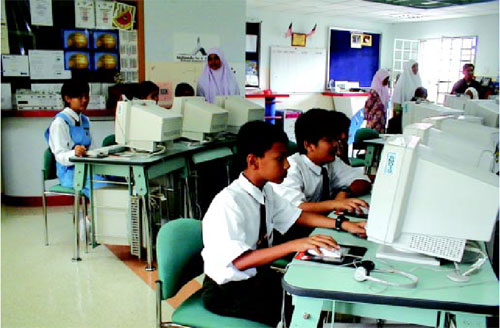
IBM, which operates large call centres in India, has developed Web-based training that can help improve language skills.

Although the technology was developed for employees in India, it has broad applicability for others as well as in schools and businesses. The programme evaluates grammar, pronunciation, comprehension and other spoken-language skills, and provides detailed scores for each category. It uses specially adapted speech-recognition software to score the pronunciation of passages and the stressing of syllables for words.

The technology also consists of voice-enabled grammar evaluation tests, which identify areas for improvement by highlighting shortcomings and providing examples of correct pronunciation and grammar.

Infotech to have positive impact on growth

Around 88% of the Indian business leaders believe that increased use of information and communication technology (ICT) will be a major determinant in overcoming socio-economic disparities. This will advance growth in the next five years, according to a joint study by Accenture and Confederation of Indian Industry. The study is based on a wide ranging survey of over 200 Indian business leaders cross all major industries. The study stated that the catalytic impact of ICT would have multiplier growth opportunities across all industries. According to the study, 94% of the businessmen believe that the use of ICT has been a major reason for India's recent economic growth, while 87% believe that socio-economic disparity is the major obstacle in the growth of Indian economy. Indian business leaders believe that the next phase of ICT-led growth will come from three main sources

E-learning Practices in Singapore

e-Learning in Singapore has its roots in the first generation type of technology-based training during the early 1970s. That was the period when mainframe computers were selectively used in banks, manufacturing plants, major government ministries like the Defence and the universities. Later when mini-computers became popular, computer-based training packages were developed on the minicomputers like the Honeywell and the PDP series of mini-computers. When the trend shifted towards the use of the desktop Apple II computers and the IBM-compatible PCs, teachers and trainers began to develop many computer-assisted learning packages using languages like the Pilot language and the Quest authoring system.

Next came the widespread use of video-based training during the early 1980s. The laser disc player became one of the more popular equipment to use for playing back video clips of training such as those for the front office hotel staff. Many multi-media based authoring software systems like the IconAuthor and the Toolbook were used widely to develop multimedia-based computer-based training. The laser discs then made way for the smaller and more convenient CD-ROMs.

Finally when the Web became very popular some time in 1994 and 1995, people started to use the Internet to browse the World Wide Web and create innovative applications. It was also during this time that people began to realise the need to track student's learning. E-learning content developers started to use e-learning standards like the AICC.

The polytechnics and universities

E-learning in Singapore took off in a big way when the Web became very popular some time in 1994 and 1995. The polytechnics and universities were the early adopters and champions of e-learning. However, e-learning in the schools in Singapore were given a boost especially with the 1st IT Master plan for Education which lasted from 1997 – 2002. Since then there is available the 2nd IT Master plan for Education, which will last from 2003

Deconstructing Secondary Education

The Smart Schools in Malaysia were never intended for smart students only when they were firstenvisioned. It was an ambitious project that brought together the Education Ministry, private industries andother stakeholders to work hand-in-hand to create a schooling culture that is informed, thinking, andcreative using technology as an enabler in the teaching and learning process in line with the country’sneeds to make the critical transformation from a production-based economy to a knowledge-basedeconomy by 2020. The project started with 87 pilot schools from 1999 is now being expanded to reach10,000 schools by the year 2010. The featured story focuses on the implementation of the teaching andlearning processes at the pilot schools and the challenges faced by the schools in trying to achieve thestipulated goals of the Smart Schools. It also looks at the post pilot phase and the rollout plans lay down bythe Ministry to move forward towards achieving Malaysia’s vision of producing knowledge-based workers.

At the initial stage of the smart school project, many people had the notion that the Smart School was a school for smart students only, and that without the presence of technology or computers, a school could not be termed a Smart School. Therefore, to put it in the right perspective, it must be stressed here that the Smart School is for all children and technology is just an enabler and not a driver, and its presence in the schools does not mean it can catalyse better educational outcomes. It is however correct to say that with the use of technology, we are able to take the Smart School to its destination more quickly and efficiently. 

The Conceptual Blueprint that was published in 1997 defines the Smart School as “a learning institution that has been systemically reinvented in terms of teaching-learning practices and school management in order to prepare children for the Information Age”. The word “systemically reinvented” is used in the definition because the Ministry of Education, Malaysia intends to make a radical transformation to the education system by reviewing the curriculum and pedagogy, enhancing the roles of teachers, administrators, parents and the community, and empowering the students to become more responsible for their own learning by practising self-accessed, self-directed and self-paced learning. 

The presence of the information and communication technology (ICT) is critical because it helps in making the teaching and learning processes more interesting and enriching, and in the long run, the students will become more technology savvy. The Smart School initiative has been planned to ensure that the education system prepares future Malaysian citizens not only as knowledge workers for the Information Age but to be able to achieve Malaysia’s vision of becoming a fully developed nation by the year 2020.

The Pilot Phase

The Smart School project started in early 1996 when the Ministry of Education (MOE), Malaysia first discussed its concept and implications on the education system. By late 1996, the Smart School Flagship became one of the seven applications identified under the Multimedia Super Corridor (MSC) initiative (The MSC is a 15 x 50 km zone, stretching from the Kuala Lumpur City Centre to the Kuala Lumpur International Airport launched in 1996 as a regional launch site for companies developing or using leading multimedia technology).

The Telekom Smart School (TSS), a consortium led by Telekom Malaysia was awarded the contract to develop the applications. The Multimedia Development Corporation (MDeC), a private company wholly owned by the Malaysian Government to manage and market the MSC, also collaborated with the Ministry of Education to ensure the implementation of the Smart School flagship.

Ninety schools throughout Malaysia were identified to pilot the project but this was later reduced to 87 because three new Smart Schools could not be built on time when the pilot was launched. This included 83 secondary and 4 primary schools. Of these, 6 new schools (2 secondary and 4 primary) were built and provided with the level A (Full Classroom Model) Smart School technology specification and the rest were existing secondary schools (41 fully residential schools and 40 day schools) that were provided with level B (Laboratory Model) and one school with level B+ (Limited Classroom Model) technology specifications. Each new Smart School with the A technology level was provided with 520 computers (7 computers in all the classrooms and science labs, 4 computer labs with 36 computers each, and the rest in the teachers’ room, resource centre, and the administrative office); Level B schools were provided with 37 computers (one computer lab with 21 computers, and the others in the resource centre and administrative office); and the Level B+ school was provided with 81 computers (6 computers in 15 classrooms and science lab and the rest in the resource centre and administrative office). 

  • Technology Infrastructurecomprising IT and non-ITequipment, Local Area Networks,and a virtual private network thatconnects the pilot schools, theMinistry’s Data Centre and HelpDesk;
  • Support Services in the form of acentralised Help Desk, andservice centres throughout thecountry to provide maintenanceand support;
  • Funding for the Smart SchoolProject was provided by thegovernment with an allocation ofRM400 million, of which RM100million was for the training ofadministrators and teachers onthe Smart School concept andRM300 million was for theimplementation of the SmartSchool Integrated Solution(SSIS) in the 87 pilot schoolsunder the Pilot Project Agreementbetween the Government andTSS signed in 1999.

The Smart School Curriculum was developed by the Curriculum Development Centre; pre-service and in-service training of teachers was conducted by the Teacher Education Division; and the training of school administrators was undertaken by the Aminuddin Baki Institute, the Ministry of Education’s staff development centre. 

The Smart School Pilot Project ended in December 2002, with 87 networked schools throughout the country, 1494 courseware titles for the 4 subjects, a computerised and integrated Smart School Management System, a Help Desk and Data Centre, and trained administrators, teachers, and IT coordinators in all the pilot schools.

The Smart School concept
 
The teaching and learning environment is integral to the Smart School concept and comprises four areas, namely, the curriculum that is designed to help students achieve overall and balanced development; pedagogy that allows for the appropriate mix of learning strategies to ensure mastery of basic competencies and promotion of holistic development; assessment that is designed to give accurate feedback of students’ readiness, progress, achievement and aptitude; and teaching and learning materials that are cognitively challenging and motivating by combining the best of network-based, teacher-based, and courseware materials.

Initial evaluation of the Smart  School Pilot Project
With the implementation of the Smart School project, the Schools Division was requested to coordinate the evaluation process, and the collaborative  onitoring was carried out twice, once in 2000 and another  one in 2001, after which it was taken over by the Smart School Team at the  Technology Education Division. When the monitoring was conducted in 2000 and 2001, the Smart School Integrated Solution was not fully  released to the schools and the full integrated solution was only utilised fully in March 2003.

Evaluation of the Pilot Schools in the post-pilot phase (2002 –  005)When the pilot project was successfully concluded in 2002, evaluation studies were carried out by various groups commissioned by the  Ministry of  ducation and MDeC.  These included a benchmarking study by Frost and Sullivan, an independent consultant, to compare the Malaysian  Smart School’s Integrated Solution with eight other countries, a study by  local academics, and  echnology  evaluation by the Smart School team and TSS. The benchmarking study compared the merits of the SSIS and its components with similar implementations in Australia, Britain, Canada, Ireland, Japan, New Zealand,   ingapore and the USA to benchmark their best practices in ICT-mediated  education with that of Malaysia. The study reported that no other country had contemplated automating the whole school process and the  Malaysian achievement had brought such sophisticated advantages within the reach of the average child attending a government school. The  Teaching and Learning (TLM) courseware was also tailor-made for  the Malaysian curriculum whilst schools in the other countries used courseware developed for the generic   arket. One of the recommendations made by the study was to intensify change management programmes and pedagogy training for all teachers on  how to integrate ICT in teaching and learning.  The study by the local academics found that almost half of the teachers surveyed mentioned that in-house  training for  subject teachers was only moderately successful in achieving its objectives and the trainings were not repeated for new teachers who had  just been transferred to the school and had never attended any Smart  School training. The Senior Assistants also said that the teachers needed  more effective training than what was  available and delivered in-house. The technology evaluation by the  Smart School team and TSS found that the Smart School Courseware was  under-utilised as teachers preferred to use the newer courseware produced to teach Science and Mathematics in  English while the Smart School courseware was in the Malay  Language. This was because the government changed the policy for  the teaching of these two subjects in English starting in 2003 for Primary Year 1, and Secondary Forms 1 and Lower Six students. Findings from the evaluations helped  the Smart School team to identify measures to try to overcome the  issues with regards to technology, infrastructure, support, and human  resources.

Making All Schools Smart
In the original Implementation Plan, the Ministry of Education intended to use the findings of the Pilot Project to prepare a Master Plan to ensure that all schools in the country become Smart Schools in stages, by the year  2010. The Government of Malaysia would play the role of architect and driver by preparing guidelines and providing basic amenities to schools, and actively encouraging all schools to become Smart Schools on their own  initiative by using their own financial resources and expertise. Following the Pilot Project from 1999 to 2002 and the post-pilot phase from  2002 to 2005, the Ministry of  Education developed a visionary plan for the roll out of the Smart School from 2006 to 2010. The plan to make all  the schools “smart” by 2010 would leverage on all the ICT Initiatives the Ministry of Education had undertaken such as the Computer Lab project (to provide computer labs to all schools),  Teaching of Mathematics and Science in English (PPSMI), Training of teachers  to teach Mathematics and Science in English (ETeMS), SchoolNet Project (to provide internet  broadband facilities), and Educational TV (ETV). Much of the activities between 2006 until 2010 will be focused on ensuring  that all schools are equipped with the hardware and courseware (and all new  courseware developed will be webenabled), and rigorous training of  teachers and administrators for the implementation of the Smart School,  and change management programmes  conducted to instill the ownership of the Smart School initiative among the stakeholders.  The Malaysian government has made  an ambitious and bold initiative and has laid the foundation for our schoolchildren, the future citizens, to  progress towards achieving Vision 2020. It is now up the various stakeholders to play their part and ensure that the path towards achieving the goals is obstacle-free. 

POINT OF VIEW

Change Management is the Formula!

Karthik KS is one of the prominent leaders in the Intellectual Capital Management Space in India. The Founder and CEO of 24×7 Learning- one among India's leading e-learning Implementation Companies, Karthik leads the company's efforts to capitalize on long-term growth opportunities and align its operations with key customer segments in the global market place. Karthik is strengthening the company's presence in key markets ranging from enterprises to vertical industries. He has been greatly successful in implementing company policies and business strategies positioning the company as a leading brand. Karthik has an in-depth knowledge of Intellectual Capital Management in Enterprises right from technology to users and also the commercial point of view. He has been at the helm of some of the best e-learning Corporate Implementations in India. So what does this active proponent of e-learning in India think on enterprise e-learning in the country?

'Two things I'd like to emphasise- one is- stay focussed. This is very easy in today's time in India. Success is all about saying 'NO'. Anything comes on your way is an opportunity though, but they are not the opportunities of success for you. Stay focussed to the thing only on which you are a specialist.'

Probably this focussed vision has helped this start-up e-learning company to see its business very good today. Although there are still miles to go, last year it grew @100% and this year it is growing at 400%. 24×7 has bagged the 'Red Herring Asia' award recently as the most promising young company, recognised as one of the 100 private Asian firms driving the future of technology.

But then why India and why education gets this focus? 'Our market is India; we remain focussed to India. The reason is

Intuition launches mobile e-Learning course for banks

Intuition, the technology-enabled learning expert has announced the installment of the world's first mobile e-Learning course for smartphones and PDAs like BlackBerry.

Intuition has demonstrated the new training technology at the recent Learning 2006 conference in Florida. The course has been developed for financial services institutions, which will allow banks to track and automatically record users' progress. Financial services institutions are working with Intuition to launch training programme through BlackBerry phone for business need of remote access for learning through converged devices. Intuition's mobile learning technology was developed for those mobile users who use their PDA's for short period of time. Mandatory training also has to be accessible to staff in the most convenient formats possible to ensure uptake across the board, and trackable mobile learning represents the latest advance in 'anytime, anywhere' training.

120 international e-Learning providers came together at online education in Berlin

120 International e-Learning providers have gathered at the world's largest international conference on ICT supported for e-Learning and training in Berlin, Germany.

About 2000 participants from 86 countries are participating in the conference to build ICT for informal and life long learning as well as the use of learning technologies in various sectors like medical, automobile industry etc. The main focus of the conference is to emphasis on ICT development in school, universities as well as in public and private educational institutions at the online education in Berlin. The conference is emphasising on emerging tools and community based services and the use of technology from school to higher education. Online Education Berlin is the world's largest international conference on technology supported learning and training. Participants of the conference discussed on adoption and innovation of e-Learning.

LATEST NEWS