Home Blog Page 1734

Practitioner’s Voice A vision makes the difference

A vision makes the difference…
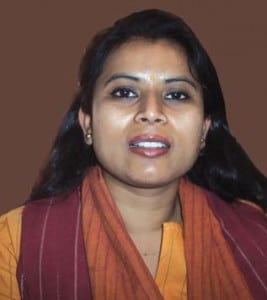
There has been a complete change in the ambit of education, especially when it is discussed in the context of Indian states. Access to progress in education is but a few more clicks away right here in this part of India-Uttaranchal. Namrata Kumar, State Project Director of India’s flagship education for all project- Sarva Shiksha Abhiyan in a conversation with Sanjeev Kumar Shrivastav of Digital Learning, on the state’s educational roadmap that takes it to its own zeniths

? What are the major interventions made under the Sarva Shiksha Abhiyan (SSA) programme in Uttaranchal so far?
We are implementing computer added learning programme in partnership with Azim Premji Foundation and it has worked out  very well. We are doing it with upper primary school level where CD based  content is being provided to students. Now the most positive effect of this programme that has happened that we are not going to just use the  content or CD based content in teaching process in the class room and the additional part like how to  operate the computer, what are the issues related to hardware and even  ensuring electricity supply and electricity backup, all these  important issues are also not bothering anymore. Apart from that if you are asking use  of technology in education programme, then we have made very  novel initiative in this in a way using video conferencing to disseminate our  instructions which is not just happening at the district level but also at block and village level. We conduct monthly meetings via video conferencing for VRC’s and CRC’s  and also do meetings at the village level.

? How much support do you get from Panchyati Raj institutions in your state while implementing your programmes?
One cannot rule out the role of Panchyati raj Institutons here, SSA has this as a base line factor. We have village  education committee (VEC). At present these VECs which we created under SSA with the Panchyati  Raj institutions will be the sub committees of the education  committee. Every Panchyat has education committee and these VECs will be the sub-committees of  these committees.

? Do the state of Uttaranchal need any state specific vision or the guideline given by the centre is adequate enough?
The government of India provides the guidelines for all the states but unless the state having its own vision I do not think that they can be outstanding. If you really want to do something outstanding then you really need to have your vision. I take proud in saying that every body from op to bottom is well informed about elementary education and providing all kind of support from whichever source is possible. What I mean is that our education minister, chief
secretary, education secretary and every body is into it. The state wants to be performing above the guidelines stated in SSA and Government of India gives it.

? What are the major challenges you
face in the state while  implementing the programmes?
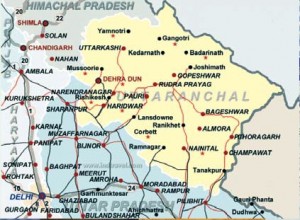
Uttaranchal is a small state. One may think that in a small state it is easy to manage and implement the programmes. But it is not so, because  it is one of the hill states where we do face problems in reaching to the  remotest areas. Another area, which is not difficult but  challenging. In Uttaranchal, industralisation is happening  very rapidly so we are getting huge number of children form other states. Their migration pattern  varies from months to months, year to year. We are trying to  overcome that by having a database of every child. We are conducting night service and worksite service  to capture other child coming from other states and to capture interdistance migration and to take the benefit of SSA to every child. Hilly  area also brings out a limitation of expanding the technology at the  speed we want.

? What are the strategies you adopt  to make ICTs as part of the  education process in Uttaranchal?
ICT will play an important role like I said we are into video conferencing to disseminate instructions and training inputs. So in that manner  if we have the proper convergence  of all information technologies like satellites, computers and  even mobile set and if we integrate these technologies together then we will be able to bring out solutions at very fast speed.

? How much support do you get from civil society organizations and private sector organizations in the SSA programme?
Uttaranchal is going at a pace very proactive for progress. Everybody is  into it, not only government but NGO’s and private sector  organizations are also involved in this process very much. For integrating  ICT, we are having a tie up with  Microsoft and Intel not just for elementary education but for secondary education also. Most of the elementary education has been  covered by the Microsoft tools for the  hardware, in fact, most of them are hardware. The teachers have sought  that training with Microsoft. This training part is being expanded to  elementary education teachers training also. We have the computer network till the block level and this  year we are planning to expand it to cluster also and we will provide  training which will be done by multiple agencies that include private sector organizations.

? Please elaborate the steps taken in improving teacher’s training
programme(s)?
We already have a teacher’s training programme. Now we are talking about specific training needs, for migrating,  irls and SC/ST students. We are giving a fully conscious approach to revive the teacher’s training  programme. Also we have school grading and school performancemapping  system where we have the endurance system by devising smaller  modules for remedial teachings. This
happens thrice in a year. ? Any comments you would like to  give on our publication? It is good and not only updates us  about happenings in ICT and education sector but also we know,  what is happening in other states/ countries. Sometimes distance is also  ime bound and this magazine is very   helpful in bridging the gap.

Jammu and Kashmir

The winds of change…
There are about 888 thousands educational institutions in the country with an enrolment of about 179 millions. Elementary  Education System in India is the second largest in the world with 149.4 millions children of 6-14 years enrolled and 2.9 million  teachers. This is about 82% of the children in the age group. Yet this state in India Jammu and Kashmir is educationally backward, despite the fact that it is the only state where education is free up to
university stage. Against the national literacy rate of 44.18% for males and 19.55% for females, the state has a literacy figure of 26.67%.

Winds of change througheducation policy
The Jammu and Kashmir government has launched an ambitious education policy- “Rehbare- Taaleem” to improve standards of  education in the state.
Under the scheme, “Rehbar-e- Taaleem” (teacher) would be engaged  for a period of two years on contract at a monthly  honorarium of Rs 1,500. The
performance of “Rehbar-e-Taaleem”  will be evaluated and reviewed by the village committee after two  years before extending  his appointment for a
further period of three years. From the third year  onwards the teacher will be paid Rs 2,000 per month. After five years   his/her performance will again be
evaluated and certified by the village committee before he/she is considered  for permanent appointment. The education department has also  started constituting village-level education committees. These  committees comprise two members  from the parents, a social worker and a representative of women, and Scheduled Caste/Scheduled Tribe.  The village-level committee will supervise the functioning of the  school and report the cases of absenteeism to the authorities. They will also address the problem of  dropouts and supervise the  implementation of various government schemes.  The scheme will not only compensate shortage of teachers, but also provide  teachers in the far-flung areas where  many do not want to go.

Towards total literacy
• Massive drive launched to achieve total literacy by 2007 by  effective  implementation of SSA; 910 primary schools opened; 2500 Education  Guarantee Centres set up; 237 primary, middle and high schools upgraded.
• All primary schools being
provided third teacher.
• Construction of 223 primary, 16 middle schools taken up; engineers’ self-help groups  encouraged for taking up school building construction;
• 30,000 posts of teachers created,  7000 teachers appointed in transparent manner, 24000 more  teachers being engaged, political interference  eliminated.
• Free textbooks scheme extended up to 8th class; special grant of Rs. 50  million provided for  improving conditions ofz
classrooms for students, mats provided in classrooms.
• New subjects being introduced in  schools, biotechnology, biochemistry, environment sciences, humanities, psychology and sociology; computer education for higher secondary level.  Seasonal schools have been opened for people in the hilly areas and for the scheduled castes. On the  technical education side, there are two  regional engineering colleges in the state. There are four polytechnics to
impart vocational training.

Open Content in a virtualised real world

The UN meaning of the Information Society emphasises information opportunities as inalienable rights of each. The participants of the second phase of the World Summit on the Information Society (Tunis, November  2005) reaffirmed “the desire and commitment to build a people-centred,  inclusive and development-oriented Information Society, premised  on the purposes and principles of the Charter of the United  Nations, international law and multilateralism, and respecting fully and upholding the Universal Declaration of Human Rights, so that people everywhere can create, access, utilise and share
information and knowledge, to achieve their full potential and to attain the internationally agreed development goals and objectives, including the Millennium Development Goals”.  The Information Society is a society
where the main production, communication and other processes  take place in the virtual environment. Such virtualisation of the real world  results in the fact that knowledge about “the ideas” becomes much  more important than practical realisation of the ideas which  becomes a routine due to the progress
in technologies. The Information Society is not only a  theoretical investigation of armchair scientists but it is phenomenal and  today one may observe its existing shoots in some mass phenomena. First, we mean open projects and free
(independent) communities developing in the Internet environment. These communities (still) take very modest practical aims but their activities  omprise
something common which, being extrapolated to wider community (up to whole society) makes it possible to perceive the other world, other interactions, other laws and other roductiveness. Along with the development of such projects and extend of the fields of  their implementation principally new methodology has emerged. This  methodology looks for and gradually
detects the techniques and modes of co-organisation of people in the  communities based on creation nd dissemination of knowledge, information and products of creative activities.

The term “open content” is (still) used in almost the same sense in the UNESCO documents, but here the word “open” has an additional nuance corresponding the organisation’s spirit and means not only the open regime but also the principle of openness and availability of knowledge, information and works of art, which UNESCO advocates

The Approaches to the Definition of Open Content In the narrow sense, open content means digital content under the  specific (open) regime of using, which
is usually regulated by the special  open license for dissemination of content. This empirically narrow  operational definition of open content is widely used now and appeared due  to the joining to the regime of production and  dissemination of open  software for other digital products such as texts, music, video, images and combined products united by the  term “multimedia”.
The term “open content” is (still) used in almost the same sense in the  UNESCO documents, but here the  word “open” has an additional nuance corresponding the  Organisation’s spirit and means not only the open regime but also the
principle of openness and availability  of knowledge, information and works of art, which UNESCO advocates.  Nevertheless, it seems to us that the whole sense spectrum of open  content could not be limited to the definitions mentioned above.  The “content” means not only content in proper sense but also essence, substance, meaning and  sense. By the way, an English word “content” succeeds in its sense to   two different Latin words: “contentum” that means “something
existing inside” and “contentus” that means satisfaction and contentment (sic!).
The second part of the term, namely the word “open” comprises in its sense not only openness as availability and accessibility but also  means something what was open, released, discovered as well as  “open” in the sense analogues to
those used for “open systems”, namely open-ended, unaccomplished,  unfinished and available for interactivity. Science as a part of culture is in
extreme need of junction of its separated and disaggregated parts  into a single whole. There is a long history of dialog on the necessity of  not only interdisciplinary research but also of joining science knowledge in a  unified consistent environment and construction of a “Knowledge  House” as well as on the need in combining of scientific, cultural and  historical contexts and creation of common depository, common virtual  memory of humankind. Apparently, this task must be one of the main  challengers for the Knowledge
Society.

Open Content as a Methodology
In some works on gnoseology and science of science, the multifold correlation between the levels of social development and dominant  methodologies has been realised. The transition to the next level of social  development is accompanied by a paradigmatic transformation of  methodology. Thus, the methodology corresponding to the industrial  society is a classical methodology. Its formation was routed in methods and  principles applied in natural science of those times, and so-call “classical  picture of the universe” was shaped.  The naturalists fondly believed that the dome of the science sky was  shadowed only with a few cloudlets to be dispersed easily and shortly.
After that they anticipated completed  picture of the universe basing on which it could be possible to use rather simple techniques for  comprehensive realisation of  necessary functions of description, prediction and post-diction.
But later it’s come clear that an attempt to remove even one cloudlet  from the dome of the science sky  leads to the necessity to study microcosm where the principles of  classical methodology occurred to be inadequate, e.g. there is no possibility  to measure with every required degree of accuracy and some measured  values are interdependent. The  perception of such results led to the
formation of so-called non-classical paradigm of methodology evolution,  and meanwhile the society entered a consumer phase of its development.  Along with the syntax and semantic elements of analysis the pragmatic  elements have emerged. It has become  clear that an integrated picture of the  universe could not be shaped when taking into account the existence only  of the macrocosm and microcosm and not considering the presence of the  world of information.
Thus, we have several pairs: industrial society and classical methodology as well as consumer society and nonclassical methodology. Although the  rinciples and methods  of post-non-classical science has been accepted by the intellectual community and recognised as  scientific thinking, our societies,
economics, political systems, social and public institutions, including  mass education, are still based on non-classical and even classical  picture of the universe. As a result, there are examples of failed attempts  to inculcate modern methods into mass education, namely methods of  personalised learning, structuring of personal learning environments and  tracks basing on e-learning.
Modern societies face relatively new  phenomenon, namely cognitive divide, which was emphasised at the  International conference “UNESCO between Two Phases of the World  Summit on the Information Society”. While the digital divide means  segregation according to the access to digital facilities, the cognitive  divide consists of inequality in formed basic competences and  hinking skills, which allow or disallow an individual  to participate on equal terms in  information, scientific and creative activities. The eradication of the
cognitive divide requires the  cardinal reconstruction of mass education system, and the postnon-  classical methodology should be laid at its basis. This is an urgent task as education system, unlike  industrial and services sectors,
operates for future, and the future is Knowledge Societies.

Manifestations of Open Content
The methodology of open content is a methodology based on the principle of uneliminability of a Subject (as an “inner cause”, i.e. subjective sense)     from any process. This post-nonclassical methodology is efficacious and applicable to the most of known productive and social processes. It  proved to be efficient and meaningful at global and local levels and handling  to the needs of an individual and communities of every extent scaled up  to humankind.
We are going to extract from the different projects taking place in  various countries and fields of activities and social communication  the essential common features and find out main driving forces and  mechanisms. The following should be underscored:
1. The open content projects are set  up for solving of definite problems. The specific goal of a project may be refined but  initially in must be defined in
terms of product (result) and not of process.
2. The goal of a project should be  not only very definite but also socially sound. The more significant goal the more  resources, attention and energy of the participants it may attract. The goal should be generous and  ethically sound. The explicit formulation of the goal is directly  related to accumulation of energy and motivation of the  participants. When the goal is degraded, the motivation is also degraded, and the prospects of  success of the project and
effectiveness are decreased.
3. Ideally, the open content projects  have no need in any hierarchies
for the project management or attaining the result, even in the form of some experts’ institute. The net model works due to the  fact that there is a limited number of possible rational reasons  (ideas, decisions, hypotheses)
while the number of the participants in the project is  unlimited (possibly all habitants of the Earth). In this case a full  set of hypotheses is guaranteed,   and the choice of the best one becomes simply a math task, according to the theory of taking decisions. In real life, the need in  some hierarchy may happen but it
should be situational. The excess of rights over necessary level  causes inequity of the  participants unfavorable for motivation and frightening adherents away.
4. Development of the open content  projects on major problems   allows  ccumulation of social  energy and canalising it in line with the most important social tendencies as far as such a model  of social activities play at the
same time a role of an organisational mode of social  discourse. A decision taken through social discourse are  collective, they are carefully considered by all stakeholders and at once the fact of collective  decision-making generates
collective responsibility for its implementation and mechanism  for  mplementation. Thus, knowledge immediately becomes  an action and the divide between thoughtful but futile discussions  and thoughtless actions
disappears (in particular, the conflict between competent  science and working
government). Being laid at the basis of new postnon-  classical social and production  institutions, the open content methodology is capable to reorganise  the society in a way making the global community able to meet adequately the challenges of globalisation, cope  with severe crisis situations resided in modern world, e.g. poverty, inequity,  global diseases, ecological problems and other disasters putting  humankind on the verge of survival.

Assumption University

Aspiring to be the seat of e-Learning in Thailand
Cathedral of Learning
The ‘Cathedral of Learning’ in Banga, Bangkok is spread across a picturesque green area with modern buildings cloaked in a mantle of  intriguing architecture, nestled in this natural environment. The imposing stone structures, roman arched  doorways and columns, in an immaculate green landscape, is a perfect model of a ‘University in a  park’. This place creates an atmosphere that is healthy and refreshing to the active mind,  intellectually stimulating and enriching, in other words, an  atmosphere conducive to learning. This ‘Cathedral of Learning’ is the Assumption University of  Bangkok.
The University is a non-profit institution administered by the  Brothers of St. Gabriel, a worldwide Catholic religious order, founded in  France in 1705 by St. Louis Marie De  Montfort, devoted to education and philanthropic activities. The congregation has been operating  many educational institutions in Thailand since 1901.  “Assumption,” besides its religious connotation in glorification of the mother of Christ, has yet another  meaning in Thai language, “the Abode of Abiding Knowledge.”  Assumption University was initially originated from Assumption Commercial College in 1969 as an  autonomous higher education institution under the name of  Assumption School of Business. In 1972, with the approval of the  Ministry of Education, it was officially established as Assumption Business Administration College or ABAC. In May 1975, it was accredited by the Ministry of University Affairs. In  1990, it was granted new status as    “Assumption University” by the Ministry of University Affairs. Assumption University has aimed to  provide scientific and humanistic knowledge, with an emphasis on business education and management  science. With two campuses in Thailand, the University has more  than 25,000 students, faculty and departmental staff. The University has  many business and academic partners in Asia, including Hong Kong, India,  Bangladesh, Korea, Malaysia, Vietnam, and the People’s Republic of  China, as well as international students from more than 58 countries. Assumption University has 26 IT  related programs. Assumption University is recognized in the USA  and other countries and the transfer of credits from the University are  accepted abroad. Graduates from the University can pursue advanced  Degrees anywhere in the world.

Srisakdi Charmonman IT Center (SCIT Center)
Recognising the importance of allowing those interested in education  the opportunity to continue their studies conveniently and promote  Life-Long Learning by using the  Internet, the Assumption University expanded its outreach from traditional  classroom-based education to Internet-based distance education. The College of Internet Distance Education is the first educational  institution in Thailand to offer  complete eLearning degree programs. Although the Board of Trustees of Assumption University has approved  the establishment of the College of Internet Distance Education on April  25, 2002, the government of Thailand  legalized eLearning degree programs in 2005.The College is located at “Srisakdi Charmonman IT Center (SCIT Center)”. The College of Internet Distance Education is housed at the Srisakdi Charmonman IT Center  (www.scitBuilding.com), constructed at the cost of about US$ 15 million. The center has 12 floors of 12,000 square meters, more than 1,000 Internet terminals, and a Network  Operation Center (NOC) with a diesel generator for power backup.  The facilities at SCIT Center spead
across 12 floors includes Computer Labs and Internet Access Room,  Courseware Development Center, Assumption University TV Station (ATV), Training Rooms for the Blind, the Deaf, the Retired, and Gifted Kids,  Video Conference Room and Mini- Theater, IT Training Room with 408  Computers Online and other facilities.These excellent facilities  are complemented by an equally excellent faculty and staff. With  its high standards and full accreditation, the College offers  “one-stop services for worldwide eEducation for anyone, from anywhere, and at anytime”.  The college at present provides a
Master of Science in Information and Communication Technology (1 Year),  Master of Science in Management  (1 year) and Master of Science in  eLearning Methodology (1 Year) that teaches designing, implementing,  and operating eLearning. Assumption University of  Thailand aims to offer more eLearning programs at all levels of education – Ph.D., Master’s,  Bachelor’s, Associate Degree, and short courses in future. In  addition to programs originating at Assumption University, the College also aims to offer accredited degree programs from the United States of  merica, the United Kingdom, Australia, and Asian countries, eventually, serving about 100,000 students per year.

The network in progress British Council in Thailand connecting people with learning ideas

The British Council, the United Kingdom’s international organisation  for educational and cultural relations, in Thailand connects people with learning opportunities and creative ideas from the UK and builds   lasting relationships between Thailand and the UK. Operating in 110 countries worldwide, it now has 4 centres in Bangkok-Siam Square, Pinklao, Ladprao and Sri Nakarin and one in Chiang Mai, after starting in Thailand in 1938. David Mathias in British Council, Thailand talking to Rumi Mallick of Digital Learning on building partnerships and networks between Thailand and the UK, on projecting creativity, and creating opportunities to connect with the latest skills, ideas and  experience.

David Mathias is a DELTA qualified teacher of English as a foreign language. He taught English in Spain and the Czech Republic before plying his trade in East Asia. After joining the British Council, Thailand, David has worked on a number of ICT  initiatives including Access English – an online community for English Language teachers; Montage Thailand – online  collaborative projects for schools, Dreams+Teams Online  Community for Young Leaders, and most recently a joint  initiative between the British Council and the Ministry of Education, Thailand – the Lab  School Middle Leadership ETraining Programme.

? What are the main focuses of British Council initiatives in ICT in education in Thailand?
I suppose there are many focuses, but the main relationship we have with the various ministries and agencies within Thailand is helping them in implementing their education progarmme. That  goes back to revamping the tight curriculum for mainstream  education that happened four/five years ago, the curriculum was rewritten and the main focus to  that is teachers should adopt different approaches, that is studentcentred  approach, integrated to different subject areas within their  own subject. With ICT it became easy for the teachers to adopt  student-centric approaches. One way was by allowing student access to information online and allowing  students to develop project works themselves, where the teacher acts  more as a facilitator of learning. So the focus of our education and ICT initiatives is among  leaders, teachers and students in mainstream education. 

? What kind of partnership do you  have with the Government in Thailand?
We are working mainly with the Ministry of Education, with the office of Basic Education Commission. For example we are working with them in  one large project- Lab Schools. We hope, eventually there will be 900 Lab  schools in the country. These Lab- Schools will act as community  schools for their region. In these Lab- Schools, we run trainings for teachers  in applying ideas in innovative  teaching, using hardwares, ideas for  putting that in practical use for
curriculum teaching.

? So is the Lab-School focused on  teachers’ training?
That’s one area, but the Lab-School initiative is something about the leaders, how they can deploy computers in their schools. So we  have done some Head teacher leadership training through bringing  leadership trainers from UK and train the head teachers here. And I have  tried to introduce the use of ICT as a

Our trial is developing a teacher as a mentor or a guide and a student as an expert. My experience as a teacher (I was a teacher in English as a foreign language) is great to work with students; I learn use of ICT from the students. We convert to a very good team, and I never feel the lack of respect or loss of face

tool for professional development of the head teachers. So we look at two
things- Head teachers being able to talk to Head teachers in forums, and also Head teachers being able to access resources for self development and professional  evelopment
.
? Do you have any kind of monitoring or evaluation method? You  work for two/three years, do you have any kind of measurement system of the outcomes?
Yes, for this there are ongoing negotiations with the Ministry of education.  here are number of aims and objectives, also indicators of what is happening. There are ways of monitoring our progress. And when  we say we’ll leave the project at a certain stage, n doubt we will  continue to consult.

? You also promote sports as a means of education!
Yes, that’s one of the very successful projects started in 2003; it’s a global project. It ran from British Council UK  in partnership with the Sports Trust of England and its an initiative that looks to leadership skills amongst 14  to 19 year old and gives responsibility for decision making that might  otherwise come from a teacher. For some reason, to reengage some disaffected learners back into the mainstream education and to give  them the confidence to carry on their education. We started that project in  2003 in three schools in Thailand. Firstly, the head teachers from  Thailand went to meet their counterpart in UK and then some teachers fro there come over to do  workshops developing sports integrated to other curricular subjects, like sport and Math, Sport and Science.

? You still have three schools in Thailand?
The project expanded in to 9 schools now. Five in Bangkok, two in Greater Bangkok, one in North of Thailand  Chiang Mai and one in Sonkla. The ministry of Education is impressed with the success. So its an initiative  they would like the Lab schools involved in.  ? There are several challenges in ICT in education. What are the present challenges for Thailand?  The major challenge is the  eaching  population is quite old. And its  getting people to be willing to change
their attitude give it a go as such and this challenge is compounded by the  fact that we still don’t have very good support teams in some of the schools,  IT teams, Internet access are still quite slow and it’s the same in our  teaching centers where we were trying  to persuade or convince the teachers that the use of ICT might be a motivating factor for a student or  might add a different dimension to teaching. There is also a knowledge  gap between the teachers and the students. If you ask a student to go  on a computer the do that in seconds,
but if you ask that to a teacher, they  cannot. So our trial is developing a teacher as a mentor or a guide and a  student as an expert. My experience as a teacher (I was a teacher in  English as a foreign language) is great to work with students; I learn use of  ICT from the students. We convert to a very good team, and I never feel the lack of respect or loss of face.

  ? But do you think that kind of culture exist when a teacher and student covert to a team? It’s beginning. Teachers are realising  now, they are more of a team now. And that’s another success of Lab school project. ?
You are focusing ICT as a prime medium of deliberating education in schools, or is it more in developing content, training, teachers capacity  building. It’s a bit above. I think Thailand still is in the stage of the custom in  themselves with use of computers in getting familiar with that. Its in a  transitional state than experimenting with the use of ICTs. I think its 50-50.  I do quite a work using multimedia devices with students to create  learning objects, to create mini  projects with series of lessons, to give teachers ideas so that they can have more continuity through out the entire term, rather than from one  lesson to one lesson to one lesson. And also we are bringing in teachers  of other subjects as well, I run a website, where I put on projects,    where I can go an integrate art and  English with maths, that also have an online element, where I can discuss  projects with other people doing it.

So it’s more blended …
Yeah, it’s more blended. But more important here is the learner. May be the teachers ability is quite low, but  they are aware what their students can do and if you are aware what your  student can do, you can use the best of your ability.

Higher education in Thailand


Education reforms have been an ongoing process in Thailand as is it with its        any neighbours in Southeast Asia. Reforms in Higher Education sector have   also been a key area in development. The history of higher education in      Thailand can dates back to 1889 when the country’s first medical school Siriraj Hospital was established. Since then, over 141 universities, both Government and private and over 50 other private higher education institutions have been established in Thailand including two open universities. Recognising today’s rapidly changing world, Thailand has embarked on a long term educational  planning in order to meet the nation’s human resource requirements. The  Commission on Higher Education, Thailand with support from the Ministry of Education has embarked on several initiatives that focus on technology as the engine for enhancing outreach and quality in education.

The history of higher education in Thailand can dates back to 1889 when the country’s first medical school Siriraj Hospital was  established. Since then, over 141 universities, both Government and  private and over 50 other private higher education institutions have  been established in Thailand. In 1970, two open universities were also opened to provide an effective and  economical way to respond to the growing public demand for access to  higher education. Both have made use  of modern technology such as radio and television to broadcast
tutorials to a wider audience and  the two universities presently share around sixty percent of all  tertiary enrollments. Thailand’s higher education has been
integrated into the national  development plans since their  inception in the early 1960s. However, recognising today’s rapidly changing  world, Thailand has embarked on a  long term educational planning in  order to meet the nation’s human resource requirements for future   generations. Thus, the Ministry of University  Affairs (MUA) formulated the nation’s  first long term plan for  higher education (1990  – 2004) and elements of this was incorporated
into the Seventh  National Higher  Education Development Plan spanning the years  1992 to 1996. In order to achieve these goals,  the plans place emphasis on equity,  excellence, efficiency  and  internationalization.   The organization
of Higher  education The Ministry of  Education Regulatory   Act, promulgated in July 2003 has  amalgamated education related agencies like the Ministry of  Education, the Ministry of University  Affairs and the Office of National Education Commission. The  Commission of Higher Education is one of the central administrative  bodies of the MoE, with a legal status  as juristic person.
The Commission of Higher Education (CHE) is directed by the Board. The  Board has the authority to formulate  higher education development policies and plans corresponding to the National Economic and Social  Development Plan and the National Education Plan.  The CHE is primarily involved in policy recommendation. Higher  education standards, higher education development plans, and handle international cooperation in  higher education. Along with devising criteria and guidelines for  resource allocation and providing financial support for establishment of  higher education institutions, the CHE is also responsible for monitoring, inspecting and evaluating the  outcomes of higher education management. The CHE is also  involved in several other functions as prescribed by the Minister of  Education or Council of Ministers.

The ICT Master Plan for Higher Education (2002-2006)
This Master Plan, which aims at training IT-related skills to teachers  and educational personnel in higher education institutions, specifies two  important objectives: 1) development of designers and users of  technologies for education will be supported in order to promote selfstudy  as well as ability in applying technologies to education and in  accessing information; 2) 40 percent  of personnel in higher education institutions will be trained to use  technologies for education. Under the IT Plans of Higher  Education Institutions, most of the  higher education institutions include  training IT-related skills for their  teachers, educational personnel and students  in their master plans. A  number of teachers and educational personnel  have been trained to use ICT in developing  teaching-learning  materials while learners  have been trained to use ICT as a tool in accessing information  required.  Following the National  Education Act, 1999,  and  with a focus on  enhancing the nation’s  competitive capabilities  by creating more  educational  opportunities to reduce the difference between  the knowledge levels of the population, the  Office of the Commission  on Higher Education has
Quality is the challenge, quality is the concern
Dr Pavich Tongroach, Secretary General, Commission on Higher Education,
Thailand in an exclusive conversation with Rumi Mallick of Digital Learning.
? What are the challenges of higher education in Thailand?
The challenges are same as everywhere in the world. In terms of man power development we have to create manpower for the country who could push the society ahead. Hence we have to deliver good quality product. This is what the society expects from us. So quality is the main challenge in terms of human  resource development and knowledge  development, the research being either for basic knowledge or acquired knowledge
? What is the policy focus of higher education in Thailand!
The policy is based on our situation. Thailand is doing quite well in terms of quantity. All together we have around 137 universities plus some other higher learning institutions so we have close to 200. This is a little  too many for quite a small country. In terms of intake, we seem to be able to  take care of all the demands coming from high schools. If all the students  who qualify school are going to university, the chances are they will  be accepted in university. However, the major concern is the quality. It  does not mean we have problems with quality as such, but we have a wide  range of quality, based on so many no
universities. At the far end we have  universities, which are ranked as world best and the others, which are trying to upgrade the academic  curriculum.

Are the quality standards same for private and Government university?
Is there any difference in the way they are enforced? The standards are similar for private and Government Universities. The quality standard assurance agency is not very old. The agency has completely one cycle of 5 years of  quality check, and is starting on the  second cycle, which has more stringent rules for better quality.

How are ICTs being used in higher  education in Thailand to build human resource that can become a part of the knowledge society and can address the challenges of globalization?
ICTs are being used extensively in higher education in Thailand. At the  university level we give them freedom  and independence to develop their own infrastructure. Its quite common that each lecturer will have his own  website, academic department will have their own server which is a part  of the campus network. At the  national level our commission is running the inter-university network called the UniNet. UniNet is one of  the strongest private network in the country. This is also linked to the  international network in the US and its
interconnection of universities in North America and also with the  pacific network of universities. We  have wide scope of potentiality to link internationally via the ICT.  Recently Thailand has come up with a very interesting and innovative initiative- the Thailand Cyber  University. It’s not an university in itself but a virtual one. This is a huge  web portal. We encourage people to add educational resources that can  be shared. We have engineering
courses, medical, physical sciences and social science courses etc.  we have 10 thousand e-book available online. 

been developing and providing various opportunities as follows: • Developing the UniNet IT infrastructure, to connect every institution of higher education to the Internet for education and  research.
• Supporting the production of courseware for dissemination via UniNet.
• Developing the Learning Management System (LMS).
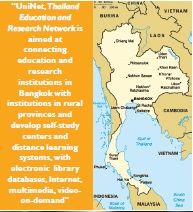
• Developing the e-library, ecommunity and the learning resource sharing centre. Thailand Education and Research Network (UniNet) Initiated in1996 UniNet is Thailand Education and Research Network, (http://www.uni.net.th/en) the ICT infrastructure connecting all universities, institutions, and campuses in the country, through ATM network via 155Mbps
bandwidth fiber optics. This infrastructure is aimed at connecting the networks in Bangkok to the rural provinces through digital leased lines with 2Mbps bandwidth The primary objective of UniNet is to provide Internet access for Universities– network infrastructure for research and facilitate IT campus for  istance Learning. UniNet is aimed at  developing self-study centers with electronic library databases, the Internet, multimedia, video-ondemand;  these centers will connect to the high performance network,  develop social-learning and lifelonglearning systems by creating  multimedia courseware, and providing  knowledge databases and distance learning systems. This is also aimed at training teachers and  assistants to apply ICT in  educational development. UniNet is the Education network  backbone of Thailand. Currently this has 145 Participants  including public universities, IT campuses, private universities etc.  The Thailand Cyber University The Thailand Cyber University (TCU)  is an initiative to assist all the higher  education institutes to deliver distance learning via the Internet. The  initiative also aims to ensure that all online courses are of a high quality  and meet government standards  and  promote the sharing of teaching resources and human resources.

? What tangible goals have you set for higher education institutions  in Thailand to achieve global excellence in education?
We have not come up with any realistic guideline even though we talk  a lot on this. We have discussed to what level is it required for all  institution to put in the ICT component as standard. When I was  working in Chulalonkorn university many years ago, we decided that we  need to put in at least 25 ICT
components at that in the learning environment in all subject areas. But  that was many years ago, I am still not sure whether Chulalonkorn university  is moving in that track. Thus we may have to come up with a guideline  where 50% of teaching and leaning will have ICT component.

? Is CHE partnering with other countries in education?
Yes we are partnering with many countries. A few months back we had discussion with the ministry of Human Resource  Development in India and UGC, the council of the Indian university  we have many good programmes running with many countries. The maximum number of programmes are  with Japan, more than 30 programmes with the French government from  molecular biology to fashion designing. We are also encouraging  direct investment of private sectors in education by encouraging direct  funding for setting up universities. Helping universities to run  programmes, in kind supports or sponsorship to students. We encourage Private sector investment  but we have not seen as much as we would have wanted to see.

? What solutions do you advocate for  the broad development of lifelong learning?
We have tried to encourage this through the numerous non-formal education centres. The non-formal education centre throughout the country has been a big success. We encourage those who have missed  out on learning at certain points in their life to join and learn. Lifelong  learning means maintaining to learn or  updating knowledge throughout life. And we try to do these though our graduates to improve their skills so  that they are able to contribute to the
society productively.

? What would you say has been your  achievement in your role as the secretary general of Commission?
My colleague and I have been put in a few milestones in the development of higher education in Thailand, we have developed this standard guideline, the bible that all university are working on to keep up to the standar

network infrastructure for research and facilitate IT campus for Distance Learning. UniNet is aimed at  developing self-study centers with electronic library databases, the Internet, multimedia, video-ondemand;  these centers will connect to the high performance network,  develop social-learning and lifelonglearning systems by creating  multimedia courseware, and providing knowledge databases and distance learning systems. This is also  aimed at training teachers and assistants to apply ICT in  educational development. UniNet is the Education network  backbone of Thailand. Currently this has 145 Participants including public universities,  IT campuses, private  universities etc.

The Thailand Cyber University
The Thailand Cyber University (TCU) is an initiative to assist all the higher education institutes to deliver  distance learning via the Internet. The initiative also aims to ensure that all  online courses are of a high quality and meet government standards and promote the sharing of teaching  resources and human resources.

Mass media for education outreach
In cooperation with the Office of the Basic Education Commission (OBEC), the TOT Corporation Public Company Limited, the Ministry of Foreign Affairs, and international organisations under the aegis of the  United Nations, the DLF presently broadcasts educational TV  programmes via satellite through 14 channels. Among these, 12 channels are devoted for the direct  teaching programmes at basic education level. The other two  channels are the international channel broadcast in foreign  languages and the community/tertiary education channel.  The DLF international channel airs its international programmes in Thai, English, French, German,  Japanese and Chinese. The programme coverage includes arts  and culture, music, science and technology, agriculture, environment,  health and innovation. The Ku-band
satellite pattern covers China (Kunming), Cambodia, Laos,  Myanmar and Vietnam. All these neighbours received the Royal  Granting of distance learning
equipment from His Majesty the King. The community and tertiary education  channel focuses on vocational and  university education. Among the Higher Educational Institutions, the Rajamangala Institute  of Technology (RIT) and Sukothaithemmathitirat Open University (SOU) produce direct  teaching programmes particularly for their students. The RIT broadcasts  programmes via the C-band satellite pattern while SOU broadcasts programmes through Channel 11. In September 2000, SOU was granted  Royal permission to conduct weekday broadcasts via the Ku-band satellite  pattern through the community/ tertiary education channel of the  Distance Learning Foundation (DLF).  Thailand has 514 radio broadcast  stations, of which 25 of which are designated for educational purposes. At the level of higher education,  Chulalongkorn University, Kasetsart University, operate radio stations.  Thammasat University and the RIT, etc. broadcast programmes providing  general knowledge as well as entertainment.

e-Learning services
The Distance Learning Foundation launched the free-of-charge contentbased  eLearning service from the  Distance Learning Television, Wang Klaikangwon, Hua Hin District in May 2002. The eLearning web page of the  DLF “www.dlf.ac.th” allows Internet users anywhere in the world to view “live broadcast” all the educational
Thailand Cyber university cooperates with higher educational institutions, state and private educational institutions to develop lessons for different courses, using quality e-learning study programmes for formal education, informal courses and study guides, short certificated courses and also promotes sharing educational resources between institutions

simultaneously with the actual broadcast. Moreover, by means of eLearning or eTraining, users anywhere are able to participate in the Flexible Learning Scheme via video conferencing and the Internet.  It is worth mentioning that in carrying out His Majesty the King’s lifelong  learning policy, concerted efforts and support from various public and  private organisations, both within Thailand and in foreign countries are leading to the achievement of the DLF. At higher education level, the increasing popularity of eLearning was  seen in several universities. Among these are two state universities,  Chulalongkorn University and Kasetsart University (KU) operates  Chula Online and KULN (KU Learning Network). The University of the Thai  Chamber of Commerce (UTCC), a
private university, has also initiated eClassrooms.  Apart from educational institutions, other government agencies also took  part in providing online learning. For instance, the National Science and  Technology Development Agency (NSTDA) in collaboration with  Thailand Graduate Institute of Science
and Technology (TGIST), has launched “LearnOnline,” a website  that was developed to serve as a central place for web-based courses  from well-known universities and organizations. Other web-based  courses offered include Cyber
tools for Research, Digital Design, Bioinformatics, Biodiversity,  Technology Management and English for Science and Technology. More  details about LearnOnline are available at http://www.learn.in.th/.

Developing materials and other technologies for Education  In 2002,
the MOE implemented several projects regarding the development of  materials and other technologies for education to be used at the level of  basic education. As for the development of software, media and learning content, the MOE has also initiated: 1) to procure legal software; 2) to encourage teachers and educational personnel to produce software that aid the teaching-learning process; 3) to encourage educational institutions, learning centres and learning sources to develop websites so as to exchange knowledge; 4) to establish multimedia centres; 5) to develop a standardised database system; and 6) to encourage, through competition, the development of multimedia and software that aid the  teaching-learning process. So far, approximately 300 electronic  books and 1,500 websites have been developed and are being used as  learning sources. Among these,
educational institutions under the sponsorship of the SchoolNet project have developed 700 websites. Moreover, the MOE also initiated a competition that will be organised  annually to support the private sector in relation to development of  multimedia and software that aid the teaching-learning process.

There is an increasing popularity of eLearning among universities, the state universities, Chulalongkorn University and Kasetsart University (KU) operate Chula Online and KULN (KU Learning Network). The University of the Thai Chamber of Commerce (UTCC), a private university, has also initiated eClassrooms

For each year, 100 sets/subjects of multimedia and software will be selected as prototype. So far, 300 sets/subjects of multimedia and software have been developed and 10 multimedia centres have been established. As a crucial factor in the transformation of Thai society into a knowledge-based society, the Ministry has embarked on an effective utilisation of technologies for education to improve the quality of  teaching and learning as well as make lifelong education for all Thai people more promising. In this regard, continuous and concrete actions must  be taken to deal with the priority tasks. These include development of materials and other technologies for education and bridging the digital  divide between Thailand and othercountries as well as between Thai people living in urban areas and those living in rural areas.


Digital Learning joins the Global Action Week for Education in April 2006

Education is one of the best ways to eliminate global poverty. Yet more than  100 million children are not in school this year. UNESCO has launched a global  coordination action week from April 24-30, 2006 for highlighting the issues   relating to gaps in education.  CSDMS too is part of this global campaign. We are planning  to hold an Asian Conference on Digital Learning from April 26-28 at Bangkok along with the Ministry of Education, and Ministry of Information and  Communications Technology of the Royal Thai Government. There are five universities, which have joined as Institutional partners, as are numerous agencies working in the field of ICT for development. These include private sector players, academia and practitioners of Digital Learning. We invite each of the readers to be part of this campaign to show your commitment. The question arises, why choose a technology driven platform for delivering education? First and foremost, is the need to fill the huge gap in the teachers required to fulfill the Millennium Development Goal of ensuring Universal Primary Education by 2015. The shortfall of teachers required number a whopping 30 million, to supplement the current 60 million teachers. Unless the teaching profession gains social respect, and the preparedness to train the students towards a knowledge economy, we will be facing a bigger divide in developing countries. In a number of places online courses delivered in remote areas may be able to substitute the dearth or teachers. Learning is a continuous process, and with  new skill sets required, mid-career upgrading of skills required for employed  people, digital learning tools and technologies could prove its worth. It has the  potential to go beyond the  classroom, and on to corporate and workers’ spaces. The online delivery in corporate training is predicted to overtake  higher education  usage in developing countries. This sector is emerging as an industry and is likely  to grow up to US$ 150 billion by 2025. Thus there should be a multi-stakeholde   interest, not only for the educators and the decision-makers within governments, who are mandated, to ensure that education, as a fundamental right, is provided to every citizen, but also to the corporate world, to respond to the need of the hour. It also makes business sense to do so. We look forward to hearing about your experiences and thoughts on how best to contribute.

One computer for every ten students plan in Bulgaria

To make the classrooms of Bulgarian schools well equipped with computers, an educational strategic plan has been made to provide one computer for 10 students. < ?xml:namespace prefix = o ns = "urn:schemas-microsoft-com:office:office" />


This is an upgrading action plan to introduce ICT in Bulgarian schools. Teachers are to go through training in order to acquire basic computer literacy. Another 2100 schools will join the national educational network. And thus over 90% of the schools will be connected though high-speed Internet and will have access to all educational resources. The education gateway will further develop through this plan.

A glimpse of success story of ‘Arohi’

Arohi, a pilot project, is now spread across 1,541 schools in Uttaranchal, aimed at using technology intervention in delivery of education and imparting technology education through the use of computers and the latest e-Learning methods.< ?xml:namespace prefix = o ns = "urn:schemas-microsoft-com:office:office" />


It is a preconceived fallacious notion of many Indians that the quality of government school teaching is relatively poorer than the public schools. To break the womb of this controversy between public school and government school
in India, Arohi presents a classic case of how technology could create a pool of not just talented teachers, but talented students. The use of technology has seen reduction in dropout rates, low levels of absenteeism and improvement in grades of students. It's a success story in itself on low cost education whereby a student who could afford was expected to pay only Rs 10 per month. An active support by the government ensured that the basic infrastructure in terms of hardware and software was set in place and teachers trained to be active participant in the entire exercise.

ETS conducted ICT literacy assessment

ETS (Educational Testing Service), Princeton, NJ announced that 7,000 students at more than 38 four-year institutions are taking the new core version of its Information and Communication Technology (ICT) Literacy Assessment.


The ICT literacy assessment is a simulation-based test designed to measure a student's ability to use critical thinking to define, access, manage, integrate, evaluate, create and communicate information in a technological environment. Institutions that meet minimum requirements can administer the test free of charge until May 5. ETS also offers an Advanced level, designed for rising juniors at four-year institutions and students transitioning from two-year to four-year institutions. Schools can also use the core test to support the need for institutional ICT literacy initiatives, better plan curricula to address ICT literacy gaps, and provide evidence to accrediting agencies on student learning outcomes. ETS is offering the assessment for free to schools that commit to testing a minimum of 100 students by May 5 and that meet minimum technological requirements. < ?xml:namespace prefix = o ns = "urn:schemas-microsoft-com:office:office" />

LATEST NEWS