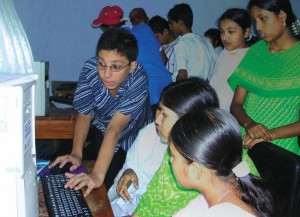
 The role of RI-SOL is to support the educational mission of each school through its expertise in technology and education. Recognising the fact that schools and communities are intrinsically interdependent RI-SOL Bangaladesh project, at present encompasses thirty telecentres, involves eighty schools and reaches almost one hundred thousand students and community members
Recognizing that schools and their communities are intrinsically nterdependent, RI-SOL, a US-based international NGO, began launching schoolcommunity dual use telecenters in Bangladesh in 2003. Over the last two and half years, we have found this approach to be viable in terms of educational, societal and ustainability goals. As the pilot phase now winds down, the project encompasses thirty telecenters, involves eighty schools and reaches almost one hundred thousand students and community members.
This project represents the third generation of RI-SOL’s educational telecenter concept, the Internet Learning Center (ILC). Not long after the introduction of the worldwide web, its value as an educational tool was recognized by industry leaders in Silicon Valley; in 1996, they created a not-for-profit organization: Schools Online (SOL, www.schoolsonline.org). SOL promoted the use of computers in classrooms and the integration of technology into all aspects of teaching and learning. The concept spread quickly, buoyed by the rampant optimism of the time for any project involving technology and the Internet. The dot com crash was a harsh blow to these and similar projects, and forced SOL to reevaluate its strategy. In 2000, Schools Online merged with Relief International (www.ri.org), an international NGO known for both its emergency relief operations (most recently, its responses to the Boxing Day Tsunami and the Kashmir Earthquake) and efforts directed towards rehabilitation and development. The merger reflected a growing commitment by Relief International to the education sector, while enabling Schools Online to make its programs global in scope. Thousands of existing ILCs in western countries began to interact with the next generation of ILCs being established in developing countries. This second generation effort added an intercultural dimension to the educational objectives. Building on ten years experience, we have introduced three evolutionary changes during the rollout of ILCs in Bangladesh: increased reliance on the host schools, increased emphasis on sustainability through community involvement, and greater willingness to customize ILC structure and operation according to the needs and capacity of the schools and their communities. Organization of ILCs into local clusters has also proven valuable. We think of the ILCs as a multi-use classroom rather han a telecenter that is used for classes – the distinction is important. The primary use of the room, both for the school and its community, is learning. The ILC belongs to the school and is run by the school, it is not an autonomousenterprise appended to the school. The expertise and authority for
running the center lies in the school itself rather than hired specialists. An ILC is: • a dedicated classroom equipped with computer equipment and some means of connecting to the Internet; • a resource for both its school and
its community; • not just the equipment, but staff and content; • an integral part of the school, community and society in which it exists; • a continuing commitment for its school and community; • always evolving; An ILC is not: • a cyber café; • a drain on the school, but an asset for the school; • a one-shot project; The role of RI-SOL is to support the educational mission of each chool through our expertise in technology and education. We solicit schools competitively in areas where we think we can make the biggest educational impact. Typically, this excludes elite institutions and focuses on schools that ave minimal or no access to computer technology. Establishment of an ILC akes place after a detailed consultative process involving both the school and ts community. During this process, the school must demonstrate its commitment and ability to network with other schools, communities and civil ociety organizations to enable the ILC to serve as a hub of activity. Schools also orm community committees at this point, a group that meets monthly to evelop and update a customized sustainability plan for each center. embers of this group include school and community stakeholders: parents, eachers, local business owners, members of civil society and representatives from neighboring schools. Typically, the ILC is time-shared during school hours by the host school and two to four neighboring schools. After school, sage of the facility is divided between extracurricular student activities and community organizations. The ILC project’s overarching goal is to use omputer technology and the Internet to advance education in the road sense: ucation of students, but also of teachers and community members. Administratively, the project is divided down the middle, with about half the effort invested in establishing and developing ILCs and half spent on developing teacher capacity and educational content. Teacher education occurs first in breadth and then depth. Immediately after equipment installation, every administrator and teacher in host and partner schools participates in a oneday computer fundamentals course designed deflate anxiety about the technology. By the end of the day, every staff member has a sense of achievement and mastery, having learned to turn the computer on, write text in a word processor, save the text, print it, and turn the computer off. By putting every teacher in the drivers’ seat, this simple lesson has proven effective in mobilizing teacher support for the ILCs from the first day of operation. Each school is then asked to nominate a teacher as a “technical lead teacher”, or TLT. The TLT becomes he caretaker of the ILC, taking on both a management and operational role. Since IT is part of the Class 9 and 10 curricula in Bangladesh, many schools already have computer science eachers – even if the school does not have computers. Although these teachers already receive a salary for their teaching assignments, it is common ractice in Bangladesh to supplement official income through private tutoring. ince the TLT takes on responsibilities that require a full-time commitment, we upplement the teacher’s salary with a small stipend for a limited period to ffset this loss in tutorial income. The school, RISOL and the teacher sign a hree-way agreement, committing the school to continue this stipend after a ertain date. The timing of this switchover depends on a ustomizedsustainability plan created by the school and RI-SOL. Schools must factor this stipend into the sustainability plan, offsetting it through income enerating activities. We have found that the majority of computer teachers in angladesh lack practical experience with computers and require training to erform the technical aspects of the position. Consequently, we have developed localized technical instruction curriculum for these teachers to improve their technical proficiency. Of course, there is a side benefit as well: hey become better computer teachers. The focus of our program is not, however, on IT – we consider computer technology to be a tool rather than an nd. A major thrust of our educational effort is to enable teachers to integrate technology into their own subjects: math, spelling, geography, etc. So, in ddition to the technical lead teacher, we work with the school to select three to ive educational lead teachers (ELTs) per institution. Again, by mutual greement of the teachers, the school and our rganization, these teachers attend an intensive one week teacher professional development training program conducted in an ILC. uring this training, they are introduced to the rogram’s educational goals and methods by example. They sit where their students will sit, and the training itself employs group-based and participatory ethodologies promoted by our project. The predominant teaching modality in angladesh is didactic and authoritative, relying heavily on rote memorization nd pattern replication. We supplement that strategy with methods designed to ncourage creativity and analytic thought. During the week of training, teachers also receive instruction on preparation of lesson plans and how to uild projects around available computer resources. At training, the ELTs are resumed to know nothing about computers; in fact, this might be a plus in that hey can approach the topic from the same point of view as the students. During both teacher training and student lessons, computer applications and program eatures are introduced on an as-needed basis, while the users are encouraged to explore further on their own. We have found that this approach s how people actually learn to use and understand computers. Reading a book bout a word processor is not as helpful as just using one, and experimenting is preferable to memorizing a series of keystrokes to perform a task. In ecognition of this intensive training, ELTs receive a certificate. They do not eceive an ongoing stipend, as their participation in the ILC is expected to occur uring their normal class time, for which they are already being paid by he school. ELTs are, however, eligible to participate in a number of rofessional career development opportunities in conjunction with the program uch conferences and international exchanges. Single training sessions, even very intensive ones like this one, will have limited long term impact unless some reinforcement is available. Likewise, a couple days of echnical training are not enough to cover all the operational and technical spects of running a telecenter. Our answer to both problems is monthly eetings. ILCs are set up in geographic clusters, with five to ten schools in each cluster. These clusters are managed by local implementing NGOs or national GOs with local offices, further promoting the schoolcommunity bond. Once per onth, the technical lead teachers gather to provide mutual support, xchange media, and on a rotational basis, conduct workshops for other members of the group. The educational lead teachers also have a meeting once er month, where participants develop, test and exchange lesson plans. oth meetings are designed to promote local expertise and foster a sense of xtended community between the participating schools. eyond the lessons developed by the teachers, RI-SOL facilitates collaborative lessons each month on local, regional and international scales. These lessons involve other nternetequipped schools within r outside RISOL’s own ILC network. The local and regional lessons are developed in our education specialists in the Bangladesh County Office. Most of these are developed in Bangla, while English is the language of wider communication for international projects. Some international projects are within RI-SOL, others employ lessons developed by online resources such as iEARN and Global SchoolNet. The Global Connections and Exchange Program (GCEP) is a major component of ILC programming inBangladesh. Children from around the world collaborating on GCEP projects learn about each others cultures through direct interaction over the Internet. Along the way, stereotypes are discarded and students gain an appreciation for the diversity of cultures connected by the Internet.
This program is sponsored by the United States Department of State, Bureau f Educational and Cultural Affairs, and its Bangladesh website is located at: http://www.connectbangladesh. org. 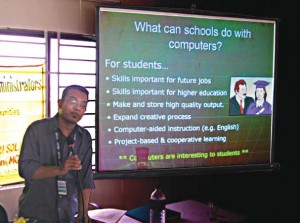 Implementing these programs requires
a substantial investment of time, effort, funds, and faith, so we are strongly ommitted to the concept of sustainability – that an ILC which is set up today will still be functional one, five, ten or more years from now. Our challenge has been to set up ILCs in such a way that chools can keep the quipment up to date and
propagate the technical and
educational knowledge required to use the centers. Unlike a free-standing elecenter, the ILC is an integrated part of the school, a classroom. Investments in the ILC are a direct investment in the school’s infrastructure. Training teachers not only produces better teachers, but a cadre of professionals who can keep the center operational. By clustering the centers themselves, the schools are empowered to help each other. During the next five years, RI-SOL
and its affiliated organizations will scale up to two hundred telecenters in Bangladesh. The model developed in Bangladesh may also find application in other developing countries. ?