



Home Blog Page 379

A shift in mindset will be needed – to teach and learn post-pandemic

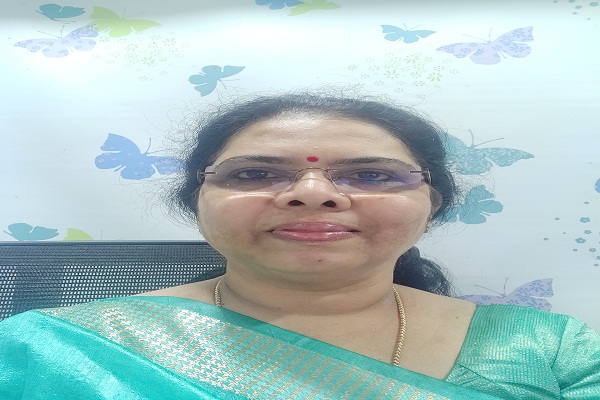
Dr Manimekalai Mohan

Future transformations will witness these classroom transactions are complemented with newfangled technological tools says Dr Manimekalai Mohan, Managing Trustee & Correspondent, SSVM Institutions, Coimbatore in a conversation with Elets News Network (ENN).

Today, due to unforeseen extensions, it is difficult to predict when schools will resume. As educators, we must look after the emotional, social and behavioural health of our learners, which is diametrically opposite to social distancing.

Currently, SSVM is effectively engaging students with online education. Our prime focus is at the inferences of the novel learning approaches that are being redefined through technological innovations, right from the live academic meetings, video interactions, online theatre, to working with all learners fulfilling their varied learning needs. Future transformations will witness these classroom transactions are complemented with new-fangled technological tools. It is time to embrace learning “anywhere anytime”.

The new reality takes us towards technological assessment systems, digital paper corrections, eBooks and smart classroom boards and many more.Moreover, it is very early to be judgemental about how the learning trajectory will be affected by online teaching.However, when students participate in online learning, their responses have been awe-inspiring, and this has strengthened the resolve of our teachers and has motivated them to work harder and smarter.

Also read: The new normal for schools post-covid-19

Moving forward, towards the new normal post-pandemic environment, we require a considerable shift in the mindset of the entire learning community— both emotional and social. We hope for the safe return of teachers and learners to school so that hands-on teaching and learning can happen smoothly. A fresh approach is the need of the hour to teach and learn in this reformed online paradigm. Therefore, a post-pandemic Institutional plan is very significant, and this demands systematic preparation.

SSVM would indeed initiate new approaches by which learners can be assimilated back into the schools’ physical setting safely from the virtual world. Besides practical measures such as frequent cleaning of classrooms and sanitising all the areas where the students regularly converge, prioritising of recess, wearing masks and face shields, distance-desk markings, sizeable students- teacher ratio, sufficient medical support- staff, safer zone to eat, play and so on will also be implemented.

A revised school calendar will be planned where the events with large gatherings of students/parents will be avoided. There would be a cancellation of field trips, conferences and inter-school competitions, but will make it possible through the virtual world without compromising on the quality. School timings will be modified, giving students’ attendance its due space. School bulletins would have colourful, pictorial depictions and slogans that sensitise students on essential hygiene and cleanliness such as washing hands frequently, safe socialising and social distancing.

Considering senior students, we have almost lost the year 2020. Bearing their future progression in mind, we must help them realise the significance of their academic excellence by educating them to gain adaptability and mental strength to face any challenges in life, aiming to achieve their goals.

These are unpredicted times, and we need extraordinary measures to tackle them. No doubt, returning to school after this pandemic will indeed be a new learning exercise for learners at all levels. Adaptability is the key to unlock any adverse circumstances.

National Education Policy advocates use of technology in education

National Education Policy advocates

The Union Cabinet has approved the National Education Policy 2020. Two committees were formed and their reports had been considered while framing the new policy. This is a historic day as the country has got a new education policy after 34 years.

The NEP, 2020 emphasized the usage of technology in education. E-courses will be developed in regional languages and virtual labs will be developed and a National Educational Technology Forum (NETF) is being created.

E-content will be developed in many regional languages other than English and Hindi in NEP, 2020.

The ministry will use the technology in education planning, teaching learning and most essentially in assessment.

Also read: MHRD forms single Higher Education regulator

The ministry will develop regulation- self disclosure & minimum human interface in education sector according the new policy.

It has also given priority to increase asses for disadvantaged groups of the society. It will also develop Divyang friendly education software.

The new policy is eyeing to digitally equipping schools, teachers and students.

MHRD forms single Higher Education regulator

Union HRD Minister

The Union HRD Minister today announced the New Education Policy for the country. It has been changed after a period of 34 years.

Many new strategies have been made for Higher education. Regulatory System of Higher Education to be distinct for regulation, accreditation, funding and academic standard setting will be all under the umbrella of Higher Education Commission of India.

In another reform, four major verticals of HECI to be National Higher Education Regulatory Council (HNERC), National Accreditation Council (NAC), Higher Education Grants Council (HEGC) and General Education Council (GEC) which would further form a National Higher Education Qualification Framework.

UGC, AICTE to be replaced by a single Higher Education Regulator in the NEP,2020.

The professional councils, such as the Indian Council for Agricultural Research (ICAR), Veterinary Council of India (VCI), National Council for Teacher Education (NCTE), Council of Architecture (CoA), National Council for Vocational Education and Training (NCVET) etc., will act as Professional Standard Setting Bodies (PSSBs).

Also read: HRD Minister announces New Education Policy; Key Highlights of the new policy

Students pursuing 4 year degree programme would have an option of getting a degree with Research if the research process is completed in the area of study as specified.

Primary task or NRF would be to fund competitive, peer reviewed grant proposals of all types and across all disciplines and also act as a liasion between researchers and relevant branches of government so as to allow breakthroughs.

Major reforms suggested in the higher education to give more flexibility to the students.

HRD Minister announces New Education Policy; Key Highlights of the new policy

HRD Minister announces New Education Policy

Changes have been introduced in the Indian Education Policy after a period of 34 years. As per the changes introduced the Ministry of Human Resource and Development has been renamed as Education Ministry.

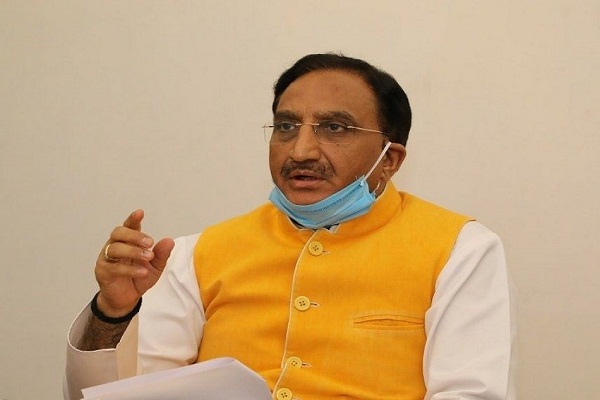
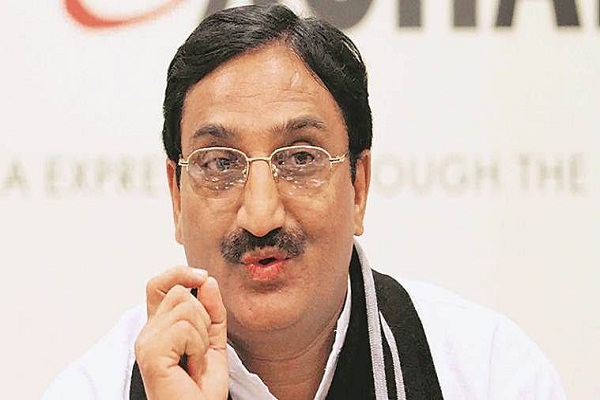
Union HRD Minister Ramesh Pokhriyal Nishank said that the New Education Policy 2020 has been structures to resolve various issues in the education sector. The minister had also shared that the new policy will provide the youth of the country with more convenient access to higher education.

National Education Policy 2020: Key Highlights

The Right to Education (RTE) has been extended covering children under the age group of 3 to 18 years. The new policy aims to universalize the pre-primary education and provide foundational literacy to all by 2025.

It proposed universalization of Early Childhood Care Education (ECCE) and the establishment of a National Mission on Foundational Literacy and Numeracy.

The National Education Policy 2020 proposes a 5+3+3+4 curricular and pedagogical structure on the basis of the cognitive-developmental stages of the children instead of their age.

Also read: Board Exams set to get easier in New Education Policy

NEP 2020 thus divides the K12 segment further into Foundational Stage, (for Age 3-8 yrs): 3 years of Pre-primary plus Grades 1-2, Preparatory Stage (for Age 8-11 years): Grades 3-5, Middle Stage for Age (11-14 years): Grades 6-8 and Secondary Stage (for Age 14-18 years): Grades 9-12.

 Coding to begin for students from Class 6. The curriculum will also include 21st-century skills, scientific temper and mathematical thinking.

NEP 2020 also has a provision for multilingual studies with a focus on the classical languages of India.

School students of all levels will have regular periods and opportunities to participate in physical activity and exercise, including sports, games, yoga, martial arts, dance, gardening, and more.

A National Assessment Centre – Parakh to be established under NEP 2020.

NEP 2020 also prescribes an independent, state-wide, regulatory body called the State School Regulatory Authority for each state.

NTA will conduct Common Entrance Exam for admission to Higher Educational Institutions.

NEP 2020 aims to take the Gross Enrolment Ratio to 50% by 2035. HEIs excluding legal and medical will have a single regulator under NEP 2020.

Universities to be named not on the basis of ownership but on quality of education.

The provisions of National Education Policy 2020 aim to provide students a multidisciplinary and holistic education with more flexibility and choice of subjects.

The National Education Policy 2020 establishes a new highest regulating body, the Rashtriya Shiksha Aayog or National Education Commission.

Board Exams set to get easier in New Education Policy

New Education Policy

In the New Education Policy (NEP), board exams are set to get easier. Over the years, Board exams which lead to a lot of stress among not just students by also parents. The board exams for Grades 10 and 12 will be continued in NEP.

Board exams may be divided annual/semester/modular offering all subjects beginning with mathematics, at two levels. It can have two parts exams or objective type and descriptive type.

The NEP moots that with regard to all of the above,  guidelines will be prepared by NCERT, in consultation with SCERTs, Boards of Assessment (BoAs), and PARAKH, the proposed new National Assessment Centre etc.

School Education Secretary Anita Karwal said there will be a change in progress card of students.

Also read: MHRD Minister announces New Education Policy

The progress card will be a holistic, multidimensional report that reflects in great detail the progress and the uniqueness of each learner. The progress card will include self-assessment, peer assessment and teacher assessment.

Teachers to be prepared for a transformation in the assessment system by the 2022-23 academic session, the NEP holds.

The NEP was cleared by the Union Cabinet and the MHRD Ministry renamed as Ministry of Education.

Elets Technomedia to organize 2nd School Tech Summit

‘2nd School Tech Summit

Technology has taken education to the next level, breaking the barriers of classroom walls. The excitement of both sets of students had no limits, wherein they discussed topics ranging from language to culture to their classrooms etc. The insight they got from this live interaction was much deeper than what they would have got from reading books and listening to lectures.

Technological advancements are inevitable as that’s the way the world is moving. It has also incorporated into the world of education where children get to experience a new way of learning and educators get to practise more effective methods of teaching. Many schools have already implemented technology-driven tools to educate and prepare their students for the future. The acceptance of technology is accelerated by the COVID-19 crisis.

Elets Technomedia and digitalLEARNING Magazine are set to organize virtual ‘2nd School Tech Summit’ on 31st July, 2020. It will be the second full day conclave of the series. Eminent speakers from the school industry will take discuss the future of school education in the world of post COVID era. The panelists will enlighten the usage of technology and importance of value-based learning in our schools. Elets Technomedia CEO and digitalLEARNING Magazine Editor-in-chief Dr Ravi Gupta will welcome the panelists. Dr MVV Prasada Rao, Director, Central Board of Secondary Education (CBSE) will be the key speaker during the full day conclave.

Esteemed names like Om Pathak, Founder & Chairman, DPSG Society & Selaqui International School, Dehradun, Dr Madhav Deo Saraswat, Principal, The Scindia School, Gwalior, Reekrit Serai, Managing Director, Satluj Group of Schools, Dr Kavita Aggarwal, Chairperson, MISA, Harsh Madhok, Director, Sunbean Group of Institutions, Varanasi, Surbhi Goel, CEO, Aditya Birla Education Trust Schools, Mumbai, Dr Sandeep Khanna, Principal, MIT- Vishwashanti  Gurukul School, Pune, Amey Parulekar, Head – Business Development, Financepeer, Arti Chopra, Principal, Amity International School, Gurugram, Payal Rajpal, Founder, Hack the Crisis India, South Asia Head Robotex, Asha Alexander, Principal, GEMS The Kindergarten Starters, Dubai will be part of the conclave.

From the industry, Vibha Mahajan, Vice President-Strategic Growth & Alliances, Ken42, Bhaskar Majumdar, VP Digital, Lamhas Satellite Services Ltd, Divya Lal, Founder & Managing Director, Fliplearn, Sharang Arvind, Associate Director – Sales and Customer Success, Prodigy Game will be part of the panel.

Embracing technology does not devalue the importance of teachers, rather it assists them in providing a more effective learning experience for the students. Schools must, therefore, strike a balance between technology-enabled and nature-based teaching to equip its students for a better tomorrow.

MHRD Minister announces New Education Policy

Ministry of Education

In a major development, Union Ministry of Human Resource Development (MHRD) has been renamed as the Ministry of Education. The Union Cabinet also cleared the National Education Policy 2020, also called the New Education Policy 2020 (NEP). The new policy will replace the three-decade old policy.

The ministry has been renamed as per the recommendations of the draft NEP 2020. The draft policy stated that in order to bring the focus back on education and learning, the Ministry of Human Resource Development should be re-designated as the Ministry of Education (MoE).

The National Education Policy has been five years in the making. During its first term, the prime minister Narendra Modi-led BJP government constituted a committee to draft a new National Education Policy in 2015.

Also read: MHRD: NCERT to revise textbooks after 15 years

It appointed retired bureaucrat, TSR Subramanian, to head it. That committee submitted its report, technically the first draft NEP, in 2016 but it was not accepted by the Centre which reduced it to “inputs”. In 2017, it appointed another committee under the scientist, K Kasturirangan, to draft a NEP. The K. Kasturirangan Committee submitted its report to the ministry on May 31, 2019.

Ed-tech firm Toppr raises $50M from Foundation Holdings

Edtech

With Coronavirus onset, Ed-tech firms are gold dust these days. Ed-tech startup Toppr has raised $50 million crore in a Series D funding round led by global investment firm Foundation Holdings.

With this round, Toppr joins bigger ed-tech players that have successfully raised capital despite the covid crisis. Byju’s raised about $100 million from US technology investor Bond in May, while Unacademy raised $110 million from Facebook and General Atlantic in February.

Zishaan Hayath, Toppr CEO and co-founder, said “…This investment will further help to develop the AI-based Toppr School Operating System (OS) – a ground-breaking platform for schools to run digitally unifying in-school and after-school learning to create a standardized and personalized experience,”.

Toppr had raised $60 million in December 2018 as part of its Series C, led by Kaizen PE, along with existing investors Eight Roads Ventures, Helion Ventures and SAIF Partners. Till date, Toppr has raised around $110 million.

Also read: Ed-tech firm iNuture secures investment from Blacksoil

Toppr claims to have more than 1.3 crore learners on its AI platform and helps them prepare for various school, board, and competitive exams. It uses natural language processing to solve learner doubts instantly.

It claims to have emerged as the highest traffic destination for K-12 learning and hosts over 1 million sessions every day. Toppr’s community of 50,000+ educators from across the country has contributed to over 35 lakh learning pieces, including questions, solutions, concepts, games and videos for the students.

Uttarakhand Board declares UBSE 10th and 12th Results 2020

UK 10th, 12th Board Result 2020

Finally, putting an end to the long wait, the Uttarakhand Board has officially announced the UBSE 10th and 12th Results 2020. Education Minister Arvind Pandey formally announced the UK Board Class 10 Results 2020 and UK Board 12th Class Results in a brief press meet. Students can check their UK Board 10th and 12th Results on the official website i.e. uaresults.nic.in.

The Board started the UK Board 10th and 12th exams from 3rd March and 2nd March respectively. The UBSE 10th and 12th exams were scheduled to end on 25th March 2020. However, owing to the pandemic exams scheduled between 23rd and 25th March had to be cancelled and were held later in June.

Also read: Uttarakhand bars schools to collect fees during lockdown

Over 3 lakh students across the state have appeared for the exams.

Steps to check the UBSE 10th and 12th Results 2020:

-Visit the official site uaresults.nic.in

-Click on Class 10 / Class 12 Result Link

-Enter Exam Roll Number and other details on the website

-Submit them to get UK Board Result 2020

Girl from Seelampur slums scores 96 pc in CBSE 12th Class with teacher

Girl from Seelampur

Fighting all odds 18-year-old Fazia, who lives in JJ Cluster in Seelampur scored 96 pc in her CBSE 12th Class Results.

Fazia lives in a 60/70 sq. ft. room with her mother, brother and three sisters. Before her board exams, she woke up each morning and performed her household chores, following by her stitching job to bring in some money.

The 18-year-old has no tuition and no teacher and it was hard for her to manage her household duties and studies together.

She also said that since she lives in a slum, the environment is so noisy and busy all day that she could only study during the night.

Also read: CBSE announces Class 12 improvement category results 2020

An NGO called Asha Society then came forward and provided her with sample papers, conducted mock tests and gave her an environment that could help her get her high CBSE 12th score.

Fazia’s mother is a cancer survivor and she told ANI that she and her late husband had always wanted their kids to study.

Fazia’s brother is a daily wage labourer and Fazia charges Rs 120 to sew a salwar suit and her earnings range from Rs 2,000 to Rs 2,500.

Fazia wants to be a Geography teacher. She wants to visit various places and the fact that geography could teach you minutely about places that one hasn’t even seen piqued her interest.

ReplyForward

LATEST NEWS