The Central Board of Secondary Education (CBSE) has released the new Marking Scheme and Sample Paper for the students who will be appearing for Class 12 Economics subject.
This new Marking Scheme and Sample Paper will help students to understand and prepare accordingly for the new exam pattern for Class 12 Economics Paper.
With this Sample Paper and Marking Scheme, students will get the clear picture of the new exam pattern and the level of questions which will be asked in CBSE Class 12 Economics Board Exam 2020.
To get the complete Sample Paper & Marking Scheme for Class 12 Economics, download the links provided below
The Bihar School Education Board (BSEB) has released the final admit card for Class 12 on its official website. The BSEB Class 12 examinations will commence on February 3, 2020 and run till February 13, 2020.
The BSEB Class 12 admit card will be available only to those students who appeared in the sent-up test and do not have any history of defaulting. Furthermore, BSEB has decided to provide relief to students who have not yet cleared their dues by releasing their admit cards as well. But these students need to clear all their dues between January 14 and 23, 2020, for which the portal will remain open. In case the students are unable to clear their dues within the stipulated time, they will not be allowed to appear in the examination. Currently, Class 12 students are busy in their practical exams which started from January 10 and will run till January 21, 2020.
Earlier, the board issued a dummy admit card for students in case they need to make any changes to important details like student name, father’s name, date of birth, gender, and category. After incorporating these changes, the board has finally released the Class 12 admit card today.
Here are a few steps that can be followed to view and download BSEB admit card:
Step-2: On the homepage, go to the “Important Links” section.
Step-3: Click on the “Final admit card 2020” link
Step-4: Enter details like registration number, school code, date of birth, and click on submit.
Step-5: Download the admit card appearing on the screen
Step-6: Check all the details carefully and take a print out for reference.
If there is any error in the admit card, students will need to get a photo identification document attested by a Gazetted officer and must present the same to the examination controller on the exam day and carry that ID proof in original as well.
The BSEB board examinations will be held across 1300+ centres in Bihar this year, and more than 13+ lakh students are registered to take the examination.
According to reports, the National Testing Agency (NTA) is going to release the results of the December 2019 Council of Scientific and Industrial Research (CSIR) University Grants Commission (UGC) National Eligibility Test (NET) today.
The results will comprise of two separate merit lists, one for candidates qualifying the Junior Research Fellowship (JRF-NET) and the second for candidates qualifying the eligibility test for Lectureship (LS-NET) /Assistant Professorship.
The results will be available for download at NTA CSIR NET’s official website https://csirnet.nta.nic.in/. Candidates will be required to log-in in order to view and download the results.
Candidates qualifying the JRF (NET) position will also be eligible for Lectureship/Assistant Professorship (NET) position, subject to satisfying the eligibility criteria as described by UGC. Vice-versa, candidates qualifying the Lectureship/Assistant Professorship position will be eligible to be recruited as Lecturers as well as for Junior Research Fellowship in various projects/schemes but they will not be eligible for regular JRF (NET) fellowship.
The candidates qualifying JRF (NET) will be provided fellowship from CSIR as per the assignment or according to associated schemes. The candidates eligible for JRF and Lectureship/Assistant Professorship under CSIR schemes will be have to follow all the rules and regulations laid down by CSIR to maintain their eligibility.
The CSIR-UGC NET was conducted by NTA on December 15, 2019 across the country except for the states of Assam and Meghalaya, for which the examination was held on December 27, 2019.
A provisional answer key for CSIR-UGC NET was released on January 10, 2020. Furthermore, any challenges against it were accepted till 11:50 pm on January 3, 2020.
The National Testing Agency (NTA) has announced that it has released the JEE Main 2020 answer key. The students can access the answer key on its official website – jeemain.nta.nic.in.
The JEE Main 2020 was conducted from January 6-9, 2020 through the Computer Based Mode (CBM). The NTA also released the question paper of the same along with the answer key.
Candidates are also allowed to raise objections in this answer key, if they have any, from January 13 – 15, 2020. They can raise the objection unto 11.50 PM of January 15, 2020.
However, the candidates can raise the objections by submitting an online form with a fee of Rs 1,000 per question.
Students can do the payment through various modes like Debit/Credit Card/ Net Banking. They also require to submit proper documents in the PDF form to support the objections raised.
With only a few months left for Board examination of class 10th and 12th, students are burning the midnight oil to cover all the syllabus on time and get good marks.
With pressure from parents and society to perform best, the students often tend to get distracted. To help you overcome it, here are some tips to do a systematic, smart and on-time preparations for the examination to be a topper:
1. Go through Previous years question paper/ sample papers
It is very important for students to go through the previous year’s question paper and sample papers. This will in-turn help them to know where they are lagging behind and work on it.
They should also make a list in place, to know which topic to read first on a priority basis to crack the examination. This will help them to divide their time of preparation for examination as per the topic systematically.
2. Make your own notes
With back to back examination, it is very difficult for students to read through all the lessons/ chapters. It is advisable to make chapter wise short notes which will help you to revise and also finish your course on time. These notes also come handy when you are in doubt before entering the examination hall and you want to have one final look at the topics.
3. Carefully underline the important topics
Students tend to highlight everything while reading a chapter. So, it is highly advisable to highlight only those lines and topics which make sense and holds importance. This will help in doing last minute read-through of the chapters.
4. Textbooks are the priority
When it comes to practice, students tend to attempt all the questions available in all the reference books rather than mastering the topics of the textbook.
You must always try to focus on being clear in your concepts in the prescribed textbooks which will help you clear any questions given in the other reference books.
5. Don’t over exhaust yourself
Board examination can be very stressful but if you want to top the exams, make sure that you schedule your study time smartly.
Maintain a balance between heavy subjects and lighter subjects. Make sure you take a break either by listening to music, watching something motivational or something of your interest. This will help you break the monotony and help you concentrate more.
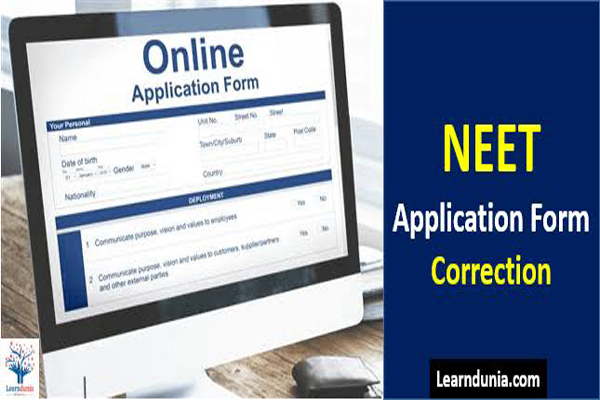
The National Testing Agency (NTA) has announced that it will open the window for corrections in the application forms filled by candidates for the National Eligibility cum Entrance Test (NEET) 2020 on January 15, 2020.
The candidates who have filled the form for NEET 2020 can check their online application form by visiting the official website of NTA NEET, i.e ntaneet.nic.in, and do the necessary changes in case if there are any errors in the form.
NEET 2020: What you should check in the application form
Personal Information: Candidates should check all the details they have mentioned in the application form like:
Date of birth
The spelling of their name
Father’s name
Mother’s name and so on
Candidates should ensure that whatever information they have entered matches with the identification card used at the time of examination. The discrepancy in the details may prevent the candidates from appearing for the examination.
If there is a discrepancy in the documents like Class 10 passing certificate, caste certificate, etc.will lead to cancellation of the candidature at the time of admission.
Examination Centre: Candidates are also allowed to check and update the choice of examination city and centre filled in the application form. They can change the choice of examination city during the correction window time.
Opting for 15% All India Quota and Submission of Self Declaration: All students except the students of erstwhile Jammu and Kashmir are automatically eligible for 15 percent All India Quota and are not required to submit any self-declaration form.
However, students belonging to union territories of Jammu and Kashmir and Ladakh are required to submit the self-declaration form.
Also, students who are eligible are also required to share their intent to participate in the All India Quota. Apart from these, candidates are also advised to check their image and signature uploaded for any error.
While school education is not a mandate of DST, we do want greater introduction to and participation of schools students in generation of creative ideas, in innovation etc. The base of the knowledge and innovation pyramid needs to be broadened, not just its height. The culture of innovation has to be seeded in schools, says Prof Ashutosh Sharma, Secretary, Department of Science and Technology (DST), Government of India in an exclusive interview with Sanghamitra Mohanty of Elets News Network (ENN).
Prof Ashutosh Sharma Secretary, Department of Science and Technology (DST), Government of India
You talked about strengthening the academic institutions through the latest equipments, funding for research and everything. There is a parallel system emerging of private universities. Is the DST also engaging in them?
The DST focuses very tightly on two or more different things. One is competitiveness; other is quality and the third is relevance. Now we are agnostic to who is competing for this. Of course, some of the private universities are bringing greater emphasis on research, and they deserve the support. But they have to compete with the rest, both public and private. If the scientific advisory expert committees find their projects competitive, we do fund them in PPP mode. We do encourage and support research in the best of universities including private universities, to enhance the quality of teachers, teaching, and students. Scientists need to be creative, they need to be fired a little bit, need to be excited, and so if they have all of that, their energies will find fulfilment in contributing to socio-economic growth rather than petty mischief.
A lot of Council of Scientific and Industrial Research (CSIR) organisations exist all over the country, how do you link the university system with them?
While CSIR is primarily focused on supporting their labs, DST’s funding is agnostic to who applies for it, competitive excellence and relevance being the only criteria. Even CSIR scientists apply for funding from DST. Clearly, research is best not done in silos. One of the things we are encouraging continuously is also to seed research which is not based solely on a discipline or tool. The historical way of funding research was in chemistry, physics, mathematics, biology, chemical engineering, material engineering, etc. Now a lot of our recent efforts are in addition also focused on the problem centric research. Sometimes you call it discovery research versus solutions research. Now what is important about solutions research is that it is interdisciplinary. Suppose there is a problem with water, it cannot be solved only by Chemistry. You need different people with different backgrounds working together. So we are also encouraging this kind of research with programmes and missions in water, renewable energy, cleaner fuels,management of energy, manufacturing science, waste processing, etc.
There is a mission on Science and Technology of Yoga and Meditation (SATYAM) which started about four years ago. It is an interdisciplinary subject, which uses the best of the tools and processes of modern science to probe the underlying biology behind traditional wisdom. There is a plethora of clinicians and scientists from places such as All India Institute of Medical Sciences (AIIMS), National Institute of Mental Health and Neuro-Sciences (NIMHANS), Postgraduate Institute of Medical Education and Research (PGIMER)-Chandigarh, who are working together on these projects by use of tools such as the Functional Magnetic Resonance Imaging (FMRI) to map the brain in neurology investigations.
Coming back to the point, how do you integrate scientists with diverse backgrounds and expertise to work on significant interdisciplinary problems? You encourage them by offering huge stimulating challenges, so by working together, one can do extraordinary things at a scale not possible by a single group. So we set aside some funding in order to form these networked groups. This is solution science, and I gave you some examples.
These examples are also important because these are some things for which earlier there was no funding. For example, there was no programme for manufacturing science. Beyond the traditional silos of S&T such as chemistry, physics, engineering of various kinds, etc. there is another way to categorise all of S&T as being made up of five M’s of doing science! These are Mechanics, Materials, Machines (devices, systems, etc), Manufacturing (and fabrication) and finally, Man! This is something I like to share in lectures and conferences. It doesn’t really matter whether one is a chemist or a physicist, or whoever, basically there are these five Ms that one usually focuses on: Mechanics, which is the understanding of how and why of things and phenomena; Materials, one needs appropriate material to be able to do anything; Machine, System or a device which is a synthesis for a purpose or function; and Manufacturing, which is requires taking into account inputs from the other Ms. This is the last mile connectivity of research with society.
The last M signifying Man or Woman is something special. It is about taking into account the relation of S&T with the needs and priorities of Society in all its forms. This is indeed the prime mover of all applications of S&T keeping in view their context, relevance and usefulness. An easy way to appreciate it to see that the concept and practice of Industry 4.0, powerful as it may be, has to be a sub-set of Society 5.0, which keeps the Man, rather than technology, at the centre.
You are only talking about increasing the manufacturing sector in the country but we haven’t yet had a focused research area.
We have seeded a R&D programme in advanced manufacturing science, which together with the Hubs of Cyber- Physical Systems (Industry 4.0) and Technology Business Incubators and SATHI Centres form the pillars of support to manufacturing. Earlier, focus has been rather exclusively on materials and mechanics, and little bit on machines, which requires a synthesis of knowledge. Actually much of what we do in college and universities education is mechanics and others are relegated to specialised courses. So while we do need to focus on mechanics or materials for very compelling reasons, that focus cannot be exclusive, because we also need to close the circle of knowledge by inclusion of manufacturing and innovation. So there can be five Ms for doing any kind of science: Mechanics, Materials, Machine, Manufacturing and Man/Woman.
An example of the cutting-edge manufacturing science is in a recent Railways Technology Mission, where DST is partnering with the Railways to equip one of the Coach Factories with the processes and resources of Industry 4.0 based largely on indigenous technologies.
It’s almost like re-inventing DST, in last five years.
It is a re-positioning owing to the rapidly changing landscape of S&T globally. Nothing should be static! The basic mantra has been to enhance quality in basic research; improve relevance, connects and delivery in applied research; add solution-science areas that need attention; and seed emerging disruptive areas in time to secure our future.
Fortunately, in the last five years, DST’s budget nearly doubled, which has been rather unprecedented. So we are able to maintain our support of quality basic research and in fact its scale up in view of the increased number of scientific institutions. A new scheme to encourage profound and disruptive science has also been introduced that allows scientists to undertake high risk research based on exceptionally novel ideas. In fact, the budget of Science and Engineering Research Board (SERB), an arm of DST for basic research, has also doubled allowing it to initiate new needed schemes for national post- doctoral fellowships, young scientists etc. while increasing its support for PI-centric projects.
The new programmes on emerging relevant technologies from manufacturing to clean energy to water to environment to transport to cyber- physical systems to quantum systems to other disruptive areas all have a compelling basic science component. The new ingredient is not to simply stop with that, but allow our processes to go beyond to technology, innovation, to industry and societal connects. Fortunately, bringing in new areas and elements has not been a zero sum game owing to substantial increase in the budget.
How are you envisioning the schools?
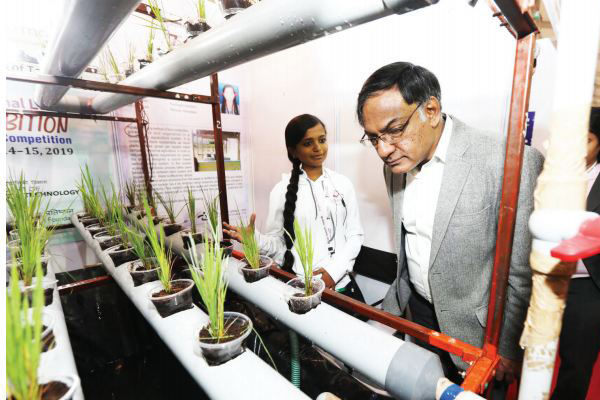
While school education is not a mandate of DST, we do want greater introduction to and participation of schools students in generation of creative ideas, in innovation etc. Our PM has often pointed out that although we have millions of problems, we also have a billion minds to address them! The base of the knowledge and innovation pyramid needs to be broadened, not just its height. The culture of innovation has to be seeded in schools. Today we have maybe about 10,000 tech based start-ups, but with the size of India, we need not 10,000 but 100,000 or even 1000,000 start-ups! How are we going to add these extra zeros with speed? It’s not going to happen only from the elite and higher education institutions. That is only the tip of the iceberg.We need to take the gospel of innovation to every corner, to young minds, for the culture of problem-solving thinking to take roots. So this is something we can do by firing up the imagination of school students.
DST thus started a new programme, Million Minds Augmenting National Aspirations and Knowledge (MANAK). The idea is to reach out to five lakh schools in the country to have competitions for innovative ideas and select the top one or two ideas from each school which can be submitted in any of the 22 languages of the country on an online portal. So we start with five to 10 lakh ideas from which an army of evaluators sift through to select 50,000 top ideas. Each of these students gets an Rs 10,000 prize, part of which is to be used to convert the idea into a prototype. Thus, using their hands and brains, workshop facilities, mentorship and so on; we introduce two key elements of innovation:respecting the power of independent innovative ideas, and then the desirability to convert a good idea into reality.
These selected prototypes then compete on district levels, state level, and national level; 10 percent of the ideas going forward at each level. Higher levels attract greater rewards, mentorship, motivation, inspiration and so on. This is a step in building the future of innovations with numbers. I have talked to so many of MANAK awardees. It is very interesting because the nature of ideas one meets here will not come from a PhD student or from me! For example, a girl in 7th standard came up with the problem of the drinking water taps in her school being mounted very high for her height. Her solution was to give a tilt to the pipe on which the taps are mounted, so that she can drink from the lower side and the taller students can drink from the other side. These kids have appreciation of both the problem and the possible solutions. We need to scout, encourage, reward and mentor them. Another girl made an interesting design of a multipurpose mechanised toilet cleaning gadget appropriate for the design of rural toilets, which was inspired by seeing the difficulty of her mother’s work.
Now, National Innovation Foundation (NIF) at Hyderabad, which implements MANAK, is creating a data bank of these ideas. In terms of its scale and ambition, this is probably the largest programme that DST has ever launched.
What is the feedback?
It has been beyond our expectations since the programme is only two years old. Not only the feedback, we also did an analysis of outcomes on the lakhs of ideas that we got last year. The analysis covered demography of the winners, their composition in terms of gender, in terms of what kind of school they come from (Municipal Corporation supported versus Central Government supported versus private), where do they come from geographically (rural, urban), etc. How many are from the socially weaker sections? It turns out that the composition of winners parallels the demography of the country very closely. This is without any preferences built into the programme itself. This is very heartening in that it confirms that innovation, innovative thoughts, creativity are equally distributed across all sections of society, regardless of the gender, location, nature of school, socio-economic strata etc. So this is very heartening, because it means that this programme has a good future and it would be able to select and inspire young students equitably from among all the sections of society.
There is an IIT and NIT system, government universities system, there are science colleges where people are doing B.Sc., but somehow they remain less engaged with the IIT level stuff.
One of the reasons for that is, with many of the colleges, we don’t have students and teachers to do research, we don’t have the required infrastructure, and we don’t have a priority or culture or systems needed for research. In the absence of these, merely providing money for research is not an optimal solution. Capacity and culture for research needs to be created. So what are the possible solutions? While many of the interventions are envisaged in the new Education Policy of the MHRD, one modest beginning was made in a SERB/ DST programme called Teacher Associate for Research Excellence (TARE). The idea is to create a fertile soil and seeds for research in colleges.
There are of course lots of colleges with excellent young faculty, who have done good research during PhD, but are not able to pursue research because of the reasons that I pointed out. How do engage this latent research manpower? This TARE programme gives a fellowship to the faculty with a proven research track record, with research potential and a deep desire to pursue research. So this fellowship and some research money allow them to work in a neighbouring institution or university with a relevant research group.
It could be an IIT, IISER, Central University, R&D lab like CSIR, wherever they find a host group, which can provide them the infrastructure and advise to allow collaborative work in the evenings, on weekends, in holidays, etc. Now, already 500 of these fellowships have been given in one year. As long as these researchers continue to engage meaningfully with progress, they will continue in the fellowship. Anyway, upto 5,000 such people should eventually be pursuing research. It is hoped that some of them may be sufficiently empowered to write grant proposals and succeed.
There are also programmes for universities and colleges to strengthen their research infrastructure. One such programme is Promotion of University Research and Scientific Excellence (PURSE). Those universities that have good research performance are given a one- time grant for creation of scientific infrastructure. This grant could be up to Rs 30 crore. There are many state universities that are greatly helped by this mechanism.
You have been in the academia; you have been a researcher and a teacher, new to administration. Your job right now is policy making. How do you handle that?
Management of DST requires deep insights into our entire science and technology ecosystem, including education. My job as a professor provided deep insights into the ground realities of higher education, scientific research, human resources, technology development, intellectual property, and even start-ups. Professors are for life! These experiences and insights have been invaluable in identifying the challenges and opportunities and in formulations of schemes that identify and address the gap areas in an effective manner. So essentially, our new directions in DST came from the evidence-based analysis of strengths, weaknesses, challenges, opportunities, needs and gaps and how to systematically address them. So I think in a ministry like this, it is necessary to have a scientist.
We have two new needed policies under the final legs. The first one is on the Scientific Social Responsibility that we discussed earlier and the other one is on Management of Scientific Infrastructure including its creation, maintenance, effective use, sharing and disposal. Two other policies are in the pipeline on Geospatial Data and a comprehensive umbrella policy on S&T and Innovation.
And there is another thing, one of the weaknesses have been in our science communication. The scientific community as a whole is not very strong in communications of various kinds, like in scientific journals, in popular media.
The Haryana Board of School Education (HBSE) has released the date sheets for the Class 10 and 12 board examinations. Candidates who have applied for the Haryana Board exam can now download the date sheet from the official website.
The exam dates were released on 10th January 2020. Haryana Board Class 10 Board exam will commence from March 4, 2020, and last till March 27, 2020, and the Class 12 Board exam will commence from March 3, 2020, to March 31, 2020.
The Board exam for Class 10 and Class 12 will be held from 12.30 pm to 3.30 pm. Candidates must follow the mentioned steps in order to download the date sheet through the official site of HBSE.
The link to get more details on the exam and check the Haryana Board Date Sheet 2020 for class 10th and 12th is www.bseh.org.in.
Haryana Board Date Sheet 2020: How to download
Step 1: Visit the official website of Haryana Board of School Education (HBSE)
Step 2: Click on Enter Website
Step 3: Click on the Date sheet Sec./Senior Sec. date sheet link provided under the notification section
Step 4: Download the Date sheet for reference or Keep a hard copy or print of the same for further reference.
Candidates appearing for the examination must make sure to reach the examination centre on time. Students appearing for the examination must not forget to carry their admit card to appear for the board exam.
Bihar School Education Board (BSEB), has released the class 10th admit card for the board examination 2020.
The board which will be conducting the board examination from February 17, 2020, onwards had released the admit card on the official website the board.
In order to download the admit card, the candidates need to fill the details like school code, candidate registration number, and date of birth. The candidates have to visit the official website of the board i.e. biharboard.online for downloading the admit cards.
Bihar Board Examination 2020: How to download the admit card
Step 1: Candidates need to visit the official website biharboard.online
Step 2: Click on the link showing admit cards download
Step 3: Enter your school code, registration number and your date of birth
Step 4: Login to the website and your admit card will show
Step 5: Download the admit card
Step 6: Take a print out of the same for future reference
The Indian Maritime University (IMU) Common Entrance Test (CET) 2020 results have been declared by IMU. Candidates who have appeared for the online CET conducted on January 4, 2020, can visit the official website of IMU to check the results. The qualifying candidates will be called for counselling subsequently.
Here are some steps that can be followed to download the IMU CET 2020 results:
Step-2: Find the CET 2020 rank card link on the website’s right side and click on it.
Step-3: Further click on the ‘Registered Candidate’ link
Step-4: Enter your username and password and download the rank card
The downloaded IMU CET 2020 results will enclose the name and date of the examination, name and roll number of the candidate, qualifying status, subjects appeared for, marks secured, and total marks.
Established under the Indian Maritime University Act 2008, IMU is a central university that deals with a wide range of topics related to the sea, including oceanography, maritime history, laws and security, search and rescue, transportation of dangerous goods, and environmental studies, among others. The university has its headquarters in Chennai and six campuses across the country in the cities of Chennai, Kolkata, Kochi, Visakhapatnam, Mumbai Port and Navi Mumbai.