Home Blog Page 795

Review committee to look NET & Non-NET Fellowships: MHRD

mhrd-logo

As a part of the overall process of bringing about change in the higher education sector, and improving access, quality, impact and equity in the Universities, the Ministry of Human Resource Development is in the process of reviewing the current research framework, efforts, opportunities, quality and output. A key imperative is the need to encourage and expand quality research in diverse fields.

For over two decades, the All India National Eligibility Test (NET), a competitive examination conducted twice a year by the University Grants Commission (UGC) has been the basis for the Research Fellowships, currently almost nine thousand that enable students to pursue M.Phil and Ph.D programmes.

The Non-NET Fellowship Scheme was introduced by the UGC in 2006. It is presently limited only to fifty institutions including Central Universities and those with Potential for Excellence. Almost thirty five thousand students are presently availing these Fellowships.

The Ministry of Human Resource Development has from December 2014, enhanced the support provided to Research Fellowships based on the NET. Junior Research Fellows will receive, for the first two years Rs. 25,000/- per month and 30 per cent House Rent Allowance (HRA) as well as a contingency grant for each year. Senior Research Fellows will receive, for the next three years Rs. 28,000/- per month, 30 per cent HRA and a contingency grant for each year.

The Government has decided to establish a Review Committee to go into the issues related to the research fellowships provided by the UGC, covering both NET and Non-NET fellowships. The Review Committee will submit its report to the Ministry within December 2015.

Amongst the issues entrusted to the Committee are:

  1. The feasibility of enhancing the number of NET fellowships, which are merit based
  2. Establishing a transparent system of transfer of fellowship amounts each month to the Non-NET fellows, which is presently being done on a reimbursement basis, and without the Direct Benefit Transfer mandated by the Government
  3. Bringing the benefits and opportunities of the Non-NET fellowship scheme to a larger number of Universities, including State Universities
  4. Considering economic and other criteria for eligibility for non-NET fellowships
  5. Recommending guidelines for the selection, coverage, award, and administration of the non-NET fellowships.

Irrespective of the recommendations of the Review Committee, all existing and continuing fellowships, NET as well as Non-NET would be continued. There will be no change retrospectively.

Baba Ramdev promotes Vaidik education

ramdev

Rooting up the Indian Vaidik education, Baba Ramdev, yoga guru has said that the Union Government will soon set up a Vaidik Education Board which will be on the lines of Central Board of Secondary Education.

Prime Minister Narendra Modi has also agreed for the same. He informed that they will be setting nearly 700 gurukuls and acharyakulum in India. The students will be taught all the world languages including English. They will also be taught our national language, their mother tongue as well as Sanskrit under the new Vaidik Education Board.

Sanskrit will be a compulsory subject from nursery to class 12. The teaching will also focus on Vedas, Upanishads, Ramayana and Mahabharat besides Vedic and Ayurveda education.

Bringing Positive Change In School Culture

Little Elly believes that learning is a continuous and lifelong process and ability to learn and grow is unique and special in every child. Vittal Bhandary, Founder and Managing Director, Little Elly shares with Elets News Network (ENN) about the role of preschools in child’s education, Little Elly’s franchise system, quality standards, future plans and more

As we know preschool is often a child’s introduction to the world of education, what role a preschool educator and facility play in the child’s future?

At Little Elly, our strong belief lies in the fact that the childhood is meant to be enjoyed and cherished. We believe that learning is a continuous and lifelong process and every child does it at his or her own pace. The child’s ability to learn and grow is unique and special. Our teachers ensure that each and every child get proper guidance to grow, in a mutually accepting and nurturing environment.

Our concept rooms make the children’s transition smooth, hassle-free and provide an environment that jump-start their developmental process, to acquire knowledge and understanding of various concepts through creative learning and play. Our programmes help children develop their latent creative, language and math skills through the Rudolf Steiner and Montessori Method.

The stimulating combination of academic, artistic and practical activities that we offer, surrounded by a caring environment, ensure that children learn without actually being aware of the teaching process.

“Franchises enable not only sharing of expenses, but also knowledge, experience, brand image, as well as technical expertise.” How far do you agree?

As Little Elly franchisees, they enjoy a lot of leverages as we provide them marketing support, ongoing operational support, ongoing logistics support, staff recruitment and training. All our franchisees are with us for a distant future as they not only share the brand image, but also the knowledge, experience and technical expertise with us.

Parents have high expectations from preschools in terms of ensuring compliance to the standards of teaching methods. At Little Elly, we provide career opportunities to people who are ready to impart knowledge and educate the new generation through our Initial Teachers Training (ITT) Programme, which offers courses on early childhood and preschool teaching.

Owning a Little Elly franchise means you can enjoy the freedom and flexibility of running your own pre-school while having the support of a strong, recognised brand at every step.

What is the set of quality standards which your brand is associated to?

Little Elly provides a nurturing and stimulating environment responsive to the changing needs of children, parents, faculty, staff and the neighbourhood. The school’s Early Learning programme provides something unique for each age group, with a multitude of activities and experiences, encouraging children’s natural curiosity and sense of learning.

In Little Elly, we instill and encourage passion in teachers because building relationships with the children and teachers has allowed us to continuously improve ourselves and influence a positive change in the school culture.

Are you planning to expand your preschool franchise further? If yes then how?

Yes, we are planning to expand our preschool franchise further. Our brand’s preferred franchise model is franchisee–owned franchisee–operated (FOFO).

Franchising a brand promotes the brand from within. With strong support from community and passion for startups in the education sector, our brand Little Elly plays a huge role in encouraging entrepreneurship and to have a rewarding and challenging career.

For people, who always want to be a part of something bigger, Little Elly provides complete support in starting their own business through franchise opportunity.

What is the investment required for starting a preschool?

For setting up a preschool, you need to invest good amount of money depending on the scale at which you want to operate your preschool. The investment would range between Rs 8 lakh to Rs 10 lakh, depending upon the location and area chosen.

What is the first step towards establishing a brand or buying a franchise?

Little Elly’s dedication in helping our franchisees is second to none.

In the beginning, they work with a team who lend their expertise in areas such as real estate, marketing, education, operations, and accounting.

Once the school is open, they receive guidance from LE coordinators in operations, marketing, and curriculum, who assist them with staffing, scheduling, managing costs and more. Our hands-on support also extends to comprehensive training programmes for the franchisees and the teachers.

Our pre-setup guidelines follows the orderly steps:

  • Sign the LOI (Letter Of Intent) by paying 50 per cent of Franchise Fee
  • Business Entity Registration
  • Site Selection
  • Agreement Sign up
  • Training and Support
  • Place Order for Toys, Teaching Aids and Furniture
  • Improvise the Property
  • Setup Support
  • Local Branding Support
  • Inauguration

What are the advantages of taking a preschool franchise?

Starting a preschool is one of the profitable business options available today. Franchising can help you succeed in business with their franchise models, training, promotions, as well as support.

Preschool business receives support of a corporate establishment with years of experience and gains excellent support services to set up, launch and operate a successful preschool.

The preschool sector definitely has a low entry barrier. For people, who always want to be a part of something bigger, preschool business provides complete support in starting their own business through franchise opportunity which offers 15 per cent ROI (return on investment) within the first year itself.


Education Resource Guide : A Guide to Resourceful Future :: October 2015

DL-Magazine-October
EDITORIAL
Learning Skills – A Continuous Process
RESOURCE GUIDE
A guide to RESOURCEFUL future
Company Profile
Advance Tech Solutions by VDPSL
Facilitating Effective Learning
Focusing Technological Solutions
Transforming School Education
Innovative learning through EduPro
Developing Language Skills
Facilitating Quality Sports Programme
Offering need based solutions to consumers
Self-Paced learning through WizIQ
Personalised Learning
INDUSTRY SPEAK
Imparting Skill Online
Sports infra for educational institutes
LEADERS SPEAK
Learning in the DIGITAL AGE
Paradigm shift for Gen Next
Devoting towards child’s development
Preparing citizens of tomorrow
INTERVIEW
Bridge the education ties
Education for All
Tying Bilateral Education Knot
Paradigm shift needed to check education
A Dream to Educate & Empower children
Reinforcing Better Education
Delivering Education the Right Way
Oman bets big in higher education
Preparing future of India
Enhancing students’ skills, job opportunities
EVENT REPORT
Skilling hands of Future
Integrating Global Ties
Cementing Capacity Building in Learning
Skill Development for Youth Need of the Hour
Enabling Metamorphosis in Learning
Learning Today Mobile, Virtual, Interactive
Growing Impact of Technology
Vocation to Upgrade Youth
International Education Initiatives Learning and Collaborative Opportunities
Integrating Industry Academia
Technological Revolution
Overhauling Education Through Reforms
Anytime, Anywhere Learning
Honing the Skills
Enabling Competent Pedagogy
Preschools – Nurturing Childhood
Bringing the Positive Change
Government should provide Quality Education
Felicitating Academicians

Imparting Skill Online

SriramSriram Subramanian, an economics graduate from Brown University, worked in the US politics, got a postgraduate degree in Transport Modelling from UCL and spent three years with PwC consulting on the UK taxes before returning to India to work in education sector.

His venture Callido Learning is a Mumbai-based tech startup which develops online skill development programme. Talking about the education scenario the world over Sriram thinks, “The best universities around the world expect students to solve problems, write effectively and think critically. Employers expect the same skills at a higher level.” Sriram is one of three co-founders of Callido Learning.

Chinmaya Kulkarni and Madhu Agrawal, Sriram’s co-founders at Callido Learning also embody these transferable skills. Chinmaya is a geologist turned energy consultant turned automotive researcher while Madhu is a UK qualified solicitor who quit her job at a Magic Circle law firm to become an educationist.

“Sometime in 2013, we asked ourselves what the biggest challenge was and why we weren’t already working on it”, says Madhu. “It became glaringly obvious that the greatest challenge was the gap between our content-driven education system and real-world demands.

A survey by the Economist confirms this view: business leaders ranked ‘problem-solving’, ‘team-work’, ‘communication’ and ‘critical thinking’ as the skills are essential to workplace success.

To address this challenge, the Callido team developed an interactive online programme called ‘Basecamp’ which simulates a research project. “Students in Basecamp develop critical skills through immersive scenarios and challenging exercises. The online platform makes it flexible – take it anywhere, anytime. The data analytics and personalised reports allow parents and teachers to track progress,” says Chinmaya, who takes pride in teaching 21st century skills with 21st century tools.

The initial version of Basecamp is aimed at students of the International Baccalaureate Diploma Programme. By popular request, a version of the programme for a wider audience will be released later this year.

Felicitating Academicians

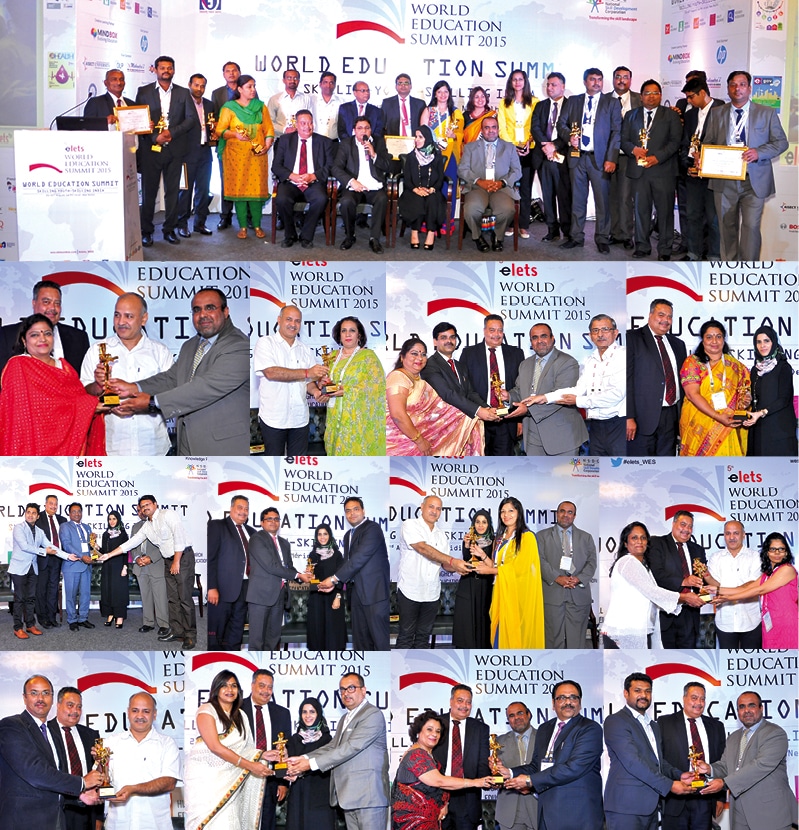
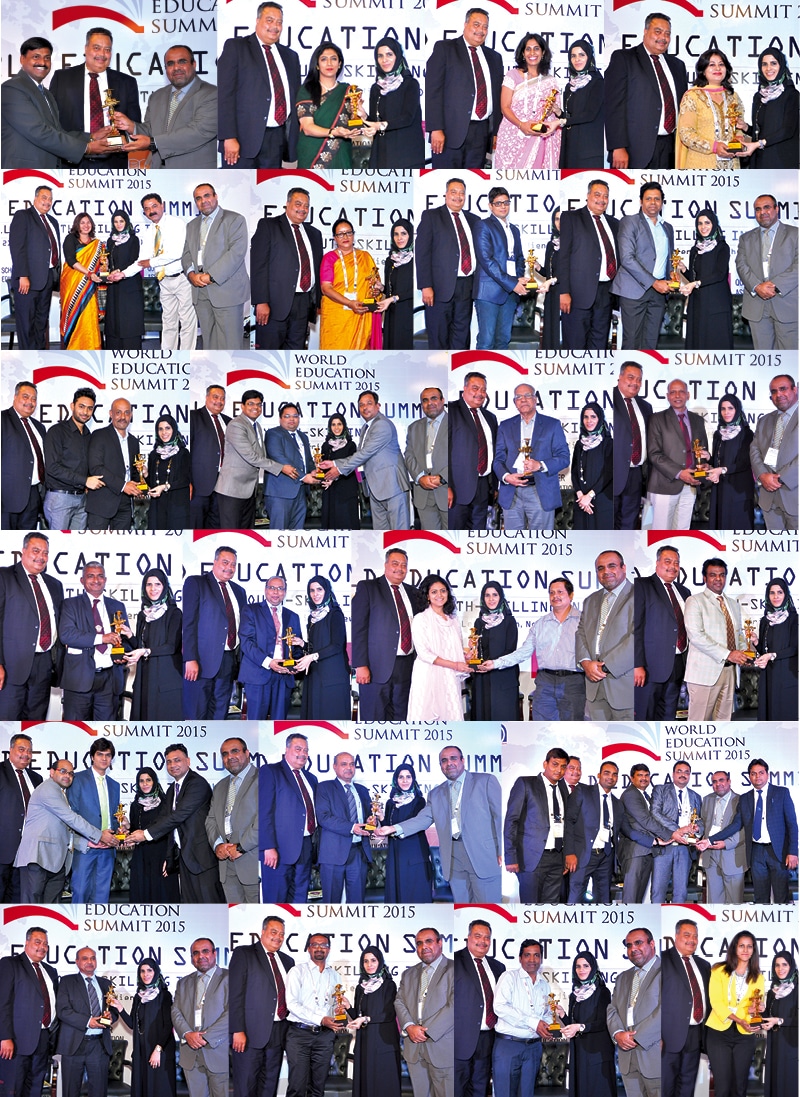
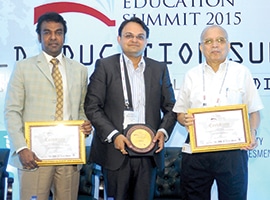
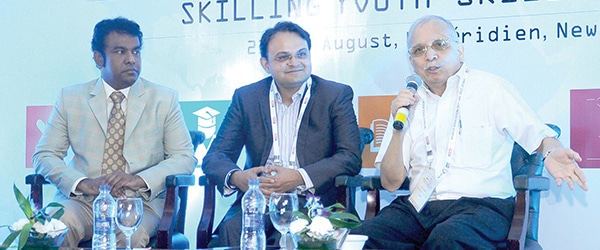
The World Education Summit 2015 awards saw a gamut of innovations being recognised and those schools who had initiated optimal usage of ICT in learning. The awards were categorised under School Education, Higher Education, Private Sector, Government Sector, Non-Government, Start-Ups, Skill Development

 Felicitating

Felicitating-1

Vocation to Upgrade Youth

Vocational Education in Economic Development

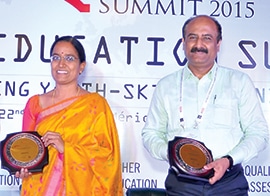
Sandhy Rani, State Project Director, AP Sarva Shiksha Abhiyan & Comissioner & Director of School Education (FAC), Andhra Pradesh Government and Santosh Birari, MD, Odisha Knowledge Corporation Ltd. were felicitated at the Plenary session at WES 2015

With the country having a tough time in the employment sector, and universities rolling out desirable candidates, a gap to enable vocational jobs to the youth and not being suitable for the market has been prevalent. Policy makers should buckle up to engage educational institutions in carrying out courses to meet the demand inux in the employment sector

SATISHProf (Dr) Satish C Sharma, Chairman and Managing Director, Maharaja Group of Colleges

Our Prime Minister Narendra Modi says, “Our youth are our strength, let the youth get those skills that contribute towards a string nation.” Since we start our education just by taking knowledge, nothing is taught in terms of jobs. If you really look at vocational education, we don’t have a single university offering vocational courses.

Technological Revolution

Usage of Big Data & Cloud Computing

Cloud-Computing-wes

Rapid advancement of technology and the development of emerging technologies such as cloud computing, the issues of reach and quality are addressed by enabling low cost implementation of IT tools

MANEESHMANEESH SHARMA, CRO, WizIQ

Cloud is helping the educational organisations and institutions to look at applications on a standalone basis. The other thing to be looked at is the concept of mobile. With the help of Cloud applications, one is being able to deliver information from various applications to mobile devices. It is now possible to deliver nuggets of information to learners, which is also called micro learning. Looking at the usage of mobile phone, it’s pre-dominantly notification-based. So, with the Cloud application, one is able to push information to students, thereby increasing the interaction between the teacher and the student. It helps bring in the concept of flip classrooms. However, looking at the consequences of Cloud, because of the proliferation of applications, the amount of data which is created is anonymous.

DR-RSK-LAKSSHMANADR RSK LAKSSHMANA PRABHU, Co-Chairman, PSNA College of Engineering & Technology

It is a digital era and so, we need to accelerate with speed in the right direction. It is the direction of intelligence that determines the pace of growth. However, the question is – “Are we using the right as well as the latest technology?” Digital learning is not meant to replace traditional learning, rather it empowers us to accelerate the right direction of the educational growth. While the prominence of Big Data is understood beyond business mission and criticality, it’s important to accept that the Cloud will become the next movers and shakers for the Internet of Things (IOT). The way ahead is to connect, collaborate and commit. India is fast emerging as high-growth market of cloud services. Moreover, Big Data is everywhere and there is almost an urgent need to collect whatever data is being generated. Big Data analytics has become crucial as it aids in improving business and providing a biggest edge to the competitors.


SS-GOKHALESS GOKHALE, Director, LNM Institute of Information Technology

The first and foremost thing we need to do is to really look inward and figure out how our faculties are going to be accepted in the society at large and then things will automatically fall in place. It is also essential to look at what set of skills are required in computer science and engineering. As a matter of fact, one of the critical areas is the automobile data, which is quite voluminous. This data needs to be sorted. There is a need to have an inductive as well as descriptive type of statistical tools. This is one of the important aspects as far as developing business intelligence is concerned. Even in Big Data, the core of computer science and engineering, data structures, algorithms, coding, etc. have to be taken over by Big Data analytics, mobile computing, Cloud Computing and so on and so forth. On one side, all of us are excited about ‘Make in India’ and its huge impact whereas on the other hand, there is not enough faculty and many seats are lying vacant in engineering institutes. Needless to say, there is a need to re-think whether we are ready for this type of a rapid change or do we need some time to absorb the rapid advancement and go systematically.

POINTS TO PONDER:

  • Digital learning empowers to accelerate educational growth
  • Big Data and Cloud will be essential keys for Internet of Things
  • Cloud helps in developing micro learning skills
  • Cloud promotes flipped classrooms trend to a great extent
  • Find apt skills required for computer science and engineering

Integrating Industry Academia

Bridging the Skills Gap

Industry-Academia

The industry academia in India has been mostly on the go to obtain a premium learning in its schools and ensuring the students garner niche education to meet the rising demands of employment sector. In the present times of knowledge economy, a productive interface between academia and industry is a critical requirement. Failure to recognise each other’s role will reduce the import of interface between institutes and industry and this can potentially give rise to mismatch between demand and supply of quality manpower. The session on Bridging the Skills Gap showcases how the void can be filled

GURMEET SINGH DHALIWALGURMEET SINGH DHALIWAL, Chairman, Baba Farid Group of Institutions

India and Canada have similar issues in the higher education domain including ensuring access, quality, establishing effective relationship with countries, maintaining academic independence and of course skills gap

HARSH MEHROTRA

In an industry where there is a plethora of opportunities to look forward to, what is left is searching for the right candidate. It should be clear what we look in a prospective employee. An employee will provide the necessary attitude and skills if correct guidance is initiated. You give them attitude, we will teach them skills, you can’t teach a horse to climb a tree. It takes time to generate the right amount of skills. It should be harnessed during the employment.
Agar kuch nahi kar sakte toh skills karlo (If nothing works, then one should do skill education). This is what comprehended from skill learning, but it is a different picture altogether.
The National Skills Quality Framework has some key aspects: Quality of training, infrastructure assessment, adequate compensation, in short, the universe of skill development is doing fine. The current government has ensured to practice National Skills Day, for skilling the abilities.
The basic thing which an employer should keep in mind is developing the curriculum, make them understand their future of the job. Apprentice opportunities like skill slab opens the gate to teach, participate in assessment, encourages the employer to recognise the skills. But there is a gap, not much is explored yet for retiring employers. These should be used as trainers, we should hire them, pursue them or request them to train, working professionals, industry should move into hiring certified candidates.
We should make skilling aspirational for both boys and girls. Academia should set skill lab to provide simulation to the students and generate in them the real time look and feel. Academia is a far away thing for college dropouts, plenty of things needs to be done, and this is just a drop in the ocean. 70 per cent haven’t even seen college. We should not get overwhelmed by skill development, a much larger role is required.

HARSH MEHROTRA,
Head Trainings, Mahendra Skills Training & Development Pvt Ltd
PROF MITHILESH DIXIT

In today’s time ensuring the right vocation to the right resource is very necessary. Today, a business magnate tells me how to teach or train teachers, where an industry expert comes and tells me, I will teach you the assessment process, how to create a curriculum. My core profession is been taken by somebody, that is the issue that needs to be taken care of. Doctors, bureaucrats and engineers acquire basic skills that are common to all professions. The university can provide them the right choice, the right market, mandatory basic human competence, professional and business combined together.


PROF MITHILESH DIXIT,
Vice Chancellor, Career Point University, Kota

POINTS TO PONDER:

  • An employee will provide the necessary attitude and skills if correct guidance is initiated
  • Right vocation should be given to the right resource
  • Don’t ignore the responsibility for the people of the unorganised sector
  • Experiential learning cannot replace any form of learning


VARUN SURIThe topic regarding skill development is very interesting. I have done my engineering in automobile as I was interested in working with cars. But after four years, I ended up not having a job. My only option was to work in a garage and gain experience. I sensed that my degree was not good enough for my practical skills and unable to relate with the physical components of the car. We developed two elements in partnership with institutions and set up an automotive lab to help students feel the different components, simulation exercises, etc. We also want to partner with skill development firms. A conventional way of learning or experiential learning cannot replace any form of learning.

VARUN SURI,
Senior Manager,Automotive Aftermarket, Robert
Bosch Engineering and BusinessSolutions Private Limited


GURMEET SINGH DHALIWALAfter years of research, to bridge the skills gap, we at BFGI (Baba Farid Group of Institutions) have come up with a unique model for skilling India, the solution side of it.
India by far has the largest higher education institutes in the world. The engineering colleges here are growing at 20 per cent per annum and the Bschools are growing at 60 per cent per annum. The academia is not getting sufficient placements, and the industry is not getting good employees, quality side needs to be looked upon. There is a lack of quality supply, and there could be multiple reasons for it: lack of regular industry academia interface, lack of job oriented and skilled based curriculum, lack of evaluation and solutions of practical skills and lack of internship and apprenticeship opportunities in the academic world.
GURMEET SINGH DHALIWAL,
Chairman, Baba Farid Group of Institutions


PROF SWAPAN BHATTACHARYAA person having knowledge cannot ensure that he has skills too. We expect our teachers to have a different set of skills. As per our society, we perceive the person taught in the class to be at a lower, we have engrained certain misconceptions in our mindset like creating a hierarchy. Some things have to be changed. We cannot ignore our responsibility we have for our society. We should think about the people employed in the unorganised sector. And working on a methodology through equipments must be taken care of as human resources are free resources in the country.
For the research labs, the government recruits best of talent and trained them for two years. It is an investment for their training, and personalities are generated for the industry we cater to. There’s time for us from industry side to reflect upon.

PROF SWAPAN BHATTACHARYA,
Director, National Institute of Technology, Surathka

Delivering Education the Right Way

Kalthoom-Al-Balooshi
Kalthoom Al Balooshi,
Executive Director, Education Development, Knowledge and Human Development Authority, Dubai

Education sector witnessing improvement everyday, quality has become a major factor to treat it right. Kalthoom Al Balooshi, Executive Director, Education Development, Knowledge and Human Development Authority, Dubai talks to Prathiba Raju of Elets News Network (ENN) about Dubai’s perspective of Indian education

There are a lot of opportunities for the Indian education sector to explore in Dubai. Can you please elaborate on it?

Over the past seven years, Dubai has seen a growth rate of five to seven per cent in the education sector. Moreover, in the Indian community itself, there is a need for 40 per cent curriculum schools after the new expansion. So, there are huge opportunities for quality Indian curriculum schools to come and expand in Dubai and for the expertise who understand the Indian curriculum to come and be a part of the education sector in Dubai.

What expectations do you have from the primary and higher education in India. How do you see the Indian education sector from Dubai’s perspective?

Back in Dubai, we have a definition for quality, which is defined by the inspection rating, national agenda and our resultant terms and conditions. So, that is our expectation when it comes to quality and we also understand that it’s all about having students who are able to achieve and do something different, who are ready for the future. This is the type of quality we are looking for, things that are focussed on the students’ achievements.

How many Indian students schools are there in Dubai? How do you think it will develop by 2020?

There are almost 80,000 students with 31 Indian curriculum schools in Dubai and we are expecting around 40 per cent more students in the Indian curriculum schools. That’s what the numbers tell us and we understand that there might be some different numbers coming up too because this is the general growth rate and it might be much more in the future. Looking at the latest statement, the Prime Minister of India, on his visit to Dubai, said, “We undersatnd that there are few government schools and we will be working as well on increasing the Indian curriculum schools in Dubai.”

How do you see the Indian education sector from Dubai as a whole in graphs?

The Indian education sector is attracting different nationalities and is actually addressing the need of the market because of the population of the Indian community. It’s growing very fast, attracting the needs, and working hard towards the quality education.

What differences do you see in the Indian education sector when compared to the UK and US-based education system?

We have two of the Indian curriculm schools, which are rated as outstanding when compared to US, UK and others. In terms of rating, to get outstanding is quite high but they are actually addressing the whole need.

So, it’s not the curriculum, it’s how they are delivering the curriculum. If a curriculum is able to reach outstanding, it covers all the requirements from achievement of the student to his well-being. We can expect more schools which will be under the outstanding rating.

Dubai has some 200 million dollar revenue for Indian curriculum. Can you just elaborate on it how it is right now and how it will be in the next five years?

Depending on the capacity, it could be doubled or tripled.

LATEST NEWS