Mindbox provides national and international level competition for students
Aiming to empower students with skills, MindBox programmes designed for students from grade 1to12 aid in developing their thinking process and creativity
MindBox is an initiative that aims to empower students with 21st century skills. The company develops creativity & life skills of students by an output method of expression using Visual Communication as language, design thinking and STEAM as a subject. The delivery happens using Technology as a tool inside the school’s campus through Project | Design Based Training Methodology for Class 1st-12th students.
MindBox provides curriculum, worksheet, software’s along with qualified faculty to conduct these sessions and a four way assessment system for school and students. They also provide national and international level competition for students to demonstrate and showcase their skills.
Programmes
Art2Robotics
The programme help students to learn to build robots and perform tasks with using pre-programmed, easy to use smart Cubo Kits. The programme help develops motor skills, improves creativity and imagination, and exposure to collaboration at a young age.
Art2Paint (Digital Painting)
This programme combines the power of software and hardware technology with traditional art skills in training students on creating digital paintings. It is a fun activity based programme, introduces students to handling of digital tools of art creation at an early stage of education.
Art2Animation
A fun based programme of claymation helps students learn to create models with plasticine clay and animate them with the help of HUE HD camera and Animation software. The Programme introduces students to the creative medium of claymation of expression of creativity and imagination. The programme helps improve the sense of colour, size and proportions, experience of creating different shapes and forms.
Art2Game (Game Maker)
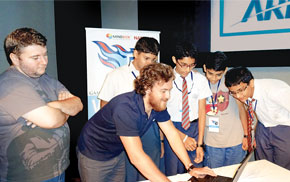
The objective of this programme is to design and develop a simple 2D game for a PC using drag and drop based programming software Game Maker Lite. The programme is for students studying in grade 4-7. It helps in improving the number and shape recognition, grouping and counting, develops sense of video perception and colour recognition, improves hand-eye coordination and promoting creativity.
Art2Video (Videography)
Art2video will create, develop and frame your moments. Select a theme or a function, conceptualise and record the entire event, edit and add titles and digital effects and produce a final video output. Programme includes videography, storyboarding, shot composition, lighting techniques, importing video, edit, adding effects, audio and text and making a final DVD of the same.
Art2Animation
An objective oriented programme designed to help students use their own creativity and imagination in creating 3D animation content using industry standard software Auto-desk Maya. A programme that covers up the entire 3D animation pipeline. The programme is designed for students of grade 8-10.
CADD@School methodology helps students to develop balanced brain skills and to apply their knowledge to better their performance in studies and activities. CADD courses are designed to equip the kids to meet their daily challenges and help them transform from a kid to Kiddovator
CADD Center is the world’s largest CAD training organisation with 520 centers and presence in 24 countries having trained over 1 million college students and professionals for 27 years. CADD Center is keen on associating with schools to add value to students through the CADD@School initiative.
CADD@School has identified certain skills needed for the students of age 12 to 17 like logical thinking, analytical ability and soft skills and will impart these skills through the specially designed and customized KIDOVATORS programme.
The KIDOVATORS programme aims to nurture balanced brain development in students of 6th, 7th, 8th, 9th & 11th standards by training them on generic, specific and soft skills which will be of great value addition.
Classrooms ought to be a digital zone that will enable the students to enter the engineering mindset. This mindset develops when the students grasp complex scientific concepts of the school or college curriculum in a practical way.
CADD@School remains a value addition programme that seeks to widen the horizons of the student without becoming an obstacle to the regular curriculum. The training using our licensed software will take place on campus in a convenient manner for both the student and the institution.
CADD@School helps in enhancing brain development in kids. Childhood is all about learning. The brain and the learning connections within the brain are the heart of learning for kids to achieve their aspiration. For instance, when student learn the fundamentals of engineering drawing they learn the concept of arts, science and analytics that are taught at schools. This early initiation from Cadd@School helps the kid acquire experience, develop skills, and broaden their knowledge by increasing the control of materials, creativity and analytical skills.
The programme brings a host of creative and professional software courses to the students of higher secondary schools or technical and vocational training institutions. The programme opens the gate to the world of imagination and creativity. It helps students excel in higher studies and future career, harnessing the power of visual thinking.
With the focus of providing smart safety solutions for students, tech Smart has developed smart modules that make school infrastructure smart and helps teachers and parents to track the child’s activities with a single move
Transport Management System to track children
The vision of tech Smart, a solution division of Secureye, is to deliver education through innovation and technology. Focusing on the security of the students at schools, tech Smart is working on providing smart infrastructure to the schools.
A pioneer in providing security and surveillance hardware and dedicated solutions for institutions, tech Smart has created a niche in the market just by providing simple and innovative solutions to cut the operational hazards of the business. The integrated solutions developed by the team of experts make infrastructure smart.
The experts at tech Smart have developed comprehensive solutions for child safety, enquiry, school bus tracking, admission, fee, class timetable, assignments, and academics of any institution for multiple locations.
Modules at tech Smart
School Bus Tracking: To keep your children safe from the challenges of going missing, abduction, road accidents and other mishaps, the School Bus Tracking solution helps in keeping an eye on the students going to school from starting point to the doorstep. The solution makes sure that every student and his guardian are well informed about the schedule of the bus. Bus will be enabled with driver console which will make driver smart by providing detailed information about stoppages and students. Parents will get a notification of the bus reaching the stop before two stops on their mobile. Parents and school administration can do the real-time tracking of the bus.
Digital ID Card: The technology will help outdoor and indoor tracking of Student once he is out of house. It will capture attendance in Classroom, library, labs etc. and the parents can get the information about the movement of their child on the mobile. It will also empower students with real time daily activities and time table along with SOS button for emergency use. Digital ID Cards will also activate cashless management in school like a student can do cashless transactions in Canteen, Fee, Uniform etc
Live recording and broadcasting of lecture: This solution presents a complete automated end-to-end system that supports capturing, editing, packaging, broadcasting, viewing, and archiving. The system architecture minimizes the pre- and post-production time, and a fully automated lecture capture system that synchronously captures all the content of the lecture, including audio, video, and presentation material.
Teachers can edit the content they recorded in the classroom. The lecture can be made available for online streaming or podcast. With the help of content management system, the recorded lecture can be published online or on the digital library of the school.
Mobile APP: The application provides real-time updates to parents at the click of a button. The app sends a text to the parents after the teacher approves absence of the students. The teacher and parents can chat and discuss the progress and problems of the child on this platform. Besides, there are add-on cameras mounted in the school buses and the classes, which record all activities. With the help of mobile app, parents can also track the location of their children. In case of misbehavior by driver or conductor or by other students, parents can immediately get the information and help their child.
Robokkidz is reaching out to more than 30,000 kids in over 300 Schools across India
Robokidz with an aim to bring a change in the development years of children has launched programmes for kids to expose them to the world of robotics. The young and dedicated team delivers robotics education programme for school students in the form of workshops and robotic lab
Born in 2010 with the motto of promoting technology, scientific thinking and innovation, Robokidz has surpassed five years of creating an aura of a science and technology spectacle year after year. Well established as Science and Technology Skill Development Company, Robokkidz is reaching out to more than 30,000 kids in over 300 Schools across India.
The company has made an inception by exposing school children to the world of robotics. The dedicated young and dynamic team creates and deliver robotics education programme for school students in form of Workshops, Year Long Programme and Robotics Lab.
Sagar Lalit Sanghvi, Founder & MD, Gemini Training & Staffing
Robokidz has a weekend programme named Young Engineer’s Club designed especially for kids with little or no knowledge of robotics and electronics. The team inspires young kids to develop an interest in science and engineering. They mentor students about doing activities in a group and analyse and solve any problems faced during their activities. Students will be working on many real life applications under the guidance of trained faculties.
The mission of Robokidz is to inspire and develop children to think creatively, reason systematically and explore their potential to shape their future. The team strives to provide best possible resources and education in the field of Electronics and Robotics.
Robocon Jr. is an initiative by MIT’s Pune Vishwashanti, Gurukul and Robokidz India LLP with an aim to unleash the young engineers within the child. It is robotics competition for kids of ages 8 to 15 years. This allows them to learn in an active, constructionist environment, building physical objects and experiencing abstract concepts in intentionally meaningful ways.
The opportunity to use robotics, to simulate learning and problem solving offers children the possibility of realising that computer technology extends beyond the reach of their desktops.
Since four years, Robokidz has been organising various National and State-level Robotics Competitions in association with premium institutes like MIT, Pune and IIT Bombay. These competitions have been creating a visual spectacle year after year. Some of the events hosted by us are:
Robosoccer – 2010
Robosoccer – 2011
Robocon Jr. – 2013
Robocon Jr. – 2014
Techfest, IIT Bombay – 2015.
Flipped Classroom is a process that would turn around the traditional technique of teaching methodology, shifting focus from lecture delivering to student learning. Zankrut Oza, Assistant Professor, VES Institute of Management Studies and Research (VESIM) shares an overview of the flipped classroom
“You will be doing your students a much greater service by reducing the amount of material that you are covering and actually ensuring that students are learning it, rather than making sure that you are ticking off everyone checkpoint in your ideal syllabus. Learning comes from practice, and you have to help and teach your students to practice just as you help and give them the basic knowledge and skills of your discipline,” said by James M. Lang, Cheating Lessons: Learning from Academic Dishonesty.
General method of teaching in our country even today is focused on the faculty in the classroom, giving students only an interactive opportunity when required, i.e. to solve any doubt or when a question is raised by the faculty, student has to revert compulsorily. The modes of teaching has been board-oriented, dictated or in power point presenlearntation form. Here, the overall feel is that a faculty is like a broadcasting station and others are the avid listeners tuning into the classroom.
Zankrut Oza, Assistant Professor, VES Institute of Management Studies and Research (VESIM)
While catching the frequency, every listener has his own grasping power to catch the content, understand and analyse it. In the whole process, it is selfunderstood (read misunderstood) by a faculty that every student has received the same content as transferred. Here, the students catered to are average or just above average, while the best of the students are not challenged on learning topics and below-the-average or struggling students are left haywire. Most of the time was spent on lecturing and a little on its application, which disturbingly dilutes the basic essence of studying in education system.
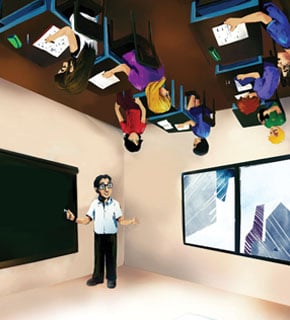
To overcome such hurdles, a teaching technique was developed known as “flipped classroom” or “inverted classroom”. We are not talking about anti-gravity experiment, but a process that would turn around the traditional technique of teaching methodology. The core of the flipped classroom is a learner-centred method, which intentionally shifts focus from lecture delivering to student learning. So, what happens exactly over here is that in place of lectures delivered in the classroom, assignments are given to be worked at home, thus creating a reverse scenario. Faculty search the online tutorial videos or podcasts or create their own subject matter of expertise and the students listen to them at home. The class time is utilised for execution based on this knowledge.
This breaks the educator’s mind-set of teaching with Bloom’s Revised Taxanomy (2001) where students are focusing on higher forms of cognitive learning like analysis, application, evaluation in the classroom and performing the lower levels of cognitive work like comprehension and receiving knowledge outside of class. Inside the classroom, students receive the support from their faculty in application and help in completing projection from their peers.
New Buzzword
In last few years, “flip classroom” has become a buzzword in the international education ecosystem. It all started with a Harvard professor Eric Mazur developing concepts which influenced flipped teaching method, by creating an instructional plan, which he called as peer instruction. Prof Mazur also published a book in 1997, known as Peer Instruction: A User’s Manual. His finding was a method to shift knowledge transfer outside the class and collate the information inside the classroom, which gives him a chance to coach his students in their learning instead of lecture.
A research was carried out in two colleges for the subject of economics by three faculties namely Lage, Platt and Tregliaon with the help of VCRs, moving away from the presentation way of teaching. They published a paper called “Inverting the Classroom: A Gateway to creating an inclusive learning environment” (2000) which says that a faculty or trainer can leverage the classroom duration that becomes available from the inversion of the classroom.
One of the first executors of this concept was Salman Khan – an educator and founder of Khan Academy. He used the Yahoo’s Doodle Notepad to teach his cousin Nadia in Maths. When asked for similar help, he made educative videos and uploaded them on YouTube. Sighting the success and recommendations, he started the world infamous “Khan Academy” on the same teaching model, which is backed by Bill & Melinda Gates Foundation, Ann and John Doerr, the Brazilbased Lemann Foundation, AT&T and Google. With the increasing popularity in Massive Open Online Course (MOOC), it became easier for faculties to find relevant online content for the flipped classrooms.
International organisation, TED, known for their conferences and online inspirational talks, took a step ahead with TED-Ed, a web portal of educational videos which can be customised further. Aim behind it was to leverage both educators and animators to create quality videos. The head of TED, Chris Anderson said, “It’s a better fit for education in the 21st century, and it’s the next logical step in TED’s evolution. TED-Ed was found as a way of empowering teachers, as well as giving a large platform for great teachers to produce their talks or lessons on video for the world.” There are many free online tools available for educators to support flipped classroom and create their own videos, customise and use them with students like SooMeta, Office Mix, FlipGrid, Edu- Creations, KnowMia, 9Slides, Jing, Video In Video, Mozilla PopCornMaker, etc. Open source Learning Management System like Moodle is also available and can be reframed according to the needs. No wonder, there is a vast community of over 25,000 Flipped Educators on a web portal called FLN’s Professional Learning Community (formerly called the Ning). One can easily join the FLN’s free online Professional Learning Community (PLC) and get connected with thousands of flipped educators across the globe. Their mission is to provide educators with the knowledge, skills, and resources to successfully implement flipped learning.
Students of this generation love technology. If it can be leveraged, they can have joy in studying and knowing a concept before it is introduced in the class
Flipped Classroom-Need
Now, the question arises is whether the students really need flipped classroom? It is positive, as the benefits for students are enormous. First of all, a change in methodology surely excites them and brings freshness in way of teaching. By using the flipped-classroom method, students can learn the subject or topics at their own pace. With the process, students start framing collaborative groups, helping each other to learn instead of just relying on the faculty.
Students of this generation love technology. If it can be leveraged, they can have joy in studying and knowing a concept before it is introduced in the class. Once they have gone through the study material, the communication in the classroom turns to be interactive and brick and mortar walls are broken. Here, more time can be given to groups with similar problems or the individual who fails to understand the given matter of the subject. With students becoming active part of the learning process, it helps creating learners out of the students. As said by Robert Talert, “Aim of higher education is to produce learners, not just students!”
There has been a debate whether it works well with higher education or not, but the reasons are reasonably sufficient enough to practice. It helps working students to refer the material whenever needed. Many of the students live far from the institute they study, lot of their time is wasted in travelling. With flipped classroom method, they can go through teaching material at any place and any moment of time. It helps the faculties, to remain absent physically on some unavoidable circumstances without hampering the ongoing sessions in an institution.
It increases the student – faculty and student – student interaction, working more in collaboration. It also helps a faculty really differentiate the level of the students in the classroom and take the flow of the subject accordingly. It has been found that with flipping the classroom, students excel in the course outlines and understand the topic in holistic nature. In an era, where many communities do not trust the educational system, or there are issues with the content of the lecture, it creates transparency among the whole ecosystem. Instead of in worrying what students are being exposed in the classroom, parents or guardians can find the discussed topics in a moment.
In flipped classrooms, students can also be assigned to individual or group readings and prepare for presentation. Flipped Classroom technique is integration in teaching, it will serve as an integral part of learning and not detach them from classrooms. Students will come to classrooms more to learn the continued topic and benefit the most with active learning system. Smart faculties involve surprise test, quiz or discussion on pre – given topic and asses the student, where points or marks are given accordingly. It’s not just an activity to be different from other faculties or institutions, but a practised methodology which can be measured and taken as a regular practice in teaching. Key elements to practise the flipped learning are divided in simpler steps:
Give an opportunity to the students for gaining first exposure to the subject prior to classroom teaching begins
Provide an incentive based system for students to prepare for classroom learning
There must be a mechanism to assess the learning of the student and consider it in grades
In this situation, in-class activities increase students dive deep in search of knowledge, which focuses on higher level cognitive activities in the classroom
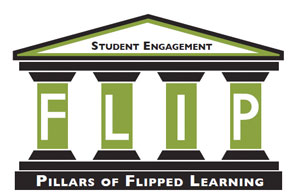
The Four Pillars of F-L-I-P as given by the Flipped Learning Network are:
F – Flexible Environment
A work environment where the faculty and the students both get the flexibility of space and medium to interact and learn from each other
L – Learning Culture
Moving away from traditional teaching methods, it enhances students to learn without teacher and a culture of selflearning is fostered among the students
I – Intentional Content
Faculties can make the content keeping in mind the level of the students and set the structure and direction of the content accordingly
P – Professional Educator
It gives an opportunity to faculty for transforming themselves into professional educators, who not only teach a subject, but also improve its instructional method, heartily accepts the criticism, be reflective in their practice and thrive for excellence in their area and subject matter of interest
While we are discussing a lot on implementing and culture creation of flipped learning, it is also necessary to know the views of the students. Talking about the perception of students, in 2013, Speak Up online surveys, done by the national education, Project Tomorrow in support with the Flipped Learning Network in USA, on 180,000 plus middle and high school students, almost three-quarters of these students agree that flipped learning would be a good way for them to learn, with 32 per cent of those students strongly agreeing with that idea. In the same survey done amongst district administrators of the education system, 25 per cent recognised flipped learning as a significant impact making method on transforming teaching and learning in their district.
For researcher in various fields of education system of academia and trainers, there lays ample opportunities to do research for understanding, developing and challenging the flipped classroom method of teaching. Various academic and management journals are looking for such scholarly research works and foster the growth and implementation of the method.
Discussing only the advantages and looking on one side of the subject is a very narrow approach, henceforth, it is necessary to have a glance and know the challenges of flipped classroom system. It has also been observed that for initial phase for most of the faculties, they find it difficult to manage the class, which they are used to keep under their control. Chaos leading to discussion and debate is good for churning the best from a topic, but if it leads in the wrong direction, it can create issues for the actioner. A methodology what we are looking now as an opportunity can also turn into an urgency, if students, stop coming into the classroom for receiving the informational content delivery which they can get easily on their own. It turns into a challenge for faculties to transform how they use their classroom interaction in such a way that it continues to be relevant and valuable for the student community. One also need to understand that self-generated videos or given material are not just a person speaking or delivering the whole as in the length of the lecture. Other problem faced is to integrate the amount of content online and offline mode, and the quantity to be served in both the mediums.
With the challenges, there are advantages and emerging opportunities to explore and execute the flipped classroom technique, with the emphasis laid on skilled India. It can be a useful way to deliver education to millions of students. Way further, it fulfils the dreams of Digital India and the next neo generation is waiting for the educators and academia to adapt their chosen and interesting mediums of learning. On the cross roads, time will be the best judge of the scenario.
Customer Relationship Management (CRM) might have been widespread in the corporate sector; its usage in education sector is gaining strength over the period of time to serve students entire life cycle, Elets News Network (ENN) finds out how CRM helps in improving student admission processes while enhancing personal communication
The shifting focus of the educational institutions towards technology helps to operate and interact with students, alumni and staff members in an innovative way. But, this will be ineffective if the focus on them is lost. It is true that the technology is paramount in every sphere today and to cope with the rising demands, it is essential for the educational institutes to change their style of working.
The institutes are in a financial press and to get through the problems of falling revenues and rising costs, more and more institutions are moving to Customer Relationship Management (CRM) software system. The software tool not only helps in reducing the cost but also increases revenue, identify new opportunities, and channels for expansion, improving customer value, satisfaction and profitability.
“The education sector is witnessing a huge change in the way prospective students are getting to know about them (digital marketing), engaging with them (social media), and converting into paying students (multiple influence points). Many of these students are in their teens or early 20s and hence are some of the earliest adopters of new technology. The dynamic nature of this demographic forces a lot of education companies to rethink how they are reaching out and talking to these students,” informs Shreekala Kurup, COO, Crack Verbal.
While CRM is widespread in corporate sector, its usage has been limited in education sphere. With the rising service expectations, universities have to realign their strategies to serve students across their entire student life cycle. But the usage of CRM will definitely play a wider role as the educational institutions may benefit from CRM by improving student facing processes, personalising communication with students, sharing information among departments, and increasing student retention and satisfaction.
Having been one of the booming technologies for organisations and institutes to decrease cost and increase revenue, this solution also helps in trimming the expenses, quality effectiveness of the recruitment process and stabilising existing relations with students.
Advantages
The use of CRM systems helps the educational institutions attract and withhold correspondingly qualified and prospective students, better relationship with corporate, improve the conversion coefficient and cut down the number of lost opportunities or applicants.
To speed up response processes, many communication elements can be automated. It can shorten the overall length of the enrollment process, reducing recruit attrition. It opens the doors to e-document submission and submission besides assisting in spotting trends which become the feedback for other departments included in the process.
The usage of CRM can help efficiently manage staff, faculty, administrative and student information and later result in significant improvements in employee efficiency, daily working processes and cross-department collaboration.Proper lead tracking and reduction in the errors or duplication of entries into institutes reduce the time of the executive for following up with the similar lead which is admitted from different source and provides further merging if there is any duplicate entry done.
Educational institutes increase their revenue because the lead is properly converted into an account with the help of dormancy module.
CRM allows to have a less length of the sales cycle due to dormancy module every lead is properly nurtured with the lead history on where most of the time is been given converting the lead into an account.
The CRM allows to have a proper allocation of the money in different areas like advertisement for varied courses, road shows etc as the CRM provides you with the graphical view of how much return every medium is providing in terms of expenses incurred.
Customer satisfaction
Customer with higher satisfaction at every stage of the lead is been integrated with predefine SMS and email with different course so when an inquiry is made by the student sms is send to the mobile number which creates confidence in students.
In present times, with the advent of the internet, most education companies have the means to attract the best students from a wider pool. The student of today is enhanced bombarded with tones of information from various sources. “The differentiating factor that the student is looking for is someone who can answer his/her queries promptly, and engage from the get-go in a relevant way. This is where CRM assumes huge significance in this domain. Email sequences and automated campaigns are some of the ways in which CRM is being used in this sector,” explains Kurup.
To help institutions succeed Kurup emphasised on three main functions that should be made operational:
(a) Lead management
(b) Conversion & Engagement
(c) Post-sales Services
To speed up response processes, many communication elements can be automated. It can shorten the overall length of the enrollment process, reducing recruit attrition. It opens the doors to e-document submission and submission besides assisting in spotting trends
Adoption of CRM
At the outset, an institute that is considering moving to a CRM needs to be forward-looking and technology- savvy. Institutes need to understand that for a CRM system to really work, there has to be a way by which everyone in the organisation is empowered to both information as well as ability to make decisions. So, in some sense CRM would require an institution to revisit its own workflows to see what changes need to be made to leverage the full functionality of the CRM. The crucial advantage of CRM comes into play when scaling up an institution – it reduces the manual effort that goes into customer management by a huge factor. So, if an institute foresees a spurt of growth in the near future, it would profit a lot from adopting CRM.
On the contrary, Kurup feels, “Currently, I think there is still some reliance on using non-automated systems such as Google Docs, MS- Excel etc. However, these systems are broken and do not provide a 360-degree engagement of the student. Secondly, many educational institutes do not want to spend too much on technology implementation and training people to using complex systems. The way forward is to use a simple cloud-based CRM system and implement only the basic requirements, before moving into a more complex integration and functionality.”
Emerging CRM processes and technologies will drive the growth of new types of resources and services
The emerging CRM processes and technologies will drive the growth of new types of resources and services. This new functionality is much focused in the student area and precisely in the higher education side. The performance of the technology will have an impact on students, administrative staff and management.
A key to any CRM implementation is to understand that the details will vary from company to company. A suggestion would be to pick up a few key metrics such as student acquisition cost and student service cost, and then measure the success based on the reduction in the costs in those parameters. This way, it will be easy to justify any further investment made on the CRM system.
CRM delivers conceptual and instructional framework for directing institutional activities to attract and retain its various customers. The benefits of implementing CRM are far reaching. Adopting the technology will increase the revenue up to 42 per ent, decrease in cost of sales by 35 percent, decrease in order errors by 80 percent, reduction in length of sales cycle by 25 percent, increase in margin by 2 percent and increase in customer satisfaction rating by 20 percent.
Impact of using CRM
The use of CRM drives the growth of new types of resources and services. The new functionality will be focused in the student area. The student related functionality and performance will have a greater impact on students as well as on the administrative staff and management, the faculty and institution as a whole.
“The education sector is witnessing a huge change in the way prospective students are getting to know about them (digital marketing), engaging with them (social media), and converting into paying students (multiple influence points), says Shreekala Kurup, COO, Crack Verbal”
CRM has a major impact on schools through shifting the focus from product to customer or client. The purpose of CRM for education institutes is to increase the pupil number, to improve pupil outcomes and so on.
A good CRM helps the schools to grow. With the increasing number of satisfied parents, and positive endorsements to prospective parents will lead to adding more numbers to the school. It is also necessary to involve practical strategies for engaging with parents or the wider community.
In an effort to understand how education relationship management tools are supporting students through the entire lifecycle, it is essential to deploy a good system of CRM to report the efficiency achieved by the users. A survey done by American Association of Collegiate Registrars and Admission Officers shows that 80 per cent of respondents reported seeing increased efficiency with the use of CRM, including efficiencies in advising, alumni development, registration and student support service.
The report also finds that CRM has a significant influence on changes in practice and staffing. 82 percent of respondents have indicated that there had been changes in practice according to the survey done by American Association of Collegiate Registrars and Admission Officers.
The CRM system has little to offer particularly to the technology savvy students of today who want to be more in control of their learning environment. They need higher level of access to information about their performance, and their future. They also demand that technology resources be an integral part of their learning experience. With the virtual access to faculty and students, the old way of interacting with them is untenable.
National Institute of Open Schooling (NIOS) has three million students in India and abroad. Prof Chandra Bhushan Sharma, Chairman, NIOS in an exclusive interview with Seema Gupta of Elets News Network (ENN) talks about the success ratio of the education programmes at the elementary level
Please share the vision of NIOS to provide online study material for all students and flexible examination system to reach out to students of all age groups?
Prof Chandra Bhushan Sharma, Chairman, NIOS
National Institute of Open Schooling (NIOS) is the largest institution, in terms of enrolment. Started as a wing of the Central Board of Secondary Education (CBSE) in 1979, NIOS became an independent organisation in 1989. The NIOS has served more learners in the school sector than any other institution. Today, it has approximately three million students on its roll in India and abroad. NIOS has developed its own Learning Management System (LMS) for providing quality school education online.
LMS has been named as VOS (Virtual Open Schooling). Through the VOS, learners can pursue school–based courses online leading to certification. Learners can study the study material using asynchronous or synchronous mode facilitating interaction with peers and teachers. Currently, NIOS is offering five vocational courses under the VOS, ICT applications and four independent six months modules of rural technology. VOS offers online admissions, online content related to the subjects, online live chat-rooms, discussion forum, blog, online classes through video conferencing, online assignment and assessment, etc. to learners through LMS. After the successful completion of the course, learners appear in on-demand examination (term end) for certification.
NIOS offers number of vocational, life enrichment and community oriented courses besides general and academic courses at secondary and senior secondary level. What is the success ratio of the students passing out from NIOS?
NIOS offers a number of vocational, life enrichment and community oriented courses besides academic courses leading to secondary and senior secondary certificate. During the academic session 2014- 15, 28,734 learners had registered for our vocational courses across India. Female learners exceeded the males, both in registration and pass percentage. Nearly 73 per cent female learners and 64 per cent male learners have successfully completed their courses. Negotiations with agencies in India and abroad are going on to augment vocational education especially of girls between 14-18 years age group.
Please throw light on your Open Basic Education Programme for elementary level courses?
NIOS has launched the Open Basic Education (OBE) programme in 1994 as an alternative educational programme equivalent to elementary education of the formal education system. It is an equivalency programme and provides three tier education under OBE i.e. A level (equivalent to class 3), B level (equivalent to class 5) and C level (equivalent to class 8). In the year 2000, the programme was also operationalised for children between 6 to 14 years age group with the help of accredited agencies (AAs).
The RTE Act, 2009 has made it compulsory for all children between the age of 6 to 14 years to join the formal schooling system. However, NIOS was advised to continue the OBE programme till 31st March 2013 and then again till March 2015.
The country still has significant number of out of school children, which is estimated to be 60.41 lakhs (2.97 per cent). Therefore, considering the proposal of NIOS, the Ministry of Human Resource Development (MHRD) has decided to continue the OBE programme for children between the age group 6-14 years till March 2017 with the objective to mainstream children.
How do you ensure that children learn basic language and numeracy skills?
NIOS offers courses at the secondary and senior secondary levels to its learners. Learners who have attained the minimum age of 14 years can register for the secondary course and 15 years for the senior secondary course. It is presumed that by this age, these learners will have already established their numeracy and language skills through their interaction at school and society at large. The learners who register for the Open Basic Education (OBE) programme have to complete six years of age at the time of registration or are adults who have already acquired functional literacy skills. There are accredited agencies authorized by NIOS to conduct classes for these learners to ensure that adequate language and numeracy skills are developed in them.
What is the student assessment system maintained by NIOS?
The Assessment of learners in NIOS is done through public examination as well as ‘On Demand Examination’. Transfer of Credits (TOC) is allowed in two subjects for the drop out learners from other recognized boards/councils. The teaching and learning activity is conducted through 30 Personal Contact Programmes (PCP) in theory and 05 PCP in practical components at the accredited institutes, study center allotted to the learners during the first year of the registration. The internal assessment is conducted at the study center through tutor marked assignments (TMA) during the course of PCP and 20 per cent of the weight-age is allotted for TMA.
Assessment in practical components is judged through external examination conducted at the relevant study centre and theory examination is done through public examination conducted twice a year or through on demand examination conducted round the year. The learner gets an opportunity to appear in nine public examinations and as many as on demand examinations during the validity of registration i.e. within five years. Fair evaluation is ensured by allotting random code to each learner appearing in the assessment. The marks of assessment conducted are recorded on an OMR award sheet in duplicate. The result of the assessment is declared within 30 days from the last date of the examination and the same is made available on NIOS website.
The Assessment of learners in NIOS is done through public examination as well as ‘On Demand Examination’. Transfer of Credits (TOC) is allowed in two subjects for the drop out learners from other recognised boards/councils
There is also a facility of accumulation of result and transfer the same into the next examination result till the learner is eligible for certification.
NIOS has also entered into many collaborative projects with NGOs and private organisations for the development of vocational courses. Kindly throw light on them? What are the subjects you are focusing through vocational streams?
NIOS has partnered with a number of professional bodies like:-
Indian Tourism Development Corporation (ITDC): The major objective of collaboration with ITDC is to provide the learners knowledge and exposure of the hotel industry. The courses are diploma in food production and management, diploma in food beverage operations, diploma in housekeeping and maintenance, diploma in front office operations, diploma in bakery and confectionary. These courses are of one year duration.
Indian Medical Association (IMA)- The IMA has helped us in designing diploma in medical imaging technology and diploma in medical laboratory technology. The duration of these two courses is 2 years.
Construction Industry Development Council– The CIDC assisted in designing construction related courses. The course on Construction Supervision (Civil) is offered through the network of CIDC. The duration of this course is 6 months.
CISCO – The online course “IT Essentials: PC Hardware and Software” developed by CISCO is being offered by NIOS. The duration of the course is 6 months and entry qualification is 10th pass.
National Informatics Center (NIC)– NIC and NIOS have taken up jointly the development of two courses viz certificate in web designing and diploma in web designing and development with specific emphasis on guidelines for Indian Government Website (GIGW).
The NIOS has plans to provide all our study material as MOOC and also provide the facility to appear for examination whenever, wherever. If our proposal is accepted, we would like to start a new stream of +2 Vocational. Learners desirous of obtaining a +2 certificate in vocational stream should be allowed to obtain it without being forced to study tradition ‘Content’ leased subjects.
The Software Define Network (SDN) Fx technology and engagement development platforms are elements that put together to make Internet of Things (IoT) relevant for education sector. With the prime need to bring innovations in the education sector, Satish Murthy, Senior Director and Bangalore Site Leader at Avaya India talks to Bhawna Satsangi of Elets News Network (ENN) about the need to upscale skills among students
Satish Murthy, Senior Director and Bangalore Site Leader at Avaya India
What are the smart solutions Avaya offers for smart education?
Avaya’s focus has been to create platforms that make it really easy for any vertical to operate. We have education solutions that are very simple. We need our educators to focus on education and not on technology elements. We need them to focus on creating content, focus on better ways to communicate to students as more and more best practices exists world over so we need to be able to use those things as India is moving towards an innovation based economy, students are expected to move beyond learning and develop critical thinking.
The demand for teachers and educational institutions is so high that it will take some time for every teacher and educational institute to reach the level of maturity that we expect from students in our country.
How do you make sure that best practices that are available are easily used by teachers in different school environments?
For that we have put on creating infrastructure that is extremely resilient, and secure. That is the foundation based on which we have build SDN Fx technology, engagement development platforms. These are sort of elements if we put it all together with self search like Internet of Things (IoT) it is possible to create highly useful solutions for the education sector.
We have worked with our partners to create a solution where inside a classroom it aids the teacher, basically speeding up the process of day to today class attendance, allow teachers to share content with the students and can do a quick test with them to make sure students have understood the content. We have focused a lot on simplicity. For example, what if a student decides to access content that is prohibited by the school and what if somebody hack from outside, that’s a security breach. These become an issue only after they become public.
The reputation gets tarnished. So creating a system, which gives that confidence to school administrator just because they are not deep into technology that doesn’t mean that the technology elements in the school can misused for anything. We are working with our partners to make sure that solutions are created that educational institutions can use it with confidence.
What is the framework you have developed for delivering these solutions?
We are talking about foundational technologies like networking, communication technologies. The technologies that we have developed on networking is called fabric and SDN Fx effect. Typically when you have a network which is basically cabling, internet cabling, wireless networking they are connected to common data centers inside of schools. It takes a lot of time to trouble shoot these things, to set up these things. Even a minor glitch will hamper the hours of productive time. What we have done from the infrastructure perspective is to make these things resilient and simple. From an educational perspective, we put element that we bring in with education specific component that they bring in and put it together as a solution that can be deployed at customer location.
How much potential does Avaya sees in education sector?
Avaya is a leader in education vertical in US and it’s an area where Avaya has a pedigree and a long history of success.
What are the opportunities does Avaya sees while deploying smart solutions for smart education?
The prime need for innovation based economy such as ours is to upscale our skills. Some of the government initiatives like Skill India, there’s more demand than supply. There’s huge number of people who needs to be trained into newer technology.
What is the rate of adoption of your solutions in education sector?
Some of the large institutions and government educational institutions have deployed our product.
What are the features of the smart campus?
Principally, any smart campus needs to have mechanism for educating students in a better way that enhances their basic capabilities. So moving away from bored, rigid classroom to an environment which supports globalisation, which is critical thinking. Any smart campus must really provide mechanism for innovative ways for education to happen.
The second area is increasingly the type of students who attend particular institution needs to be addressed in more student specific ways. For example, students with special needs who need specific type of education or children who have different aptitude, institutes have to create mechanism where education is targeted to students that would be an example of a smart campus.
Currently our focus is to make Internet of- Things as an area which in the next 5-10 years and beyond will play a significant role in our life
We live in a hyper connected world, so school security has become paramount. Schools in terms of real estate cost, manpower cost everything is going up. Improving efficiency, removing redundancy in terms of energy, one of the key reasons where smart campuses can make a big difference. Smart campuses would leverage smart devices that we already have.
Students are expected to move beyond learning and develop critical thinking
How will smart schools play an important role in improving the performance of the students?
Significantly it will play an important role. I think every student has a specific requirement and we typically treat group of students, which really not helps in targeting that particular student to upskill herself. In a smart campus, a benefit to the student is to get tailored information. The entire best practices from institutions can be used to educate the students.
How Avaya is supporting the Make in India initiative in developing the solution?
Avaya India has R&D centres in Bangalore, Pune and Hyderabad. India centres are most important locations for innovations happening for Avaya. Some areas like SDN Fx effect technology has happened in Bangalore offices. Lot of work has been done from Bangalore and Pune. From make in India perspective we are shifting gears towards the country.
What are your future plans?
Currently our focus is to make internet of things as an area which in the next 5-10 years and beyond will play a significant role in our life. That’s the area of innovation on which we are working on. Other areas we are working on creating technologies that make it irrelevant where you are sitting in terms of location. Even if you have campus spread across multiple locations, or to rural areas, creating more mechanism for certification and resilience that’s what we are focusing right now.
The launch of Digital India initiative will lead India in making a true knowledge economy that can alter the face of education in a country which has long suffered due to the digital divide. Aditya Malik, CEO & MD, Talentedge talks with Elets News Network (ENN) about the digital empowerment to succeed academically and professionally
Aditya Malik, CEO & MD, Talentedge
I dream of a Digital India, where access to information knows no barrier.” These are the now famous words of Prime Minister Narendra Modi that underscore his commitment to creating a digitally connected nation where information technology empowers all citizens in areas as diverse as education, health, employment, taxation, etc. He launched his ambitious project ‘Digital India’ amidst much fanfare and media buzz and for good reason. The vision and goals charted out as part of the initiative can go a long way in making India a true knowledge economy and can alter the face of education in a country which has long suffered due to the digital divide.
Digital divide refers to the gap that exists, in a country like ours, between those who have ready access to information and communication technology and those for whom digital knowledge is still a distant dream. In India,the digital divide exists due to a variety of factors such as poor computer skills, abysmally low literacy levels, inadequate funds, lack of political will so far, unavailability of the internet in many corners of the country etc. However, in the last few years digital inclusion has been deemed not just as a minor social issue but as one of the primary economic concerns for the country. In a highly competitive global market, digital empowerment has become a pre-requisite to succeed academically and professionally for our large and youth-dominated population.
Faster communication facilities such as National Optical Fibre Network and wider adoption of internet enabled devices are likely to spur a string of highly positive changes in the education sector of India. The Digital India Initiative holds the power to make education modern and accessible to all. Increased broadband connectivity can truly lead to higher penetration of e-learning, successfully shattering the barriers of geographical distance and economic disadvantage in access to education. If the ambitious plan of Digital India is actually translated into reality, the education landspace can really be revved up and a greater percentage of our population can be given quality and productive training, equipping them to contribute to the GDP in a significant manner. In fact, according to a McKinsey report, the incremental impact of Digital India on the GDP is likely to be in the range of 25 to 30 per cent by 2025.
Digital India Initiative will certainly revitalise the Indian education system, propelling K-12, higher education, vocational and skill building in the right direction. Since 2004, government has invested significant funds to build solid educational infrastructure. However, such programmes were often not successful due to lack of, or sometimes the complete absence of, technological interventions. Digital India is an opportunity for us, as a nation, to revisit and improve the student learning experience, build teacher capacity and provide better educational governance.
Some of the key provisions of the Digital India Initiative that are likely to boost the education sector include the national scholarships portal, the e-education programme, Bharat Net and the Digital Locker System. With the national scholarships portal coming in to being, it will be simpler for the students across geographies to apply for national level scholarships and also track their scholarship amount status. This system will not just ensure a seamless and transparent process, but will also give students ready information about the scholarships on one singular platform. At present, many students are completely oblivious to the kind of educational aid they are eligible for, especially in cases where they aren’t connected to specialized career counselling services or information. Also, through this facility the scholarship amount will be credited directly into the student’s account with a status update on mobile at every step of the disbursement, delivering a higher level of ease.
The e-education programme aims at making technologically advanced education available across the latitude and longitude of the country. Several remote areas in the country currently suffer from the lack of good quality educational infrastructure. This highly acknowledged pain point can finally be addressed with digital learning initiatives and will receive a further impetus through mobile learning. Education can be imparted even in areas where it isn’t possible to have good teachers via e-learning programmes and content. Bharat Net on the other hand is likely to serve as the infrastructural backbone for the endeavor of delivering digital learning services to rural India. The government targets, providing broadband connectivity to a quarter of a million rural villages by 2019 and making Wi-Fi hotspots available in schools. This will enhance the reach of the e-education programme and help in the development of superlative content by experienced professionals and faculty available to those who need it most. Through virtual classrooms and interactive e-learning sessions, spreading education can become hassle-free for administrators and far more enjoyable for students.
Several remote areas in the country currently suffer from the lack of good quality educational infrastructure. This highly acknowledged pain point can finally be addressed with digital learning initiatives and will receive a further impetus through mobile learning
With unwavering political will and industry participation, Digital India can truly revolutionize the education space in India. For years, our country has been the IT hub of the world. It has produced the world’s best talent in the space of information technology yet somehow it hasn’t managed to leverage this expertise to solve many of its own problems. However, with the advent of the Digital India campaign, the transformation of the Indian education space and every other key sector is now likely to be accelerated. Talentedge with the aim to inspire ‘Now you can’ vision for the learners is extremely excited to be part of this digital revolution era that will change the way India learns forever.
Traditional classroom teaching model has slowly metamorphosed into digital education learning platform, which is self-driven, ‘eduprenuerial’ and fast! – making India one of the biggest education markets in the world believes Sameer Buti, Director, Classteacher Learning Systems
Sameer Buti, Director, Classteacher Learning Systems
Access to information ‘anytime, anywhere’ is becoming the defining mantra for educational digital learning solution providers in India. Traditional classroom teaching model has slowly metamorphosed into digital education learning platform, which is self-driven, ‘eduprenuerial’ and fast – making India one of the biggest education markets in the world. Pupils well-versed with the likes of PlayStations and iPads, via digital learning, are making smart classroom environment more inclusive, participatory and transforming the education system into an IT-enabled education system. However, resistance to change along with certain infrastructure challenges is hindering the growth of this market. But with digital undercurrents via Narendra Modi’s digital India dream, India’s online education market is poised to grow to a $40 billion market by 2017.
Online learning or Live Virtual Classrooms (LVC) have opened new career avenues for young professionals who are driven to imbibe new skills – at the luxury and comfort of their own pace and time. With the evolution of technologies such as the Cloud, Data Centers and Virtualisation, the digital education ecosystem that we forsee is not a distant reality. There is a growing affinity by Indian youth for new technologies and products such as tablets, notebooks, LMS and IWB, educational institutes,and schools as there is a huge potential for technology to be integrated into education industry. Trickling down to the K12 segment, number of rural schools and teachers are embracing the ‘selflearning’ teaching models, serving as a significant communication bridge between students and teachers.
On the corporate front, with a vision to make education more contextualised, relevant, edgy, and agile, there are quite a few companies that have carved their business imperatives on one common theme: to make education reachable, offline and online, affordable, and relevant for today’s quick-witted students. No- table companies like Intel, Qualcomm, Datawind, Samsung, Tata are looking to leverage on digital India’s initiatives.
For creating 5 million digitally literate Indians by December 2015, Intel has created activity charts to make learning more relevant to rural areas and to provide app-based learning, which will serve as a blueprint for other corporates to follow-through on the digital learning initiatives – both on government and corporate level.
Today, teachers are not just giving lectures, they are facilitating an e-learning culture via embracing new age digital media technologies serving the education industry. The scope of instant interactivity – given that students are ‘mobility-driven’ and want information fast at the press of the button – is generating demand of tablets and offline pen drives, which serves meticulously as a repository of online course (chapterwise), for entrepreneurs to come up with their ‘brainchild’ of learning systems to best serve the effervescent and fastgrowing education industry in India.
The digital platforms, by a huge margin, strategically deal with the less innovative pedagogy styles and lack of teachers for specialised subjects – giving students the best e-learning experience and seeding an element of independency in their learning style.






 Art2Game (Game Maker)