Home Blog Page 830

Stephen’s interview policy questioned

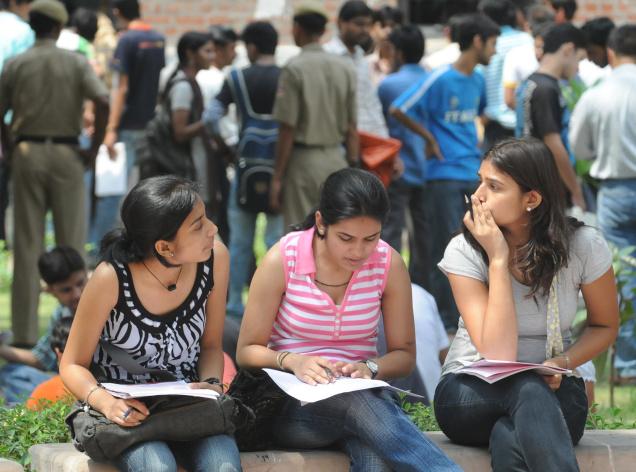
St.stephen After being in the news for a 99 per cent cutoff for English, now St. Stephen’s policy of interviewing just four candidates per seat is being questioned by teachers.

The teachers argue that like for the rest of Delhi University (DU), nearly all St Stephen’s candidates apply for more than one subject. A science stream student is likely to apply for all the sciences and an arts student for the arts and social sciences. And with every interview, they say the number of candidates appearing for the next one, shrinks.

An open letter has been written by Stephen’s principal, Valson Thampu to students who have not made it to the interview. It states: “I, too, dreamt of studying in St. Stephen’s. I, too, failed to qualify for the interview,” he writes. “In my case, the issue was not cutoff; it was my Kerala background. There was an assumption in those days that students from my state could not measure up to the standard of St Stephen’s. But life did not end there for me. I decided to prove myself. Got enrolled in a junior college in Kerala. Studied like one possessed, topped the university and joined St Stephen’s as a graduate student. Excelled enough to be invited to join the faculty. The rest is history.” He says he hopes the candidates who didn’t make it “feel challenged and energized” as “excellence results from lifelong pursuit”.

It may be mentioned that recently, a resolution was passed by St Stephen’s College’s Supreme Council stating that its alumni have not right to interfere in its internal matters. This comes in the backdrop where a group of former students, Association of Old Stephanians, have alleged “rampant illegalities” in the functioning of the college.

The college’s Supreme Council, which is the decision making body of the institution, resolved that certain alumni are resorting to “false propaganda” and the college shall not be forced to deviate from “its time-tested traditions, conventions and convictions, nor forego its Constitutional rights, through any tactic or strategy based on it.”

Universities can customize syllabi for CBCS: UGC

UGC

 In a new development to the implemention of the proposed Choice Based Credit System (CBCS) from the 2015-16 academic session, the University Grants Commission (UGC) announced that universities can customise the model syllabi by 30 percentage depending upon their areas of specialisation. This move has given more space to the universities in introducing the system.

UGC previously uploaded the model syllabi stating that 20 percentage leverage for modification is allowed, but its proposal for CBCS has been facing major opposition. Various teachers’ groups, including Delhi University Teachers’ Association and students’ groups are protesting the move. Even the right-wing National Democratic Teachers’ Front from DU has been questioning the feasibility of implementing the system. On the other hand there are many state universities who have updated the ministry of human resource development about their preparedness.

It may be mentioned that the Indian government recently made the Choice-based Credit System (CBCS) mandatory for all 400 public universities at the undergraduate and postgraduate level beginning in the academic year 2015-2016. At present, Presently, DU’s Executive Council has approved the implementation of the CBCS from the upcoming session, ending confusion among candidates seeking admission to the undergraduate programmes, but things are not as simple. Major opposition still stands tall, severely criticising DU for this. Sources have informed Elets Technomedia that the council comprised 17 people, of which five were not in favour of CBCS being introduced.

CBSE wants 3 months for AIPMT re-test

pre medical tests The Supreme Court (SC) has been old by CBSE that it is not possible to re-conduct All India Pre-Medical and Pre-Dental Entrance Test (AIPMT) within a month as directed by the apex court. It has sought three months time to hold the test. Over 630,000 students will have to take the All-India Pre-Medical Test afresh.

The SC cancelled this year’s AIPMT after finding out about tech-savvy students who cheated in the examination by getting answers to questions through electronic devices they smuggled into test centres across the country.

It may be mentioned that an estimated six lakh students had appeared for the examination at 1,050 centres. After it was confirmed that a section of students had smuggled electronic devices into exam centres across the country to get answers, the Supreme Court (SC) cancelled the entrance test and asked the CBSE to hold a fresh examination within four weeks. The SC has taken serious note of a confidential report submitted by the Rohtak superintendent of police in its verdict.

The links of the scam regarding cases of cheating in the AIPMT Test have been found in Nagpur, Nashik and Gondia. Recently, the country’s apex court scrapped the All India Pre-Medical and Pre-Dental Entrance Test following the cases of cheating.

IISc Bangalore first choice for Delhi topper of IIT JEE Advanced

Anjishnu Bose Anjishnu Bose, the boy who’s likely ranked the highest in IIT JEE Advanced in Delhi, wants to study Bsc at Indian Institue of Science (IISC) Bangalore. Surprisingly, with a score of 398, the Indian Institutes of Technology are not even the first option.

In his class 12 boards, Bose had secured 97.4 per cent. His All India Rank (AIR) is 26.  he’s also has a Government of India scholarship for pure science students that’ll see him through to research — and all-India rank of 26 to Indian Institute of Science, Bangalore. Bose wants to be a full-fledged scientist.

In the past few years, there are many JEE toppers who have made unusual choices. Abhinav Kumar (from Jamshedpur), didn’t join IIT and completed his BS from MIT in EECS, mathematics and physics from MIT in 2002 and did his Ph. D  from Harvard. It might be easy to leave IIT to go to MIT, but Ayush Sengupta,left IIT to study mathematics at Indian Statistical Institute, Bangalore. He is currently an Assistant Professor at Princeton University.

Prashant Bhushan, who became famous during his struggle days with Anna Hazare  and Arvind Kejriwal,  quit IITM in the first semester to study economics then philosophy and finally law.

Outreach Programme to mobilise 400mn youth for skills training

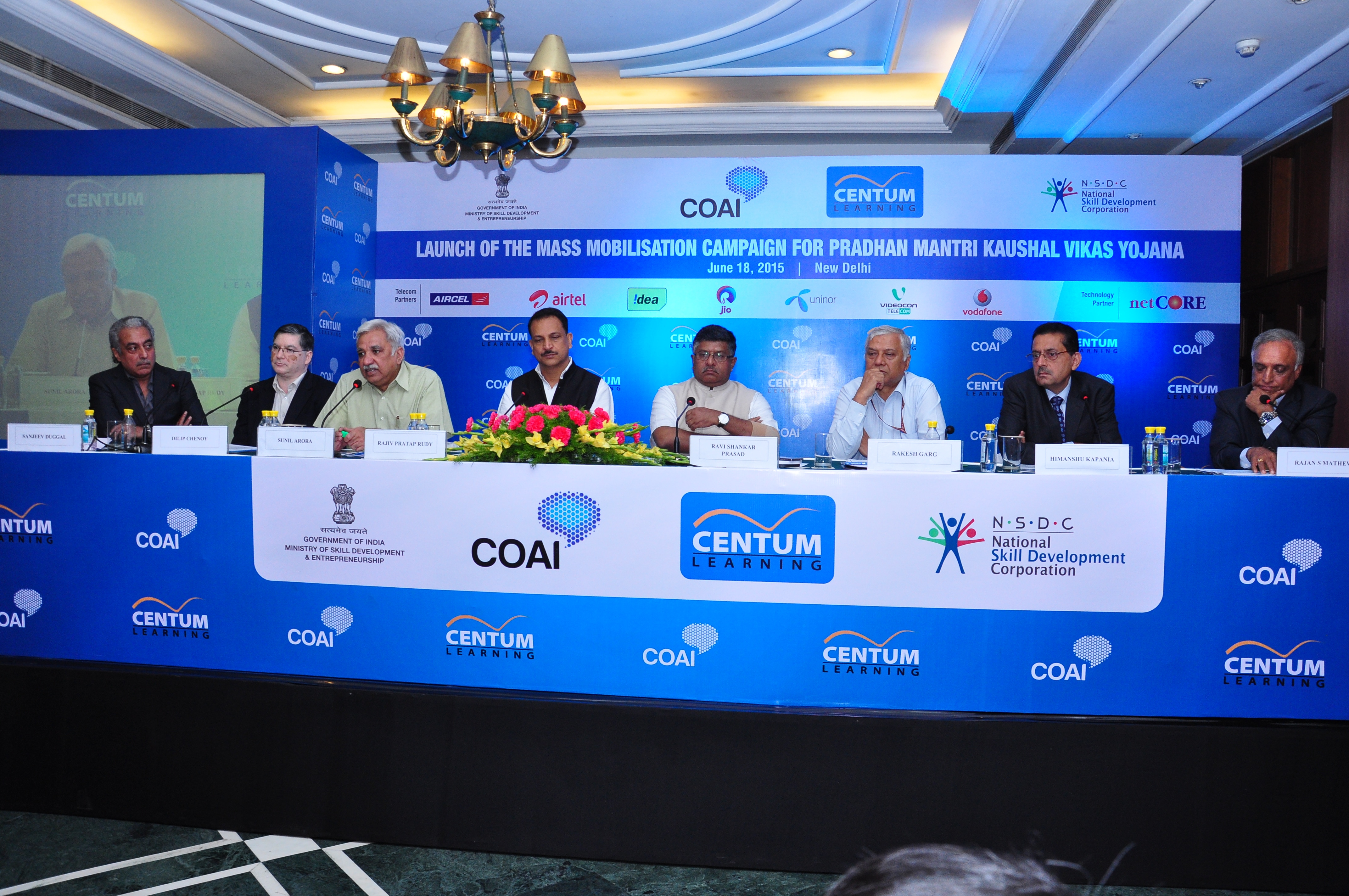
LtoR_Sanjeev Duggal_Dilip Chenoy_Sunil Arora _Rajeev Pratap Rudy, Ravi Shankar Prasad_Rakesh Garg_Himanshu Kaplani_Rajan MathewsTo mobilise under privileged youth for skills training, COAI and Centum Learning has launched the a massive outreach programme. The initiative would help implement Pradhan Mantri Kaushal Vikas Yojana (PMKVY), a flagship outcome based skill development scheme under the Ministry of Skill Development and Entrepreneurship, which plans to skill over 2.4 million people across the country.

One of the biggest hurdles facing skills training is reaching out, educating and motivating youth in the remote areas of the country. COAI and Centum Learning’s outreach programme aims to address this challenge. Initially, the pilot project in Bihar would cover a subscriber base of over 1.5 crore people. Following this implementation, it will be rolled out nationwide by COAI member telcos to cover nearly 400 million subscribers after the formal launch of the scheme in July.

Telecom providers would send text and voice-based awareness messages to the target audience. Interested youth can give a missed call to a toll-free number 1800 102 6000 and an interactive voice response pushed to the candidate would capture relevant details on an online application. Data analysis would then be done with callers being profiled on the basis of their age and location. Finally, interested candidates would be mapped to their nearest enrolment centres.

Rajan S. Mathews, Director General, COAI, shared, “The demographic dividend of India indicates that almost 57 per cent of the country’s population is aged below 30 years, and almost 75 per cent of that population is unskilled. Since early in the 11th Five Year Plan, the National Policy on Skill Development has set a target of 500 million people to be skilled by 2022. With such ambitious targets, the challenge of reaching out to the millions of people for mobilising them to learn professional skill sets needs to be overcome. The Indian mobile telephony industry, which has grown phenomenally to become the 2nd largest market in the world with over 970 million connections, is perfectly situated to help enable this massive outreach programme, to reach out and contact the unskilled workforce to seek skill training under the Pradhan MantriKaushalVikasYojana. We look forward optimistically towards a grand success of this campaign.”

Sanjeev Duggal, CEO and Director, Centum Learning said, “Skilling today has rightly been recognized as an agent of Social Transformation for a country like India. We are delighted that Centum’s brainchild for mass mobilization elicited such enthusiastic response from Mr. Sunil Bharti Mittal, Chairman, Bharti Enterprises that he helped muster active and spontaneous support from all COAI members. I also believe skilling in India is akin to evangelizing and needed a disruption in the existing ecosystem to reach even ‘media-dark’ states in the country, where TV & print reach only 20 per cent of the population. I am certain such collaboration will aggressively advance the National skills movement.”

BTER extends the date of admissions

students collegeThe Board of Technical Education Rajasthan (BTER) has extended the date of admissions in Rajasthan Technical University and its affiliated colleges. The date is extended till June 30. The authorities extended that dates as there were less applications filed against 65,000 seats in 154 engineering colleges.

Earlier the admission was to close on June 10. According to the sources 30 colleges seats are still vacant and other 30 colleges have less than 30 students. This has prompted the university to extend the date of admission.

Major opposition in the way of Delhi’s Education Bill

AAP Showcased as an initiative to end the donation culture in Delhi schools, the state government’s draft of the proposed Delhi School Education Acts and Rules (DSEAR) 1973, has not been appreciated. In fact, schools, parents and activists are all opposing it.

The draft amendment bill covering fee hikes in private unaided schools proposes to set up a committee that will hear complaints related to fee hike. The government has said it plans to amend three sections – section 17, 24 and 27 of the act – to bring in “fee rationalisation” within the “ambit of the common man.”

Through amendments to section 17, a committee formed by the government can act on complaints against fee hike by a particular school. Under the section, the director will also have the powers to regulate fees charged by private schools and issue binding guidelines.

Section 24 of the act gives the government the power to impose various fines and punishments on schools found guilty of engaging in illegal activities. Insertion of Section 27(a) will make schools liable for an imprisonment of three to seven years, along with fine of Rs 1 to 5 lakh for contravention of the act. By adding rule 145 to the Delhi school education rules, the director will regulate admissions to classes, including entry-level classes, in private schools.

June 22, 2015 has been extended as the last date for submitting suggestions regarding the legislation.

Schools are busy preparing their objections with the proposed bill. It may be mentioned that school bodies are opposing the draft on account of the proposed legislation “destroying autonomy of private schools”, parents and activists have expressed reservation over the efficacy of the bill in curbing the rampant donation culture. Activists are also calling the bill eyewash.

More girls qualify JEE exam this year

JEE2015This year, Krati Tiwari from Indore with All India Rank (AIR) 47, is the topper among the girls who passed the JEE (Main). 2015 has seen a marginal increase in the number of girls qualifying the exam from the previous year’s 3,009. OBC topper Majji Sandeep Kumar from Vizianagaram also got an AIR of 10. Chinmaya Sahoo from Pune is the topper in the OBC and disabled category.

The IIT-Madras zone has bagged five of the top 10 merit ranks in the country. The region, which had 50 of the Top 100 rank-holders last year, saw only 28 students fall in the top list this year. The Delhi region, which had the maximum succeeding candidates last year, saw a drop in the numbers—from 6,528 to 4,511—this year.

The topper in the IIT-Bombay zone is Bharat Khandelwal, with an AIR 5. Khandelwal (17), from Delhi Public School, Ahmedabad, managed a score of 440 in the test. Based on students’ performance, the IITs brought down the cut-off from 177 (35 per cent) to 124 or 24.5 per cent of 504. Similarly, cut-offs for each subject have been revised to 7 per cent this year from 10 per cent in the previous year. The highest score, 469/504 (93.05 per cent) secured by Jagwani, despite the difficulty level of the paper, was higher than last year’s 334/360 (92.77 per cent) scored by Chitraang Murdia. Of the 26,456 candidates who have qualified, 21,156 students made it to the common merit list.
It may be mentioned that nearly 1.5 lakh students had written the exams conducted on May 24, 2015. The exams were entrance test for students seeking admission for B.E./B.Tech courses.

In 2015, Paper 1 had 262 questions and while Paper 2 had 240. Students had issues with the excessive negative marking after the exams. Under the revised pattern two negative points are given for wrong answers.

Boards should work on their marking indicators: St Stephen’s

delhi-university After it announced a staggering cut-off at 99 per cent for admissions this year, Delhi University’s (DU) St Stephen’s college has said that the boards should work on their marking indicators to make scores more ‘realistic’. The college says that it decides the cut-offs after evaluating three parameters- board marks, student-seat ratio and number of applications received.

The college received 6,000 applications for English Honours which has just 30 seats. Commerce students wishing to study English at St Stephen’s College must have a score of 99 per cent, one percentage point more than applicants last year. This year, there is no cut off below 96 per cent in the best-of-four (BO4) aggregate.

It may be mentioned that St Stephen’s has received a record 32,100 applications for 400 seats, highest in the college’s history.

Meanwhile, the centralised fitness trials for admission to Delhi University’s undergraduate courses through sports quota will begin tomorrow, with the varsity taking strict measures to avoid any “bias” and “ensure transparency” in the selection procedure.

Soon, ‘Digital India’ for education by govt

ebasta Come July, the Narendra Modi government is planning to launch under ‘Digital India’ a number of ambitious projects like eBasta on which all NCERT text books as well as some State Boards’ textbooks will be available online for downloading from an app free of cost. Another initiative for Aadhaar card holders will be digital locker—DigiLocker—facility which will enable Indians to secure their certificates and access them online at the click of a button. Filling up online forms using the e-sign facility and the DigiLocker will ensure elimination of usage of fake documents.

A media report states that these are the pet projects of Prime Minister Narendra Modi and his office has been personally monitoring the preparation and implementation of the projects.

Recently, Union HRD Minister Smriti Irani had said that students across the country will no longer struggle  to get a copy of a lost college certificate, and digitisation of every certificate of every university in India would help resolve problems faced by many students grappling with loss of paper certificates.

LATEST NEWS