In case of default of education loan repayment, central government is planning to create 1000 crore credit guarantee fund that banks can draw in case of defaults. The move will encourage the banks to lend loan to students. The proposal of giving funds to banks came after the government asked banks to give education loans to the students. The government believes that no child should miss out on an opportunity to pursue studies due to lack of financial resources. According to the RBI data, the banks outstanding totaled Rs.63500 crore till February 20, 2015. The Finance Ministry has also proposed to give loan for skill development courses and extension of the education loan tenure which is 5-7 years at present. The Indian Bank Association has listed 1100 accredited education institutes for banks to extend education loans. The list does not include skill development training institutions.
There are 1.4 million schools in India, around 25% of which are private schools. That is a huge market waiting to be explored, says Seliha Muvva, Director, Edukul India, which provides an interactive app and platform for the schools
Give us a brief of the various reasons behind starting the Edukul India.
Rearing two kids, I came to realise the huge communication gap between the teachers and the parents. The parents are unaware of whatever is happening in the school. At the same time, the teachers are completely exhausted. The schedule in the school is punishing. Reining in 30 children in a class is not a joke! Even kids, not to speak of others, have not got any secure platform to learn, connect and enjoy at the same time.
What are the various difficulties and hurdles in doing business on the ground level?
The schools are our customers. These institutions are like forts where the principal is the king. Getting across to meet them is the toughest job.
What is the market size of the services offered by you in India at present?
There are 1.4 million schools in India, around 25 per cent of which are private schools. That is a huge market waiting to be explored. We are targeting not only the desktop but, also the smart phone users.
What is the major benefit for organisations and individuals adopting your solutions?
It takes the teaching and learning experience to higher level. The teachers can individually connect with every student. For the teachers, it reduces the work load by simplifying the everyday tasks and even delegates some tasks to the parents. We are also the mobile first platform in education which will make the SMS packages obsolete for the schools.
What is the vision of your company for next two year?
Getting every teacher in India to use the Edukul app, designed only for a teacher, is my avowed objective. It will be launched in May.
What are the various methods you are using to increase the visibility of your organisation?
Although a few-months-old start up, we have successfully got the product tested in two schools. Now, we will work on increasing our visibility through digital marketing and print media.
How do you differentiate your services from your competitors?
We are the only ones in the market to provide an interactive app and platform for the schools.
How do you engage the customers? Can you cite any special case study?
We interact with the teachers and the students in the schools every week. A 10-year-old boy once came up to me during an interaction and told, “It is too slow. Fix it up faster as we get so much of work to do on Edukul”. It helped us move quickly and revamp the site.
What are the major stakeholders and sectors you are focussing on?
We are focussing on the education sector and reaching out to our stakeholders – parents, teachers and students through the schools.
What are the various initiatives taken by your organisation to emerge as a market leader?
Although we can’t disclose them as of now, yet we will certainly share the initiatives once we have emerged as the market leader in the education sector.
Private Schools, affiliated CBSE and ICSE schools in Noida has been directed by Noida District Magistrate NP Singh to follow Right to Education Act and admit poor students to school. He has asked the school authority to ensure fee fixation and get the approval from fee fixation committee as per the rules in RTE. He emphasised on the complaints raised by the parents on unjust fee hike by private schools. He has also directed the schools to get approval of the fitness certificate of school buses from the transport department. The DM has also laid stress on giving admission to the children of farmers and authority employees. There is a 10 percent reservation for them. Schools were also asked to CCTV cameras for security and take measures for women and female students’ safety. Private has been asked to adopt villages and provide free education to deserving students.
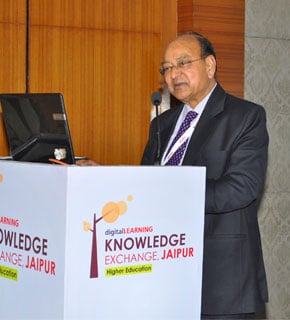
Indian education system, one of its kind in the world, is in dire need of reinvention in order to keep pace with the world and to equip the Indian students with enough skills to compete at the global level. Some of the best minds in the country came under one roof at the digitalLEARNING Knowledge Exchange in Jaipur to deliberate over how to teach NextGen.
here is a need to understand and reflect upon what is needed to build a world-class education system. A serious concern for the higher education policy makers and the educationists is the need to maintain high academic standards. Today, technology and globalization have increased the accessibility to higher education, and some of the best educationists and technocrats across the country came together at the Knowledge Exchange platform provided by Elets Technomedia in Jaipur to discuss how teaching with technology is not only about staying updated on the latest tools, but also about knowing how to successfully incorporate the best tools into your teaching when and where it makes sense, and take education to the next level.
For this purpose, they held sessions over a variety of topics changing the educational landscape of our country.
Technology enhanced learning – What can we learn from MOOCs?
In recent years, the concept of online or distance learning has extended to include a growing number of Massive Online Open Courses (MOOCs), free higher education courses open for enrollment for an internet user. The MOOCs are a recent trend in distance learning promoted by several prestigious universities. The educationists also discussed over how the MOOCs enhance accessibility, student engagement, and experiences for lifelong learning. Interacting with audience, Dr P Balakrishna Shetty, Vice Chancellor, Sri Siddhartha Academy of Higher Education, Tumkur opined that today’s students are not deprived of technology in any way. They are full of technology instead. “We need to provide our students enough time and incentives to use that technology”, he said and expressed that there is a need to engage students at all levels with techniques like open questions, individual questions, group questions. “We have to involve university students as researchers, give the students freedom and autonomy.”
According to a report ‘Education in India: Securing the demographic dividend,’ published by Grant Thorton, the primary and secondary education, or K-12 sector is expected to
Agreeing with Dr Shetty, Prof Iftikhar Alam, Dean, International Institute for Special Education (IISE), Lucknow also echoed that we have to keep faith in the aptitude of students. “Technology is indispensable but we cannot be slave to it.
MOOCS is here to stay. It is something which we have to use judiciously. Today, the millions can be hooked to same programme worldwide, not just one country. But even with MOOCs we have to go that extra mile to make it interesting. Then it can do wonders for our country. Maybe then reverse brain drain will happen in the interest of India if we make good use of it”, he said.
Dr RN Sharma, Vice Chancellor, IASE University, Churu said that technology should not be merely imparting info, but the aim should be to churn, so that the students can make good use of knowledge and learning gained from it for greater social betterment.
How Indian engineering education system can support “Make in India
Prof KC Singhal, Vice Chancellor, NIMS University, Jaipur said that “the traders and the politicians only spoil the education system. The purpose with which the British had painstakingly put up an education system is far from served. We, therefore, are still producing only supervisors, not innovators and thinkers. That system must change, if the country has to progress. We need to start dissemination of knowledge and building of the society from the day 1.
DD Shukla (Alpha College of Engineering, Ahmedabad), further added that “Before we start with this dream, we need lots of work before beginning to produce results. We need more relaxation for the foreign investments. Only then will we progress. More than anything else, we need to produce entrepreneurs.
New light was thrown on indigenous development by Deepakh Parekh who said that “We should come out of bureaucracy. Why is China market so vibrant and in India we have markets flooding with “Make in India”. Create more entrepreneurs than engineers. Engineering education means training in manufacturing, creating and innovation. We don’t go to industry for feedback to find out what are the lacunae in the industry, which is the main beneficiary of education system, give back to it.”
Need of global tie-ups to improve research based education
Today’s world is a global village. Stressing on this point, Rajan Mahan, Chairman – Board of Studies, Haridev Joshi University of Journalism & Mass, Communication said that “Besides the real world, a cyber world has come up. This global village is both a challenge as well as an opportunity. The human lives have fundamentally changed in every sphere. This comes for higher education at a time when we are facing a transformational change in the sphere. One way is collaboration to face challenge, where the resources and knowledge are shared.
With the view that India is being looked upon as a flourishing market, Dr Sraban Mukherjee, Director, KIET Group of Institutions, Ghaziabad, said, “Education is different and knowledge is different. Research is not carried out in isolation.”
He elaborated as to how we helped the university, the students and the teachers for more research as it should not be education for the sake of a job. “The media often creates hype regarding high packages to the IITs and the IIMs, which are not right for development. If research has to become socially beneficial, why not inter-state collaboration so it can be locally beneficial?”
Dr K Veera Venkataiah, Principal and Director (International Relations, Chaitanya Postgraduate College, Varangal) said that research should be beneficial to the society. Dr DD Shukla, (Principal, Alpha College of Engineering, Ahmedabad) said that no verification is needed if the research is genuine. All one needs to do is pay money to get it published. This brings the credibility of research done in India under question vis-à-vis the foreign universities and the students.
According to a report ‘Education in India: Securing the demographic dividend,’ published by Grant Thorton, the primary and secondary education, or K-12 sector is expected to
Role of technology to make teaching, learning & assessment convenient
Sraban Mukherjee threw light on the fact that today, even school children need smartphones. Today, Facebook and other social networking sites keep the students occupied and focused. The students are all unique with their different learning abilities. These different learning needs can be taken care of by technology. The traditional classrooms could not do that.
Dr Ashok Kumar Jetawat, Director, Aravali Institute of Technical Studies, Udaipur held that what is missing in education is motivation and raised the question as to why digital content is not available in the local languages. He shared the results of experiments, where the use of technology is much preferred and makes a successful study for the students.
Naresh Duble, DGM, Training and FMD, Armstrong explained the importance of acoustics in education. “We will develop on how acoustics really impact and can enhance higher education in the country. In India, this is a new initiative we have started. It is not enough to understand what is taught in a class. We need to absorb, assimilate and reproduce that. The teachers and the students have to connect. It can only happen if you have the correct acoustical environment and architecture. The background noise and reverberation time are the two main aspects as far as acoustics goes. We have a nice instrument which can distinguish sound once it comes back to it after .5 secs. It can help the backbenchers and people with hearing impairment. The results dramatically improve. Acoustical comfort is a new term being added, which comprises intelligence of the sound, privacy, low distraction and concentration. Global standard for background noise is 40 decibel. We need to see where we stand globally as far as reverberation and background noise are concerned.
This view was reverberated by all. Especially when today, we are not talking of classrooms of just 50-60 students, but 100-400. Singapore uses thousand seated auditoriums for the same. We need to make noise about sound. Knowledge transmission otherwise will not happen.
Prof BR Natarajan, Vice Chancellor, Sangam University, Bhilwara, said that one needs to grab opportunities. He talked about Indian mindset of Indians regarding business and how dignity of labour is impacted by it. “Why can’t we use tech in teaching the way we use it in every other sphere of life, right from travel booking, to banking, to even booking for darshan in temples. People thought that the teachers could become redundant if technology were to be used.”
The speakers agreed that use of technology is often the biggest fear of teachers. They should be trained in it and technology should be used to accurately evaluate the students.
Can incubation centres assist to boost employability?
Today, there is a growing importance of incubation centres in the country. HRD Minister Smriti Irani has been stressing on it and urging educational institutes to take them as a stimulus for nation building.
Recently, the incubation centres have become a very important part of education in the country. Prof Dr Virendra Kumar Sharma, Vice Chancellor, Bhagwant University, Ajmer said that employment generation is an important part of employment generation. While incubation centres may not be able to assist in boosting employability, they can certainly boost employment generation. All of us. “In country of billion plus population, we should have billions of entrepreneurs. I remember the time when the textile industry was nationalized and no one questioned that if a person can’t run the enterprise, can the government do it. Every student in educational institutes should be motivated for entrepreneurship. There is a great promise in running incubation centres in campuses.
Prof Satish C Sharma, Chairman, Maharaja College of Engineering, Udaipur said that UN Secretary General Ban Ki Moon says worldwide there growing recognition of need to strengthen policies and investments involving youth. Then let’s support young people. Morgan Stanley says thatby 2015 end, India will be biggest economy in east. 500- 700 CEOs are needed in the next 2 years, 10,000 functional heads, and million jobs across all sectors.”
He said that Abdul Kalam had rightly said that unemployment is not a major problem in India, the problem is unemployability, and it will affect whole world. “There is an incubation fund in the budget (1 cr fund provided through AICTE for incubation centres). In India we are not investing in SME’s where the mass will go, we are only taking care of class. The question is how to include people from all walks of life – rural and urban. Upgradation of ITIs, polytechnics, etc for small jobs is needed. It may be noted that Telangana had introduced the first Dalit incubation centre with a corpus of Rs 5 crore. Prof S S Gokhale, Director, LNM Institute of Information Technology, Jaipur said that incubation is something entirely new, a concept that came into being in 21stcentuary. As an academic institution, as a facilitator of incubation. Most of the incubation centres die down after 5 years. It is about an opportunity and somebody has to do it so you do it.”
Many personality traits required in becoming an entrepreneur. As far as entrepreneurial spirit goes, there has to be constant motivation to start something new after 7 years. An entrepreneur cannot stop or else stagnation will settle. In every state, incubation would be done by 1 or 2 persons only. This can’t be compared to fully grown mature company that we are talking about. The experiments show that use of technology has resulted in better performance of the students.
V Venkaataih said that today the countries are of two kinds. Some use more technology and others use less technology. The Vice Chancellors have to check plagiarism in thesis, research etc and promote genuine work.
Dr Rupesh Vasani, Director, SAL Institute of Technology & Engineering Research, Ahmedabad said, “We don’t have to see technology and traditional learning material differently. They must be used to complement each other.” He shared his experiences of delivering lectures and how well it worked.”
AICTE has given nod to 27 Delhi University colleges for running B.Tech courses. This decision came as a major relief for colleges seeking approval. According to media reports, “It was agreed at a meeting between Delhi University and AICTE officials that AICTE will take a lenient view and examine the case from a fresh perspective. AICTE is likely to conduct a fresh inspection of the colleges and consider it as a special case.” It may be mentioned that in a fresh twist to the stand-off between DU Vice-Chancellor and the Human Resource Development Ministry over the introduction of FYUP, AICTE had last week asked the colleges to submit an affidavit within ‘six hours’ through which they were asked to promise that they would address the shortcomings of faculty and infrastructure within the next six months. The principals found the deadline to be ‘impractical’ and, as a result, only about six colleges are understood to have submitted the same. “After the six-hour deadline passed, DU had approached AICTE explaining the difficulties in adhering to the directive. The varsity was assured that non-submission of the affidavit would not impact the procedure of granting the nod in this case,” as per media reports.
A study conducted by the Sarva Shiksha Abhiyan (SSA), Kerala states that though government and aided schools are losing out to private schools when it comes to Class I admissions, there seems to be a reverse trend as far as admissions to Classes V and VIII are concerned.The report of the study — ‘Shift from Government and Government Aided Schools to Unaided Streams of Schools (Nature and Causes of the Shift)’ — was recently discussed by SSA authorities.
“After analyzing the data, we found that the preference for private schools compared to government and aided schools was marginal. On the contrary, students from the unaided sector were found to be joining government and aided schools in Classes V and VIII,” said SSA project Director E P Mohandas.
The study was conducted to understand people’s perception about government, unaided and private schools and also the multiple factors that directly and indirectly contribute towards the selection of a particular school. Parents of students and teachers from the three categories of schools, education experts and education department officials were interviewed as part of the study. Also, enrolment data from Classes I to VIII in schools in three districts — Thrissur, Kozhikode and Malappuram — was analyzed.
It may be mentioned that the number of students enrolled in government and aided schools in the three districts was not only high but the number increased from Class I to VIII, while in private schools it showed a declining trend.
Also, the study found students shifting from government schools to better government or aided schools. Also, a child, once enrolled in a government school, is seldom shifted to an unaided or unrecognized school. It also states that parents consider English medium education compulsory for high profile jobs and therefore enroll their children in private schools.
With the change in teaching methods and the evolution of new technologies in education sector, there’s come a new way of teaching tool named MyPedia. Deepak Mehrotra, MD, Pearson India throws light on how MyPedia, a new technology is adding value to the education system and helping teachers and students to develop their skills. The Elets News Network peeps into a mind.
Please throw light on MyPedia?
The challenge for a learner is the skills that you are acquiring. The learner typically starts slotting and classifying them according to the subject specific capability. Where as we typically learn concepts and subjects, we try and get to know those concepts a little better. Transferability of that conceptual learning and the skills moving and getting aligned more to the concept and not to the subject is at the heart of the entire MyPedia philosophy.
It has four key elements in it in terms of the text books and the way the whole curriculum is delivered. The idea is to get a child in the formative years, to get clarity on the concepts and get the child to learn concepts through an integrated curriculum. Integrated curriculum is delivered by ensuring that the concepts that the child should be cleared about get reinforced through all the subjects he is going through. So at a particular point in time, the child will be taught a concept and in every subject teacher will be drawing from the same board and plan should be reinforcing the conceptual learning.
Integrated curriculum and text books which are ensuring that learning from one to another are reinforced and multiple layers are getting used to reinforce the learning around the concept. Ample number of schools today have digital classrooms, however, the child possibly gets to see the content only once.
All of us have different way of learning. Some of us are audio learners, active learners, video learners, so those who are not great video learners need to watch the video second time or third time or may be more, they can opt for MyPedia.
In MyPedia the curriculum is integrated and there’s a home application which is available to the child, so whatever teacher is teaching in the class, the child on that particular day (on the text books there’s an indicator that there’s a video available on particular chapter or topic) just need to put his scanner of the smartphone and the scanner starts with one visual and takes you straight to the app and the video will start playing. This way parents get to know what the child is learning in the class and can actually partner relate more with him.
The entire exercise of Mypedia is resting on a very strong assessment backbone. The assessment backbone is helping the teacher know at the root level. All of those kinds of things, which provide fantastic insights both to the teacher and the parents, help the child use time more productively.
There are set of assessments which can played on and the child typically answers those. There is a very strong assessment tool which tags the response to say what part of the learning has the child got right and in case you did not get the answers right, what possibly is the conceptual gap that the child needs to cover. The entire exercise of MyPedia is resting on a very strong assessment backbone. The assessment backbone is enabling the teacher to know the problem at the root level. All of those kinds of things which provide fantastic insights both to teacher and parents enable the child to use the time more productively.
What is the success rate of MyPedia?
We have launched the product late this year so the adoption by the schools will start by Dec 2015-Jan 2016. So, several parts of the country will see the adoption cycle growing this year. But wherever we were able to reach out we got fantastic response and have received lot of queries. We are looking at a number of 100 schools to adopt the technology in class 1-5. We are looking at North, East and West at present. South is till to happen which we will tap in June 2015.
In which cities do you see the adoption of MyPedia growing?
I see enough space for adoption in every city. The entire assessment insight is an advantage every school seeks. Irrespective of the fee point, irrespective of the city, we have seen a positive response. The aspirations in the metros are fairly well known to everybody. There are fairly well informed schools and parents but then the mini metros give an opportunity for our children to compete with the students who are the best available possibly in the metros. We are seeing a pattern of adoption all across the cities.
As part of this product, we are also offering some teacher training tools, a big plus to every school struggling to get a good quality teacher to ensure that teacher delivers.
Are you targeting government or private schools at present?
Right now we are looking at private schools. For Government, the interaction and the conversation have to happen. While we have seen some state curriculum showing interest but we haven’t really gone the government school route yet. But in some point of time we will be tapping them as well. Right now it’s only a function of ability to reach. The buying cycle of government schools is very different.
Does the teacher get an assessment report of the assignment completed by the students?
As the child does it, a teacher gets the complete report. 50 kids got the assignment, 30 attempted , 20 completed it, 18 got it right, 2 started it but not completed it, so each of these granular information is available for the teacher to actually go back and start engaging the students. The excuses don’t work in this technology.
Are the teachers comfortable using MyPedia technology?
They are excited, anxious but the fact that we are willing to handhold it and stick them through the whole journey makes it interesting. The way we are thinking and doing it like as if school picked up 1-5 class, we will actually help them create a small room within the school with the video conferencing facility or chat room facility. We are going to use technology to ensure that the teachers are in touch with their peer groups and the training that we are typically talking about for the teacher.
The education policies have long been ignored in India. Modi-led government has however broken a fresh ground. Walking the talk and pulling out all stops, commas, the NDA government has put its heads together. A new education policy will hopefully see light of the day for the first time in more than two decades. The government has made clear its priorities of reforming the internationalisation in higher education, digitisation of education and skills development.
In a fresh release of the documents, 33 discussion themes – 13 for secondary, 20 for post-secondary – stood out, central theme of which will be formulated after an open consultation with people, a process which the government expects could take up to a year. The attempt to internationalise has caught attention of many people including Richard Everitt, director of education at the British Council in India, saying, “It’s not whether it should happen, but how to make it happen.”
Among the other hallowed objectives of the Government are strengthening of vocational education, promotion of languages; integrating skills development in higher education, promoting open and distance learning and online courses, and engagement with industry to link education to employability. These issues have been thrown open for public discussion. Put on the government’s website, all the issues will be concluded at the end of March.
The international education stakeholders in the country say the list of proposed discussion themes show the government is taking a relevant approach to modernise the current education environment. However, the educationists are of the view that the government needs to make clear its stance on allowing domestic provider to partner with the foreign institutions.
“As we face our capacity challenges in India, we also have a responsibility to offer a clear framework that will make operating in India reasonably easy,” said Lakshmi Iyer, Director and Head of Education for market entry specialist Sannam S4.
Iyer added in the same refrain that India has huge potential to become an education hub for the students from Sri Lanka, Afghanistan, Nepal, Iran and Africa, given the right government support.
“We have traditionally attracted students from these countries and Africa, we can attract more if we have international campuses that open up,” she said.
For many years, the foreign and the domestic providers have been constrained by the government’s tough but often unreasonable stance on keeping foreign providers out.
Educating India starts and ends with creating ‘infrastructure’, new schools, colleges, IITs and IIMs. It is a different matter that even the budgetary allocation is nowhere near the recommendation made five decades ago by the Kothari Commission. As is the practice in every other sector, education is an opportunity for business, exploiting a multi-billion-rupee market.
For many years, the foreign and the domestic providers have been constrained by the government’s tough but often unreasonable stance on keeping foreign providers out.
The problems have run deep into the social consciousness of the populace. Recently, the cheatings during an examination in Bihar were beamed across the country through the ever watchful electronic and camera carrying media. Now it is past its shelf life. But the shame begs for a proper explanation and careful analysis. It is rather unfortunate that one more opportunity has been missed for analysing the much larger question: Are we educating India?
Let us recognise one important fact. India is educated by its teachers and not by the classrooms, desks and benches, pipettes and burettes. The teacher must become the centre of education. The key question is: What are our schemes and plans to develop and improve the quality of teachers? Our motto should be to impart the same quality of education to every child in India, irrespective of her background, and, for that, the teachers all over the nation must be of the same high quality.
The important fundamental step required to start off in this direction is a central service for the teachers. One appears to be blind to as to why this country, while recognising the need for civil services in many spheres, did not think it necessary for education. Put aside the downside of the all-India civil services and concentrate on the obvious positive points.
Teachers being the key, two things are important: One, we need to attract dedicated and talented people to this profession by paying them the market salary and giving them the status they deserve. And two, they should be trained and retrained in modern methods of imparting education.
There is a need to introduce an Indian education service, according to some educationists. Although there is no unanimity over the suggested introduction, this can be at almost all levels — primary, secondary and high school. One wonders if the IAS model should be followed. Carefully chosen on the basis of a competitive examination, some educationists say that the successful candidates should be put through a rigorous oneyear training programme based on the IAS model. The breaking and stagnating educational institutes in the states can be renovated into at least five training academies in each State. There can also be a common programme drafted by international experts, well known for their modern teaching methods. Teaching is not only about mathematics, physics, chemistry and history. Teachers need training in understanding, motivating, moulding and even reprimanding a child.
Let these teachers be placed in government schools in the district headquarters. With time, let them adopt surrounding village schools. Let there be provision for them to grow in their profession. Let there be scope for a sabbatical for them to rejuvenate and qualify for a higher position. Let them be groomed to occupy important positions in the sphere of education.
Let them be catalysts for a revolution in education. That our education lacks quality, defined in a very conventional sense, has been pointed out by several studies. A few well-intended attempts by corporate giants, using their Corporate Social Responsibility fund of 2 per cent of profits, is not enough to solve the problem. In fact, this CSR money can well be used as financial support for the training academies, with no interference in administration.
It is not that higher education, which from the Nehruvian era got preferential treatment, is all hunky dory. Technical education is in a shambles. Sitting in an interview panel, I was shocked to see 39 out of 40 engineering graduates fumble on the equation of a straight line — a basic concept taught in school! ‘Make in India’ will remain, at best, a pleasant dream if this knowledge gap is not urgently addressed.Governments cannot take the narrow view like parents who, in most instances, look at education as a path for material wealth. Prosperity is a byproduct and not the main goal.
The idea of a central service will have the twin advantages of integrating India and normalising quality across the States. Language, no doubt, will be an issue, but not an insurmountable obstacle that can be solved with a broad frame of mind.
What is needed is cooperation between the Centre and the State, and not competition. Education cannot form the grounds for parochialism, though a child has to understand the society around her. Indian education, be it school education, higher education or technical education, requires a serious change in the mindset of the planners.
Let the government not be paranoid about growth and other macroeconomic indicators. Education is the foundation of society, its values, culture and progress. The Bihar incident is not an outlier, but yet another example of the rot that has set in. It is time we bring back the archetypal school teacher.
It is also time to realise that education is too serious a business to be left to the private sector.
Karan Manral Head - Special Projects and Marketing
Karan Manral Head – Special Projects and Marketing
Karan Manral, Head – Special Projects and Marketing, Actis believes that the market for the AV technologies is opening up in India in education sector. With the wider scope of adoption of tools among the premier institutes, the ROI will improve significantly in the long run.
How do you see the audio visual market growth?
The broader audio visual market is growing quickly in Asia, perhaps faster than anywhere else in the world. Speaking more specifically, we believe that the market for AV technologies and solutions in the education sector in India is only just opening up.
So far the implementation in schools, colleges and other learning institutions has been limited to specific tools (like a projector, or a whiteboard). Also the adoption of more powerful tools was limited to the premier institutions like IIT, IIM, ISB and so on.
But with newer concepts like Networked AV and more flexible tools like portable VC trolleys, this is now becoming a more widely applied set of practices.
What are the stumbling blocks and problems of the market?
We think that educators are sometimes a little short-sighted in calculating the ROI and impact of these technologies. Perhaps this is understandable keeping in mind for the rapid growth that the education segment has seen in the past decade. There was also a tendency to use these technologies to impress, as opposed to actually using it in a way that it enhances what the faculty is trying to communicate.
Another area where there was a bottleneck and where rapid improvement is now happening is the quality of educational content – both because content producers are getting better and because schools and faculty have developed the skills to create better content. But all of this is changing, and we believe that we are already seeing a shift on why and how AV technology is being applied to educational environments.
How many kinds of audio-visual products are available in the education sector?
There are many, audio-visual products that are useful for the education sector, such as – interactive projectors, video conferencing systems, visualisers, audio tools, wireless connectivity systems, mobile videoconferencing systems, video content recorders and streamers.
But we believe that the design and integration of these products is the key to creating effective learning environments and help institutions in applying enterprise grade AV technologies (like wireless connectivity) in a way that makes learning simpler and easier. Given the realities of the education sector, we try to design their environments in a way that provides them with good value over the longer term – both on capital and operational costs.
What are the technology trends that have strengthened the teaching and learning process? How can these help the specially-abled people?
The list of trends that are relevant to educational institutions and which are now coming to maturity is pretty amazing – Networked AV, control and automation solutions, video and unified communications, lighting control and energy management, media recording and streaming, video conferencing on the cloud and so on.
For people with learning disabilities the greatest change is the ability to “customise” the experience and content delivery to suit their requirements via different kinds of video and audio aids. For example, there are ways to create audio recordings so students with hearing disabilities can have sound reinforcement via headphones or through ceiling speakers in a specific area. They can also get “audio notes” by recordings of the teaching session. Students with visual disabilities can similarly use video recordings to refer to sessions from their classes.






 In case of default of education loan repayment, central government is planning to create 1000 crore credit guarantee fund that banks can draw in case of defaults. The move will encourage the banks to lend loan to students. The proposal of giving funds to banks came after the government asked banks to give education loans to the students. The government believes that no child should miss out on an opportunity to pursue studies due to lack of financial resources. According to the RBI data, the banks outstanding totaled Rs.63500 crore till February 20, 2015. The Finance Ministry has also proposed to give loan for skill development courses and extension of the education loan tenure which is 5-7 years at present. The Indian Bank Association has listed 1100 accredited education institutes for banks to extend education loans. The list does not include skill development training institutions.