


Home Blog Page 988

Empowering Citizens with Education

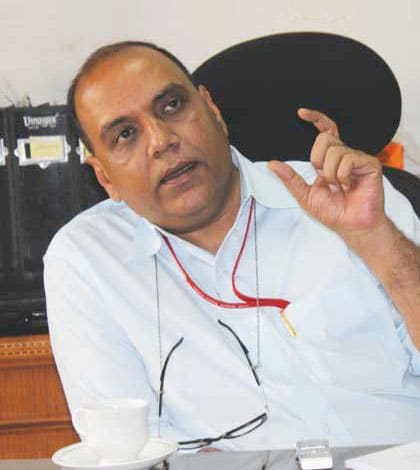
“If we want to have the best ICT infrastructure in our schools then we have to be ready to make very large investments,” says Mantriprasad Naithani, Minister of Education, Government of Uttarakhand. In conversation with Mohd Ujaley

In the meeting of Central Advisory Board of Education (CABE), you raised the issue of slashing the budget of states under Right to Education Act (RTE). What has been the response of HRD Minister on this issue?
The Minister has replied positively, he has explained the reasons behind the cut. However, in the states, we have to look into it from the point of practical implication of this decision. What has happened is that initially an amount was sanctioned for the states under Sarva Shiksha Abhiyan (SSA). After that the states started their planning for the expenditure but suddenly, the budget has been cut. This has created much discomfort for the states. For example, in my state – Uttrakhand, we have recruited people to work on RTE; however, now we are unable to ask them to join as we don’t have budget for the same. Such issues create lot of distrust and problem for the general publtic. I have spoken to Minister and requested him that at-least budget should not be slashed midway as investments on some of initiatives have already been done.

Large numbers of schools are yet to comply with various provisions of the RTE Act. What should be the best way forward for higher compliance?
We enact laws for the people; therefore, we have to see whether it is serving it purpose or not. An amendment can always be made if required. The good thing about RTE is that it has created huge awareness about education across the country. But best results can only be achieved when the government has the will to strictly enforce guidelines on the implementation of RTE. The Gross Enrolment Ration (GER) has increased, but it is also true that there are large numbers of schools that are yet to comply with RTE. I feel we need to be more flexible and punish only those schools which have shown complete negligence. We may also give more time to schools for adhering to the guidelines of RTE. Also, we have to keep in mind that various initiatives under SSA or RTE cannot meet the deadline, because budget has been slashed midway and some of the states, such as Uttarakhand, have their own socio-geographic dynamics that is different from rest of the country.

Requirement of minimum area under RTE is another bone of contention. In Uttarakhand, it is hard to get 3.5 acre of land for schools. What is your view on this subject?
That is absolutely right. In Uttrakhand the population is booming and there is lot of pressure on land, therefore it is hard to get the land required to follow the RTE Act. That is why before finalising legislation, it is important to take into account the diversity and other sociogeographic challenges of the country. Various central government schemes have not yielded the anticipated results because we failed to adequately focus on the diversity of the country and I feel that is huge failure at planning level.

What is your opinion on central government opening more new universities in state?
I think, central government should open more new universities in the state. When centre opens an university, its structure, functioning and approach is bound to be more universal. State universities are created to serve the people of the state; the state government should try to bring them at par with central universities such as DU, JNU, JMI etc. The Hemwati Nandan Bahuguna Garhwal University has been converted from state university to central university. I am not in favour of such conversions, as they do not help the state. Through such conversions we are not creating new infrastructure or new jobs rather we are surrendering one of our universities to centre government. Now our local students are facing problem in getting admission. Ideally, centre should open more new universities in a state; the centre should also help the states to overhaul their state universities to make them at par with central universities.


One good thing about RTE is that this initiative has created huge awareness about education across the country”


What are the major challenges you see in ICT in education?
Use of ICT is good for education. Technology gives us an opportunity to reach out to maximum number of students. The main challenge that I see is that of investment – ICT in school requires huge investment, and there seems to be confusion on the best practices that have the best returns. Also, our aim should be to use ICT in schools for learning general subjects such as Maths, English, and Science etc., in easy and efficient way rather than getting carried away by newer technologies. The other big challenge to technology is poor infrastructure of our country. You may have best of the technologies, but you can’t use it if you don’t have adequate infrastructure in place.

You have always expressed the opinion that education should have some kind of value in it to bring maximum benefit to the students. Can schools alone inculcate value in a student?
School alone cannot do it. It is the shared responsibility of schools, parents and society at large to give right values to students. At government level, we can create syllabus, sensitise our teachers, but the parents also have to take an initiative. They have to play a more constructive role in the overall development of a child. I am happy now education is becoming priorities for the parents and it will surely produce good citizens in the country who will respect their elders, women and person in need. In Uttrakhand, we are heavily focusing on girl’s education and we are among the top states which fully utilises the central government initiatives. And, I feel, the more educated girls are, the better it is for the country.

Providing Quality Education from Cradle to Career

Jain Toddlers – an international play school
Year of inception: 2007
Founder and Chairperson: Chenraj Roychand
COO: Chandrashekar D.P.
Head office: Hyderabad
Address: Survey No.187, Botanical Garden Road, Masjid Banda, Kondapur, Hyderabad – 500 084
Website: www.toddlers.ac.in

Jain Toddler has been granted international affiliation based on the standards of its environment, curriculum, learning resources and faculty. The school’s team comprises a group of experienced and passionate early childhood practitioners with extensive training by international instructors in all areas of child development.

School’s Philosophy
Providing quality education from cradle to career thereby creating human assets. Fuelling economic growth by developing new generation entrepreneurs. Creating a globally networked community of leaders, technocrats, scientists, sportsmen and professionals.

USP
The school’s child centric curriculum ‘PEARL’ (Play, Engage, Activity, Reflect, and Learn) helps us to focus on personal care, parent’s involvement, besides traditions and values. We believe in holistic development and nutritious food and structured sports

Franchise Process

Business ExpansionPresence across India –  22 locations
Franchise Option – Yes
Number of franchise – 5
Expansion Plans  – 100 centres by 2015Requirement for taking Franchise: Investment required for 8000 sqft area is `23 – 25 Lakhs Investemnt required for 4000 sqft area is `18 – 20 Lakhs
Deliverables for franchise owner:
Layout and Designing: Floor plans and an easy to follow design/build package is created during the initial fit-out stage, which is managed with the complete support and direction of the Jain Toddler’s in-house team.
Launch Support: Initial training seminars and on-site help is provided, organize and conduct the grand opening launch. Oneon- one support is provided whenever required.
Training Programmes: Complete comprehensive training programme to prepare the owners and key managers with the knowledge and tools to manage a Jain Toddler’s franchise is provided, from class curriculum to marketing and business operations.
Videos and Manuals: In-depth operation manuals provide an additional resource for managers, teachers and owners, and provide ongoing details for running a Jain Toddler’s franchise.
Continuous Support: A home office team is available for questions, assistance, and all concerns within 48 hours !
Marketing and Branding: An array of unique promotional and marketing materials are provided. Franchise owners are helped in detailed marketing plans and strategies. Wide range of online, web-to-print and design solutions makes it easy to market the business.Why Partner with Jain Toddler’s ?Cradle to career: With JGI network spread across pan India, there is scope for continual education for toddlers in Jain schools and institutions, which is an added advantage for our partners.

Strong background: Jain Toddler’s is backed by the Jain Group of Institutions which has over two decades of rich academic experience, which would be the guiding strength behind our franchises.
Knowledge Sharing: Presence in over 22 locations has given the right exposure and knowledge of school operations which will benefit our franchises.
Child-centric Curriculum: JGI has a unique and balanced self developed curriculum ‘PEARL’ (Play, Engage, Activity, Reflect, Learn) which gives the group an edge over other pre-schools.
Multicultural Advantage: Having schools in five different states helped the group excel in diverse cultures and geographies so will help new franchisee owners wanting to venture in a new area.
Contact person for Franchise Enquiry: Rishi Pransukhka, Franchise Manager; +91 7396029351


Admission Process

Minimum Age for admission: 1 ½ yearsAdmission procedure and fee Structure: Open to all and fees varies from centre to centre.Programmes for student development: KIDS Club, Kinder Kamp & Kinder Classes
Qualifications required for teacher recruitment: Graduate and passion for learning.
Training programme for teachers development: Jain Academy for Early Childhood Education and Teachcraft
Support to parents: Toddlers Touch, Kindercare and Open Houses
Contact person for admissions: Sudha Kolluru, Centre Manager; +91 9908573331Employment opportunity: If you wish to work in a Jain Toddler school send your profile at jgihyd@gmail.com

Emerging Preschool Chains in India

Preschool chains offer a great opportunity to aspiring entrepreneurs. Educating kids is a profitable as well as satisfying investment. Today Indian preschool franchise industry provides numerous options with number of branded franchisors available, which has broaden its scope for growth and development.

The concept of Preschool took off in India with daycare centres that take care of child when parents are at work or not around. Preschools were primarily day care centres for children in around 3-5 age group. But now they are seen as an early training ground for children to develop their skills. Over a period of time, it has seen paradigm shift from optional day care centre to important early childhood education. Some researches proved that preschool plays a very crucial role in laying good foundation for the child and preparing him for the future. It enhances abilities and skills of a child in areas such as language, motor skills, psychosocial cognitive, learning, etc. Early childhood is a crucial stage of life in terms of a child’s physical, intellectual, emotional and social development. Growth of mental and physical abilities progress at an astounding rate and a very high proportion of learning takes place from birth to age six. It is a time when children particularly need high quality personal care and learning experiences.
Five years back parents used to consider preschool as a place for letting their children interact with peers and spend some time away from home. They wanted to help their child to conquer shyness and be comfortable in meeting more people. Nowadays the parents are aware of the child’s pace, focused on each every milestone achieved by their child and on holistic development of the child. The shift has been immensely on taking preschools as a casual place to keep their children occupied for a few hours to taking preschools seriously as monumental in their child’s development.
Priti Srivastava, Founder Director, Vidyãrambh – The International Preschool and Childcare Centers
says, “We have seen a huge shift in the mindset of the parents. Seven years ago only the higher income group in metros recognised the need to send their children to preschools but now all parents are open to the idea of sending their children to preschools. The awareness about the way quality early childhood education can bring about to the child’s personality has been recognised widely. The other major change and concern that has started happening is that K-12 schools have started opening preschools under their banner. The preschool space has seen a major change in the last few years and only those players who provide quality education in the long run would be present in the near future with lots of consolidation happening over time.”
Ongoing research established that, the preschool, as an institution, provides stimulation for the child’s physical, intellectual, social, and emotional development, in ways that one could not get in the home environment. This sector has shown tremendous growth during the past few years and is familiar not only with the high-end income groups or the affluent class, but is also rapidly gaining popularity among the middle class households, which have the capability and willingness to pay for quality education.
The owner of Strawberry Fields preschool, Anita Rao, Founding Director and the Managing Director, Educational Catalysts India Pvt Ltd says, “Pre- school education has changed for good over the years, especially the early childhood education. Schools have moved from rote method teaching to more activity based teaching and learning. There is more awareness about childhood development and the importance of learning in this age group. However, the schools are still more focused on developing 3R’s, more ever all the areas( cognitive ,language and Physical) seem to be getting addressed but there is no focus on the Social Emotional development. Especially in this age when the family structures are moving towards nuclear structure and both the parents are working. This area is getting neglected. Unless this area of development is addressed well by the Educational institutions we may have a huge problem with young people with emotional problems and ill adjusted individuals towards the society.”

round1
The significance of this very industry
can be measured by the very fact that
it occupies the 3rd largest expenditure
group in the Indian household

It is expected to be worth `13,300
crore by 2015-16, according to a Crisil
research report

Fee depends largely on the
location, franchise and type of the
preschool


A S Ganesh,
Founder And Managing
director, Smart Kidz“Teachers with required qualification are very few, so we suggest the Franchisees to appoint teachers who are graduates with good communication skills”


Significance of Preschools has changed in last five years.Industry leaders share their experiences on this shift…


Chandrashekhar,COO,
Jain Group of Institutions (Jain Toddlers)

Over the last 5 – 6 years, the preschool sector is witnessing a shift towards organized segment. Lately, the modern preschools have started shifting their focus from ‘teaching’ to ‘learning’ environment. This shift is more than just a change in language, a change in systems operation; in fact it is more of an adoption of the latest educational trend. This is definitely fuelling the growth engine of pre-school business in India

Kiran Kumar,
Director-Operations & Franchising, Blossoms International

Last five years has seen a sea change in fronts like the quality and number of schools. The main change is the nurturing in preschools, which has made difference to the little ones. The most important change has come in the attitude of the young parents who realise the importance of right school/ educator and of their own participation in shaping the minds of the young ones


Ranjan Goyal,

CEO, SerraPreschoolsEducation and the acquisition of skills is a lifelong process and starting early in life is crucial. New age parents have realised this need and are constantly on the look out for a good preschool. The conventional methods of teaching and the traditional outlook towards a preschool have changed radically. An aunt next door operating a preschool or home-schooling during the preschool years is not the norm anymore.

Amar Kapasi,
Director, Planet Kids

The preschool space has taken a massive leap over the years. Today the amount of things that the children are learning at the Planet Kids schools is phenomenal. Few years back a preschool franchise was not considered the part of a child’s education, which has changed over the years. The entire industry has evolved and with the new players coming in and a lot of correction is also happening.The players who are here for a longer duration shall be able to sustain themselves in this area. The various parameters to providing quality in the business have to be maintained on a regular basis to be able to sustain in a long run. The franchise should not only be able to provide good returns to the owners but also provide an institution to the parents for quality education in for a long haul.

Dharmesh Kapasi,
Founder & CEO,
Shanti JuniorsThe trend has been changing drastically, surveys look good on Power Point slides and the time you act upon, the trend moves on so has been the education sector. Preschool was an introductory product a decade ago but now it has turned out to be the necessity.We have many Women Business Partners joining in to carry ahead our brand which compelled us to launch our special Women Entrepreneur Encouragement Schemes “WEES”.
Vittal Bhandary,
Founder & MD, Little Elly Play SchoolI think the challenge is always to find the right partner and a good property opening the preschool. It is definitely challenging to get the right person. But I feel even if we get a semi-skilled manpower with the right attitude, we can mould them accordingly through our training programmes.
Deven khullar,
Chairman,
Brats and CutiesThe journey so far has been very eventful with new teachings with each passing day. The learning has been enthralling and has helped the group to grow and continuously evolve with new ideas for the betterment of the  group.
Navneet Anhal,
CEO, Zee Learn LimitedThere is a challenge of safety of children, which is under the bucket of non-regulation or absence of governing body in this segment. There is a challenge of finding qualified staff that knows what is right for the child. If we work on all this it can flourish into a good business opportunity and more importantly early development of a child.
SK Rathore,
Founder Director,
Sanfort SchoolsThe preschool franchise business needs individuals who are committed to provide quality education and ready to work relentlessly towards providing innovative education with hands on involvement and monetarybenefits shall follow eventually.

Burgeoning Preschool Industry

The rise in nuclear families and increase in disposable incomes have led to greater demand for quality preschools even in small towns and non-metros. Still preschool industry is in nascent stage in India with around 1.1% enrolment in comparison with France or Scotland where preschool enrolment is 100 percent. There is a mushrooming growth of preschools in India over last decade but only 17% of Indian preschool market belongs to the organised sector. This segment is attracting investments from private players.
According to a research report published in 2011 “Indian Preschool Market Forecast”, Indian preschool market has been witnessing rapid growth for the past few years on the back of rise in disposable income, rising number of working mothers, increasing trend of nuclear families, and escalating demand for high quality preschool education for toddler. However, low market penetration and low barriers to entry along with the increasing awareness, popularity, and propensity of young working professionals to pay, are some of the drivers, which suggest that the market offers considerable opportunity for investors. Moreover, it is expected that, the preschool market will reach to USD 1,833 Million by 2014, growing at a CAGR of around 13% during 2011-2014.
The preschool Industry is growing at a very fast pace that is 36% per annum as against the education industry growth of 15% er annum, which means that the parents are understanding the importance of early childhood education.

Drivers, Challenges and Trends

DRIVERS CHALLENGES KEY TRENDS
Untapped Market Operational
challenges
Corporate investments
Increase in disposable income Large Unorganised
Sector
Rapid expansion of
preschools
Improvement in quality Mergers and
acquisitions
Change in urban lifestyle Upgrading to K 12
sectors
Awareness in Tier 2 and Tier 3
cities
Ease of neighborhood


Alok Kumar Modi,

Chairman, Maple Bear

The franchise should have the will to follow the directions, manuals and curriculum to the hilt and should not try and innovate his ownstuff. The partners should also stick to  the core strength of the group by not cutting corners and would then benefit from the structure  provided by the group and ultimately profits would follow if the processes are thoroughly followed


Kopal Maheshwari, Founder and Chairperson, Little Einstein, “The opportunity is huge in preschool industry. The industry is growing at 36% and branded preschools are growing at much faster pace. This opportunity is best suited for entrepreneurs as it is low risk low investment model and you need to spend only 4-6 hours a day to operate preschool, giving you ample time to spend with family and pursue other opportunities.”

Starting a Preschool
Looking at the tremendous potential of preschools it makes great economic sense market to open a preschool through franchise model India. Various models exist under organised industry in preschool are direct chains, through franchise model and extended K-12 school.
There are various benefits that the franchise model offers such as the opportunity to be associated with established brand, which helps in attracting more kids. Further the franchisors provide curriculum support, training support, set up support, branding and marketing support, etc. One major advantage of this business model is sharing of expenses, knowledge, experience, brand image, as well as technical expertise.


Ajay Gupta, Chairman, Bachpan School


The quality standards of Bachpan are 
maintained through all the franchises across India by making franchises a part of the system and not by belting out penalties. We believe in having a healthy 
relationship with our franchises so that they have a continuous support from us for running a successful business


Key Preschool Franchisors

Preschool
Franchisor
No of Preschools/
centres
Expansion Plan Investment
required
Minimum Area Requirement Presence
Zee Learn 900 2 acres 330 cities
Bachpan 900 1000+ by 2013 7-10 lakh 1500-2000 sqft
Hello Kids 220 500 by 2015
Smart KidZ 140+ 200+ by end of 2013;
500+ by next five years
6-10 lakh 2500-3000 sqft 9 states
Shanti Junior 115+ 170+ centers across the
country by 31st March
2014 and 300+ centers
by 31st March 2015
7-10 lakh 13 cities 15000 sqft
Little Elly 90 Focusing on metro and
two-tier cities
8-10 lakh 1500-2000 sqft South and
western India
Maple Bear 44 30 more by March
2014
15-20 lakh 3000-4000 sqft 45 schools
Serra Playschool 37 undisclosed 15-20 lakh 2000-5000 sqft 14 cities
Little Einstein 34 16 centres coming up
shortly and targetting
200 centres across
Asian countries by
2015-16
2-15 Lakh Not available 21 cities
Strawberry
Fields
15 undisclosed 5-30 lakh 2,500 to 3,000 sqft indoor
space with approx. 500 sq.
ft. outdoor area for playing
Hyderabad only
Planet Kids 15 200+ 12-20 lakh 2500 sqft
Blossoms 15 Targeting 20 Branches
this Season and would
be 25 by the end of the
Current Academic Year
4-7 lakh 1200-2500 Sq ft of Built up
area and at least 150 Sq Ft
open area in the front for
play area
Brats and cuties 8 undisclosed 7 Lakh
onwards
1500 sqft in Metros & 2000
sqft in Other Cities
Jain Toddlers 5 100 centres by 2015 18-25 lakh 4000 sqft

Requirements for taking franchise
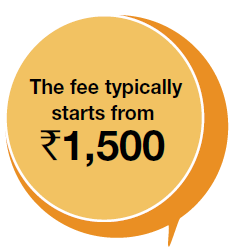
Different franchisors have different requirements and deliverables. Typically a preschool needs minimum space requirement 1,000-2,000 sqft and Initial investment starts from around Rs 500,000 along with trained personnel. Location also plays an important role. The franchise needs to work out all the important details including investment, profit sharing and revenue models with the parent company.

Roadblocks
Trained Manpower: There is massive scarcity of teachers in the playschools space. The teachers are no longer Just Montessori trained but also have passion to continuously learn and unlearn. Preschool owners look for teachers who want to learn continuously and like the concept of being with small children. The people who have good communication skills and can reach out to the children at a tender age. The people with these traits can be trained according to the curriculum requirements of different preschools.
A S Ganesh, Founder And Managing director, Smart KidZ on the vast shortage of teachers in the preschools, “Teachers with B.ED / ECCE qualification are very few, so we suggest the Franchisees to appoint teachers who are graduates with good communication skills. We provide an intensive training which educates them about the child psychology, new trends of teaching methodology and concepts. We believe in the warmth and affection the teacher gives to the child rather than her qualifications. To facilitate the untrained teachers, we provide NTT Program approved by the AIECCE – Government of India.”
These schools organise regular training programs to fine tune the teachers about role plays, classroom coordination, handling the inquisitiveness of the children and the way to handle kids so that they learn all the things in a playful and handy way.
The quality audits in the classroom helps in identifying the various loopholes and these are then passed to the training module. The training takes care of teaching the teachers all aspects of providing quality and fruitful interaction with the children under her care. The group also believes in constantly appraising and appreciating the good work done by the teachers.


There is more awareness
 about childhood development and the importance of learning in this age group
 

Anita Rao,
Founding Director and the Managing Director, Educational Catalysts India Pvt Ltd


The regulation will in a
 way help us to grow rather than being a hindrance

Pritam Aggarwal,
Hello Kids


This opportunity is best
 suited for entrepreneurs as it is low risk low investment model 

Kopal Maheshwari,
Founder and
Chairperson, Little Einstein

Need for Better Regulation
The government is planning to introduce regulations for pre-schools as well. Most of the branded Preschool segment would put cap on the fly by night kind of operators of school those who want to make quick money. These players expects that regulations must bring standardisation in quality and safety, then it would help in bringing good players in the field and also help in keeping the standards maintained.

Initial investment starts from
around `500,000

Pritam Aggarwal, Owner, Hello Kids, “I believe the regulation should be introduced with immediate effect as it will help in providing visibility to the big players who are already there in the market for a long time now. The regulation will in a way help us to grow rather than being a hindrance. If RTE comes into play it might rule the fee structures and other aspects, but at the same time it will act as a boost to the upcoming franchise to venture into pre-school business as the number of students attending preschools will increase.”

Structured Program for Toddlers

Maple Bear Canadian Preschool
Year of inception:
2004
Founder and Chairperson: Rodney Briggs (Founder,President) and Alok Kumar Modi (Chairman)
Managing Director: Hazel Siromoni
Head office: 4-7 C DDA Shopping Centre, Second Floor, New Friends Colony, New Delhi- 110025
Website: www.maplebear.in

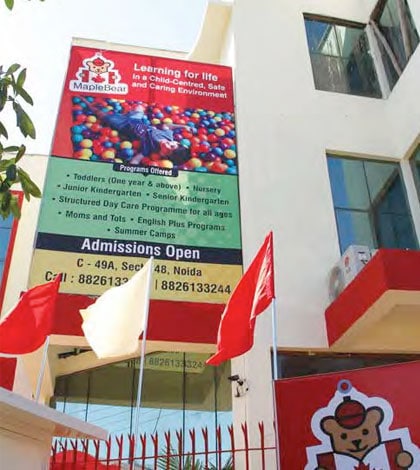
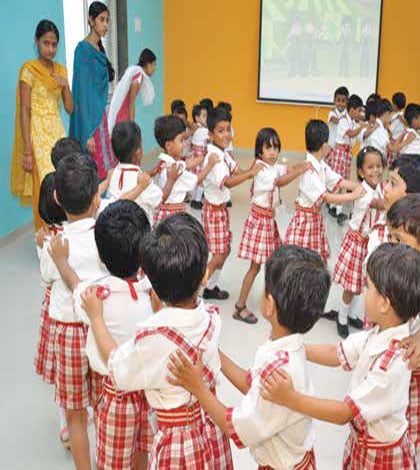
Maple Bear is unique and truly international brand present in India and different parts of the world. Maple Bear provides the world class education at your doorstep. Maple Bear Preschool is a programme designed to educate the child intellectually, physically, emotionally and socially in a stimulating environment that encourages creativity and self-expression. It also aims at developing a positive selfimage with children and enables them to become competent learners. It is a 4 years structured program for toddlers, Nursery, JKG and SKG. It covers the age group from 18 months to 5 years old children. Maple Bear also offers unique after school programs like Day Care, Moms and Tots, English plus (4 – 10 year old children), Thematic Summer Camps.

School’s Philosophy

Immersion style of learning English, inquiry based teaching and learning, learning through questioning, observing, investigating and doing.

USP
International brand name, unique concept of learning and teaching, curriculum and content prescription, day to day with minute to minute plan, teachers training and 24×7 support to franchisees.

Franchise Process

Business Expansion
Presence across India –  45 Schools
Franchise Option –  Yes
Number of franchise –  44
Expansion Plans –  30 more franchisees by March 2014
Requirement for taking Franchise:
Space Requirement: 3000 – 4000 SqFt (space could be self owned or leased)
Total Initial investment: 15-20 Lakhs
Deliverables for franchise owner: Canadian Curriculum, free teachers training, business advising, marketing support,
infrastructure set up support, website development and training support and quality assurance.
Contact person for Franchise Enquiry: Gaurav Sharma; +91 9873999279; gaurav.sharma@maplebear.in


Admission Process

Minimum Age for admission: 18 months
Admission Procedure and fee structure: Depends on individual Maple Bear schools
Programmes for student development: Apart from the regular programmes the school offers English Plus programme that enhances the overall personality.
Qualifications required for teacher recruitment: Main teacher should have 1 or 2 years experience in play school, Assistant teacher can be a fresh graduate with good communication skills.
Training programme for teachers development: Maple Bear provides various trainings to teachers like minimum 2 onsite trainings (in a year), training through webinar, Skype, Education leaders workshop, Observation & coaching etc.
Support to parents: Meals for children, day care facility, transportation facility, regular updates to parents regarding the child’s performance, assurance of safety, security and hygiene.
Contact person for admissions: Maple Bear franchisees have mini website on main Maple Bear website.
Employment opportunity: If you wish to work in a Maple Bear school send your profile at careers@maplebear.in


Equipping Children to Meet the Challenges Ahead

SMARTKiDZ Play School
Year of inception:
2008
Management Team: AS Ganesh (Founder & Managing Director); Ganesh Akella (Founder & Finance Director);
A G Malathi (Founder & Technical Director); Madhuri Akella (Founder & Technical Director)
Head office: Plot No. 97, Phase I, Gunrock Enclave, Near
Mudford, Secunderabad, Andhra Pradesh – 500009
Website: www.smartkidzindia.com


SMARTKiDZ
emphasises on the overall development of the child through age-appropriate learning experience, preparing them thoroughly for the next stage of their schooling.
SMARTKiDZ Play School ensures that children learn as effectively and efficiently as possible in a caring and friendly environment where equal consideration is given to social, physical, emotional, spiritual and intellectual development and where children are very well equipped to meet the challenges ahead.

School’s Philosophy
SMARTKiDZ believes that
• Each Child is a unique individual and they develop at a different pace.
• Children should learn in a safe, child centred environment through exploration and a variety of open-ended activities.
• The learning environment and educational process should recognize the different learning styles, abilities and interests.
• Education should address the holistic needs of the child which in turn leads to the scientific development. The kindergarten programme should focus on the physical, social, emotional, aesthetic and intellectual development of the child. The early establishment of the positive self-concept and a positive attitude towards the school provides a foundation for formal education.

USP
The school provide Value Based Education.

Franchise Process

Business expansion
Presence across India –  Andhra Pradesh, Karnataka, Maharashtra, Tamil Nadu, Gujarat, Odisha, Kerala, Uttar
Pradesh and Bihar
Franchise Option –  Yes
Number of franchise –  140+
Expansion Plans  –  Plan to have 200+ Franchisees by the end of this year and around 500+ Franchisees in
next five years.
Requirement for taking franchise:
Investment around 6-10 lakhs, Independent house having area of 2500 – 3000 Sqft and area restriction 3kms.
Deliverables for franchise owner:
• Association with Brand Name
• Interior and Exterior designing of the school
• Effective Advertising, Promotion and Publicity Support
• Ongoing training for the teachers / centre head & Positive Parenting Workshop
USP of your group:
Excellent support by the Franchisee Development Team & the Technical Team for successful running of the school.
Contact person for franchise enquiry
Satya Srikoti, +91 9581514444 (South & West); Sulabh Khare , +91 7748974974 (North & East).


Admission Process

Minimum Age for admission: 18 months onwards
Admission procedure & fee structure: Need to submit the duly filled in Admission form along with the necessary documents mentioned in it.
Programmes for student development: Age appropriate learning activities, good student-teacher ratio, individual attention and observation based assessment.
Qualifications required for teacher recruitment: Graduates with pleasing personality and good communication skills.
Training programme for teachers development: Sessions on child psychology, concepts, new trends in Education, parent – school relation, etc NTT course affiliated to AIECCE.
Support to parents: Orientation and Positive Parenting Workshops.
Contact person for admissions: Radhika Thota, +91 9581044144
Employment opportunity: : Business Development Executive for Chennai / Lucknow / Hyderabad

Provides Learning Ladder

Year of inception: 2010
Founder and Chairperson: Ved Prakash Chiripal
COO: Dharmesh Kapasi
Head office: Ahmedabad, Gujarat
Address: 4th Floor, Chiripal House, Shivranjani Cross
Roads, Satellite, Ahmedabad – 380 015
Website: wwww.shantijuniors.com


Shanti Juniors
(SJ) is one of the educational ventures by SEI -Shanti Educational Initiatives (SEI) which is a corporate citizenship initiative by the Chiripal Group – `2500 crores conglomerate involved in textiles and petrochemicals in India. Education is one of the portals which are instrumental in helping the Chiripal family return multi-fold to society, as they themselves received so generously.

SJ came into existence in the year 2010 by inaugurating 6 centres in Ahmedabad in one single day. Since then SJ has grown leaps and bounds every year with its single slogan of “Celebrate Childhood”. The other two ventures of SEI are Shanti Asiatic School, K-12 School and Shanti Business School – B School.

School’s Philosophy
At Shanti Juniors, we have discovered our own teaching philosophy after a lot of research and development, which is based on young minds response and reaction. Our philosophy is I3 Learning Ladder (Inquiry, Interaction and Innovation) synchronized with 4 C’s(Curiosity, Confidence and Creativity and Continuity)

USP
• Age appropriate constructive development of the child.
• Holistic approach towards the child.
• Encouraging their talents by identifying and fulfilling their individual needs for a wholesome growth. This is done through the various programs we offer, which are as follows: Playgroup, Nursery, Junior KG, Senior KG
• I3 Learning Ladder with 4 Cs.
• First ISO 9001:2008 certified Pre School Chain of Gujarat.
• Working towards creating synergy between digital academics and manual academics.

Franchise Process

Business Expansion

Presence across India –  115 + centres in India throughout 13 cities
Franchise Option –  Yes
Number of franchise –  115 Franchises across India
Expansion Plans –  Shanti Juniors looks forward to operate 170+ centres across the country by 31st March
2014 and 300+ centres by 31st March 2015.

Requirement for taking Franchise:
• Investment: Upto `8 to 10 lakhs which includes Franchisee Fees, Material Kit, Furniture and Fittings, Equipments and
Educational Material.
• Space required: 1200 sqft to 2000 sqft area with equal amount of outdoor area. Bungalows and tenements on prominent
road in residential areas are preferable.
Deliverables for franchise owner:
• A well designed curriculum and content based on our basic I3 Learning Ladder Methodology
• Play and learn equipments and furniture
• Latest teaching aids
• Effective teachers and counselors trainings
• System Process, academic and marketing guideline manuals
• Support in Staff-Recruitment.
• Brand building, promotions and advertisements
• Holistic business management consultancy
• Periodic product developments and updates
• Online support
• Orientation and induction programs
• Parental involvement programs
• Opportunity to attend national and regional business partners confluences
• Transparent operational policies.

Contact person for Franchise Enquiry: Rinku Vyas, Zonal Head – Business Developments, +91 90990 79825


Admission Process

Minimum Age for admission: 1.5 years old toddlers
 Admission procedure and fee structure: Parent shall locate the nearest center and fill up the admission   form with due documents of child. Fee Structure varies from centre to centre.
Programmes for student development: PG | Nursery | Jr Kg | Sr Kg, Mother –Toddlers.
Qualifications required for teacher recruitment: ECCE Trained and experienced Teachers.
Training programme for teachers development: Teacher Induction Programme, Refresher Induction Programme, Phonic Workshop, Innovation ways of teaching workshop, etc.
Support to parents: Celebration of “Parents as Partners”, Different informative workshops on Parenting and dealing with PreSchoolers. Also creating an interface to connect parents directly with SJ parents called “E – Juniors”
Contact person for admissions: Counsellors / Centre Heads at the SJ centre
Employment opportunity: If you wish to work with E-mail your profile at hr@shantijuniors.com or career@shantijuniors.com
Enquire for admission: 99796 66660

We must do Justice to Quality Requirement

The target of 27 percent GER is not difficult to achieve, but addressing quality is the key issue, says R P Sisodia, Joint Secretary (Higher Education), Ministry of Human Resource Development (MHRD) Government of India. In conversation with Rozelle Laha

From being a District Collector to the Director of Technical Education and Secretary of the Andhra Pradesh Board of Intermediate Education, you have held several responsibilities in the education sector. What are the key issues that plague higher education in India?
The most important thing that plagues education sector is the severe lack of infrastructure and quality resources. Though we can find good quality resources and facilities in the private colleges, it comes with a high cost implication. In the public institutions, sufficient focus on the part of the government is lacking; basic facilities are also not available thus making quality a casualty. Also, a palpable lack of skills and commitment is observed in the people managing the institutes.

There is a major debate around increasing the GDP spending on higher education to six percent. Can this solely play a significant role in enhancement of quality in education?
Whereas, it is not the only answer to ensure quality, it should remain a significant and key goal for us. Against Kothari Commission’s recommendation of spending six percent of GDP on education, we are spending on an average of four percent of our GDP on education. Out of this 4 percent, roughly one percent spending is on higher education and three percent on school education.
In the past, education was essentially driven by public investment or by philanthropy, today you have entrepreneurs, corporate and CSR investments coming. In the present scenario, a lot of private investments are coming in. If we add everything together, time might have come to have a re-look at the six percent spending. Until now, the goal of spending six percent of GDP on education remains a dream. We do need to focus and prioritise our spending on education.

With the entry of both private players and public institutions in the education sector, how can we ensure threshold quality across institutions?
The basic threshold level of quality should be maintained regardless of private or public sector. The threshold quality is basically the basic minimum that needs to be ensured by the regulators be it in the public sector or the private sector. This threshold quality can be determined with reference to accreditation. The basic quality should be in the nature of ensuring minimum standards in parameters like teacher-student ratio, the classroom space available for the students and so on. Such basic things should not be compromised upon and must act as the threshold. Above the basic threshold, every institute should have the flexibility and the ambition to go up higher and higher in terms of quality.
The fact still remains that the investment coming from the private sector are coming into some specific regions, areas and disciplines. It is not coming equally in all areas. For instance, the private investments are not coming in northeastern areas, hilly areas, or backward areas, there are not having any private sector participation. There may be oversaturation of private institutions in the metropolitan and the urban areas where there is demand. This is also distorting the landscape in some way. There is an immense need to highly regulate not only the quality but also the numbers. At times, such a distortion might lead to a very unhealthy kind of competition leading to adoption of unfair practices in order to attract students, or to ensure that you get the maximum out of the revenues that are generated which are not healthy or desirable trends for education.

The Kakodkar Committee report suggests, even the top IITs are producing 1, 000 PhD scholars every year, which is much below the average of 8, 000 to 9, 000 scholars being produced by the USA and China each in technical education. How can we make our national institutes of importance more efficient?
The first priority of our institutions happens to be catering to the learning requirements of the students. If we start comparing ourselves to research universities, then we are somewhere being over- ambitious. However, this is not to undermine the fact that our institutions and students have huge potential to undertake research. These days, students are going abroad to do PG and research work. The question is what makes them go out? Are we not having the facility, capability or necessary guidance that is required for research activities? It is perhaps the combination of all. The number of PhDs being produced by the reputed institutes of the country is less compared to international standards. A proper strategy needs to be put in place. You do not churn out PhDs just for the sake of giving PhDs. It should lead to gainful research dividend and that would come when you try to expand your capacity slowly. The institutional objective needs to be re-defined so as to re-orient ourselves towards encouraging research.

UGC has recently proposed tougher norms for private universities. Do you think that it would be a good step?
It would be a good step. Some of the private universities are operating in a way that is not conducive with good learning. Even in terms of quality, if we really compare public institutions and private institutions, you would find that private institutions lack that core focus on quality as somewhere commercial considerations takes the core position and tends to dilute the focus on quality.

Which are the organisations that would play a major role in improving quality in the education sector in the days to come?
The key role would be played by UGC in time to come. The distance education regulation has gone back to UGC and the technical education regulation is also going to be with them in future. NAAC, NBA would play a key role in addition to some more accreditation agencies that we are planning to set up. We need to have a body which has the capacity and the wherewithal to monitor the quality and you need to empower the universities. We need to de-centralise the quality control by empowering the universities to become a formal accreditation agency so that they ensure the quality of all the affiliated colleges under them.


Universities have to become a formal accreditation agency to ensure quality of  all the affiliated colleges under them”


Will UGC not be over burdened with so many responsibilities?
Yes, UGC is a funding body and now it will also become a regulatory body. Having a limited capacity certainly is an issue which needs to be looked at and we are very seriously looking at it.

How do you envision the country’s education sector at the end of 12th Five year plan period in 2017?
We need to define quality, set the measurable indicators of quality, identify the benchmarks, the thresholds and then plan on how we propose to take it beyond where it stands and most importantly, how we can bridge the huge gap that happens to be there between the top institutes like the IIT Kanpur, Kharagpur, Delhi University, JNU and some of the institutions which are below average. When we talk of quality, we need to bring institutes that are below the standards of the good ones in our country at a level so as to assure minimum quality standard. This is the challenge that we have to grapple with during the 12th and 13th Five Year Plan.
We need to focus on ensuring quality through mandatory accreditation. We also need to ensure that the institutes adhere to the basic minimum standards laid by the regulators and that the regulators properly monitor the quality by putting proper frameworks in place.
The target of 27 percent GER is not difficult to achieve, but addressing quality is the key issue. We have brought ourselves at par with the Asian average in terms of GER, but the key question that needs to be addressed is whether we are comparable to those institutes in terms of quality education. We must do justice to the quality requirement.

Integrating Modern Pedagogies of Teaching

Planet Kids
Year of inception: 2005
Founders: Chandu Jain; Amar Kapasi
Head office: Bangalore
Address: C-7, ‘Unity Buildings’, 1st Floor, J C Road,
Bangalore- 560 002
Website: www.planetkids.in
Email:info@planetkids.in; franchise@planetkids.in
Contact Numbers: +91 80 411-45744/844
Toll Free Line: 1-800-103-6766

SPlanet Kids is a start-up incepted in the year 2005 at Bangalore with an honest attempt to create a difference in the pre-schooling industry by providing an experience of international standards to the children as well as the parents. The company started off with company owned and operated model of preschools and was a pioneer in the field by integrating modern pedagogies of teaching combined with a state-of-the-art infrastructure at an affordable price point. With-in a very short span of time Planet Kids created an indelible impression in the industry at Bangalore for delivering high quality standards as well as pioneering creativity based activities for the children and a wholesome experience for the parents. Till date over 12000 children and thousands of happy parents have been a part of this hugely successful story and are fast growing by the day. Started with one school with three students in 2005 to 15 schools with over 2000 children in 2013, the journey indeed has been exciting and a fulfilling one. And yet we say, ‘we have just begun’ as there is a lot more to achieve and accomplish.

School’s Philosophy
The brand name ‘Planet Kids’ denotes a whole different world for the children to explore, learn and enjoy the process of growing up in a happy atmosphere along with acquiring learning skills ‘the fun way’. A planet of the children, for the children and created keeping in mind the various requirements of young learners. The name is synonymous to quality learning for children along with the endearing and friendly Lion mascot ‘Frizzy’.

USP of your Group
Excellent brand equity, young and creative team, extensive knowledge and know-how of Preschooling Industry, and extremely qualified training personnel

Franchise Process

Business Expansion
Presence across India –  Currently present at Karnataka and Uttar Pradesh
Franchise Option –  Yes
Number of franchise – 10
Expansion Plans –  Expansion Plans pan India

Requirement for taking Franchise:

A Planet Kids preschool centre can be started off in an area which is 2,500 sqft and above carpet area with an investment ranging from `12-20 lakh of rupees, depending on the location and set-up costs. Preferably it should be located on main roads of prime residential localities with ample outdoor play space and also good visibility and accessibility to customers.Deliverables for franchise owner:
Planet Kids will offer the franchisee extensive support to start and operate a centre. Basic guidelines on how to start operations,
the décor, and the materials required et cetera will be shared with the new franchisees. The in-depth Operations manual will
be a ready reckoner to the franchisee to get the framework of policies and procedures to be incorporated. A two day franchisee
induction programme will be conducted to help the new franchisee understand the pre-school industry and also how Planet
Kids functions. The teachers will be trained by academic leaders from Planet Kids at the beginning of the academic year and also
during the year if the need may arise. Constant on-going assistance via phone calls and e-mails will be available to the franchisee to help them settle any issues of concerns. Education coaches will visit the franchise centres and do classroom observations to help teachers perform better. Marketing co-laterals like advertisement designs, banner designs, leaf lets et cetera will also be given based on the needs.


Admission Process

Toddler Programme: 1 year – 1 year 8 months

Play Group: 1year 8 months – 2 years 8 months
Nursery: 2 years 8 months – 3 years 8 months
Lower Kindergarten: 3 years 8 months – 4 years 8 months
Upper Kindergarten: 4 years 8 months – 5 years 8 months
Daycare: 2 years to 8 years
Activity Hub: 2 years to 12 years
Fee Structure: Ranging from 24000 to 60000 per annum for preschool
Programmes for student development: X-SEED curriculum, Kinderdance, E-Blocks & Raise a Reader Programme
Qualifications required for teacher recruitment: Freshers/Qualified (NTT or Montessori Trained)/Exprienced
Training programme for teachers development: Regular Teacher Training & enrichment Programmes
Employment opportunity: : If you wish to work with Planet Kids in Teachers/Centre heads/Academic Head positions, please mail your profile to jobs@planetkids.in

Skilling Kids in a Free and Spirited way

Little Legends
Year of inception: 2005
Founder and Chairperson: M G Vasan
COO: Sumy Vasan
Head office: New Delhi
Address: Shubham Enclave, Paschim Vihar New Delhi-110063
Website: www.littlelegends.in

Little Legends is an inspiring and ultra-modern pre-school and playstation for your child. Your child gets international quality of education with Indian values amid joyous ambience. The amazing blend of Academics, Technology and Infrastructure not only delights but energizes your kids to learn while playing.
Little Legends truly matches the best of playschools globally and presents lively learning and playing. The infrastructure supports your kids to unleash their creativity and innate skills in a free and spirited way. Learning is fun at Little Legends with the concern for overall growth and grooming of the child to transform him into a bettesr citizen.
Little Legends mixes modernity with technology to produce the future citizens. All sorts of facilities have been offered for your child’s growth. At us, IT related aspects, play stations, large amphitheatres and equally charming tools help out the children to learn while playing and sense things differently.

School’s Philosophy: Creating leaders of the future

USP: Grooming, learning and teaching through novel methods and judicious use of technology

Admissions Process

Minimum age for admission: 1.5 years
Admission procedure and fee structure: Rs. 5000-10000 depending on location
Programmes for student development: Technology based teaching, special curriculum, stage exposure, physical exercise, brain teasers
Qualifications required for teacher recruitment: Graduate with Montessori training/ NTT
Training programme for teachers development: Regular and continuous training
Support to parents: Watch them learn-live surveillance system
Contact person for admissions: Sitara, +91 9891816161


Franchise Expansion

Presence across India: 3 schools in Delhi (Paschim Vihar, East Patel Nagar, and Greater Kailash-I)
Franchise Option: Yes
Expansion Plans: Franchisees all over India
Requirements for taking Franchise: 3,500 SqFt area with an investment of approximately `30 Lakh
Deliverables for franchise owner: Franchisee fee
USP: Technology based education
Contact person for Franchise Enquiry: Sabu V Jacob, +91 9891999975

LATEST NEWS