Home Blog Page 1556

UGC committee recommends additional 735 universities

To increase the enrolment rate in higher education, a UGC committee has suggested starting an additional 735 universities in the country during the 11th Plan ending 2012.

The UGC committee, comprising Prof Duraisami of Madras University and Prof Sudhansu Bhusan of National University of Education Planning and Administration, has said that more universities will be needed to increase gross enrolment rate — the percentage of youths in the age group of 18-24 years in higher education — to 15% from the 10% at present.

The committee, set up to suggest reforms on the affiliation system and monitoring of education in 11th plan, has worked out a formula of 20,000 students per university to achieve the target. As per this criteria, the requirement would be 735 universities in the country by 2012, the report said.

'We will study the report and make a final suggestion to the state governments for starting the new varsities,' UGC Chairman Prof Sukhadeo Thorat said.

At present there are 388 universities in the country. The committee's report assumes significance in view of the estimation of National Knowledge Commission last year, when it said that at least 1,500 universities are needed to make India a knowledge society.

The enrolment ratio in higher education is abysmal 10% in India. It is less than 8% in states like Assam, Gujarat, Madhya Pradesh, Mizoram, Rajasthan, Jharkhand, Orissa, Tamil Nadu, Punjab and Uttarakhand.


Breaking the ICE! Technology in JNV : P. Ravi, Principal- Jawahar Navodaya Vidyalaya, Shimoga,, Karnataka, India

Q. What have been your experiences in introducing ICT in your school?

Though our school, Jawahar Navodaya Vidyalaya (JNV), is equipped to implement ICT in education, introduction to communication technology for our students happens only after they join here, as 75% them come from rural areas. They are also not very conversant with the use of English language. Thus use of technology in the teaching process comes as a big challenge for our students, who are introduced to it in the 6th standard.

Our experience has shown that these students are not handicapped by their lack of exposure to technology, if their specific needs are kept in focus while introducing technology in education. Our students have a fast learning curve and use these tools very judiciously.

Although computer aided technology was introduced way even before 2001, clarity on its use and integration into education had been lacking. This was mainly because of lack of training among teachers and an attitudinal aversion towards technology in the existing mindset.

Q. How did you break the ice with teachers towards acquiring ICT skills?

Initially, only a few teachers showed interest in using ICT. But the group grew bigger with time. Once, as the principal, I picked up some skills myself, the ball was set rolling for others to do the same.

It is important to start by setting an example and with my continuous pursuance teachers were motivated to start using technology in education in 2003. They were provided exposure through trainings and encouraged to participate in competitions, like the ones held by Intel and Microsoft.

The training on project based teaching-learning by Intel helped our teachers to participate in the Intel Award for Best Integration of Technology in Education in the year 2004.

Our teachers and students bagged awards for Best School for Integrating Technology, Best Teacher for Integrating Technology and Best Student Project. This motivated many students and teachers towards using technologies. In the subsequent years we bagged many more awards. 

With consistent effort, we bagged the Computer Literacy Excellence Award 2005 at the national level and the cash prize of INR 8.5 lakh was used to upgrade infrastructure in our school and motivate teachers to use technology in day-to-day teaching.

Improvement in the Internet connectivity has enhanced the technology atmosphere in our JNV. In fact, for some teachers technology has become a way of life and they are setting new trends among their peers.

Our school is also involved in an Oracle project called ‘think.com’ and Confederation of Indian Industry (CII) project ‘shiksha’ and Intel ‘Teach to future’, including others.

Q. How would you describe the current level of expertise among the teachers?

Presently all our teachers are computer literate and half of them are actively using it in their day-to-day teaching. In the beginning some of them did not fully understand the manner and extent to which technology needs to be used with the result that a few students developed hatred towards technology aided teaching. Some teachers just started showing films on the subject matter and felt it will take care of the teaching process. They failed to understand that technology can only supplement and complement them in teaching. However, timely guidance and discussions with teachers improved the situation.

So, the head of an institution can bring about a transformation with regular guidance to tech-savvy teachers. As a academic supervisor, he/she should regularly monitor the technology aided classes and have review meetings to improve it. If technology implementation is properly monitored, it is a powerful tool to bring change in the learning environment.

Q. How did the school adjust to the change in terms of schedule, curriculum, teachers training, etc?

Computers were available by the year 2001, but both teachers and students were scared to use the computers and lacked confidence. Exposure to basic training programmes gave them confidence and set a new trend among teachers. Initially, I encouraged few teachers to use technology and developed them as a core group to implement the technology in the school, which has slowly roped in the rest to adapt to the changing environment. School level training was arranged for the teachers by allotting special slots in the timetable, called TAL (technology aided learning) periods to make them comfortable with technology. No rest-riction was placed on their frequent use of computer labs. Staff meetings would be held to highlight TAL classes while discussing the benefits of the same.

Teacher were encouraged to give more technology aided assignments, specially browsing information through Internet, etc. Work done by students and teachers would be periodically showcased to motivate others. All this slowly improved the percentage of use of computers in the teaching process.

Q. Would you like to share examples of direct use of technology? How was content created and what kind of software applications were used?

In the initial stage, teachers were dependent on ready-made CD contents. But slowly some teachers became independent and started customising content by using Internet resources. Irrespective of their subjects, all teachers started using technology. Technology empowered the teachers and also helped them in their professional growth. So it is not the subject that makes a difference in the use of technology. It is the technical knowledge and interest of the teacher that makes the lesson more interesting and thus creates a technical atmosphere in the school. So as a head of the institution, Principals must ensure that regular training /input should be given to the teachers to upgrade them technologically.

Q. Please tell us about the new pedagogical ideas introduced in the school to promote technology enabled education.

While insisting for the use of technology among the teachers, I have also taken care to provide necessary infrastructure in the school. After setting up a multimedia room with LCD projection facility, there is an increase in the frequency of teachers using technology and it is fruitful. Rather, some of the teachers have created good e-Content for their syllabus and started using regularly.

Encouragement on the part of management has motivated few teachers to the level of bagging national level awards in technology use. Moreover, the image of the teachers has improved among their colleagues and parents and students. Thus technology empowers the teacher professionally as well as personally. There is also a marked improvement in the learning environment and students’ participation has also increased.

Q. What has been the impact of this technology enabled teaching and learning process on your school?

As any other technology, computer technology is not an exception to misuse. In an effort to ease their work, some teachers started using ready-made educational CDs on the subject contents. This developed an aversion among the students and did not bring the desired results in teaching with technology.

But when used properly, technology has the tremendous potential to

Exchanging CLASSROOMS : Terry Culver, Executive Director- Global Nomads Group

Q. Give us a broad outline of the projects of the Global Nomads Group.

Global Nomads Group (GNG) is an international NGO that delivers interactive educational programmes for students. GNG does this in two ways: (1) Global Virtual Classrooms, where students learn about and discuss subjects with their peers from around the world in live, facilitated lessons via videoconference; and (2) Videos and learning content on a variety of subjects relevant to teachers and students. All of GNG’s programmes are directly linked to school curricula and education standards, and provide lesson plans and training to teachers. Programmes covers a range of topics like civics, social and global studies, geography, world history, science, politics, and 21st Century skills. In the course of participating in GNG’s programmes, students learn about each other and their cultures, and become aware of global issues. In short, we bring the world into the classroom.

Q. What are your plans for connecting young people around the globe? How do you make it happen?

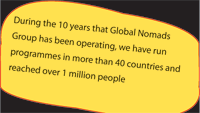
During the 10 years that Global Nomads Group has been operating, we have run programmes in more than 40 countries and reached over 1 million people. As a result, GNG has developed a solid knowledge base about interactive, ICT-based education, and about how young people become global citizens.

We are now building on this expertise to engage more students and schools in more effective ways. Interestingly, we have found that as a result of the live nature of the programmes, the academic topics become more relevant to students’ lives, and even moderately interested students become active in the classroom. We have also found that students are eager to learn about their peers in other parts of the world over sustained periods. So we have begun to increase the number and diversity of interactive programmeme offerings, to develop long-term connections between schools.

We make these connections happen by constantly adding schools to the GNG network all over the world, by developing innovative and relevant programmes for classrooms, as a fully integrated part of the curriculum. These programmes are also aligned with education standards.

Q. What issues/concerns do you address in the education sector through your project?

I think first and foremost, GNG helps young people under-stand global issues and how it affects their daily lives. GNG also helps young people from around the world speak to each other and learn together. This is an effective strategy for learning a range of subjects, including social studies, geography, science, history and politics. It also helps students develop a global perspective. GNG’s programmes are in general based upon child-centered and project-based  learning, global citizenship, & development of 21st Century skills.

Q. What is your vision for expanding global collaboration? How do you see the ‘eINDIA’ forum giving a platform for this vision?

We have mapped out a plan to do more of what Global Nomads Group does well: that is to help young people learn about global issues and their peers through interactive, international dialogue. We are doing this by increasing the number of programmes and by developing long-term programmes with schools in specific countries including India and the US. We are also keeping the programmes
cost-effective.

Q. What are the challenges in accomplishing the objectives of the project?

The biggest challenge is ensuring that the programmes are relevant to teachers and students in different parts of the world. So we spend a lot of time listening to teachers, educators, decision-makers and students, and we are constantly learning. 

There are also technical challenges, particularly when GNG runs live programmes via Satellite link from areas with limited connectivity. But we are committed to providing innovative programmes, and often the best ones take place in remote areas. For example, from October-November 2008, GNG will help organise a series of videoconferences with scientists on an expedition in Antarctica about climate change. This will be a fascinating way to learn about how and why one of the coldest places on earth provides clues on global warming.

Q. Please shed some light on your partners/supporters, at the government, private sector level.

GNG has been fortunate to have a group of terrific partners for many years. One key partnership is with Polycom, which creates videoconferencing hardware and software. More than this, Polycom has a strong and long-term commitment to improving education, which we have found to be very helpful.

Q.Are there any upcoming educational programmes that might be of interest in the education community in the Asian region?

GNG is currently developing the ‘Virtual Classrooms Initiative’ for schools in India and the US to have an ongoing virtual exchange. I believe the time is right for such a programmeme, and there would be significant benefits for students in both the US and India.

University of Delhi Aiming at Global Standards : Deepak Pental, professor of Genetics and Vice Chancellor-University of Delhi, India

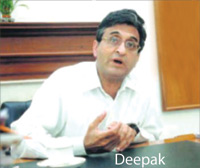
Dr  Deepak Pental is a professor of Genetics and Vice Chancellor of the University of Delhi since 2005. He is also serving as the Director, Centre for Genetic Manipulation of Crop Plants. Prior to taking over as the VC, Dr Pental served as the Director of university South Campus for five years. A noted scientist, he is also an elected member of the National Academy of Agricultural Sciences, National Academy of Sciences and Indian Academy of Sciences. Dr Pental has coordinated two major national programmes on ‘Development of Transgenics in Major Crops’ and ‘Functional Genomics in Plants’, besides penning 61 publications on genetic manipulation of plants. 

Ever since taking over as the Vice Chancellor of the University, Dr Pental has been instrumental in introducing many amenities in the University to attain global standards like better science labs, innovative project on life-long learning, introducing elements of ICT in the system, tie-up with the industry for skill enhancement courses, etc.

In an interview with Digitial Learning, Dr Pental shares his vision for improving quality of education in the University.


What is your vision for quality of higher education in the University of Delhi?

My focus, as the Vice Chancellor, has been to plug gaps in the existing system

Answers, Sridhar Rajagopalan, Director of Amedabad based Educational Initiatives Pvt Ltd that plays a pivotal role in the pursuit of improving quality learning…


Q.  Tell us about the concept behind setting up of Educational Initiatives, tracing the journey from setting up Eklavya School to a private company.

After working with IBM for two-and-half years, I left the job to start Eklavya School, Ahmedabad, in 1996, along with the two colleagues (who later co-founded Educational Initiatives with me), Venkat Krishnan N and Sudhir Ghodke.

For five-and-half years till 2001 we ran Eklavya School and Eklavya Institute of Teacher Education. In the teacher training programme we had a format in which the teachers were supposed to spend alternate days in schools observing and teaching children. Through this experience we came across some important facts that later on became the foundational principles of Educational Initiatives.

One of them was that rote learning had become the prime method of teaching and learning in our schools. Other was the disinterest of people with the talent and qualification to transform education, to actually become teachers and do something. Problems such as these were common in schools across India. We felt that education was not being tackled systematically and scientifically enough.

It was then that we felt a need for a tool that could actually show in terms of concrete data that the children were probably not learning with understanding. We wanted to work for the education system as a whole (private schools, government schools, at a national level, pool and increase knowledge, do research in this area) rather than simply develop a few institutions.

In 2001 we set up Educational Initiatives Pvt. Ltd. with the objective of focusing more sharply on learning and how to improve the quality of learning.

The flagship project of Educational Initiatives has been and is ASSET, a diagnostic test to find out ‘how well our children are really learning’. This test has been developed after researching textbooks and curriculums extensively in India and about 7-8 countries abroad, based on which  a list of scholastic skills and methods to test these skills (and not simply rote or textbook learning) have been developed.
 
Q.  Please comment on the school education scenario in our country. What, according to you, are the issues plaguing classroom teaching in schools today? 

Due the widespread practice of rote based teaching and learning the school education in India has substantially transformed into a rote learning system, which assess a child’s memorizing skills much more a foundational understanding. The phrase “Learn by heart” has become so ingrained in the system that it is difficult to diagnose where it actually starts. The Board exams only reinforce this type of system. One of the factors also responsible this is that the education system is not able to attract good quality teachers, who hold a much deeper understanding of a child’s understanding. A reason for this lack of talented teachers is the fact that the financial returns are not as good as other professions, but at the same time the education system fails to inspire talented individuals to get out of comfort zones and take up the task of renovating the system.

Q.  Tell us about assessment tests for schools. Please give details like its benefits, how it is carried out, and how many schools are using this; also share with us some of your experiences with schools and children. 

We want to create a system where children are learning with understanding. ASSET is an instrument through which we show schools and parents that what children are learning is something they cannot be happy about.
                                                                                        
The tests use multiple choice questions to test a student’s understanding of concepts. The findings are mapped on to spreadsheets telling the school how its students performed in concepts of a particular subject compared with schools tested in the rest of India. Schools

Setting Quality Standards in Schools : Meera Balachandran, The Education Quality Foundation of India, India

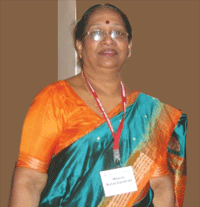
The Education Quality Foundation of India was founded in 2007 by Dr Anjlee Prakash with an aim to set quality standards in schools and help them achieve better levels of quality in terms of infrastructure, teaching methods, content etc. It has approached the issue of quality keeping in mind the specific needs of the Indian school system.

Meera Balachandran, Director of the Foundation, shares with Digital Learning the goals of EQFI and the crucial need for quality mapping in schools.


Q. What are the goals that drive EQFI?

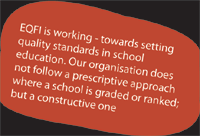
India has achieved a fair degree of literacy. But there is  hardly much focus on quality in schools. Although we have been able to spread education through programmes like Sarva Shiksha Abhiyan in far flung and remote areas, the time has now come to review the situation. The focus should be not just on quantity, but also quality of the content. It is in this direction that EQFI is working – towards setting quality standards in school education. Through our pilot project, we have conducted quality mapping in some private schools and given them a detailed feedback. Our organisation does not follow a prescriptive approach where a school is graded or ranked; but a constructive one where we identify the school’s weaknesses and strengths and tell them what their opportunities of improvement are and how they can proceed. We also help schools with their progress in transformation.

Q. Apart from private schools, which other schools have EQFI touched upon?

We recently signed an MoU with 367 Navodaya Vidyalayas for conducting their quality mapping. To begin with, workshops will be held for principals for introducing them to the organisation’s mission. The entire process will be three-year long, during which we will measure their improvement. We do not have grading system, but an
indication is provided to the schools as to what scoring band they will fall in, i.e. whether it is between 65 to 70% or 75 to 80%. Ultimately, we would like all schools to take initiative in the process and ensure quality themselves.

Q. What parameters are followed for measuring quality?

EQFI has developed certain quality assurance criteria and guidelines. We have a ‘Quality Assurance Criteria in School Education’ document which is customised according to the schools. For example, the Navodaya Vidyalayas are residential schools for rural children. So we have customised the document so that we take into consideration the rural background of children, teachers, to go ahead with the study. Different schools have different sets of problems and therefore have to be studied accordingly.

While mapping quality, we take into consideration leadership quality, knowledge management, student stakeholder focus, and address issues like what are the systems in place and what is the level of technology usage in teaching and school administration. Are the schools really catering to the satisfaction of the students and parents, etc. Usually schools are judged purely on academics, but we feel the need to go beyond that because academics, although important, is not the only measure for testing quality. When we take up results, we take up every area such as extra-curricular activities, innovation in schools, creativity, etc – everything that contributes to the overall success of the institution.

A lot of research has gone into achieving this set of generic criteria. We have heavily relied on a document called ‘Malcolm  Baldrige Standards of Quality for School Education’, which is used extensively in the United States. We have also consulted other sources such as UNICEF, Singapore schools and contextualised their experiences to suit Indian scenario.

Q. Are there plans to cover boards like the CBSE, ICSE?

EQFI started off in July 2007. Our aim is to cover as many schools as possible. Right now we are planning to go to the states so that we can make quality assessment for schools at the block and district levels. We will also plan to look at private schools ultimately. We have started with Navodaya Vidyalayas, but there is a long way to go.
 
Q. What aspects are taken into consideration while evaluating schools?

Normally, one would think of infrastructure, but that is only a part of the evaluation. Other aspects are also taken into consideration, like financial resources, allocation of resources, etc. There may be schools with minimum infrastructure and no modern facilities, imparting really good quality education. We try and give equitable importance to all the aspects contributing to quality. We include technology as a very big parameter for quality mapping. There are questions on how they use technology in data management and analysis, classroom transactions, etc. This will also encourage schools to take the evaluation more seriously.

Infrastructural resources are important but what is most important is that the transactions in the classrooms are interactive and qualitative and if they aspire to integrate technology, the situation becomes ideal.

Q. What has been the response to evaluation from schools as well as government bodies?

We have started a pilot project for some of the private schools, which is for free. It will take some time, but we hope that more schools will open up to us and the idea of quality evaluation, like the NVS. We also hope to get KVS in the loop, followed by the state schools. States like Gujarat , Maharashtra and Andhra Pradesh are already working towards raising educational standards.

As far as government is concerned, we have got a positive response. There have been consultations with the Ministry of Human Resource Development, and they have liked the concept of a neutral, external  agency conducting such an evaluation which will provide them with an  unbiased and critical  perspective. We are hopeful of expanding this to the states very soon.

Q. Apart from the evaluation, what other projects or initiatives have been undertaken?

We have initiated a big project called  ‘Citizenship Project’, where  we try and spread awareness among children regarding civic issues and also take their assistance wherever required. This is originally an American project called ‘Project Citizen India’, and we started it in 2005 with 11 schools. Now we have  about 252 schools  all over India, including rural schools. Children take up all sorts of issues like adopting a monument, looking after senior citizens, looking into the government policy on street children. We also have a tie-up with Kazakhstan to train their people for this project. We have also linked up with the University of Indiana, Iowa, where our teachers will receive training. Almost 3,000 teachers have  received training in the Right to Information. 

Other initiatives are also on the anvil, like the study of the Constitution of India. We also showcase our activities annually in September. In 2007, a village school from Andhra Pradesh won the prize for their outstanding work on construction of proper toilets in their village. In other cases, children made an entire village smoke free and even adopted a

Centre: Let

As the Minister of State for Higher Education, how do you view the higher education policies and practices in this country?

Higher education has expanded many folds since the time we attained independence in 1947. Post independence, there were about 20 universities and 500 colleges, while today there are over 400 universities and 20,000 colleges. Even the number of faculty has increased from 15,000 to 5,00,000 plus. The Gross Enrolment Ratio in higher education, or rather in education, has also risen from 1% to around 10-11%. But this should not make us complacent. There are challenges to be addressed and hurdles to be crossed in making education accessible, equitable, relevant and of quality. I think these are the core aspects which need focused attention.

Please elaborate on these core areas and how Ministry of HRD is trying to address them.

When it comes to accessibility, particularly since 2004, we have been trying our best to ensure that every child is able to access education and resources should not be a constraint. We also want to take education closer to the marginalised sections of society, particularly in the rural areas. Private players have definitely played their role in this, but yet there are disparities, like geographical, inter-university, inter-disciplinary, etc.

Talking about geographical disparity, take the case of technical education. Technical education has seen a spurt in South India due to private players coming in much earlier, than in North India. There is also an inter-university disparity in terms of accreditation process as not every university has subjected itself to it, especially with the mushrooming of institutes of higher education.

The inter-disciplinary disparity emerges because there is not much awareness about certain disciplines, for example, civil engineering. Two-three years back there was not much rush for the stream. But today, there is so much emphasis on infrastructural development, but complete dearth of civil engineers.

As far as relevance is concerned, there is a gap between the market requirement and what our universities and institutes are offering. However, we are trying to address it by opening a dialogue with the private sector and stressing on their participation in the curriculum framework.

When it comes to quality, infrastructure is a major aspect that needs to be looked at. We are trying to bring in as many colleges under the University Grants Commission (UGC) funding by giving incentives to state government to upgrade them. Quality-wise there is a shortage of good faculty in both the central as well as state universities, which poses a major challenge. Not many young people are interested in research nowadays or pursue MPhil or Phd since there is lucrative pay outside the teaching profession.

We have taken some measures to address the shortage of faculty by increasing the superannuation age from 62 to 65 years. Faculty can also be appointed on a contractual  basis till the age of 70 years provided they are fit to fulfill their obligations. In western countries, particularly,  you will find teachers as old as 75 years.

We also have the faculty Early Induction Programme, initiated by the All India Council for Technical Education (AICTE), wherein adequate support is given to those graduates who are interested in pursuing research. We have also increased the number of the Junior Research Fellowships and Senior Research Fellowships and also the grant given to them.

So UGC and AICTE have been taking various measures to lure young graduates into research and thereby the teaching profession.

What is the role of Public-Private Partnership here?

Today, our country spends about .81% of its GDP on research and 80% of it comes from public sector. However, in a country like India with geographical and demographic challenges, it is not fair to lean on the government every time. We would like the private sector to play a responsible role and supplement the efforts of the government.

The Ministry of HRD is looking at PPP, particularly in vocational education and setting up of polytechnics.

To come up with a policy on PPP, the government needs to take consensus of various stakeholders. We have opened a dialogue with the private sector and are also in consultation with the state education ministers to see how we all can play our role in PPP.

What is the level of support provided by Ministry of HRD to the states?

The Centre has always been supportive of the state governments.  For example, elementary education is completely a state subject. But in it we have the Sarva Shiksha Abhiyan programme and the Mid-Day Meal scheme for schools, which are centrally supported.  Infact the states are asked to submit proposals to the Centre, which are normally accepted, unless there is misutilisation of funds.

As far as higher education is concerned, UGC, which is a statutory body under the central government, has been supporting the state universities. So there is no way the government of India is shying away from its responsibility.

Here, I must emphasise that though India’s public expenditure in higher education has increased to 6% of the GDP, unfortunately we have seen an increasing expenditure from the Centre. Earlier, the ratio of government-state expenditure  was 20:80, which has now increased to 24:76. This needs to change and states need to shoulder more responsibility.

What role do you foresee for ICT in education?

India’s Gross Enrolment Ratio in education is 10-11%. But if you take developed countries like US, Canada and European countries, this ratio is 40 to 60%. In developing countries, the ratio is 21%. The international average is about 23% and for a country to be economically stable we need to have a gross ratio of atleast 20%. Even China has a ratio of 15%. Keeping this in mind, the Planning Commission of India has kept a target of raising the Gross Enrolment to 15% by the end of the 11th Five Year Plan. I think, ICT has a greater role to play against this backdrop, as we are looking at reaching remote areas and marginalised sections of society. And ICT definitely provides the kind of space  for learners who want to pursue education at their own pace and convenience. Integration of ICT in education is therefore a good opportunity  for both the country, where focus is on increasing the gross ratio; and learners, who can pursue education anytime anywhere.

What are the reasons for India still lagging behind in ICT integration?
Although Edusat was a very good beginning in that direction, we do agree that ICT has not been used to its full potential. People talk about US$100 laptop, but do not realise that US$100 means spending INR 5000 per child. With infrastructural problems like power supply, trained manpower, etc, glaring in our face, our priority should be to put the infrastructure in place before latching on to such schemes. I don’t think any other country, except for China, faces the kind of challenges we have in terms of demography. We need to holistically ke


MHRD Ministry’s policy stresses on blogging, radio in school curriculum

Under its national policy on Information-Communication-Technology (ICT) in School Education, the Ministry of Human Resource Development (MHRD), India has recommended to encourage children to blog and communicate through community radio stations.

As part of a consultative process of the government's ministry of human resource development (MHRD), which oversees education, the recommendations were drawn from more than 400 stakeholders in the burgeoning education sector: education experts, ICT specialists, businesses and students. The recommendations state that blogging should be encouraged to support creative writing. Spreadsheets, databases, concept maps, and hypermedia authoring tools (Web development tools) to encourage critical thinking could also be encouraged. It is also suggested that digital devices like robotics kits, digital microscopes, graphing calculators and global positioning system devices for science, math and social sciences curricula can also be used in curriculum. To improve rural access, the draft recommendations also press for creation of localized content to be accessed on the web to help children “proactively explore and capture local realities''. The recommendations also suggested Internet access for all the schools and better technical infrastructure. The MHRD Ministry has also raised ICT spendings in school education from INR 1,00 billion in the 10th Plan to more than INR 6,00 billion in the 11th Plan.

Laptops for Indian students at INR 400

Soon students across the country will be able to buy designed laptops at affordable prices as the government is planning to provide them laptops at around INR 400. The Indian Institute of Sciences in Bangalore and the Indian Institute of Technology, Madras have developed a special laptop at a cost of $10 for students to help them excel in studies.

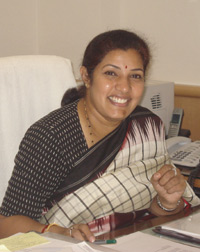
While inaugurating the eINDIA2008, an international conference of IT solution providers and government agencies to facilitate practices of e-governance and digital learning in the country, the Minister of State for Human Resources Development, New Delhi, D. Purandeshwari stated that the government has taken this initiative to enable students to make the most out of information technology, which is emerging as a catalyst for the country's socio-economic development. She stated that ICT will empower the mode of learning both in school and at higher education level. These efforts will make the students 'Netizens' in order to enhance their self-learning skills and develop their capabilities for on-line problem solving. The new mission will also focus on developing a very low-cost and low-power consuming access device, making available free bandwidth to every Indian for education purpose. She also released 'Towards a National Policy on ICT in School Education' at the function.

Several IT experts, educationists and government officials from more than 40 countries will take part in the three-day conference to discuss over the modalities of using ICT in e-governance, digital learning, e-health, e-agriculture and municipal functioning.

New British universities could struggle to survive: Standard & Poors

New British universities could struggle to survive

Newer British universities may disappear because of global competition forcing them to spend more, a leading ratings agency has warned.

Credit analysis by Standard & Poors warns of 'certain universities ceasing to exist' because of increasing competition from China and India and within the UK.

The analysis suggests that more research-intensive universities will be in a stronger position to cope but newer, more teaching-focused universities will struggle.

Standard & Poors publicly rates five UK universities

LATEST NEWS