Home Blog Page 1584

Arena Animation launches Arena Animation Academy Specialist Program 2008

Global leader in animation and multimedia training, Arena Animation has announced the launch of the brand new version of its comprehensive 2.5year high-end animation-training course, the Arena Animation Academy Specialist Program 2008 (AAASP 2008), designed as a complete 3D Animation Career Program.

This specialist program is aimed at training students in the latest industry relevant technology so that they enter the world of animation as trained professional animators. Through project-based work in conjunction with theoretical and practical experience, students would get an opportunity to explore different ways to put ideas into practice for developing their portfolios.

The key features of AAASP 2008 include:

* Laddered learning

NNE launches exclusive portal on education in Pakistan

In it's yet another endeavor to cover the entire gamut of educational activities world over, the National Network of Education (NNE) has launched a unique portal for specifically covering the educational scenario of Pakistan with www.PakistanEducation.info.

The first of its kind initiative not only offers a plethora of information on the entire educational scenario of India's neighbouring country but also provides information on all the famous schools, colleges and universities operating in each province of Pakistan.

Furthermore, comprehensive sections on Engineering, Management, Law, Architecture, Medical, Fashion Designing and IT Education have also been covered.

The other notable sections include 'Open mode of Education in Pakistan' and section on libraries active in the country etc, with more services to be added soon.

It's worth mentioning here that the National Network of Education is the largest Indian Educational Network in the world comprising of 46 portals each on India's 28 states, 7 union territories, 4 metros and 4 major cities of India. The objective of the network is to offer instant access to latest information on every facet of education.

Orissa institute to start open school for tribals near Bangalore

Encouraged by the success of running a tribal school in Bhubaneswar, Kalinga Institute of Social Sciences (KISS) is planning to a start a similar school near Bangalore.

The proposed school complex would come up in five to ten acres of land to provide education and necessary infrastructure facilities,including accommodation to the tribal children. A proposal had already been submitted to Karnataka Governor Rameshwar Thakur seeking allotment of land.

Disclosing this to UNI, KISS Founder Secretary Achyuta Samanta said here that the school would initially provide free education to around 1000 children belonging to tribal families. Funds required for the project would be raised locally, once the land was allotted by the Government, he added.

The ultimate objective was to set up a University of Tribals,exclusively for children hailing from various tribal belts across the country. Facilities, among others, to be provided at the University included food, clothes, books and education from Kindergarten to Post Graduation, all under one roof, he added.

He said KISS had already succeeded in its venture to provide free education to tribal children in Bhubaneswar, where 5000 children were accommodated in a Tribal Residential School in the KISS campus. This included some from tribes classified as primitive. The intake would be increased to 8000 children during this year, he added.

Dr Samanta, who has the distinction of being the youngest Vice-Chancellor of a University in India, as recorded by Limca Book, has to his credit a conglomeration of educational Institutions, ranging from Engineering, Rural Management, Computer, Language, Law and Health through a non-governmental organisation called Kalinga Institute of Industrial Technology (KIIT).

Arjun Singh assures education bill in monsoon session

Union Minister for Human Resource Development Arjun Singh has assured a delegation led by Shanta Sinha, Chairperson, National Commission for Protection of Child Rights (NCPCR) that the Right to Education Bill will be passed in the monsoon session.

According to the bill, every child between 6 to 14 years of age will have the right to free and compulsory education. Ashok Agarwal, who was member of the delegation said, “We have approached the minister for tabling the right to education bill in parliament soon.”

“The bill is important because it is the first step in the direction of the government's active role in ensuring implementation of the constitutional amendment,” he added.

And he assured us that the bill will be tabled in the coming monsoon session. The delegation included Mridula Mukherjee, director of the Nehru Memorial Museum & Library, and Amarjeet Kaur from the All India Trade Union Congress.

According to the bill, government schools shall provide free education to all children and private schools will admit at least 25 per cent children in their schools without any fee.

From Products to Solutions HP has it all for Learning : V Sukumar, Country Manager- Education Solutions, HP, India

 V Sukumar, Country Manager,Education Solutions, HP V Sukumar represents a division called Hewlett-Packard (HP) Personal Systems Group. It is one of the three divisions of HP, the other two being the Imaging and Printing Group and Technology Solutions Group. The PSG focuses on the personal systems group ranging from the desktops, laptops, iPods, work stations.. that are used for commercial and consumer purposes. PSG in India, as part of the strategic initiative for the coming years, has taken education as one of the key focus areas. V. Sukumar, Country Manager,Education Solutions, HP, says the new initiative will now focus on the company’s reach to the education institutions in the form of a solution, rather than merely offering products.

How do you see your educational offerings transformed from products only to solutions?

We look at the requirements of the schools and then talk to them. Similarly, we list the requirements for the colleges. It took us almost 6-8 months to find out what they need, and more importantly, understand their challenges, if they feel the need to introduce technology in their system. The whole srategy fails when you introduce something for the sake of introducing, but it succeeds if it is introduced in an area where it will alleviate the pain.

Most of the teachers spend close to 30-40 % of the time on non-academic work, like charting, preparing question papers, declaration of results, marksheet preparation, correction of papers, activities in the school function, identifying children with dancing and music skills, etc. So in every academic aspect they spend 30 % of their time for doing non-academic activities. That eats into their time for academic preparation. When we talked to them, we identified a lot of needs and areas where we really feel that technology can make a difference. That is how we decided to identify solutions that will take care of these challenges. For instance, when we talk about teachers using technology, the first thing arises is the fear- will I be able to use technology, how can I be exposed in front of the children who are very good at computers

SNDT: Empowering Women Through Distance Education : Dr. Chandrakant Puri, Director- Centre for Distance Education, SNDT University, India

Digital Learning talks to Dr. Chandrakant Puri, Director, Centre for Distance Education, SNDT University

The SNDT Women’s University, first of its kind in India, was established in 1916 by social reformer Dhondo Keshav Karve in Pune, Maharashtra on the model of the Japanese Women’s University in Tokyo. From a single college with just five students, the SNDT university has come a long way with over 2000 teachers  and more than 60,000 students enrolling every year throughout India.
  
The university is committed to women’s empowerment through education with emphasis on higher education through relevant courses in formal and non-formal streams. It aims to provide a range of professional and vocational courses to meet the changing socio-economic needs and creating employment opportunities for women across the country.

In pursuance of its single-minded mission of women’s empowerment, the university set up the Centre for Distance  Education (CDE) in 1979 along with the open university programme. Over the years, the CDE (www.cdesndt.org) has made significant contribution in providing women access to high quality education, irrespective of age, region or formal qualifications, through need-based academic  programmes. Every year more than 11,000 women on an average pass out of the CDE. It has introduced several new initiatives like ‘Education on Wheels’ and ‘Mobile Education’.

Keeping pace with the IT revolution in today’s world,  SNDT has introduced professional IT courses in distance education. It has introduced the first diploma in BPO skills (call centre management) in the distance mode along with six technical graduate and post-graduate courses in IT.

What according to you is the essence and meaning of distance education?

We at SNDT believe that education has to be affordable, manageable, and student-friendly. Distance education is not just the physical distance between the educator and the student. It is giving education anytime, anywhere and in whatever format the learner wants. Education has to be flexible, and that is its future. Recently, we had an 86-year-old lady who was keen on pursuing education through the distance mode. Educational institutions under the distance education mode have to go beyond the buildings and make education open in the true spirits by taking educational opportunities to the community and weaker sections of society.

Can you share with us CDE’s transition from conventional to ICT based learning systems?

SNDT has a strong social mandate. We aim towards the inclusion of not just techno-savvy women learners but also those who are not well-versed with the medium. So we conducted a small survey among the students to find out the facilities they have, in order to gain an idea before starting the e-learning course. The survey was done to assess the availability of computers, connectivity options and most of all the availability of electricity. And it was found that few students were ICT-enabled to undertake on-line courses, so we formulated a blended approach strategy.

Can you elaborate on the steps taken in integrating ICT  in its distance education mode?

Radio was the first technology option SNDT made and programmes were broadcast through Gyan Vani channel in 2004. But there was a hurdle as the broadcast was done from Churchgate, Mumbai and its range was only 30 km. Churchgate being a high profile area was not a viable option in terms of its reach among the weaker sections of the society. So we started recording speeches and lectures series for students to have instant access to course modules. We have also used the  visual media to make films and video clippings for communicating subjects like heritage management. 

Apart from teaching, in what other areas of CDE functioning have you integrated ICT?

We have incorporated ICT in providing basic information to our students. Our website has an interactive forum primarily to resolve students issues and grievances. Our study material is also available in e-format and self learning mode on our website to make education accessible. Since the conventional postal mode would take almost a month to reach the students, we have a download section on our website, wherein lots of course modules have been made available.

We also have e-groups and chat rooms on our website which are very cost effective and also save time. All the teachers are part of these e-groups which are active discussion boards to help students share knowledge and ideas and also seek counselling from teachers.

Computerisation of the departments was the next step towards integrating ICT in the functioning of the CDE. We have complete information database available with us and also ensure that all student-related information is centralized. This includes sending regular updates to students on events, contact programmes, announcements and other academics related information.

In what ways have you ensured direct access of university resources?

We have launched six IT programmes under the SNDT Digital University, the content for which was developed in collaboration with the six IITs. Resource made available at the university becomes a liability unless the software to access it are available with students. Since setting up labs inside the campus is not at all cost-effective and also reduces the flexibility of the learner by making it inaccessible, we plan to provide CDs and softwares to students. We have a content committee comprising experts from the subject areas and educationists, who are responsible for building comprehensive and student friendly content in the self-learning mode.

Please elaborate on the ‘Education on Wheels’ project.

Distance education is going to be the future. And ‘Education on Wheels’ is our pioneering programme in bringing education closer to the community. We have a mobile bus, equipped like a virtual classroom, which goes to doorsteps to provide education to those women who are keen on pursuing education. The bus is fully equipped with all facilities, including an LCD projector, to support lecture delivery.

Tell us about your latest initiative.

‘Mobile education’ is our latest initiative in the introduction of technology at SNDT. Through the SNDT server one can log in and take the basic entrance examination. The server has a database of questions which can be used in a quiz format for conducting the exam. The students can obtain instant results on their aptitude and competency in a relevant subject. We plan to use this technology extensively for admissions for those students who want to pursue higher education from SNDT after completing schools.
 
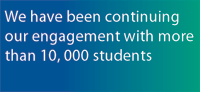
We have been continuing our engagement with more than 10, 000 students and believe that education opportunity and access should reach all in the coming years with the proactive engagement of the distance mode of education.

Please shed some light on the new IT courses that CDE has initiated.

Tracking on Merit and Evaluating Abilities : Madan Padaki, Co-founder & CEO-MeritTrac., India

A skill assessment company, MeritTrac, designs tests to evaluate abilities, skills and knowledge for corporate, academia and individual customers since 2000 has assessed over three million candidates for more than 150 clients cutting across industry sectors like IT, BPO, BFSI, engineering, FMCG, healthcare, retail, manufacturing, PSUs and education among others.

How did MeritTrac come into being?

MeritTrac started in 2000 as a skill assessment company catering to BPO and IT companies. As skill levels go up, it has become imperative for companies to conduct skills tests before recruitment in order to ensure quality.  So we offered to design and roll out the tests for them across the country. MeritTrac is totally into testing and not into training and placements.

What are the criteria you have set for assessments?

Assessments fall into four broad areas:

  • Communication skills like written and spoken English.
  • Inherent skills and abilities, analytical thinking, problem solving ability, learning ability, process orientation, etc.
  • The domain, that is, accounting, technology, engineering, and so on. We do tests across domains. We have tests in around 200 technology areas, 20 engineering areas, and 20 to 30 areas in accounting.
  • The fourth area is the behavioural orientation. We do not conduct psychometric testing, only orientation tests. We categorise candidates depending on their inputs in fields of interests like customer service, sales, etc.

How are the tests conducted? Who are your clients?

The tests are designed by a team of designers led by Dr Natrajan, a reputed name in the field of skill testing. All the tests are delivered in both online and offline modes, under supervision. The online tests are delivered using OnTrac, a web-based testing engine. Our delivery team has administered tests in over 120-130 cities in India throughout the country. IT giants like Microsoft, HP, Wipro have used these tests. In the non-IT sector, we have several customers like the ICICI bank, Hindustan Petroleum, HCPA, ITC, etc.

Please tell us about the initiative ‘TracSkills’.

A recent industry survey has revealed that only 15 % of the graduates in the country are fit to be employed. So what happens to the rest 85 %? MeritTrac’s individual certification programme TracSkills seeks to bridge this gap by assessing candidates across the country and providing structured feedback on their ’employable skills’ – those skills that are critical to performing well in any job. The programme started two years back.

Apart from over 150 client companies across sectors, the programme also has partnership with academic institutions like Bharathiar University, Visvesvaraya Technological University, among others to help the academia understand, improve and demonstrate employable skills of students.

TracSkills is being used in the IT, BPO, services and MBA talent pools. The IT TracSkills is now called the NACTECH (Nasscom Assessment of Competence (NAC) test)  and was launched a month back in collaboration with the NASSCOM.

A recent industry survey has revealed that only 15 % of the graduates in the country are fit to be employed. So what happens to the rest 85 %? MeritTrac’s individual certification programme TracSkills seeks to bridge this gap by assessing candidates across the country and providing structured feedback on their ’employable skills’ – those skills that are critical to performing well in any job

How can a single test assess candidates coming from various institutions and courses?

This test normalises scores across universities. It doesn’t matter which university you come from, what matters is your score on this common test. TracSkills measures your industrial rating, which includes basic communication skills, analytical thinking, learning ability, and process orientation. It also includes some basic domain understanding. For example if the candidate is from computer science background, he or she may be asked questions on programming, data structure, etc. So basically, you are tested for what you know, which is a different approach from being tested for what you don’t know.

This programme works on two philosophies. One is called ‘Playing to the strength’. Typically, interviews play to your weaknesses and you are asked what you don’t know. For example, if a person’s language skill is not too good, then you try to find out if his accounting skills are good and take him on that job. We help in identifying the strengths and then mapping them to the industry’s requirements.

The second thing is what we call the ‘Shortest distance to employability’. We give short duration training in the field a candidate is comfortable with, rather than training him for a longer duration in something which he does not know. That is the shortest distance to employability.

Are there any plans to tap the schools also?

Communication and analytical skills cannot be learned overnight by a student pursuing graduation. In order to enhance employability, one needs to start early so that the foundation is strong. We want to take MeritTrac to schools to check the gaps in skills. This way we will be able to predict a class 7 student’s employability, 10-20 years down the line. Currently, this predictability is not there in our education system. MeritTrac can also help the student figure out his or her aptitude.

Do you foresee any challenges in taking MeritTrac to schools.

MeritTrac does not propose to change the existing systems in schools, but supplement it. Let students who are interested take the test, and in the next five-six years it will start showing results. Gradually, more and more schools will pick up the process and thereby help students make a choice.

Please tell us about the challenges faced in the initial days.

The initial few years were spent proving ourselves since we were representing a new concept. The industry had never heard of skill assessments, so we were instantly written-off. But now, people understand the need for assessment and realise that it is a science that requires expertise. The greatest achievement has been that MeritTrac now has a brand value.

Does MeritTrac enter into partnerships with governments?

Partnerships with governments are important. In 2001, we worked with Andhra Pradesh government on the Graduate Employability Test where McKinsey was also involved. In 2006 we had partnership with Karnataka government on something called the Computer Skills Proficiency Test (CSPT). We have also worked with West Bengal governemnt.

Please elaborate on the CSPT.

CSPT was an interesting partnership with the government of Karnataka. With the e-Governance initiative of the government, micro-finance jobs came up in a big way. There was lot of push for rural BPOs, which meant a heavy requirement


Equiping Teachers to Unleash Learners


Tell us about the idea behind the innovative training module Easy Now!.

I am basically a nuclear scientist and have worked in BARC. In the 1960s, our digital struggle was to convert some numbers into a meaningful model by which we could run our nuclear reactors. Then India made a computer CDC-12, in which you could feed the data and have the desired models on a teleprinter. We were on top of the world. That is how my association with computers started.

Between 1969-73, I went into an ad agency, where my training as a nuclear scientist was put to good use. I started using mathematical calculations  in market research to establish consumer choices, patterns and standard sizes of products. I also worked with an engineering consultancy helping people solve practical problems using mathematical models. Then I joined a company called Computronics India where I was involved with various projects for for different groups of clients across the globe. I realised then that although we have made technological advancements, these are not being used for right applications.

When computers came to be used extensively, the ability of calculating simulation through graphics, etc was of direct interest to education. At Computronics, we were involved in the development of a software called the White Board. The software allowed simultaneous transmission of messages or data between the teacher and students.  Through this technology students could communicate with the teachers by typing in queries and receiving answers. However, during demonstrations I realised that the teachers found it difficult to utilise to make drawings. So I created a product for them called Easy Now!

Please elaborate on the concept of Easy Now.

Using the Easy Now! module, teachers can create a slide show for students, which would be optimum so that it could go up on a regular dial-up line net connection. This would allow the teacher to record the lecture in an audio, match it with video of the lessons on the whiteboard and deliver it in no time. Through this system, almost 120-150 hours of classroom teaching can be recorded in one CD and disseminated to students who may not be in quality schools.

Using the Easy Now! module, teachers can create a slide show for students, which would be optimum so that it could go up on a regular dial-up line net connection

 Similarly, lectures by a good teacher can be archived for future use for the benefit of a large number of students. This method is also very cost-effective as it requires simple tools for recording a classroom lecture. Moreover, this innovation is friendly to persons with disabilities and can be used by the visually challenged as well as hearing impaired.

How can the learning divide be surmounted using Easy Now?

Through the Easy Now! one can archive a classroom lecture and use it for educating students in a remote village or inaccessible place or even children who cannot afford quality education. The product is also inclusive in nature as it can be used by the visually challenged or hearing impaired. The learning divide can thus be surmounted by empowering the marginalised sections to use this cost-effective open source. All one needs is simple technological tools like the VCD or MP 3 player to play high quality classroom lecture. For example, we have conducted training sessions for the Yashwantrao Chavan Maharashtra Open University (YCMOU), Nashik, Maharashtra and the teachers there are now trying to reach out to the tribal population there using this method. So Easy Now! is going to be a big revolution in terms of its reachability and affordability and further the mission of open and distance learning.

How has the response to this product been?

The response to Easy Now! has been very encouraging. Students find the whole concept of teachers preparing the lessons and archiving them very interesting. This year we have already conducted training sessions in YCMOU, Maharashtra, Sri Lanka Open University (SLOU) and the Bangladesh Open University (BOU). We would now be going to Tamil Nadu Open University (TNOU) and Malaysia for holding such sessions. We have also conducted classes for a private organisation ‘Chanakya Mandali’ in Maharashtra, which provides education to almost 4000 students. The Mandali feels that they would be able to reach out to more than 50,000 students through this technique.

With Scale Come Challenges! : Pial-Islam, Project Manager-Digital Ecosystem, World Economic Forum (WEF)

Tell us a bit about your role with the World Economic Forum?

Primarily, with the World Economic Forum, I do two things: one is, we lead an initiative called digital ecosystems which looks at the convergence of IT, telecommunications, media and entertainment industry at a global level. The other side is the Global Education Initiative, with projects in Palestine, Jordan, Egypt and the Rajasthan education initiative (REI) in India specifically. I interface and manage the Rajasthan piece. Within the REI, we have a number of core partners, CII being one of them, and so is Global e-Schools and Communities Initiative (GeSCI). Then we have a number of private sector organisations, some that the WEF brings, for example, the Intel, Cisco, Microsoft and IBMs of the world but there are also a lot of interesting local organisations that are a part of it such as the Aziz Premji Foundation, NIIT and others. My primary role is to make sure that the partners that are there from the WEF side are able to get what they expected to get out of it, are able to contribute in meaningful ways.

Tell us a bit about the REI agenda. What has your experience been in the implementation of the initiative?

The primary role is to help support the government of Rajasthan

ICT: The Greatest Equaliser : M C Pant, Chairman- NIOS, India

The National Institute of Open Schooling (NIOS), formerly National Open School (NOS), with approximately 1.5 million learners on roll, has emerged as the largest open schooling organisation in the world. Initiated as a project in 1979 by the Central Board of Secondary Education, the Open Schooling programme has now taken shape as an independent system of education in India.

What is the guiding mission of the National Institute of Open School (NIOS)?
Please elaborate on the vision of the institute vis-à-vis open schooling in India.
The NIOS is globally recognised for providing sustainable learnercentric school education, skills up-gradation and training through open and distance learning,
and also for ensuring convergence of open schooling organisations. This has resulted in getting closer to an inclusive learning society, human resource development, national integration and global understanding. We envisage substantial upscaling of the open schooling at the national level. A vision document, which provides a framework and direction, has been in place for development, training, delivery, networking, extension and other programmes required to best promote open schooling at the national and international level.
NIOS aims to work as a resource organisation for open schooling with usual programme delivery role. The State Open Schools (SOS) are required ICT: The Greatest Equaliser www.nos.org The National Institute of Open Schooling (NIOS), formerly National Open Sc ool (NOS), with approximately 1.5 million learners on roll, has emerged as the largest open scho ling organisation in the world. Initiated as a project in 1979 by the Central Board of Second ry  ducation, the Open Schooling programme has now taken shape as an independent system of education i  India. M C Pant, Chairman, NIOS shares the journey of evolution of open schooling programme at NIOS. 26 May 2008 | www.digitalLEARNING.in to assume major responsibility for expansion of open schooling in India as prospective learners would opt for regional languages as medium for instruction.

In your understanding what ails India’s school education system? How is NIOS planning to address this?
Our education system is facing three major challenges: The challenge of numbers; the challenge of credibility and the challenge of quality. The formal education system is attempting to address these challenges through Sarva Shiksha Abhiyan (SSA), and Rashtriya Madhyamik Shiksha Abhiyan (RMSA) A number of hurdles, like the choice of study courses, differential pace of learning, varying needs and requirement of infrastructure, make it diffi cult to address the educational needs of the millions of children and adolescents, particularly at the secondary level. The open school system is needed to address these challenges of mass and universal education. Although the efforts under SSA have given good results, there is still a challenge of universalisation of secondary education. Both formal schooling and the open schooling systems are required to meet this challenge of education on priority basis.

How NIOS plans to bring changes in the vocational educational system?
Acknowledging the fact that the young entrepreneurs are the wealth of the nation, the learner friendly vocational education programmes of NIOS provide excellent prospects. It offers as many as 75 vocational education courses in areas like agriculture, business, commerce, engineering technology, health,
paramedical, home science and hospitality management. In order to upscale and improve these vocational courses, NIOS is forging collaborations with reputed institutions and organisations in various sectors like medicine, IT and industry. It is planned to make Vocational Education and Training (VET) courses modular and creditbased with features of vertical and lateral mobility. Work is already underway on preparation of modular courses in the area of computer education. The curriculum framework for open vocational education developed by NIOS takes into account the curricular diversity by conforming to various target groups of learners.

How many regional centers does NIOS have?
There are 11 regional centers: These are at Hyderabad, Kolkata, Pune, Guwahati, Patna, Jaipur, Delhi, Chandigarh, Bhopal, Hyderabad, and Kochi. Besides these, regional sub-centres have been established at Dehradun, Bhubaneshwar and Darbhanga.

Which are the most highly soughtafter courses?
The secondary and senior secondary courses and several vocational education courses of NIOS are popular among learners. Vocational education courses in the following areas are very popular: Computer and Information Technology sectors, Home Science and Hospitality Management, Business and Commerce , Early Childhood Care and Education.

What are major highlights of NIOS that make it different from CBSE
system?
NIOS provides its students fl exibilities pertaining to place and pace of study.Hence it is less rigid compared to the CBSE system. Moreover, the credits
are accumulated. A student can complete a course within a span of one to fi ve years depending on his or her preparation. So it is a viable mode of education for those who are unable to attend conventional schools for various socio-economic reasons or those who have missed out on opportunities to complete
school and developmental education. It also meets the educational needs of children with disabilities and provides a ‘safety net’ to drop-outs so that they do not remain alienated. Open schools also address the needs of children from the minority communities. Talks are on with madarsas for using the NIOS system.
In its effort to further the national agenda of Universalisation of Secondary Education, NIOS has started on-line admission, which is open round the year under On Demand Examination system. Last year, more than 30,000 children
registered on-line for various courses. Provision has also been made to pay fees on-line while the study material can be downloaded from the NIOS website.

For over many decades, NIOS has been at the forefront of open education in India. Please elaborate on the journey hereafter for open schooling
.
There is great scope for open schooling in India; not only for ‘reaching the unreached’ but also for providing relevant and need based educational programmes for different clientele. Programmes offered by state open schools in the regionalmedium of instruction is bound to attract more students into the open schooling fold.  aking note of the potential of open schooling system, the CentralAdvisory Board of Education (CABE) has suggested that 15 % of the students at secondary level may be covered by the open schooling. Keeping this in view, NIOS is endeavouring to substantially upscale its programmes as well as those at the state level. Those states which do not have open schools are being provided with consultancy and resource support for opening them.

LATEST NEWS