Home Blog Page 1596

February 21: international language day

The ninth International Mother Language Day on 21 February 2008 was observed as an occasion of a double celebration as it also marks the launch of the International Year of Languages with the slogan 'languages matter!' Both occasions provide an opportunity for the recognition of linguistic diversity and the importance of multilingual education.

On 16 May 2007, the United Nations General Assembly proclaimed 2008 to be the International Year of Languages. As language issues are central to UNESCO's mandate in education, science, social and human sciences, culture, and communication and information, the Organization has been named the lead agency for this event.

However, the digital divide remains. This access inequality is also a linguistic inequality, as the languages used on the Web are not those most widely spoken. Accordingly, UNESCO is concerned with the protection of cultural and linguistic diversity and promotes language diversity on the Internet too.

Roll up for the Eddies

Now into their fourth year, the 2007 Edublog awards saw more than 500 nominations in 14 categories, including new additions such as “best educational use of a virtual world”. Attendees, or rather their avatars, gathered on the Island of Jokaydia in the virtual world of Second Life. < ?xml:namespace prefix = o ns = "urn:schemas-microsoft-com:office:office" />

Edubloggers: Roll of honour

  • Best educational use of a virtual world
    Suffern middle school in Second Life: rampoislands.blogspot.com

  • Best educational use of a social networking service
    Classroom 2.0:
    www.classroom20.com

  • Best educational wiki
    Welker's Wikinomics: welkerswikinomics.wetpaint.com

  • Best educational use of video/visual
    RBG Street Scholars Think Tank Multi-Media

  • Best e-zine:
    rbg-street-scholar-multi-media-e-zine.blogspot.com

  • Best educational use of audio
    SmartBoard Lessons Podcast: pdtogo.com/smart

  • Best elearning/corporate education blog
    eLearning Technology: elearningtech.blogspot.com

  • Best educational tech support blog
    El tinglado: tinglado.net

  • Best librarian/library blog
    A Library By Any Other Name: alibraryisalibrary.blogspot.com

  • Best teacher blog
    The tempered radical: teacherleaders.typepad.com/the_tempered_radical

  • Most influential blog post
    Is It Okay To Be A Technologically Illiterate Teacher?
    thefischbowl.blogspot.com/2007/09/is-it-okay-to-be-technologically.html

  • Best resource sharing blog
    TipLine – Gates' Computer Tips: tipline.blogspot.com

  • Best new blog
    dy/dan: blog.mrmeyer.com

  • Best group blog
    Techlearning blog:
    www.techlearning.com/blog

  • Best individual blog
    ScienceRol: scienceroll.com

A full list of winners and nominations can be found at www.edublogawards.com

Make education loans easier and faster – FM

There are good many numbers of public and private sectors banks in India offering education loans to bright and deserving students for higher study in India and abroad. With a view to provide better educational facilities to bright and deserving students across the country, the Finance Minster Mr. P Chidambaram has asked all public sector banks to clear education within 15-30 days. < ?xml:namespace prefix = o ns = "urn:schemas-microsoft-com:office:office" />

Mr. Chidambaram, in a written reply to the Rajya Sabha, said, “As per the norms prescribed under the Model Education Loan Scheme, the banks are required to dispose of loan applications within a period of 15 days to 1 month.”

The minister also added that banks should also institute an on-line system to clear such loans. In fact the facility is now provided by all major public sector banks. “The government has advised the banks to institute an on-line system of loan applications,” the minister added.

Pointing out the advantages of online loan system, the minister said, “This will enable students to download the loan application form, apply online and learn the status of their loan application.”

Indian Government focuses on higher and technical education

This is the first time the economic survey has equally devoted its attention to primary, secondary and higher education sector by highlighting initiatives in these sectors, which will further expand in the course of the 11 th Plan. < ?xml:namespace prefix = o ns = "urn:schemas-microsoft-com:office:office" />

The government has also committed to provide good quality elementary education to all children in the age group of 6-14 years. According to the survey, SSA has already constructed 1.70 million schools, 7.13 additional classrooms, 1.72 million drinking water facilities, 2.18 toilets and free supply to 6.64 billion textbooks, while MDM provides free food to 9.7 billion children. In the 11th Plan, MDM will be extended to upper primary level that would result in inclusion of 1.7 billion additional children of classes VI to VIII. SSA is expecting to allocate more than INR 13000 billion and MDM will allocate approximately INR 10,000 billion.

There are other two highlights; universalisation of secondary education and expansion of higher education institutes. The scheme – Universalisation of Access to Secondary Education (SUCCESS) envisages mandatory secondary education to children in the age group of 15-16 years by 2015 and universal retention by 2020. This includes work on eight new IITs, seven new IIMs, 10 new NITs, three Indian Institutes of Science Education and Research, 20 IIITs and two new SPAs. Then, there is the plan for 14 world class universities, 16 central universities and 370 new degree colleges.

NIS Academy introduces the Karma Jyoti Scholarship

NIS Academy, an educational initiative of NIS Sparta Ltd., Asia's leading Training, Education and Learning solutions provider, today announced the Karma Jyoti Scholarship 2009. The annual scholarship introduced this year has been formed to recognize the meritorious students who would like to excel in the corporate sector, in various customer interface roles including but not limiting to Sales, Customer Service, Supervision & Management. The total amount of scholarships that will be offered this year exceeds INR 3 crores! Based on the students' performance in a competitive written test, personal interview and their qualification level, they will be offered a fee waiver of INR 10,000 on NIS Academy's popular “Program in Business Skills” like PGPBS, GPBS & APBS, or a Free Laptop based upon the Scholarship Test. Each NIS Academy centre across the country will offer limited number of Karma Jyoti Scholarship, ranging between 50-75, depending on the city and the specific centre. The scholarship offer is valid till 10th October 2009. The scholarship tests will be conducted across NIS Academy centres on specific dates, in each city. Students who have completed their Class XII or equivalent and/or those currently pursuing graduation (especially aspirants for BBA, MBA, Job-oriented course) are eligible for the Karma Jyoti Scholarship. 'The Karma Jyoti Scholarship introduced this year, is an attempt to recognise and foster financially challenged meritorious students. We believe our initiative will help and benefit students to go a long way in achieving their career goals. NIS Academy has been the pioneer in skill based learning and an encouraging force for comprehensive education. We are sure that this scholarship will support the youth to successfully learn the essential skills needed to pursue a career and make them employable, without compromising on quality of education, said Muralidhar Rao, President and COO, NIS Sparta.' The application forms for the test are available through NIS Academy centres across the country. n Delhi, the forms are available in its centres in Preet Vihar, North Campus and Gurgaon.

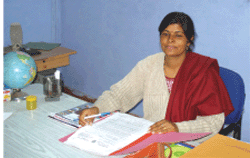
After All, It Is Difficult To Teach A Teacher : Mamta Sharma, Jawahar Navodaya Vidyalaya (JN V) Mungeshpur

Navodaya Vidyalaya Samiti is an autonomous body that was set up to establish and manage fully residential co-educational schools (one in each district in the country) known as Jawahar Navodaya Vidyalayas (JNV). Education in JNVs is free for all enrolled students, including lodging, boarding, textbooks, uniforms, etc. 

One of the first to integrate technology, NVS has actual grassroots experience in the integration of technology in education.  In 1999, NVS and Intel started a joint initiative launched by the Department of Education, Ministry of HRD, Government of India. Since then, Intel has three ongoing programmes running, the Intel Teach curriculum, the Intel Initiative for Research and Innovation in Science (IRIS) and the Intel Learn curriculum. Digital Learning spoke to Mamta Sharma, the Vice Principal of JNV, Mungeshpur, who talks above the Intel-NVS collaboration and the digital opportunities in the school.

How do you view the changes in the integration of ICT in school education?

Officers came, the entire vision changed, the priorities change. Every person has their own vision and mission.  ICT, once meant just the procurement of computers, now changed to not just the presense of computers, but also how much you are able to use these computers – ‘usage’ model.  NVS believes that ICT integration means how you can most effectively use computers, how to effectively utilise the resources that we have, and how to benefit the community around! NVS has changed the definition of ICT integration with changes in the overall scenario. Writing a speech or presentation is not an end.  Delivering it is an end, reaching out to the needy ones is another end to which the presentation itself is just
a ‘means.’

We also have project-based learning, where we have moved out of the textbooks, towards inquiry and how to search for solutions to a problem, making connections to real life.  Real life connections would really mean, design activities in such a manner that meet the learning needs of the students, connect to the world outside of the classroom, and include meaningful tasks or projects that in

How do you integrate the given curriculum with ICT?

The steps to integrate technology into the curriculum starts right from the day our teachers get training on professional development curriculum of Intel. They learn to use technology into their curriculum, practice student-centric approaches. These teachers then train other colleagues on the same curriculum. The teachers then plan multi-disciplinary lesson plans that not only promote judicious use of teachnology but also engae students into meaningful and authentic real life activities.

How the scope of ICT in education changed?

Earlier the teachers who would go for training on ICT integration were usually Maths or Science teachers. Now the perspective has become larger with Art teachers and Language teachers. So there is a lot of scaling-up that has happened since. I’ll give you an example, earlier when it came to teaching the science curricula, topics such as ‘the universe’ and ‘pollution’ were always there. Today, there are more sensitive issues that have been included. ‘Women empowerment’ using examples of women in different careers, etc, was a nice project that was done earlier. So teachers are also looking beyond the textbook.

How do you evaluate teacher training?
We don’t really evaluate teachers, but it is the programme that is evaluated in terms of how far we have reached? The issues faced by teachers are usually similar, just their proficiency levels in terms of ICT varies and they usually need brushing up of their technical skills. Regarding pedagogy, most teachers are good in NVS and now thankfully, most of them are also on par with technology. The training has components to gauge teacher ability in a peer-based evaluative environment, called ‘Showcasing.’

After Showcasing, teachers get time to revisit their projects and make changes and that is the necessary feedback in terms of evaluation. After all, it is difficult to teach a teacher. But we still have to evaluate the teachers, which we do through showcasing and areas of improvement are suggested. So there are two aspects to teachers’ training. Firstly, as a teacher, they plan the lesson involving project based learning and integrating technology judiciously. Secondly, as student, they make student samples that highlight the higher order thinking skills imbibed by students while doing projects.

What is the community involvement of your school?
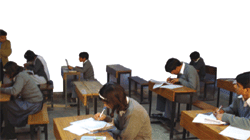
The Intel Learn programme has a component called ‘Pacesetting’ of MHRD under which we provide opportunity to children of neighbouring schools that might not have computers or infrastructure. In addition to developing IT skills in the laerners, the Intel Learn Programme inculcates necessary skills for the 21st century like collaboration skills and problem solving abilities. The curriculum is especially designed to also develop presentation and communication skills, basic skills which repair students for the workplaces of tomorrow.

These students come to the Vidyalaya for a 15-day programme as they learn a curriculum called Technology. Using a project based approach, the curriculum activities and projects, demonstrate to learners how technology can contribute to and help improve their communities and variety of jobs respectively.

Learners not only develop new technology skills and learn about their communities and various professions, the develop critical thinking skills as they collaborate to collect information, analyse that information, and finally, present it to their fellow students, teachers and other special guest from or outside their schools.

How is the ICT component built into the syllabus?

About 20% of the CBSE syllabus has to be taught through ICT wherein they have to bring projects connecting to real-life scenarios, catering to problem-solving skills, developing critical thinking and how to take typical topics and explain those which are difficult to explain in class, such as photosynthesis (Biology), chemical-bonding (Chemistry), etc, these can be easily explained using computers. The students are also motivated by the audio-visual aspect of the lesson. The student can actually see things that would not be possible to be observed otherwise.  Using a computer-made presentation, such abstract concepts can be easily taught.

What other challenges did you face in integrating ICT?

Like I mentioned earlier, 20% of the syllabus in all subjects and all classes has to be taught using ICT, except for third language. According to the demand from students and their teachers, I feel we need more periods.

I also feel that we need to have computers in every classroom. Currently we do loose a little time when students move to the Smart classrooms or the computer room. We also need to increase our infrastructure in terms of addin


Key To ICTs In Education Is Human-ware, Not Software : Sam Carlson, World Bank, India

Sam Carlson is Lead Education Specialist for the World Bank in India. After teaching in Asia and the USA for several years he undertook graduate studies at Princeton University, he joined the World Bank. Assignments include education project preparation and implementation in Latin America, Africa, East Asia and South Asia, along with research in educational technology, secondary and higher education. In 1998 Sam started World Links, a programme which links secondary schools around the world  via the Internet for online  collaborative project-based learning

In terms of technology-induced education, the World Bank hopes to provide useful technical assistance in planning and implementing educational programmes which integrate the use of technology, Sam says.

What is the World Bank’s mission for education in India? What does it want to do in technology-induced education?

The World Bank’s mission for education in India is multi-layered. In terms of elementary education, our objective is to assist the Government of India in the attainment of Education For All and the Millennium Development Goals, which means all children (both boys and girls) completing at least six years of primary schooling. We do this through our technical and financial support for the Sarva Shiksha Abhiyan programme.

At the secondary education level, our goal is to assist the states and Ministry of Human Resources Development (MHRD) to prepare new investment programmes to expand access and improve the quality of learning at the secondary level (for example, through use of technology to improve learning in Maths, Sciences, Social Sciences).

We do not currently provide financial assistance to the secondary level, but that may change if the Government of India requests our support. Beyond secondary education, our objective is to help address the skills shortage in India, which is a constraint on inclusive growth. We do this through our support for the USD 280 million Vocational Education and Training Improvement Project and the USD 250 million Technical/Engineering Quality Improvement Project.

In terms of technology-induced education, the World Bank hopes to provide useful technical assistance in planning and implementing educational programmes which integrate the use of technology, based on our knowledge of other countries’ experiences around the world. The Bank hopes to ensure that the focus of technology-induced education remains on students’ learning and skill development, rather than on procurement and installation of thousands of computers in schools.

Technology can promote development of higher-order information reasoning skills, problem-solving skills, cross-cultural collaboration and communication skills, and technological skills, all of which are demanded in the labor market linked to the global knowledge economy. But these skills are simply not measured by secondary-level board examinations, which in India’s extremely competitive education system are the obsession of parents and schools alike. The risk here is that the knowledge and skills enabled by technology which can help Indian youth succeed in life may not be measured or valued by parents or teachers, such that there will be underinvestment in the key areas needed to make technology useful in Indian schools.

What is the impact of the World Bank on access, learning outcomes and reducing skills shortages in India?

The World Bank’s impact on access, learning outcomes and skills development cannot be measured independently of the impact achieved by state departments of education and MHRD in the implementation of their projects and programs. For example, Sarva Shiksha Abhiyan has had a huge impact on expanding access to elementary education, enrolling more than 15 million children who were out of school. This was achieved primarily through the efforts of the central and state governments, which the World Bank has been privileged to support. 

In terms of impact on learning outcomes, both MHRD and independent assessments (such as Pratham’s ASER 2007 Report) show improvement over earlier baseline assessments, but there is still a very long way to go. SSA is increasingly focused on this important aspect, as the access issue becomes less acute. With respect to addressing skills shortages, our support to vocational and technical education has increased the numbers of graduates from these levels of education and, more importantly, improved their employability. For example, the placement rate of technical education graduates increased from 38% in 2003 to 65% in 2007, with a doubling of average starting salaries.

According to you, what are the challenges faced at different stages of education in India?

As mentioned earlier, at the elementary level, the challenges are (i) to reach the hardest to reach children who are still out of school and get them enrolled, and (ii) to improve the quality of learning so that enrollment means something in terms of acquisition of cognitive skills. At the secondary level, the challenges are to expand access (a gross enrollment rate of just 40% is far below where India should be, relative to labor market and household demand, and relative to its GDP per capita) and improve quality at the same time. 

At the technical and higher education levels, there are major challenges in terms of institutional and governance reform; the sub-sector is over-regulated and under-governed and the twin challenges of increasing access and improving quality are also there.

Outline World Bank’s engagement in Indian education at the State level.

In addition to support at the Government of India level, the World Bank supports education through Development Policy Loans in Orissa and Bihar, where specific reforms are being undertaken by the state departments of education (for example, massive recruitment of new teachers in Bihar). We also support institutional strengthening of the Department of Education in Karnataka, and targeted investments in primary education in Rajasthan. Our vocational and technical education projects are implemented at the state level, nationwide, so that ultimately we are engaged with all the states.

What defines a successful Policy in ICT in Education? How do you review the formulation and implementation of educational policies and practices in the country with special reference to ICT?

A successful policy in ICT in education is one which provides a vision and medium-term strategic framework for the expanded use of ICTs in Indian schools to improve student learning in all subjects and to enhance the development of ICT-specific skills which are essential for both future employment and lifelong learning. Such a policy must embrace all the key ICT components: hardware, software, electronic content, teacher professional development, promotion of learner-centered instruction, assessment, technical support, investment and recurrent financing needs. In addition, the policy should tap the respective comparative advantages of different players in the public and private  sectors, so that all knowledge and resources which can be brought  o bear can be integrated. 

Typically, the temptation is to over-focus on the rollout of technology hardware to schools and to declare victory in the integration of ICTs into education long before it is<

UP tech varsity sets up Noida centre

A fully equipped Technical Varsity was set up by the Uttar Pradesh Technical University (UTPU) in Noida, UP, at the cost of INR 17 crore. The centre, which will soon commence operation, is equipped with a virtual classroom and will be linked to other colleges under the varsity, using ICT. The campus will be connected to its nearest centre in the State, and each college will be connected to the nearest centre.  Scientists and technical experts will be able to avail the connectivity to interact with students and colleges all over the state.

The centre, which has been built with the technical help from IBM, will control the activites of nearly 70 engineering and technical education colleges in the region. The varsity has even signed an MoU with Intel, to set up a research centre at their headquarters in Lucknow. Microsoft has agreed to train the first batch of 12,000 teachers, 900 of which will be teachers from just the home state of Uttar Pradesh. Nearly 500 students will be imparted on-the-job training every year and special scholarship programmes are also on the anvil.

Leader

 What forms the compelling basis on which Hey Math! solutions are based on?
    
Every child, irrespective of whether they go to school system in any part of the world, we feel that they should get quality education. It is a well known and accepted fact that there is a fundamental teacher shortage. Because of that there is a subjective discontentment amongst the students and every one on the teaching quality of the subject teachers.

This concern comes from the parents as well and they try to supplement with tutorials. They, out of desperation, send their children to the tutors. Again, tutors are also less in number; there is a fundamental shortage in the whole system. There is also no more one to one tutoring, and the students end up going from one set to another set of class rooms and end up doing additional work. The desired solid foundation of a given subject is not built up. When the students go back to the school, they find themselves in great trouble, as the teaching method in the school is very different from the tutorial teaching set up.

Through our Hey Math! curriculum, we want to provide students access to the best teaching methodology by collaborating with high performing Mathematics system. We try to tap on the experts on Maths across the world to contribute to our contents.  We understand the effective ways of digitising those and making available for students.

 Could you tell us about the adoption rate of Hey Math! programme, who needs it, where does it go

Indian Government focuses on higher and technical education

To promote the education in the country, the Union Government of India has cleared that the government will focus on higher and technical education in its 11th plan. This is the first time, the economic survey has equally devoted its attention to primary, secondary and higher education sector by highlighting initiatives in these sectors, which will further expand in the course of the 11 th Plan.

However, it is also surprising that the survey is silent on the manpower crisis in higher education. Promoting and expanding higher education without making teacher's job attractive can result in a big crisis. The government has also committed to provide good quality elementary education to all children in the age group of 6-14 years. In this regard, the achievement by Sarva Shiksha Abhiyan, Mid-Day Meal Scheme and Kasturba Gandhi Balika Vidyalaya are noteworthy. According to the survey, SSA has already constructed 1.70 million schools, 7.13 additional classrooms, 1.72 million drinking water facilities, 2.18 toilets and free supply to 6.64 billion textbooks, while MDM provides free food to 9.7 billion children. In the 11th Plan, MDM will be extended to upper primary level that would result in inclusion of 1.7 billion additional children of classes VI to VIII. SSA is expecting to allocate more than INR 13000 billion and MDM will allocate approximately INR 10,000 billion. There are other two highlights; universalisation of secondary education and expansion of higher education institutes. The scheme – Universalisation of Access to Secondary Education (SUCCESS) envisages mandatory secondary education to children in the age group of 15-16 years by 2015 and universal retention by 2020. This includes work on eight new IITs, seven new IIMs, 10 new NITs, three Indian Institutes of Science Education and Research, 20 IIITs and two new SPAs. Then, there is the plan for 14 world class universities, 16 central universities and 370 new degree colleges.

LATEST NEWS