

The 11th Plan, running to 2012, has budgeted for as much as 5-6%
Brunei’s Mobile Teaching Learning (MobiTeL) training project ends
According to the Deputy Director of ICT Department, Ministry of Education, Hj Abd Rahim Derus, with the introduction of SPN21, ICT will be an integral part of the curriculum and technology and play a pivotal role in the 21st century education in transforming teaching and learning towards quality education.
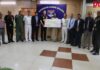
He was speaking during a certificate presentation ceremony for 30 participants of the Mobile Teaching Learning (MobiTeL) training project, yesterday. He pointed out that teachers will be playing an important role in integrating ICT in their teaching and 'transforming learning methods through the use of JCT. Currently, over 2,000 units of MacBook have been distributed to schools and each secondary schools in the country gets 40 units.
According to Hj Musa Masdi Muhd Sa'idun, the principal of Maktab Duli Pengiran Muda Al-Muhtadee Billah College, the MobiTeL training project, held on February 11 and 12 for teachers at the college, was aimed at introducing them to the Macintosh environment and familiarise them with four iLife applications of Apple Mac computers: Comic Life, iWeb, iPhoto and iMovie.
He went on to say that the training is in line with the ministry's vision of a 'Digital School', whereby the teaching and learning are enhanced -through pervasive computing and professional development of the tutors.
At the event, a slide presentation was also held showing the participants' activities and their submitted works such as the production of iMovies and iWebs during the two-day training.
Distance learning for Kanpur (India) medical students
Now the students of GSVM Medical College of Kanpur (India) can access all the important lectures of the expert professors of AIIMS and Chandigarh PGI from their own college through the distance learning facility.
The state government is planning to connect these colleges on-line to provide better learning facilities. With the college sbecoming a distance learning centres, the students will easily access the lectures by the expert professors from the top medical colleges like AIIMS, Lucknow and Chandigarh. The on-line learning programme will also help them in accessing the lectures of foreign experts.
US sets national ICT literacy standards
The National ICT Literacy Policy Council has recommended a set of national ICT literacy standards to serve as the basis for the Educational Testing Service (ETS) iSkills
IT recruitment from IIT slows
Firms like IBM, HCL, Hughes Software and CSC opted out of placements this year and hiring by firms like India's largest IT services provider Tata Consultancy Services (TCS), Infosys and Wipro has dropped. Confirming the trend, a placement official from IIT Roorkee said: “While many companies say they have a particular number in mind and would recruit likewise, our alumni network at these companies informs us that these IT giants are exercising restraint in recruiting trainees due to a slowdown.”
Recruitment by IT companies at IIT Kanpur has gone down from 130 students in 2007 to 72 in 2008. With the US slowdown and rupee appreciating against the dollar for most of 2007-08, IT firms are under tremendous pressure to manage margins and costs.
The companies, however, maintain with the boom in other sectors like investment banking and retail, and the urge to be entrepreneurs, IT firms are left with little option but to reduce their hiring from these institutes.
MBD Group to invest 100 crore in e-Learning
“Cyberspace is the new gateway for delivering education and our effort is to capture it to push our educational contents,” Monica Malhotra Kandhari, Senior Director of MBD group, said Wednesday. “We have already invested nearly Rs 30 crore in the last eight months and would invest an additional Rs 100 crore within the next three years. From a product-based company, we are reinventing ourselves as a service company,” Kandhari told IANS.
The company will create customised services for 'well-defined verticals' such as content business, technology in education, teacher training modules, campus solutions, retail and technology services among others. E-learning is considered to be the future in delivering content. According to an estimate, the e-learning market was about $7 billion in 2004 and is expected to touch $28 billion by end of the current year.
A.K. Malhotra, managing director of the Rs 1,000 crore MBD group said that the new initiative would function under the banner of MBD Alchemie. He said the content would be provided through an interactive web portal. IBM would provide technology support.
Kandhari said students, executives and those preparing for competitive exams could log in and register their name. They could avail services round the clock as per their requirement and convenience. Students can ask questions directly to an expert, interact with teachers and take part in a mock test to hone their skill and capability.
New e-Learning initiative on organic agriculture and agro-ecology
The European Government has launched a new European project, Organic.Edunet, which aims to raise awareness about Organic Argriculture and Agro-Ecology in schools and agricultural universities.
The project is coordinated by the Greek Research and Technology Network (GRNET S.A.), which also involves 15 partners from 10 European countries. The project will facilitate the access, usage and exploitation of digital educational content for teaching topics related to Organic Agriculture and Agro-Ecology. The government will also set up a network online repositories with educational resources from various content producers. These online repositories will be accessible from the Organic.Edunet Web portal, a multilingual environment that will facilitate end-users' search, retrieval, access and use of the educational resources. Organic.Edunet is also planning to study all educational scenarios, which will use digital content to support teaching concepts related to Organic Agriculture and Agro-Ecology in schools and agricultural universities. The project is expected to be completed by 2010. The project is aiming to inform about the benefits of Organic Agriculture and Agro-Ecology to European youth, so that they can develop a sustainable and ecological way of living and working among future consumers and young agricultural experts.
Czech government and industry launch science award for school students
The Czech company Ceska Hlava, in collaboration with the Czech Senate and the Czech Ministry of Education, Youth and Sports, has launched a competition for secondary school students. Entitled 'Innovating Minds – Czech Awards for Young Europeans', the natural sciences and technology competition is open to all European students up to 19 years of age.
The prize will be awarded in five categories: information and communication technology (ICT), health and quality of life, environment, product and technology innovations and design and architecture. Applicants must submit their project synopsis online, including an independent expert's review provided, for instance, by a science teacher. The applications for the Innovating Minds Award 2008 have to be submitted before 10 September. The award ceremony will then be held in October 2008 in Prague.
An international jury will select the winners in each category, who will each be awarded
Introduction of ICTs in classrooms has not changed the model of teaching
The school institution hardly changed during the last century, despite television, radio and other information and communication technologies (ICTs) transforming the principal manner of transmitting, producing and reproducing information in our society.< ?xml:namespace prefix = o ns = "urn:schemas-microsoft-com:office:office" />
This is the subject of Sergio Monge Benito's PhD thesis, undertaken at the Faculty of Social and Communication Sciences of the University of the Basque Country (UPV/EHU). His work analysed the process of the introduction of ICTs in secondary education in the Basque Autonomous Community (CAV ) over the period 1999 to 2004.
The aim of the research was to identify the keys of the process of the introduction of technology into teaching, outline the current situation, identify fundamental obstacles to the process and put forward actions for improvement.
The PhD, entitled La escuela vasca ante el cambio tecnol