



Home Blog Page 1621

UQSE 2007

A three-day International Conference on Universal Quality School Education (UQSE) was organised in New Delhi by Educational Technology and management Academy, in association with Unicef, Unesco, and Media Lab Asia.

The conference was participated by a number of academicians, educationists and experts from across various sectors that included Schools, corporates, non-government and government. The conference took off with a welcome address by prof. Marmar Mukhopadhyay, Chairman UQSE and Director Educational Technology and Management Academy (ETMA), followed by the inaugural address by Dr. Karan Singh, Member of Parliament. Speaking on the occasion Dr. Singh stressed on quality education for all and that equity and quality should go together. Dr. Singh also highlighted the need for a strategic planning for cultural diversities and disparities in the country. The MP also shared his concern over the incorporation of value education in school curricula.

Prof. Mark Bray, Director International Institute for Educational Planning (IIEP) delivering a key note address pointed out that 77 million children are still out of school, with half of them in the sub-Saharan countries. Prof. Bray observed that the efforts for improved access to primary education puts pressure on the secondary education and therefore neither of them can be ignored. He also said that policies striving to ensure quantity of education negatively impacts secondary education and serves only as remedial primary education making up for the deficit in the quality of primary education. This arrangement leads inequalities to remain in society in a disguised form. Throwing light on shadow education system, Prof. Bray said this system exists along with and because of the mainstream education system, and is proportionally related to the mainstream education system.

An address on Quality Education and Development of Minorities was delivered by Arvind Singh, the Minister of Education govt. of Delhi. The Minister pronounced the need to modernise the Madarassa system of education and emphasised on its significance to make primary and secondary education accessible to minorities. Day one of the conference covered interesting themes like ICT in School education; Education for Sustainable Development. This was followed by concurrent sessions on quality issues, teaching learning process and economics of quality school education.

The second day of the conference covered themes relating to Science of Education, ICT in Education-The Futures and show cased Quality Primary Education. Following which concurrent sessions on leadership for 21st Century Schools; Teaching learning process and economics of Quality School Education have been organised.

Speaking on the occasion Prof. Ved Prakash, Vice-Chancellor, National University of Educational Planning and Administration, focused his speech on the stratification of societies in South Asian countries that hampers their development-social, cultural, political and economic, and said empowerment through education is the solution of the problem. The Vice-Chancellor drew attention towards the fact that the 11th five-year plan does not emphasise on the universalisation of Secondary education, rather it says universal access to Quality Secondary education. He also said that assessment in principle should be used to identify inadequacies rather than judging students’ performance so that education can be accessed by every child and that they can learn. The other important speakers of the day were L. Samphe from UNICEF, Satish Kaushal from IBM, Hari Iyer from CORE.

The last day of the conference was dominated by themes related to beliefs and values in quality school education; leadership for 21st century schools and economics of quality school education.

Towards a Policy on ICT in Education, the session of the conference was organised by the key speakers like Anshul Sonak, from Intel, Radha Ganeshan of Quest Alliance, Ajay Kapur from Oracle, and Douglas Bell from Education Development Centre (EDC). The session was chaired by Osama Manzar from Digital Empowerment Foundation.

This session elaborated on the role of technology in leveraging school education and emphasised on  the need to have a guiding policy at state/district level to solve the complexities of implementing ICT in school education. It was highlighted that technology is one of the ways to solve the problems in the education sector but it can not solve all problems in the area. The guiding principles pointed out during the conference were having the importance of paying attention to the curriculum demand and content supply, leadership development in the people associated with education sector and good practices that should include a dialogue among the implementors and policy makers, taking care of cost and competitiveness, and adequately address the need to incorporate skills for success like collaborative and problem solving attitude, systematic planning and content knowledge application, learner centric approach. It was also echoed during the conference that any practice in educational sector should fuel the policy and said that a good public private partnership makes an important ingredient to sustain any formula. A larger dialogue among all stakeholders is necessary for developing an appropriate mechanism.

Speaking on the occasion Douglas Bell from Education Development Centre (EDC) thrust upon the role of ICT to support teacher in imparting effective teaching. More efforts in advocacy are needed to bring greater awareness regarding ICT in education and at the same time efforts should be made to bring more access of ICT  to teachers. The learned speaker put a stress on public private partnership model of education for sustained progress quality incorporation in education. The obstacles in the path of education as enumerated were the lack of financial assistance and absence of quality standards as the principal factors in efficiencies in the educational field.

The session discussions stressed on the learner-centric policy and focused on the parameters of requirements of ICT in school education. The speakers mentioned to target professional development of teachers, revision of the curriculum of institutes of teacher training and suggested that infrastructure component should be guided by a comprehensive policy, that should be adequately fortified with security checks. The conference was put to an end with a high note with suggestions and recommendation from the audience and the speakers. Almost 80-90 percent of the audience responded in affirmation when asked whether the country needs an ICT in education policy. It was also suggested from among the audience that a top down approach is the need whereby policy-maker should be trained and made aware of the role of ICT in education followed by implementors, teachers and students. Value based preservation through ICT was the dominant opinion among the audience as was the suggestion that children should be involved in the creation of  content, local knowledge access and dissemination. Its was also suggested that technology should build project-based content to be used in diverse culture through a right teaching and learning environment. Lack of respect for the teaching profession is a great concern that needs to be taken into consideration by  policy makers. and hard to reach areas of each country.

Rapid and Compliant e-Learning Content Development for Corporate

Various small industries who had seen the potential of e-learning are today leading players servicing big clients in ensuring continuous and focused learning benefits their customers to achieve better ROI and improved productivity. The reasons of various successful implementations of e-Learning models are many but primarily it's the core value proposition of using technology to learn anytime, anywhere for workforce skill base improvements, enhanced knowledge acquisition and productivity improvement which makes it exceptional and almost irreplaceable. The need of rapid and compliant e-Learning content for quick deployment on learning management server is ever growing.

Infosys has a global footprint with offices in 18 countries and development centers in India, China, Australia, UK, Canada and Japan. Infosys has over 58,409 employees covering 57 nationalities. Infosys focuses on creating strategic long-term relationships with its clients. Over 97% of it's revenues come from existing customers.  Infosys is rapidly differentiating itself from the competition to achieve rapid growth. The focus of this differentiation is to provide unique business and sourcing solutions to the clients that improve their odds of success by increasing their competitiveness; and to deliver these solutions with the industry-benchmark Infosys Predictability that lets them sleep peacefully.

In line with this vision statement and the recruitment philosophy of learnability, the training process at Infosys has been conceptualised to provide high quality education and training to the employees. This is done through Continuous Learning Programmes, which focuses on technical process, management and leadership training. This processes which enable and develop Infoscions, encompass all sub-processes to provide education, training and development for entry-level, ongoing and specific requirements of Infoscions. For all-round development, key dimensions of training and associated prime responsibilities are identified as a virtual Infosys university.

Experienced instructors including those having Doctorate and Masters degree with academic and industry exposure, impart the training. Individual and team training needs are identified based on inputs from business goals, departmental action plans, performance appraisals, role based competency,  client satisfaction survey, 360 degree feedback. Project level training is imparted on specific technology needs and a part of the project effort goes into on-the-job training on technology / process areas. In order to provide best in class services for its customer Infosys has to constantly focus on its workforce talent development using “Technology Competency Center” and it has  developed an exceptional hybrid model (Traditional/e-Learning) to train the fresh hired graduate in a different environment and train other workforce in an ongoing basis all using state of the art infrastructure and world class technology solutions. In its pursuit to build a world-class training facility, Infosys decided to consolidate its learning activities in Mysore and started the Global Education Center.

Be it Technical Training, Quality process training, personal effective managerial programmes or behavioral programmes, “Technology Assisted Learning” e-Learning model supports all and allows to match the scale we look for. Various stake holders can create the e-Learning contents rapidly based on the internal published guideline for quick and easy deployment of the same on Infosys LMS (Technology Assisted Learning) to provide easy accessibility for geographically distributed people. Being operating as one of the biggest corporate university, Infosys not only understand the constraints academia faces but are also involved in resolving the same. The research in e-Learning and programs like “Campus Connect” to benefit academia has helped both industry and academia bridge the knowledge gap in order to produce better equipped and industry ready professionals.

Characteristics of a good Learning Management System

The main advantages of the “Learning Management System” is self paced learning, knowledge anytime  anywhere, increased availability of trained resources due to efficient time utilisation, better learn-ability and better knowledge retention for immediate production use and knowledge anytime anywhere. “Learning Management System” is fast becoming a proven approach for skill-based trainings, competency development and informing or attracting customers or business partners at a rapid pace.

Learning through this mode can provide substantial and immediate rewards, but developing a strategy is complicated for several reasons such as acceptance, usage of appropriate and scalable technology, etc.

e-Learning industry standards and specifications

With the emergence of the word e-Learning various bodies and organisations started developing specifications and standards. However this definitely never met the end user need due to non compliance with factors such as interoperability, reusability, manageability, etc. The early work in this was done by many such as ARIADNE (Alliance of Remote Instructional Authoring and Distribution Networks for EUROPE), DUBLIN core Meta data initiative, IEEE. However collaboration among them was missing and there was a need of someone to drive them and others in one direction. US Department of Defense took the lead role to bring in the work of all together into a common and usable reference model popularly known as SCORM (Sharable Content Object Reference Model).

Various standards and specifications

Advanced Distributed Learning
The Advanced Distributed Learning (ADL) Initiative is a strategy  sponsored by the government, industry, and academic leaders to facilitate instructional content development and delivery using current and emerging technologies. Specifically, its Sharable Content Object Reference Model (SCORM) project focuses on next generation open architecture for online learning, including standards for run-time communication, course structure, and content meta-data.

Aviation Industry Computer-based Training Committee
The Aviation Industry Computer-Based Training Committee (AICC) is an international association of technology-based training professionals that creates guidelines for the development, delivery, and evaluation of training technologies. The AICC pioneered the most widely accepted interoperability standards for computerbased and web-based training.

IEEE Learning Technology Standards Committee

The Institute of Electrical and Electronics Engineers (IEEE) Computer Society Standards Activity Board has chartered the Learning Technology Standards Committee (LTSC) to develop technical standards, recommended practices, and guides for computer implementations of education and training components and systems – specifically, the software components, tools, technologies, and design methods that facilitate their development,  deployment, maintenance, and interoperation.

IMS Global Learning Consortium

The IMS Global Learning Consortium, Inc. (IMS) is a non-profit corporation that began with a focus on higher education. Today, they've expanded their specifications and projects to address a wide range of learning contexts, including school, university, corporate, and government training. Available specifications include: Learning Resource Meta-data, Enterprise, Content Packaging, and Question and Test Interoperability.

Tools for rapid e-Learning content development for deployment in industry

The concept of developing e-Learning contents for effective learning is not old. However some sophisticated tool usage requires specific skill and additional domain knowledge for appropriate usage. At the same time there are tools which are easily available at almost no cost which can be used to generate quick SCORM compliant contents that can not only act as re-usable learning objects but are also easily deployable to any Learning Management System. Although there are many standard products in the market, here in this article, the objective is to demonstrate two of such easilyavailable solution for rapid e-Learning content generation and deployment.

PowerPoint

PowerPoint is a tool used to make presentations. At the same time this tool can also be used for designing e-Learning contents quickly. PowerPoint, if used appropriately can help you create rich, compelling, and instructionally sound e-Learning content. In most of the cases Subject Matter Expert (SME) uses Power Point to develop the initial content. e-Learning developers and instructional designers often use PowerPoint to create outlines or storyboards as it is easy, convenient, and quick.

An e-Learning developer or instructional designer can take the existing base materials and enhance it further. And this enhancement can be done in PowerPoint – the native format of the content. Rather than convert the SME's training presentation over to
another tool, the instructional designer or developer can augment and improve the original within the same tool using the same format. This means a SME's PowerPoint presentation can be used “as is” with narration added in Breeze if the delivery need is immediate. If more time is available the original materials can be enhanced to add richer media, interactivity, quizzing, and improved instructional design. Links can also be added to slide content to provide non-linear navigational design. Materials can also easily be enhanced by inserting pre-existing Flash movies or software simulations
directly into a PowerPoint slide as objects.

PowerPoint comes with numerous design and presentation templates. The design templates get you started with the graphical look and feel and the presentation templates provide a skeleton for arranging and outlining your actual content. Interactivity in any form of e-Learning greatly enhances both the appeal and the effectiveness of learning. The PowerPoint Breeze plug-in makes it very easy to addquizzes, tests, and surveys to e-learning content. (The scores and data from these can be sent directly to your AICC/SCORM LMS.)

The Breeze plug-in simplifies the addition of audio narration. Adding narration to online training content has been proven to increase retention rates. In most cases it is also the learner's preferred mode of receiving instruction or information. Very often the simplest approaches to a problem are the most effective. Tools designed specifically for e-learning authoring can beused to produce some wonderful online content However it demands time which could be a constraining factor. Power Point usage can significantly increase the speed of development of e-Learning by using an authoring tool with which your SMEs are already familiar.

MS Producer

Free to licensed users of PowerPoint, Microsoft Producer features include improved audio and video quality, better synchronisation, and presentation-sharing tools. Microsoft Producer for Microsoft Office PowerPoint is a software which is used to capturevideo, audio, and still images from a Web camera, a video camera (digital or analog), or from your computer screen. The captured content can be used in Producer presentations. Producer can also be used to import existing Microsoft PowerPoint presentations, Windows Media files, still images, and HTML files, and then synchronize narrations with video and PowerPoint presentations. It can then publish the presentation to LMS, an e-Service provider, to a corporate intranet site, on a corporate network, or to the Web. Thus using MS Producer we can create a SCORM compliant e-Learning course quickly.

MS Producer can be used to capture various objects like voice, video, presentations etc or import the same from a pre-existing setup. One can
then synchronize them for
appropriate integration. It has various templates to use which allow minimal effort from the person designing the e-Learning content to avoid development from scratch. Not only this, it can generate the contents to be played back at multi bit rate later or based on the available bandwidth for play back at run time.

Here are the simple steps which need to be followed in order to have your e-Learning content ready for deployment on any Learning Management System.

Getting content into Producer

In this step all digital media is added into Producer Project. The files which are added can include audio, video, Power Point Slides, HTML files, etc. If some of the objects are already available then they can be imported otherwise they can be captured using connected devices such as Web Camera, Microphone, etc.

Editing in Producer

After digital media is available this can be arranged in the project. Timelines can be added. It basically is the Producer workspace in which various elements that appear in the presentations can be arranged. The timeline enable to edit the entire project or elements of the project, such as individual audio and video files. Unwanted video and audio can be trimmed out of the presentation. Further enhancements can happen by adding video transitions and effects.

Synchronising your presentation

This step allows synchronising existing video and audio files with your PowerPoint slides. This is important feature of Producer because it lets you take different digital media files, such as audio, video, still images, and slides and then quickly synchronizes them to create a rich-media presentation. Synchronising is done through the synchronise slides features.

Previewing your presentation

In this step entire presentation can be reviewed. This is an important step to have a check before the contents are published.
Publishing your presentation. After project editing is over its ready for the final publish. While publishing theproject as a presentation, all the digital media in the project, including any video, audio, HTML files PowerPoint slides and templates, is compiled into one final presentation. This final presentation and the files contained in it can then be published to a local computer, Web server, Windows Media server, e-Service provider, Learning Management System or even to a CD that can be used for later distribution.

The need for e-Learning in a corporate university or academia is more or less the same due to the challenges they have. e-Learning has existed in some form or the other for more than 20 years now. However, its current form is the most attractive and promising. Many of our customers, associate partners and academicians in university are either trying to implement the e-Learning solutions or going for a solution available on the shelf with little or no customisation. No organisation can grow without focusing on development of their precious human resources. Learning Management System in its current form provides an excellent approach to achieve this with a great flexibility. There are various methods of developing the e-Learning contents. SCORM compliant Rapid content generation today is very easy because ofwidely available tools in the market. Some of the tools like MS Producer; Power Point, etc can be used to develop the contents for quick results and easy deployments. More sophisticated course development requires the usage of tools beyond this.    

MKCL&rsquo:s Online Certification Test for IT Literacy Trainers

Maharashtra Knowledge Corporation Limited (MKCL) has been implementing a Maharashtra Statewide IT-Literacy training programme over last five years under its Maharashtra State Certificate in Information Technology (MS-CIT) brand.
MS-CIT is a 132-hour (3 month, part-time) course in IT literacy in English/ Marathi / Hindi medium offered at more than 3000 Authorised Training Centers (ATC's) of MKCL spread over all 35 districts and 358 tehsils of the state spanning urban and rural areas.

MS-CIT has emerged as a de-facto standard in IT Literacy in the state and more than 2.6 million learners have undergone this course over last five years. The response to this course is steadily increasing over the years.

MKCL has implemented several measures for quality improvement, some of which are:

1. Novel Curriculum and its continuous upgradation in response to emerging trends in technology and market and exceeding international benchmarks in IT literacy

2. A continuously evolving (ver 23.0) interactive multimedia tutor powered by MKCL Learning Management System (LMS) with rich voice over in English / Marathi / Hindi

3. Quarterly quality assessment of all Authorised Training Centers (ATCs)

4. A fully Web-based management framework for management of Learner life-cycle from admission to certification and management of ATC life-cycle

5. Wider and transparent availability of recent and vital information of all aspects of this entire activity on MKCL Website to all stake-holders and public at large

6. An online supervised examination system at about 1000 Online Examination Centers in the State leading to instant e-Certificates.

Problem definition

The problem was how to conduct a meaningful assessment leading to certification of a large number of trainers; at affordable cost; with high quality, reliability and trustworthiness; with widest accessibility over metropolitan, urban, semi-urban, rural, tribal, and hilly areas of the state; in shortest possible time of 3 months; in a mass-personalised manner leading to personalised assessment rather than mere mass-testing so as to offer developmental inputs to the trainers.

An e-Learning technology-mediated approach was the only inevitable pointer to solve all these complex problem.

e-Learning technology mediated approach

MKCL devised a unique assessment model of Online Certification Test (OnCeT) and designed and developed an enabling technology platform for it in the form of MKCL's Online Evaluation Framework (OEF).

MKCL's OnCeT model for certification of IT literacy trainers
Online Teachers' Certification programme (OnCeT) has been launched to examine the skills and competencies of the Trainers of IT Literacy for using various application software tools effectively and efficiently, through a set of assignments and thereby evaluate the level of their mastery on the subject matter so as to bring about overall improvement in quality of academic delivery of the course.

Evaluation pattern
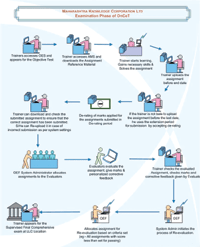
OnCeT comprises of eight unsupervised weekly tests and a final supervised comprehensive Online examination at the district location.

Type of each of the eight tests includes Practical and Objective type online tests. Each Practical Test comprises of three assignments which are to be solved in unsupervised environment and submitted in one week's duration and passing threshold is at 50% marks. Each of the Objective tests shall consist of 30 questions to be solved online in a single session of 45 minutes maximum one week delay in submission May be allowed with 20% de-rating of score, thereby requiring 62.5% marks for passing instead of 50%.
Eight tests have a weightage of 80 marks and a final supervised comprehensive Online examination has a weightage of 20 marks.

In all the interim assignments of OnCeT, various skills and competencies of the trainers at various levels have been tested, such as, knowledge, comprehension, application of knowledge and analysis.

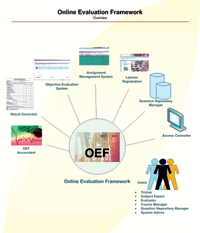
MKCL's Online Evaluation Framework

MKCL's Online Evaluation Framework (OEF) is a collaborative framework that facilitates Online Assignment Management and conduct of objective type tests with various types of questions.

Assignment Management System features

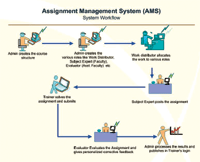
Authenticated Personal Interfaces: Online Assignment Management System offers authenticated personal interfaces for Trainers, Subject Matter Experts (Faculty), Evaluators (Assistant Faculty), Tutors (Lab Instructor) and administrators. This has been designed and developed with an integrated approach to enable the Subject Matter Expert (Faculty) to post assignments for the trainers based on the course structure.

Assignment Randomisation: By using the feature of randomisation, a set of assignments can be prepared and various assignments can be given to multiple trainers randomly.

Submission and Evaluation: Trainers can download, complete and then submit the assignments online for approval and feedback from the assistant faculty or local tutor which after approval are made available to the evaluators. This functionality is optional and in case of Supervised Final Examinations, assignments can directly be routed to the Evaluators for final evaluation.

Work flow: The automated work flow in the system keeps track of every assignment of individual trainer. Framework also offers the facility to the trainers to get the assignments evaluated from best of the evaluators.

Objective Evaluation System features
OEF also has an inbuilt engine to conduct Objective type tests with functionality offered to evaluators to frame variety of questions to test the trainers.

Different types of questions include multiple choice single correct, multiple choice multiple correct, match the following, fill in the blanks, picture identification, jigsaw puzzle, crosswords, hotspots, second level reasoning and concept map.

By following international QTI standards prescribed by SCORM, to maintain the question repository, different question parameters are stored, such as, difficulty level, type, marks, and associated learning unit.

Continuous up-gradation of the question repository enables the question paper setter to go for varied combinations while designing the paper structure. Also, framework supports random paper generation.

Trainer authentication features such as photograph and signature display on the screen are also best supported by the system.

Some of the important distinguishing features include test attempt record, result, and crash and recovery system.

System Interfaces
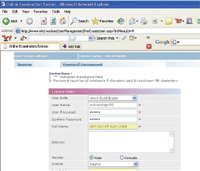
Admin's login: Admin creates users to perform specific role. With the specific user name and password provided by admin, the users can access OEF.

Work Distributor's Login: Work Distributor allocates the work to the Subject Experts (Faculties) and Evaluators (Asst. Faculties). While giving the assignments for Evaluation, Work Distributor decides the number of assignments to be given to one Evaluator. 
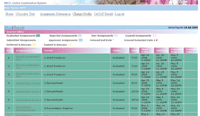
Subject Expert's Login: Subject Expert can post the assignment for various topics using the interface. While posting the assignment, s/he can set the start and end dates, extended date if any, maximum marks, number of re-submissions allowed, etc.

Evaluator's Inbox: Evaluator can download the solved assignment submitted by the Trainer and can Evaluate the same. After evaluation,
s/he can enter the marks and personalised corrective feedback for
that assignment.

Trainer's Inbox: Trainer can get a set of assignments to be solved in his/her inbox along with the reference
material available for download for
each assignment. Using the same interface, solved assignment can be submitted, marks allotted and corrective feedback given by the Evaluator
can be seen. 

Trainer's Interface for Objective Test:  Trainer can access all the objective Tests by using this interface. Upon selecting any Test paper, trainer can view the start and end dates, duration of test, total questions, etc…

Trainer's Result sheet: After
the evaluation process is complete, the Trainer can get the Result sheet in his/her Login. The Result sheet will
have the marks obtained out of maximum in each topic and also
the final percentage of marks and
final result.

Difficulties encountered and solutions designed and deployed during the implementation phase

Several difficulties that are addressed during the implementation phase are
(a)Failure to submit assignments on-time; (b) Incorrect Assignment Submission by Trainers; (c) Virus Infected Assignment Submission; (d) Natural calamity like floods; (e) Evaluators' Performance; (f) Re-evaluation requests from Trainers.

Extended Date of Submission was provided for the Trainers to submit the assignment after the original end date. A new feature was added in the OEF, which helps the trainer to view the already submitted assignment. The new feature routes the assignments for re-evaluation automatically, based on the criteria set by the System Admin. Special sessions on distributed classroom were arranged to orient evaluators. Continuous call center support was provided to the Trainers to handle their issues related to assignment submission using OEF. Integrated SMS Gateway technology was used extensively for instant communication and follow up with evaluators.

Spin-offs and future directions

 OnCeT Model was found to be generic and can be replicated for conducting IT based Certification Programmes by best using the configurability and customisation capabilities of the system. Online Evaluation Framework can be used for students of the Universities / Colleges offering Distance Education programmes. OEF can cater to the needs of the students undergoing these programmes by offering them an access to interim assignments and also the corrective feedback by remote evaluators.

About 12100 teachers (who appeared for OnCeT), 67 evaluators have contributed to the successful implementation of OnCeT programme and more than 180000 assignments have been submitted and evaluated so far.

OnCeT has become a case study for its unique methodology for skill testing, quality of the assignments, huge number of uploaded assignments, functional use of state-of-the-art e-Learning technology frameworks by thousands of grassroot trainers spread over the state of Maharashtra, and moreover, the characteristic collaborative effort of the evaluators to offer personalised corrective feedback to the trainers.

OnCeT programme, thus, attempts to simultaneously satisfy all the complex parameters affecting the learning services, such as, low cost, high quality, high speed, high touch, wide access and personalised experience to masses. 

In essence, Online Certification Test (OnCeT) illustrates effective functional use of eLearning Technologies by grassroot Trainers to test their IT competencies and set an example of avoiding the Digital Divide effectively. 

Blackboard backpack introduces SCORM support

The US based Agilix Labs has released Blackboard Backpack 3.1, an update to the company's mobility solution for the Blackboard Learning System. The new update adds support for the 2004 Sharable Content Object Reference Model (SCORM), including support for viewing SCORM content offline.

Blackboard Backpack is a system designed for mobile users of Blackboard learning management systems, providing offline access to Blackboard content, including courses, discussions, announcements, tasks, and calendar items, among others. It also allows Blackboard users to complete assignments or compose posts for discussions while offline, then upload the content the next time they log in to the Blackboard system. New in version 3.1 is support for SCORM content, including the ability to view SCORM content while disconnected from the server, as well as the ability to upload grades automatically from SCORM content to the Blackboard server gradebook, according to Agilix. The company said the new version also reduces network bandwidth requirements, contention, and latency. Blackboard Backpack 3.1 is available through Blackboard for Windows XP/SP2 and Vista. It requires the latest Blackboard Learning System update to support the new SCORM features. A free 30-day trial version is available.

DepEd inks partnership with STI to launch second mobile school

The Department of Education (DepEd) of Philippines has launched the second mobile school to make ICT based education more accessible to students and teachers in schools without computer laboratories.

A Mobile School is an Isuzu 50-seater roving bus managed by an instructor. A mobile School is equipped with 27 units of networked multimedia computers with broadband Internet connection. These computers are equipped with DVD-CD writers, LCD monitors, and sound system. DepEd had launched the first mobile school in January, 2007 and it has already benefited 6,000 students and visited 71 sites in Luzon. This joint initiative, coursed through DepEd's Adopt-a-School Program, also aims to enhance computer literacy among public school teachers.

Jakarta to Host the Global Conference on Open Source

The Ministry of Research and Technology and the Department of Communication and informatics, Association of Open Source Indonesia (AOSI) is currently preparing a great event titled 'Global Conference on Open Source'. This event is scheduled to be held in Jakarta on October 26 to 27, 2009 and is targeted to be attended by 500 participants, 50% of them are delegates from various countries around the world. Global Conference on Open Source (GCOS) aims to bring the global open source community together in order to address the growing demand for open source technology in every social spectrum. GCOS will generate an international collaboration among governments, businesses, academicians, and communities to strengthen the position of open source, making it more attractive and valuable for the society at large.

In a meeting organized by the GCOS Committee on September 11, 2009 at the Ministry or Research and technology office in Jakarta, various aspects of GCOS event such as speakers confirmation, venue and participants was discussed. Nearly 100% of Indonesian speakers have confirmed their participation They include Dr Zainal Hasibuan from the National ICT Board (DeTIKNas), Dr. Gatot HP from SEAMOLEC (Southeast Asian Minister of Education Organization Regional Open Learning Center, Dr Onno W Purbo (the National ICT activist), and from various institutions such as Telkom, Samudera Indonesia, Nanggroe Aceh Darussalam Province, Jembrana District (Bali), BlankOn Linux, Sangkuriang Studio, University of Gajah Mada, Department of Communication and Informatics, CommonRoom, and Bandung Istitute of Technology. Many International speakers such as Todishiro YOSHIDA (NTT Japan), Dr Clam Webb (Harvard University), Richard Randriatoamanana (CNRS France), Prof. A Min Tjoa (Vienna University of Technology), Ms Andrea Reimer (Councilor, Vancouver, British Columbia, Canada), and Prof. Rajanish Dass (Indian Institute of Management) have confirmed their participation. In addition, Asia Open Source Software (AOSS) and NECTEC Thailand have also confirmed to participate. The GCOS committee is at the moment finalizing several more confirmation from other international speakers from MAMPU (Malaysia), SITA (South Africa), Gendarmeri Nationale (France Police), MIC(Japan), NICTA(Australia), TEC (New Zealand), Indian State of Kerala, Open Source Initiative, Extremadura Regional Government (Spain), KERIS (Korea), Asianux, (Korea), Bayanihan Linux (Philipines), IBM, Sun Micro System, Userful, Inc (Canada), Kerstel Signal Processing(USA), Ubuntu, Canonical Inc (UK), dan OpenSUSE, Novell (German/USA). Several workshops will also be conducted during the conference.

Software to track school dropouts in India

The Indian state of Tamil Nadu has introduced back2school, a unique web-based programme under the Sarva Siksha Abhiyan- the flagship education programme- to track school dropouts in one of its districts.

All the 8,867-odd children in the district will be targeted to be back in school by December, 2007. The new initiative is a web-based software for tracking and monitoring all out-of-school children. The programme works two fold: in the first phase, data about all children of school going age in the district is collected and collated. The software generates a unique id for every child in the central database for tracking its further development. In the second phase, a group of volunteers at each of the panchayats periodically collect basic information about each child and update the details on the system. Though the project is currently restricted to Krishnagiri district, the standardised processes with the entire software in place will make it easy to replicate. 

eInstruction to acquire Interwrite Learning

The US based eInstruction has signed a definitive agreement to acquire Interwrite Learning. Both companies develop classroom technologies for K-12 and higher education environments, including whiteboards and student response systems and software.

The combined company will go by the name of eInstruction. Darrell Ward, founder of eInstruction, will remain CEO of the combined company, while Interwrite's Steve Kaye will take on the role of president. The product lines of both Interwrite and eInstruction will continue to be fully supported, and no products will be discontinued in the short term. Interwrite's products include the Interwrite Board, Interwrite Panel, Interwrite Pad, Cricket (a student response clicker), Interwrite PRS (another student response device), and various software products, including Interwrite Workspace. eInstruction also provides classroom response systems and software, including CPS, a classroom system that allows all students in the class to respond to questions simultaneously by entering input into a handheld pad. It can be used for testing purposes, for the collection of data for comparison against state standards, for collaborative learning, and for assessment. The acquisition is expected to be completed in December.

India to launch universalisation of secondary education scheme

A centrally sponsored scheme for universalisation of access to and improvement of quality of education at secondary stage will be implemented during the 11th Plan period.

The objective of the scheme is to make secondary education of good quality available, accessible and affordable to all young persons in the age group of 15-16 years. The funding pattern of the scheme has not yet been finalized. 

UGC releases list of fake universities in India

The University Grants Commission (UGC) of India has released a list of 21 fake universities and institutions that are in existence in the country in violation of Section 22 of the UGC Act, 1956.

In order to curb fake educational institutes, the UGC has proposed comprehensive changes in the UGC Act, which include, inter-alia, inclusion of the expression of the word University, Vishwavidyalaya or Vidyapeeth etc. in various regional languages and also providing for deterrent punishment including imprisonment for a period upto three years and penalty upto Rs. 10.00 lakhs, besides making the offence cognizable as well as non-bailable.

The list includes the following universities and institutions: Maithili University/Vishwavidyalaya, Bihar; Varanaseya Sanskrit Vishwavidyalaya, Varanasi (UP) Jagatpuri, Delhi, Commercial University Ltd. Daryaganj, Delhi, United Nations University, Delhi, Vocational University, Delhi, ADR-Centric Juridical University, New Delhi; Badaganvi Sarkar World Open University Education Society, Belgaum, Karnataka; St. John’s University, Kerala; Kesarwani Vidyapith, Jabalpur (MP); Raja Arabic University, Nagpur, Maharashtra; D.D.B Sanskrit University, Tamil Nadu; Mahila Gram Vidyapith/Vishwavidyalaya, (Woman’s University) Allahabad, U.P., Indian Education Council of U.P., Lucknow (UP), Gandhi Hindi Vidyapith, Prayag, Allahabad (UP), National University of Electro Complex Homeopathy, Kanpur, Netaji Subhash Chandra Bose University (Open University) Aligarh (UP), Uttar Pradesh Vishwavidyalaya, Kosi Kalan, Mathura (UP), Maharana Partap Shiksha Niketan Vishwavidyalaya, Pratapgarh (UP), Gurukul Vishwavidyalaya, U.P., Indraprastha Shiksha Parishad, Noida, (UP), Indian Institute of Science and Engineering, New Delhi.

LATEST NEWS