


Home Blog Page 1700

Hamro Pathshala

Hamro Pathshala (meaning Our School in Nepali) is a distance education of Madanpokhara community multimedia centre (CMC) ideally designed for any 13-14 year old disadvantaged Magar ethnic girl from Palpa district in Nepal. The targeted audience will be currently studying in class 8 and appearing for school leaving certificate (SLC) exam in three years time. The main goal of the initiative is to improve the performance of rural poor and disadvantaged students when they appear in SLC exam in three years time

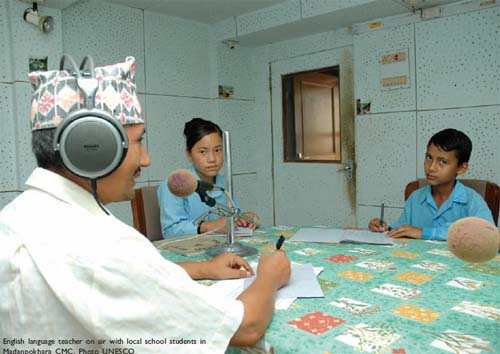
Madanpokhara community multimedia centre (CMC) in Palpa is an outstanding example of rural based community access in Nepal and South Asia. Community Multimedia Centres (CMCs) promotes community empowerment and addresses the digital divide by combining community broadcasting (community radio and TV) by local people in local languages with the Internet and related technologies. The CMC here combines community radio in local language with telecentre facilities. The main goal of the radio station is to contribute to local development by promoting public awareness and dialogues, knowledge sharing, good governance, community participation and local culture and positive entertainment. It is run, managed and controlled by the media committee comprising of various community people engaged in development works.

In August 2005, the CMC launched a new educational programme called “Hamro Pathshala” (Our School) using both radio and new media tools. With majority of young people failing in school leaving exam, the programme aims to improve local students' performance over the next three years. Recently the programme completed its first year of academic session. It has become an effective distance learning tool for students in Palpa in western Nepal who face disturbing and disruptive political situations in Nepal hampering the educational progress. Over 99 episodes of half an hour programme have been broadcast between August 2005 and March 2006.

Why a formal course in non-formal mode?

Hamro Pathshala is ideally designed for any 13-14 year old disadvantaged Magar ethnic girl (Magar is the most predominant ethnic community in Palpa with majority of this ethnic girl child failing in SLC) from Palpa region. The targeted audience will be currently studying in class 8 and appearing for SLC exam in three years time. She has an average intelligence level but cannot afford special tuition classes outside school. Her family is completely dependent on agricultural labour and they cannot afford to send her to private school in Tansen, the district headquarters.

According to local District Education Office (DEO), Palpa district pass percentage in 2005 School Leaving Certificate examination was a dismal 26.43%. In 2004 only 38% of the total 2,16,303 examinees managed to pass. An analysis of the figures shows that students from ethnic, dalit and backward communities predominate among the failures. Compared to other South Asian countries, the SLC failure rate in Nepal is very high, the average of five year results in the Palpa district being as low as 40%.

Although the main reason behind the failure is none other than the education policy and programmes adopted by the government have also played a negative role. The shortage of trained and motivated teachers is another main reason, and the others are understaffed and under funded rural government schools. Limited skilled teachers are available in subjects like Mathematics, Science and English of remote areas in Nepal. All this coincided with the Maoists shutting down private tuitions and schools during the conflict and a ban on using government funds for development work. It was a double whammy for a district that placed a premium on education. As the blockade closed highways, students appearing for SLC had to walk to the district head-quarters every day for their exams. Considering all these challenges Madanpokhara CMC came up with the plan to use media for education to improve the student performance, teaching and learning process.

Programme design

Hamro Pathshala is ideally designed for any 13-14 year old disadvantaged Magar ethnic girl (Magar is the most predominant ethnic community in Palpa with majority of this ethnic girl child failing in SLC) from Palpa region. The targeted audience will be currently studying in class 8 and appearing for SLC exam in three years time. She has an average intelligence level but cannot afford special tuition classes outside school. Her family is completely dependent on agricultural labour and they cannot afford to send her to private school in Tansen, the district headquarters.

Hamro Pathshala is run by local teacher who have volunteered from three local high schools and airs three days a week for 30 minutes. Last year the interactive classroom targeted class 8 rural poor and disadvantaged students in subjects like Mathematics, English and Science. This year the programme will reach to class 8 and 9 students. In the following year, the programme will reach to class 8, 9 and 10 students.

The programme planning is done with teacher volunteers and the production team. Four local teachers participated in the UNESCO supported two phase week long training on educational radio concept development and radio literacy. During the training, teachers were also introduced and trained in the application of computer and Internet in web browsing the educational materials, learning and teaching processes. The programme combines actual teaching with school content covering awareness, general information, teaching and learning experiences.

Programme clock

The programme effectively reaches to over 27 village development committees (VDC) and Tansen Municipality covering over 7 lakh potential audience. According to DEO fifteen thousand students of sixty high schools in the region directly benefits from the programme. Madanpokhara CMC has also extended its network with the establishment of four telecentre facilities in the government run schools. The telecentre facilities in the schools are used for basic computing training, digital content production and accessing the educational programme for students studying in class eight, which will be later followed by class nine and ten. The recorded educational programmes are archived in the form of digital library in each of these telcentres. The students and teachers use the telcentre facilities in listening to previous day's education content and discuss about the programme. It is particularly useful for students and teachers who miss out during the broadcasting time. This education programme has become the part of the school curriculum in these four centres. The telecentre facility also helps the programmer get the immediate feedback<
ICT Competencies Among Adults in Rural Malaysia

The article reports on the evaluation of two programmes – Computer Literacy and Civic Development offered by a government agency (KEMAS) to rural communities, in addition to discussing the goals and challenges of adult education in Malaysia. The evaluation makes out some suggestions for the government agencies, private sector, NGOs and the wider community to work together in order to support adult learning especially in the rural areas and also recommends for a comprehensive assessment to be conducted by KEMAS in order to keep up with the current demands.

As a developing country, Malaysia grapples with the task of building its economies to achieve sustainable development and to improve the quality of life of its people. There is a growing recognition that the education of the adult population is essential to sustain economic growth and development. As a country that has developed tremendously for the past two decades, Malaysia has become an example and is often cited by economic analysts and developmental planners as a model of a developing country. To continue to become fully developed, Malaysia needs a labour force that is well educated, dynamic and skilled.


Pursuing Better Access, Availability, and Affordability to Learning

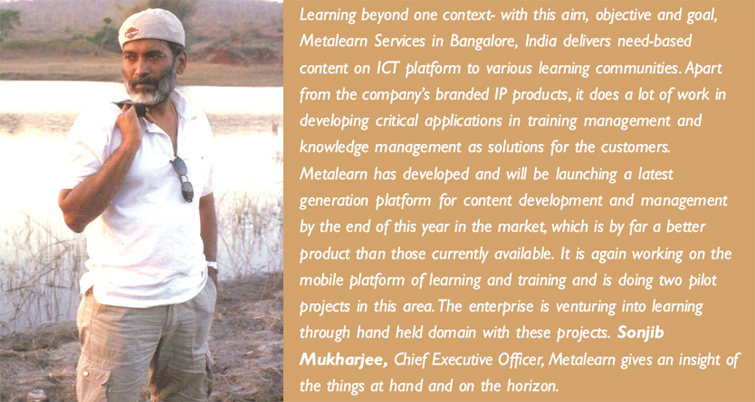
What took learning to be named as Metalearn by you? Please tell us about how and from where did you start your journey towards Metalearn.

Meta is a terminology that is analogous to the IT industry today. Meta means beyond in one context. The idea here is that learning will move beyond the usual practices into new domain and experiences for all users with technology as the great enabler. As dynamic learning environments emerge and demands from users evolve, IT and ICT will meet these new challenges continuously in the global context.

Metalearn was founded in 2003 with the singular objective of taking the user experience in learning beyond the contemporary into the future. The axiom that we follow from day one is to create better access, availability and affordability of learning for all.

What is the real focus of Metalearn- academic or enterprise e-learning? If both, then in terms of reaching the target who comes first?

We do not essentially differentiate between users in terms of pure experience of joy and usability between academic and enterprise learning. These are business sectors defined by user demands of different kind. At the end it's the user experie-nce that counts and we have built our competence equally in both sectors.

In terms of reaching the target, the need has been quite clearly defined by the enterprise learning users already in the market and our reach potential is the highest today in this sector. However, the fact remains that in the long run the volume and industry challenges are bound to be much greater in the academia and the scenario will dramatically change in the coming two to three years.

How do you see the Global market of e-Learning? Which sector of the market (K-12, higher education, corporate learning etc) do you think will see the maximum growth in the next few years?

The corporate e learning sector is seeing certain amount of standar-disation and consolidation in terms of process and practices already and is growing faster than the education sector in terms of specificity and ROI. But the education sector on the whole has a much larger and wider potential in terms of growth and in sheer spend terms will be way ahead of the corporate sector by 2010 globally.

Adventus seems to be the most viable product of your company. How flexible are your products in delivering content enterprise wide.

We have two pure technology IP products in the stable, Adventus and Metatest. Both these products have been widely accepted by users worldwide and after a successful debut in the Indian market we now receive a high level of demand from the global market as well. These are leading brands in LMS and Test Engine today coming out of India in the world market. The products are capable of high level of robust and scalable deployments and can meet complex solution architectures for delivering learning across thousands of users in diverse environments.

Your products are better recognised as bridging the cost gap. Please justify. Does that mean you target primarily to small and medium enterprises?

You are absolutely right. We offer a large cost advantage compared to other global brands and learning officers worldwide and university budget committees love our packages. It was a conscious decision on our part to keep prices affordable in keeping with our view of access, availability and affordability. This of course means that large segments of the SME everywhere become our customers automatically. The potential of the SME cannot be undermined in the learning business today since in the global process of ancillarisation the SME sector is one the largest consumers of learning.


What have been your organisation's achievements in this line? Do you think you have made a mark in this sector? How?

Our biggest achievement has been to break the price barrier with global quality. In three years we work with leading companies of the world, and provide complex solutions to their learning needs, operate and lead with brands and believe that we have shown what it takes to be a global player despite being small and Indian.
We attribute this largely to the fact that we are an open organisation and our teams love the work they do. We follow standard benefit norms but have very low attrition.

What has been the critical roadblock that Metalearn has crossed to be where it is now?

Our major challenge has been to compete globally. And trust me, India is quite a global market. One who succeeds in India can succeed globa-lly. It was a very tough route to take but we could crack it in two years. Today we enjoy references from our customer global MNCs in India to their headquarters back home. This is big for us. The response from the global market to our products and services is huge. We have just kicked off Metalearn US based in Florida USA. The critical roadblock was to match investments with global scaling. This could break our back but we are through all that.

As the CEO, where do you see Metalearn five years from now?

By 2010, we will be the most reputed e-learning company out of India globally with highest profitability. This India part is important to us because as an Indian company we have the potential to produce best quality work in learning technology and we will pursue this continuously to give better access, availability and affordability to learning. We will be more of a practice, more of a specialist and a knowledge house rather than a super large producer of elearning.

Rural Literacy

The rapid progress in modern Information and Communication Technology (ICT) is seen as one of the potential tools for literacy and non-formal education. It can be effectively used for designing and developing locally relevant and acceptable curriculum with sensitivity to individual learners options and interest. Although this ICT enabled learning curriculum needs to be placed in an appropriate socio-cultural context of the community to achieve the proposed objectives and development. The article attempts to focus on the process of intervention, approach and strategies adopted by M.S.Swaminathan Research Foundation (MSSRF) in India where ICTs are being used to facilitate rural literacy programmes at village level through the Village Knowledge Centers.

Learning is a social process; It is important to develop a demand for learning among the individuals. Family and community act as the motivational factors for learning. Family helps to set the personal learning goals with learning inside and out side the classrooms. Learners' previous knowledge and his/her environment are vital for developing materials for learning. Facilitation and discussion instead of instruction is essential as a teaching method. Technology facilitates access and meets the challenges of the learner-centered curriculum. Learner specific curriculum developed by the learner him/herself with the help of family ensures the relevance of learning to the learners.

Location and partners

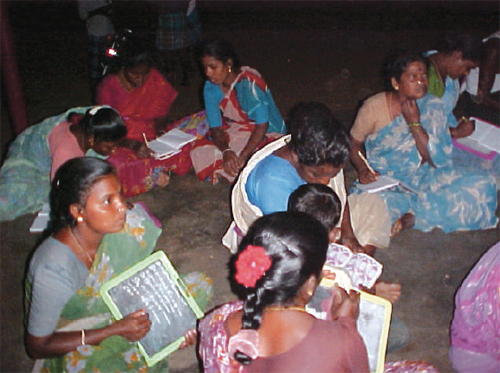
In Kannivadi region of Dindigul district, Tamil Nadu, India, M.S.Swaminathan Research Foundation (MSSRF) has been working for the last five years on issues related to sustainable agriculture and is involved in developing multiple livelihood strategies to alleviate rural poverty. The mobilised farmers and landless people were facilitated to form Self-Help Groups (SHGs). These SHGs are managing the project activities at hamlet level. Through a survey and analysis among the illiterate members in each village, 25 men and 25 women were selected for the first batch. While selecting the learners two criteria's were applied such as individual's enthusiasm and interest to learn and the family's support to cooperate with the learner.

Family is considered as the agency to facilitate the learning process and guarantee the learner to continue the course till he or she becomes a functional literate. The importance and approach of the project was shared with the family members and a request was made not only to ensure that the family would allow the person to complete the course, it should take the responsibility of acting as a learning center for the participant and finally it should help to assess the result at the end of the project.

Learning plan and learning resources

Village Knowledge Centres (VKCs) come as the most effective means for MSSRF to take on this ICT and rural literacy drive. The VKCs are computer based knowledge centers with Internet connection provides need based static and dynamic information. A set of VKC's operating in a region are connected with a 'hub' in the center and the 'hub' is the nodal point, which receives the generic information and adds value by converting it to locale specific information. The local community manages the VKCs; access is ensured to all irrespective of caste, class, gender and age. Need based content creation is regularly done on the basis of the need assessment and feed back from the local women and men visit the VKC. The local village people are trained in the management of modern information and communication technologies like operating the computers and hardware maintenance.

The participants were trained in using digital cameras, prepared the visual materials and the appropriate local wordings/phrases (curriculum) to develop a learner specific learning materials. The facilitators collaborated with each learner to prepare the material in power point mode and compiled it in a Compact Disc (CD).

Self-learning material aroused and sustained the interests of the learners. Generating learner specific and hamlet specific resource materials reduced and discouraged the instructions and dependency on instructors/teacher. The computer based self-produced, self instructional materials eliminated the gap and strengthened the link between the learner and learning materials. Use of advanced technologies like digital cameras and computers with touch screens, an electronic tablet for writing practice accelerated the process of individual based curriculum development and encouraged the active participation of the learners in the programme.

Learning as fun: The family's support

In the process of material preparation not only the individual learner but also the whole family were involved and converted the activity as fun. The other members in the family played the multiple roles of instructors, co-workers, collaborators and evaluators in the learning process of the participant. The family shared the responsibility of the entire process starting from designing the curriculum to evaluating the results at the end. Family gave the opportunity to the person who has relatively more free time to participate in the project. Functional need of literacy to the individual is also considered by the family for recommending the person to participate in the project.

Animators as mentors

The animators facilitated the learning process through discussion and attending the specific needs of the individuals. Continued feedback and motivation from the facilitators help the participants for consistent improvement. Sensitivity to individuals learning styles helps each participant for a smooth sailing. The informal approach adopted by the facilitators encourages the learner to express his/her doubts and opinions without hesitation, this also helps to promote peer teaching. Encouraging peer teaching and group work provides an environment for examination of each other's experience and arriving a consensus on issues related to learning process.

Learning is a process

The family and VKC share the responsibility of providing favorable learning environment for the learn



ESPN-StarSports launches ESPN Mobile service for mobile phones

< ?xml:namespace prefix = o ns = "urn:schemas-microsoft-com:office:office" />

ESPN-StarSports (ESS), Sports broadcaster is launching a value added service domain for mobile phones. ESPN-Star Sports is launching ESPN mobile, which will offer subscribers news, interviews and other information on sports events.


ESS is hoping that approximately 100 million subscribers will use this service. Company has invested about Rs 40 crore in this service. Initially the service would be offered in Hindi and English and later on company will provide services in regional language also. User can access this service from their mobile phones. Mobile ESPN is a 360 degree sports service which will cover all games in all possible game formats like video, voice, text, SMS with the monthly package from Rs. 50 to Rs. 100. 

Cisco wins the Gold Brandon Hall Learning Award for delivering mobile learning platform

    Cisco announced that the company has been awarded for the Gold Brandon Hall Excellence in Learning Award for its Mobile Learning Delivery Platform. Cisco has developed this platform in conjunction with Sify e-Learning, the learning services practice of Sify Ltd.


    Cisco's Mobile Learning Delivery Platform will allow user to read Cisco's Quick Learning Modules from their handheld devices like mobile phones, PDAs. A Cisco Quick Learning Module is a free online training component, which will help in enhancing skills or completing a specific configuration task on newly released Cisco products. Cisco and Sify has created a customized Macromedia Flash tool to develop and deliver the QLMs on the PDA platform.

    Educomp brings Smart Class Programme in 200 Indian schools

    < ?xml:namespace prefix = o ns = "urn:schemas-microsoft-com:office:office" />

    Educomp Solutions, < ?xml:namespace prefix = st1 ns = "urn:schemas-microsoft-com:office:smarttags" />Delhi based e-Learning company is planning to bring 200 new schools across the India under the preview of its Smart Class programme. Presently, Smart Class programme is already developed in 126 private schools in the country as well as a few schools in US and Singapore. 


    Smart class is a complete solution, which will allow teachers for instant access of instructor-led multimedia content and instruction materials mapped precisely to the curriculum guidelines. It will also allow teachers to access and evaluate the students learning achievements. According to Abhinav Dhar, senior vice-president (K-12), Educomp, there are about 35,000 thousand private schools in India and company has already spent INR 700-800 crore to bring this technology in India. The company is talking with several state governments, including Tamil Nadu, Karnataka, Assam and Delhi to implement this Smart Class programme in schools.

    Cisco grows base of Networking Academies by 73% in 2006

    Reiterating its commitment to bridge the digital divide and foster education, Cisco, the worldwide leader in networking for the internet has announced a major expansion to its NetAcad (Networking Academy Program) in the Gulf region. Over 2006 financial year, the program grew 73 percent as compared to 2005 and in all, 45 new academies were established over the last year.

    This announcement also follows a recently published IDC report highlighting the growing gap in the supply of qualified networking professionals required to support the technology infrastructure of the booming Middle East economy. The expansion to the Cisco Networking Academy Program aims to bridge growing ICT skills shortages in the region by providing a curriculum tailored to industry's needs. The program runs in high schools, colleges, universities, technical and military schools, community-based organizations and government organizations. Its curriculum combines the theory and practice of designing, developing and implementing the networks that underpin businesses and other organizations. In all, 111 academies have been established across UAE (27), Pakistan (56), Afghanistan (7), Oman (10), Bahrain (3), Kuwait (4), Qatar (2) and Yemen (2).

    Launched in October 1997, the Networking Academy program has grown to more than 11,000 academies in more than 151 countries. The curriculum comprises a variety of courses for careers in network design and administration, technical support, programming, software engineering, database development and administration.

    It is delivered in 11 languages to over 1.9 million students in academies in high schools, colleges, universities, technical schools, community based organizations and other educational programs around the world.

    The Academy program uses a blended learning model, integrating face-to-face teaching with a Web-based curriculum, hands-on lab exercises, and Internet-based assessment. Graduates are prepared for networking and IT careers in the public and the private sectors, as well as for higher education in engineering, computer science and related fields.

    All primary schools in Bangladesh to get free Internet in 10 years

    All the primary schools of Bangladesh will be given Internet connections free of cost in the next 10 years under a deal between the government and a US-based company.

    Presently, there are about 78,000 registered, non-registered, community and government primary schools across the country, while the number of secondary schools stands at around 16,000. Always On Network (AON), a US-based communication services provider, will invest US$ 60 million for ICT training, setting internet exchange, tower and countrywide network, cooperating to set high-tech zone and start e-commerce, as per the Memorandum of Understanding (MoU) inked between the two parties. Under the project, the company plans to build Middle Mile, Last Mile and backbone networks using wireless transmission equipments to expand high bandwidth Internet services in the rural areas.

    The project will first initiate radio-link wave and progressively introduce the fiber-optic link. It will have several base stations at 87 points across the country, which will include 19 in Dhaka. The American internet service provider AON received licence from Bangladesh Telecom Regulatory Commission in March this year as a joint venture company – Always On Network Bangladesh Limited.

    Sakshat, new e-Learning programme launched in India

    < ?xml:namespace prefix = o ns = "urn:schemas-microsoft-com:office:office" />

    Human resource ministry is planning to set up vocational education programme named, Sakshat, which is one stop education portal for 50 crore users. The programme was formally launched by the President A P J Abdul Kalam on Oct 30, 2006.

    The University Grants Commission has also accepted the proposal of this programme. The portal of this programme is also available http://portal.sakshat.gov.in/wps/portal The Commission will provide broadband connectivity to approximately five lakh college teachers of central and state universities. UGC, AICTE, IGNOU, NCERT, KVS, NVS, CBSE, IITs and IISc has developed the content links for Sakshat and provide wide range of knowledge resources, educational views, examination alerts, sample papers and other useful links on the web. The portal has five functional modules, e-books, e-journals, digital repository and digital library. The links of various Olympiads would also be provided in this programme. Even students can interact with their teacher in real time and as well as access e-mail, web blogging, web casting, onlie chat and discussion forum. 


    LATEST NEWS