

Home Blog Page 1765

Networking for Capacity Building

Cisco Network Academy Program
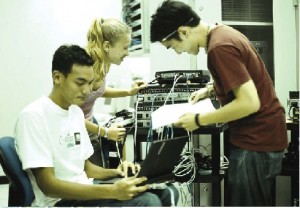
Cisco Systems runs theCisco Networking  Academy Program through a highly successful alliance between Cisco System, education, business, government and communities to create a pool of trained manpower  that can addressed the growing  need of  networking professionals in a globalised world.

over 41,000 networking professionals during 2005-10,  driven by regulatory compliance. Telecom sector, which currently  accounts for around 16% of the total demand of networking professionals, is  expected to witness an additional demand of over 75,000  professionals during 2005-10. BPO/ITES is the segment will witness the highest growth in the demand with a CAGR of  35% during the period 2005-10. Due to an increase in technology adoption, the  demand for networking professionals in the governance and  the retail sector is also expected to increase considerably.

Cisco Networking Academy Program- a response to global needs
Cisco Systems, Inc. is the worldwide leader in networking for the Internet. Today, networks are an essential part of business, education, government and home communications, and Cisco Internet Protocol-based (IP)  networking solutions are the foundation of these networks.  Cisco Systems runs the Cisco Networking Academy Program  (CNAP), a timely response to such challenges in India and around the  world. It is a highly successful alliance between Cisco Systems,  education, business, government, and communities. Through an innovative partnership with educational  institutions across the world, the CNAP is a world wide philanthropic  rogram (part of Cisco’s corporate  social responsibility initiative) aimed at creating a pool of trained manpower  that can address the growing need of networking  professionals. The CNAP offers a solution to address  he need for greater  technology literacy. In developing and emerging markets,  the content and learning  methodologies  provide a significant step forward in  education and opportunity for  participating students. The key  promise: a way to spur growth in a  global economy that places high value on technology  leaders.  Since its launch in 1997, the program
has grown to more than 10,000  worldwide academies in over  160 countries, with curriculum taught  in nine different  languages. Over 1.6 million students participate in academies operating  in high schools, colleges and universities, technical schools, community-based organizations, and other educational  programs around the world.  The program objectives and modules

The program empowers people
through e-Learning environments that enable them to learn anytime, anywhere, at their own pace, and with  more targeted assessments and accountability than traditional  classroom settings. It is an e-Learning model that delivers web-based  educational content developed by networking and education experts,  online assessment, student performance tracking, instructor  training and support, as well as preparation for industry standard certification. It provides educational  institutions with leading-edge IT  curricula and hands-on lab exercises  to train a workforce that may attract highly desirable  technology employers. One of the most popular courses, Cisco Certified Networking Associate  (CCNA) is a complete, four-module program on the principles and practice  of designing, building, and maintaining networks capable of  supporting national and global organizations. The Cisco Networking
Academy Program is in line with  needs of colleges, and features hands-on, project-driven training in  high-demand job skills. It incorporates an e-Learning system that includes  multimedia curricula, online testing, performance-based skills assessment,  and classroom management through a Web interface. The Networking Academy program  also offers courses sponsored by Hewlett-Packard and Panduit Corp. as  a part of the overall basket of course offerings. The sponsored curriculum  enhances IT competencies throughout the the program and, by  broadening its scope, offer more students the opportunity to take advantage of the program.

Cisco partnering for education
There are several successful examples of the positive impact of the Cisco Networking Academy Program on arious countries/economies. One of them is the Jordan Education  Initiative for which Cisco Systems  was awarded last year’s US Award for Corporate  Excellence.  The Jordan Education Initiative (JEI), an ambitious e-Learning project, is  helping improve Jordan’s educational foundation and establish an Internetenabled  learning model that can be replicated around the globe. CiscoSystems President and CEO John T.  Chambers proposed the idea of creating the JEI at the January 2003  World Economic Forum (WEF) meeting in Davos, Switzerland,  as a way for companies to join forces with government and nonprofit organizations to create a technologybased  education program. Cisco and the WEF, along with World Links (a Washington, D.C.-  based organization devoted to using the Internet to improve education), and several Jordanian ministries, launched the JEI five months later.  The Jordan Education Initiativesupports the Jordanian government’s vision of building a knowledge-based  economy by providing lifelong   earning opportunities for all citizens. The JEI’s broad application of elearning, hardware, curricula, and  training is already transforming education in public schools  throughout the country. The Jordan Education Initiative has set the stage for similar initiatives to be replicated in  other parts of the  world. One such initiative is Cisco Systems’ partnership with the Indonesian Government. Indonesia’s  efforts to produce a whole new generation of IT professionals with a  strong foundation in networking and the Internet received a  major boost in 2004. Cisco Systems and  the Indonesian Ministry of Education  signed an agreement to extend the Cisco  Networking Academy Program to 400  vocational schools across the country, in  an initiative  spearheaded by the Directorate of  Technical and  Vocational Education to support Indonesia’s economic  growth and public and private sector requirements.  Another example is the Rajasthan Education Initiative  (REI) that was aunched in November 2005. A  Memorandum of Understanding(MOU) was signed between Government of Rajasthan, India and  Cisco Systems, to introduce the Networking Academy Program to 32  district computer education centers. Cisco will initially provide training  to 100 teachers, who in turn will train 3200 students with fundamental  IT skills in the first year of the project. As part of the initiative, Cisco will  also provide consulting services on networking and security aspects for  connectivity within the Education Department Computerization Program  and its data center to link locationswithin the state.  The key demographic groups that the REI will focus include: girl children,  rural children, urban underprivileged children, children with special needs.  Outside of REI, Cisco has setup more than 130 Networking Academies  across 20 States and Union Territories, with more than 6000 active
students. These academies look to bridge the digital and gender divide in  the country by providing career opportunities to aspiring students in  the networked digital economy. The networking academies include  institutes like IIIT Bangalore, Anna  University, Amrita Vishwa Vidyapeetham, Guru Gobind
Indraprastha University, IMT  Ghaziabad, PNB Institute of Information Technology and several government polytechnics. There are  also six  academies that impart networking and basic IT essentials  education to women. The academies  are in Jaipur, New Delhi, Pune, Kerala and Himachal Pradesh. Other countries where the Cisco  Networking Academy Program is running successfully in the Asia  Pacific region include China with 219 Academies and 12,445 students,  Australia with 212 academies and 8,732 students and Philippines with  136 academies and 26,990 students  among others.

Looking ahead
The Cisco Networking Academy  Program is playing a key role in building technical human capacity across the world, especially  developing nations. It is  roviding  new opportunities to countries and individuals to participate in the digitally networked economy. Cisco will continue to work with  governments  round the world to  expand the reach of the program.  It will also keep evolving the curriculum to keep pace with  technological advancements and extend it to new areas/technologies such as IP telephony and wireless among others. ?

India Inc. Leads the Way

Blueprint for a Knowledge Society Dr A P J Abdul Kalam presents his  vision
The President of India, Dr A PJ Abdul Kalam, in his inaugural address at the recent Partnership Summit 2006, in Kolkata, presented his vision for India to become a knowledge society. Digital Learning shares extracts from his speech and more.

Knowledge society, role of education
“The whole purpose of education in a country is to develop and enhance the potential of our human resource and progressively transform it into a knowledge society.” Addressing the Partnership Summit in Kolkata, India, in January this year, the president of India, Dr A P J Abdul Kalam, presented his vision for India to become a knowledge society.  The president envisioned the knowledge society to be a society producing products and services  that are rich in both explicit and tacit knowledge, thus creating value added products. The president emphasized – “Our education system should realign
itself at the earliest to meet the needs of the present day challenges and be fully geared to participate in the societal transformation through innovation, which is the key to competitiveness. It should also  develop a global outlook.” The real capital of this knowledge society will be its knowledge  components. Education in this respect has the most crucial role to play in the country’s progression to a  knowledge society.

Building a networked society  on the foundation of connectivity and partnerships
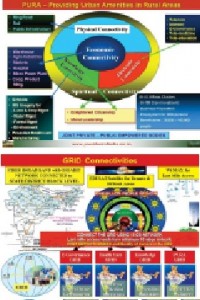
The president proposed two systems  of national development that will lead to rural development, the PURA  (Providing Urban Amenities in Rural Areas) system and the national  electronic GRID connectivity.   PURA facilitates creation of employment in the rural areas itself. PURA achieves this by providing physical, electronic and knowledge connectivities to a cluster of villages thereby leading to their economic  connectivity and prosperity. Knowledge creation and knowledge  utilization is the key to the success of a PURA programme.  The president further pointed out that integrated Village Knowledge Centres  will act as an inter-connected delivery mechanism for tele-education, telemedicine and e-Governance services apart from individual access by the people, within and between the  Village Knowledge Centres. This GRID will weave the people together in to a strong social fabric. Apart from economic prosperity it will bring  societal transformation. The president’s vision entails this society to be highly  networked to be able to create knowledge intensive nvironment along with enabling process to efficiently create, share, use and protect knowledge. The networking should happen through an electronic connectivity, partnership between governmental and multiple institutions in the public and private domains and a synergy between various components of education, healthcare, e-Governance and rural development. With respect to connectivity, the president envisioned the importance of physical connectivity through quality roads and transport and electronic connectivity through telecommunication  with high bandwidth fiber optic cables reaching the rural  areas from urban cities and through Internet kiosks.  With respect to education, the president emphasised knowledge connectivity through education,   vocational training for farmers, artisans and craftsmen and entrepreneurship programmes. These three connectivities (physical, electronic and education) will lead to  economic connectivity through starting of enterprises with the  help of banks, micro credits and marketing of the products. In this respect, the president emphased a public-privatecivil society partnerships in development efforts. The strength of this partnership for collaborative growth and economic prosperity should be facilitated by free flow of knowledge and information in  a seamless manner cutting across levels and boundaries  embracing all walks of life in the three sectors of the economy such as agriculture,  manufacturing and the services sector He said “Two decades ago,  there had not been many international partnerships in India. Therefore, one could keep track of all the partnerships entered into by various business houses. In the recent past there is a trend of increased partnerships by India with many  countries”. The president recomemded that CII create a directory of  existing partnerships and make this available to the development community. This will enable propagation of real
meaning of globalization and will stimulate more partnerships and draw our youth into partnership operations.  The president highlighted the importance establishing connectivities among the  various components of education, healthcare, e- Governance, rural  development. This could be achieved by establishing GRIDs namely knowledge  grid, healthcare grid, e- Governance grid and the PURA knowledge grid. These  connectivities through GRIDs will maximize the synergy  between these various components; bring seamless
access and information flow among the various domains  leading to maximization of GDP and productivity. This interconnecting grid will be  known as societal grid that will promote knowledge sharing,  knowledge utilization and knowledge  re-use which is very vital for faster
economic growth and productivity. ? 


Forty Years of Collective Design-Making

The Southeast Asian Ministers of Education Organization (SEAMEO) In recognition of the importance of regional co-operation in facilitating development in general and Education, Science and Culture in particular, the Southeast Asian Ministers of Education Organization (SEAMEO) was established to promote regional cooperation for human resource development in Asia. Since 1965, SEAMEO, through its various regional centers,
spread
across 10 member countries, has successfully explored the fullest potentials of people in the region through quality and equity in education, preventive health, culture and tradition, training, research, information and communications technology, languages, poverty alleviation, and agricultural natural resources. Today, SEAMEO is not only the oldest chartered intergovernmental organization serving the Southeast Asian region but also the Southeast Asia’s largest, longest existing, and most dependable provider in human resource development. This issue of Digital Learning profiles SEAMEO and its outstanding presence in Southeast Asia.

The Southeast Asian Ministers of Education Organization (SEAMEO) is an international and intergovernmental organization established in 1965 to promote regional cooperation in education,  science, and culture. Its 10 Member Countries include Brunei Darussalam, Cambodia, Indonesia, Lao PDR,
Malaysia, Myanmar, the Philippines, Singapore, Thailand, and Vietnam. It embodies 7 Associate Member Countries: Australia, Canada, France, Germany, the Netherlands, New Zealand, and Norway; and one Affiliate Member, the International Council for Open and Distance Education (ICDE).

Organizational structure
The SEAMEO Council, the Organization’s governing body, is composed of the 10 ministers of education of the SEAMEO Member Countries. The Council determines the general policies and strategic directions of the organization. The SEAMEO Secretariat, based in Bangkok, Thailand, is the headquarters and executive arm of the Council. SEAMEO Secretariat The SEAMEO Secretariat is the executive arm of the SEAMEO Council and the Headquarters of the Organization. Based in Bangkok, Thailand, the Secretariat is headed by a Director who is the legal and administrative representative of the Organization. The Director is supported by a team of professional staff recruited from member countries and a group of general staff from the host country. The primary functions of

the SEAMEO Secretariat are to:
• execute the instructions and decisions of the SEAMEO Council
• convene the key meetings of the Organization: the Centre Directors Meeting (CDM), the High Officials Meeting (HOM) and the SEAMEO Council Conference (SEAMEC)
• present the recommendations of the SEAMEO Centres from the CDM to the HOM for endorsement of the Council
• liaise between the Council and the SEAMEO Centres
• coordinate activities and facilitate cooperation among SEAMEO Member Countries, SEAMEO Centres, partners and institutions
• develop membership, raise and manage funds, execute public relations, disseminate information, organise special project and develop project proposals on behalf of the Organization.

SEAMEO regional centers
Over the past three decades, SEAMEO has developed 15 specialist institutions in 8 of its 10 Member Countries that provide regional leadership in human resource development and the diverse expertise that they offer in learning, health and environment, and agriculture and natural resources. These centres are closely linked with the educational  environment of the country hosting them. Each Centre has its own governing board with a representative from each Member Country. The Regional Centres maintain SEAMEO’s work and  spirations to nurture human capacities and explore  the fullest potentials of people in the region through quality and equity in  education, preventive health, culture and tradition, training, research,  information and  ommunications  technology, languages, poverty  lleviation, and agricultural natural resources. Since its inception, the SEAMEO has  not only become the oldest chartered intergovernmental organization  serving the Southeast Asian region but also the Southeast Asia’s  largest, longest existing, and most dependable provider in human resource development.  SEAMEO regional centres The SEAMEO has 15 specialist  institutions that undertake training and research programs in various fields of education, science and  culture. Each Regional Centre has a Governing Board composed of senior  education officials from each Member  Country. The Governing Board reviews the Centres’ operations  and budget and sets their policies and programmes. Programmes of the SEAMEO  Secretariat Community Involvement Project – The Secretariat coordinates with the SEAMEO Centres in sharing expertise  in education, science and culture with selected schools in SEAMEO Member  Countries to improve school systems and to help schools achieve  sustainability, focusing on students, teachers, learning facilities, school management and parents’ involvement. Conferences – The Secretariat  organises joint seminars and workshops integrating various   interests in education, science and culture. Information Dissemination – The Secretariat compiles and updates information about the Organization and coordinates with the entire SEAMEO network and beyond Southeast Asia in information exchange. Internship – Coordinates with organisations and governments from around the world in developing  the skills of young people in professional work, especially  attaining international work experience.  Partnerships – Establishes relations  with local, national and international organizations, institutions and  individuals with interest in education in Southeast Asia to provide venue for foreign cooperation and educational innovation and excellence.  Press Awards – The SEAMEOAustralia Press Award is given  annually to print journalists in the region to recognize excellence in the coverage of education; cooperation  between the SEAMEO and the Government of Australia and in  coordination with the University of Melbourne and its Asia Link Centre. Research Fellowships – The  SEAMEO-Jasper Research Award is an annual grant bestowed by the  Government of Canada and the SEAMEO for outstanding research  conducted by SEAMEO Member Country nationals; provides endowments to support research fellows in their specialisation choice. Study Visits – The secretariat plans  and organises with the full cooperation of SEAMEO Member and  Associate Member Countries to  acquaint and widen the educational and cultural perspectives of people in the region and citizens around the  world about Southeast Asia.

SEAMEO events
The SEAMEO Secretariat convenes three major annual events: The Centre Directors Meeting (CDM) is attended by Directors and  Network Coordinators of the SEAMEO Regional Centres. It makes  assessments of the activities of the Centres and the Network, plans future SEAMEO activities for further submission to HOM and Council decisions, and discusses with  the Secretariat various internal problems and their solutions. CDM is  usually held in July. Last year’s CDM was held in July 2005 in Kuala  Lumpur, Malaysia. The High Officials Meeting (HOM) is held towards the end of the year,  usually in November. The Meeting provides for a cooperative study by  the high officials of the Ministries of Education of the SEAMEO Member  Countries, representatives of the Associate Members, the Centre Directors, Network Coordinators and the Secretariat of the items to be taken up in the Council Conference. It recommends actions to be taken up by the SEAMEO Council Conference on the items of the agenda. The main purpose of the HOM is to assist the Council in expediting its actions on the agenda items. Last year’s 28th HOM was held on 21-24 November 2005 in Phetchaburi, Thailand. The Southeast Asian Ministers of Education Organization Council Conference (SEAMEC) is convened in the first quarter of each year. It may meet in an Extraordinary Session. It is attended by Ministers of Education of Member Countries who make up the SEAMEO Council, which is the governing board of the Organization; representatives of Associate Member Countries, Centre and Network Directors and Coordinators, SEAMEO
Secretariat officers, and observers from donor governments, foundations, international organizations and agencies. The 40th SEAMEO Council Conference was held 15-17 March 2005 in Hanoi, Vietnam. Singapore will host the 41st SEAMEC on 21-24 March 2006.

Partnerships: Little steps to lofty goals

It is perhaps easier to build collaborations and partnerships than to sustain it. There are numerous examples of collaborations that have been successful and have been ustained over a long period of time. There are also several examples where conflict of interest among partners has  hindered the success of a project.  What are some of the factors that have led to the success of partnerships? What are the processes that have been put in place? What have they kept in mind to address conflicts and challenges? Essentially, partnerships entails all partners have in place formal concepts about their structure, organisation and intention. Successful partnerships have demonstrated that trust among partners, a clear focus of the partnership with clearly defined objectives and outputs are essential. Is that all? Doesn’t partnership require an enthusiastic leader who acts as  champions of their particular cause? Maybe successful partnerships require the partners to focus on sustainability from the very beginning of designing of any activities. In this issue of Digital Learning we have attempted to justify our statement and answer some of the above questions. We have selected a few of the collaboration examples in the field of ICT in education, that are successful and which continue to play an important role in bridging the education divide. These initiatives exemplify the public-private partnership models, countrywide partnership models and cross-country network models. Evidently, more and more national gove rnments are partnering with the  private sector leaders for fulfilling their development objectives. Recently, the President of India, Dr A P J Kalam emphasised that role of the private sector in partnering with the government and civil society to build a virtual university as a step towards building the knowledge society. In Asia, several regional partnerships have resulted in effective delivery of development goals. The Southeast Ministers of Education Organization (SEAMEO), for over 40 years, through its regional collaborations, has successfully spearheaded human resource development in Asia, setting an example for many in the region. This issue of Digital Learning magazine brings to you the president’s blueprint for a networked knowledge society and SEAMEO’s outstanding leadership in human resource development  Also, recognising the criticality of partnership in education and taking forward our vision to facilitate collaboration for  education, we have taken the initiative to bring these outstanding Asian collaborations to the forefront of the development community as examples of best practices. We are organizing Digital Learning Asia 2006, an Asian level ‘Partnership for Education’ conference to bring the main stake holders of ICT in Education on one platform to discuss and debate policies and trends and plan for the future of ICT in Education. Mark your calendar for the 26-28 April and plan to be a part of Digital Learning Asia 2006. Till then, we hope you enjoy reading the Digital Learning magazine

www.ict-in-class.net


The integration of ICT into learning and teaching on the primary and  econdary school level is a relatively new and complex field. It entails a new  form of  eaching and learning based on a greater individual  implication of the learner and  brings about a change in the role  of the teacher within the class environment. Teachers in both developed and  developing countries  are exploring optimal solutions and, thus, can always benefit  from relevant resources and an exchange ofexperiences. The Swiss Institute for  Media in Education and Culture  (educa.ch), involved in    he promotion and coordination of the integration of ICT in  the Swiss education system, in partnership with the Swiss Agency  for Development and Cooperation  (SDC) developed a thematic website titled ‘ict-in-class’. The  website aims at  providing an entry  point for teachers with no previous  or little experience in the  integration of ICT in class. The  website intends to achieve this through the creation of a concise  but comprehensive overview of the basic aspects to  upport teachers  more directly in their efforts to integrate ICT in their primary and  secondary school classes.  The partnership, educa-ict4d, aims to further, and encourage the dynamic and participative  integration of information and  communication technologies (ICT)  in class. The educa-ict4d partnership is based on the vision of the SDC to strengthen the integration of ICT in school education and, the desire of educa.ch to share its extensive  experiences in the integration of ICT in education in primary and  secondary schools in  witzerland. The current website structure was  based on the “production-accessuse” model for the integration of  ICT-based learning and teaching material in education. This model was developed by educa.ch in its  activities in Switzerland and describes the process by which  ICT-based teaching and learning material traverses the education  system beginning with the idea and ending with the evaluation of its use in class. This core  structure named “ICTbased Teaching/  Learning” is  complemented with  information pertaining to the wider context of  educational development  and ICT4D as well as information on ICT in Swiss education. Here,  educa-ict4d aims to provide some context for international  partnerships, which are  popular activities between educational  institutions and can also help to further the integration of ICT in education. The website is  available in German, French and  English. The website is a work in progress.  It will be completed over the next months  ccording to a previously developed concept.  Nevertheless, in the meantime,  educa-ict4d would welcome viewer’s feedback, ideas and suggestions. ?


Rajasthan Education Initiative- A vision for education

What could have just another meeting  between the chief   minister of a state in India and the   global leaders in World Economic   Forum Annual Meeting,  2005, in   Davos, turned out to be one of the   most comprehensive education  initiative in the country with ICT,    that promises to improve the1 lives  of thousands of  school children in   one of the poorest and lowest   literacy states in India. The  Rajasthan Education Initiative (REI) has broken records in operationalising the Chief Minister’s pledge in Davos and the state  overnment’s vision into action, in less than a year’s time. Rajasthan Chief Minister, Vasundhara Raje, the Education  Minister Ghanshyam Tiwari and the team of state administrators led by C K Mathew, Principal Secretary, School  nd Sanskrit Education of Rajasthan. With eight MoU signed so far between the state government and the global business leaders, this initiative, launched officially in November 2005 in Delhi is promising to achieve more than just raising the level overall education in  ajasthan. Inspired by the philosophy, approach and results of the Jordan Education Initiative (JEI), Rajasthan state government ventured on engaging global and local partners from the private sector, foundations and NGOs in innovative multi-stakeholder partnerships to  support education in the State of Rajasthan. Supported by the World Economic Forum, the Confederation of Indian Industry (CII), the Global e- Schools and Communities Initiative (GeSCI) and in partnerships with biggest name in the IT sector: IBM, Microsoft, Wipro, and  Cisco, the state Government embarked on improving schools in Rajasthan. The World Economic Forum, facilitated this public-private partnership. The programme aims to reform teaching and learning through state curriculum and learning assessment renewal,  supported by innovative facilities,  new equipments and resources and the deployment of news ways of learning through ICT.  Truly collaborative vision This programme aimed at  collaboration and participation at all levels from  conceptualisation to the implementation of the  programme. Two planning meetings, one held in August and other in October last year  exemplified the true participation that is the essence of the initiative.

The first planning meeting in August refined the objectives of   the programme along with signing   four MoUs. The REI signed MoU    with Microsoft under ‘Partners in    Learning’ programme, where   Microsoft set up a state-of-the-art lab to train 8000 teachers in the   next five years. The second MoU   was signed with Azim Premji   Foundation for ‘Learning     Guarantee Programme’ in two  districts, involving assessment of   the current educational level and   mproving the competencies. The    other two MoUs signed were with   Hole-in-the-wall Education Ltd   (HIWEL) and Educate Girls   Globally (EGG).   The second planning meeting held in October in Jaipur formalised four more MoUs along with identifying areas of concern in the initiatives that needed consideration. Presided by C K Mathew, (Principal secretary), Satyadeep Rajan (Word Economic Forum), Abhay Kumar Poddar (Confederation of Indian Industries) and Paul Callan (Global e-schools Initiative), the meeting deliberated on the various components of the programme, along with taking firm commitments of collaboration/ contribution from the organisations present and produce the Vision Document for REI.  MoUs were signed with  ntel for training of subject teachers in over  3600 schools. MoUs were also signed with CISCO for development of skills of teachers through existing computer facilities in the district, with America India Foundation for professional Development of teachers through computer    technology and with Bodh Shiksha Samiti, for capacity building of slum children in Jaipur city. The partners in vision The REI now has four key partners: Government of Rajasthan, World Economic Forum, Confederation of Indian Industry and the Global eSchools and Communities Initiative (GeSCI) – an initiative of the UN ICT task force. The REI plans to continue mobilising resources within India and from the international community as well as engage the World Economic Forum’s regional and global communities in the project’s activities. Although most of the resources (funds) are already in place, private participation will enhance the quality and professionalism. However as Vasundhara Raje points out ‘It wasn’t about money but the expertise the companies had: from mid-day meals and training to teachers to making students computer-literate’ that encouraged the Rajasthan Government to engage these diverse organisation. Non-profit organisations contributing to the REI include the Azim Premji Foundation, Akshaya Patra, American India Foundation, Aga Khan Foundation, Bodh Shiksha Samiti and Educate Girls Globally, which have all begun work in various districts across Rajasthan. The government of Rajasthan had announced its first IT policy in 2000. With the expected growth of Information Technology enabled Services (ITeS), the government of Rajasthan is in the process of drafting the IT and ITeS policy 2005-2008. This policy would focus on modernising and upgrading the skills of the ordinary citizens among others. The policy focuses on IT for the masses by augmenting computer literacy and education campaign in rural areas, subsidising computer education for the girl child and training teachers. The REI concurs to the state vision for education to develop skill of the young generation in the globalised  society. The vision: strategies The REI will work on a twopronged effort aimed at balancing the goal of achieving “Education For All” (EFA) with that of providing improved opportunities  to gainful employment in India’s fast growing knowledge-based  industries. One, technology based education will leverage the power of ICT to improve the learning  skills and competencies of students; and two, to create an enabling environment aimed at social responsibility programmes  for holistic development of the hild. Unlike Jordan Education Initiative, which focused on only technology interventions,  REI has both ICT   as well not  ICT-initiatives  in the programme. The REI’s efforts will concentrate on girls, rural  children,  urban  underprivileged children, and  children with special needs. It will be implemented over three years  after which the Government of Rajasthan  has committed to expand the project under its ongoing ‘Sarva Shiksha Abhiyan’ or Education  For All programme, which is scheduled to complete  by 2012.  Monitoring and evaluation of the educational outcomes will be conducted by an external  independent agency. REI launch at Delhi The REI was officially launched   on November 29, at the World Economic Forum’s India  Economic Summit 2005. The Hon Chief Minister of Rajasthan, Vasundhara Raje;  C K Mathews; Principal Secretary schools education, N. Srinivasan; Director-General,  Confederation of Indian Industries (CII) Stephen Nolan; Executive Director, Global  e-Schools and Communities Initiative (GeSCI), India,  Rangnath Salgame; President,  India and SAARC, Cisco Systems, India. Mohandas Pai; Director  and Chief Financial  fficer,  Infosys Technologies, India,  among others attended the launch. ?

Learning Lab : learning using mobile devices

The learning lab initiatives has experimented with mobile  echnologies to create an engaging learning environment for students. The experiments has indicated that mobile devices is a  calable technology assisted learning alternative to address the gaps in mainstreaming teaching

 
Mobile device based learning – the Learning Lab
initiative The Learning Lab initiative seeks to evolve a set of guiding principles for the implementation and use of Mobile ICTs, keeping in mind the educational challenges unique to the subcontinent. Our longstanding expertise in the ICT domain has also been valuable in our efforts to envision a range of possible use cases, applications and services for mobile devices, which are described below:

BookBox: Integrating education and entertainment

So how do you tell a Brazilian story in Hindi?
How do you use storytelling to teach a child to read or learn a language? How do you make reading educational as well as entertaining for kids? BookBox does just that! Based on what is known as  Same Language Subtitling (SLS), BookBox is a essentially a web-based jukebox of digital books in 18 languages from  round the world. SLS essentially involves same language  (audio) subtitling of the audio-visual program. In Book box SLS has been  integrated into a book/story.
BookBox synchronizes the text, audio, and visual media to create an  ducational and entertaining reading  experience for children. Children can relate the  phonetic sounds with the visual subtitles to accelerate reading skill   evelopment. Sophisticated eye-tracking  research has proved that when SLS is integrated into a “book”, reading happens  utomatically and subconsciously thus making stories not just interesting but also educational.  BookBox aims to not only enhance children’s basic literacy, but also  facilitate their proficiency in foreign languages.  BookBox was a result of experimentation with SLS-an  experiment that began and resulted in a project that taught early  literates and illiterates to read while watching popular Hindi film  songs in India. The above may sound very simple (or too complicated!) but for Dr Brij Kothari SLS has been a tool to address mass illiteracy in India. In  1996, he hit upon the idea to use SLS while watching a Spanish film  to improve his Spanish. In his own words –“I was watching a Spanish film with friends to improve my  Spanish. The Spanish movie had English subtitles, and I remember  commenting that I wished it came with Spanish subtitles, if only to help us grasp the Spanish  ialogue better. I then thought, ‘And if they  just put Hindi subtitles on Bollywood songs in Hindi, India would become literate.’ That idea became an obsession. It was so simple, intuitively obvious,  and scalable in its potential
to help hundreds of millions of people read — not just in  India, but globally”. Now a decade later Dr Kothari explains, “The idea  of SLS tends to divide people into two camps – those who think it’s too  simple to achieve anything, and those who understand that its simplicity and ability  to integrate into popular culture can fundamentally  alter the approach to the massive problem of low literacy”.  What exactly is SLS?  In a research paper on the same subject titled ‘Reading Out of the “Idiot Box”:  Same-Language Subtitling on Television in India’ written by Brij Kothari, Avinash Pandey and Amita  R. Chudgar, SLS is explained as ‘the idea of subtitling motion media in the same language as the audio. The audio track is reproduced verbatim and in a  synchronized manner’. The paper further clarifies ‘SLS needs to be distinguished from Same Language  Transliteration (SLT). An example of SLS is video in Hindi, subtitled word for word in Hindi (which uses the Devanagari script). The same media, subtitled in the Hindi language using the Roman script,  is not SLS but SLT. However, both SLS and SLT may be useful for  criptacy as long as the script is meaningful for the viewing neo-semi-scriptates (literates)…SLS has been primarily directed: to promote scriptacy skill improvement  in the first language among early scriptates’. Those in India who call recall ‘Rangoli’ the program featuring Hindi firm song sequences (aired on Sunday mornings in the National channel, Doordarshan), SLS features as Hindi subtitles (in Devanagari script) to Hindi songs. Starting this experiment with Chitrahar  another Hindi song based program, a simple addition of SLS gave weekly reading practice to almost 80-100 million early-literates in India using TV. So does SLS really help? Studies have evidences that SLS raises the literacy skills of all  early literates on a mass scale, through lifelong practice,  increases the frequency of literacy practices among: early literates, not in school (children  and adults), and emergent literates in schools or literacy  enters. SLS also motivates nonliterates
toward literacy, through entertainment and popular  culture, makes reading an
automatic and reflex phenomenon in everyday life,  creates a reading culture and an environment for reading. Dr Kothari assures that SLS is cost effective offers a financially sustainable model for lifelong  literacy skill improvement.
Why BookBox? Because children love stories!  Because SLS makes reading inescapable! BookBox builds on the children’s inherent interest in stories. With SLS that subtitles stories word to  word, children develop reading skill through
this text-sound correspondence. BookBox  also distinguishes itself by the cultural diversity of its story content by collecting stories from all around the
world or engaging local authors to create or adapt stories based on their individual cultures and traditions. In BookBox the  visual remain the same
while the narrator tells the story in different  languages. Thus a  Brazilian folk story can be told in Hindi or Japanese  and vise-versa! Thus while enhancing the
entertainment value of storytelling through multimedia, Book box  also provide automatic reading practices for  children. The stories are simple and they teach a moral. Available in DVDs,  BookBox stories are  titled in English as ‘the first Christmas, Four friends, Boo in the shoo,  Turtle’s Flute, Elephant Goes To City, The First  Well. BookBox got special  mention in the category of best e-content in e-learning in Manthan  awards (www. manthan awards.com)  in 2005

World Summit on the Information Society (WSIS), 2005, Tunisia

The World Summit on the Information Society (WSIS) phase II, organised by the International Telecommunication Union, took place in Tunis (Tunisia) from 16 to 18 November 2005. Leaders from over 70 countries and delegates of governments, businesses and  NGOs attended this conference. The WSIS focused on discussing  issues of promoting development through constructing the  information society through estrategies, e-commerce,  e-governance, e-health, education, literacy, cultural diversity, gender equality, sustainable development and environmental protection. WSIS, MDGs and education  Among other issues, the Tunis Summit showcased several  initiatives and deliberated on the potential and ways in which ICTs  can help to enhance outreach and quality in education; in  augmenting basic literacy as well as to build human capacities. There has been a spurt of ICT enhanced  lesson plans and processes that  make technologies more useful for educational purposes but can also build human capacity to use  technology for better access to knowledge. Education and ICTs were recognised as a fundamental basis for preparing for a  knowledge society. Various civil
society groups organised themselves into a Civil Society Plenary  (CSP) at every official meeting of the WSIS process, and advocated  their agenda through Civil Society Content and Themes Group and  the Civil Society Bureau. Identifying the priorities for  action Recognising the  criticality of education and capacity building in  constructing the knowledge society, a Task force on  Education, Academia and Research, set up under the Civil Society Group, identified  the education priorities for  knowledge sharing. The two key principles for education are  nowledge sharing and open access.  To further these principles, the Task Force identified four major  priority issues in education and research: • Teachers’ Education with ICT;  • Open Courseware; • Media and ICT Education; and • A New Status for Research  In support of open courseware, the Task Force pointed out that such  approach ‘can generate huge   avings in the long run and help developing countries to bridge the “digital divide” in education’.  However these open courseware, should be ‘submitted to serious accreditation and quality assurance processes’.  The Task Force also suggested the adoption of ‘free software and an exemption of Intellectual Property  Rights in matters of education, documentation and archiving in  non-profit context’.      The Task Force highlighted the need for media and ICT education for youth, with both a critical and a  capacity-building approach to help  he youth to learn to ‘inform and be informed, via the networks, in a learn-to-learn lifelong process’.  The task force pointed out that one needed to be ‘ICT literate and  information literate’ and “media and ICT education” literacy is  ‘a pillar of democracy and one of
the elementary rights of every citizen’.  The Task Force recommended that this specific education should be  introduced wherever possible
within national curricula as well as in tertiary, non-formal and lifelong  education. The Task Force pointed out that  research on ICT should focus beyond technological innovation  and market development to users and the social and cultural  implications of the Information
Society. However, ‘sociallyorient d research should not develop apart from, or just in addition to, but in close connection  with industrial research from the earliest stages.’ The Task Force also reminded that the scientific community should work in close connection with civil society, the industry and political institutions. The Task Force also tabled some
concrete strategies for international consideration and implementation • Lowering the cost of access to  nternet and ICTs for education • Against exploitative targeting of children and youth through ICTs. • An ‘open cognition platform’ for fostering education for general interest The Task Force called upon the private sector to increase their investment in regional IP backbones and access points. The Task Force also recommended the Governments and international  organisations to create an enabling environment for the provision of ICT infrastructure, particularly for rural and marginalised communities, especially for the
education sector. The education Task Force for long has been  advocating for a “open cognition  platform” for fostering education,
as a UN recommendation to be adopted by all countries. The Task Force made the following recommendations:  An Open courseware validation
body To help create a coherent body of  standards and formats, for coaccreditation and exchange across currently existing websites (and
extension to mirror sites in developing countries) that provide the primary teaching materials for courses taught at educational nonprofit institutions;  An international rationale for Media and ICT education
To train media and information literate people, in national  curricula. Such document must provide a modular curriculum,  with evaluation criteria and   rocedures and adequate teaching materials and resources, in local language;  An education exemption to IP rights for access to repositories of content  In the non-profit contexts of education and research, like schools, museums, libraries,  archives, etc., along the lines of the directive currently enacted at the  European Union; An international researchers’ charter  To promote the status of teacherresearchers and ensure their independence and low-cost access
to repositories of knowledge. The message was clear. Access to  knowledge is crucial for building human capacity. Access to knowledge creates well-informed and competent citizens who can participate and strengthen the knowledge society.

Sound schooling – Radio for distance education

Despite rapid developments in communication technologies in the last few decades, radio broadcasting remains the cheapest mode of mass  communication in India that can benefit  rural and deprived communities with low iteracy rate and little  excess to education

At a recent conference on Digital Learning in Delhi [18-19 October 2005], the participants sat bemused as Dr. Sugata Mitra of NIIT gave a very  engaging account of his ‘Hole in the Wall’ project. Dr. Mitra explained how Delhi slum children with no education and no  knowledge of English quickly picked up different computer  functions, when given
unsupervised access to a computer and the internet through a kiosk.  This project in ‘minimally invasive education’ was later extended to  rural India, prompting a rather disbelieving audience to ask how the Hole in the Wall computers could function in remote and rural  India, with erratic electricity supply, negligible telecom  penetration and next to no maintenance.  Dr. Mitra gamely reeled off a  catalogue of solar-powered UPS, self-rebooting, maintenance-free  PCs, VSATs and other marvels of  digital technology that could presumably keep computers running forever in the boondocks, but it sounded more like a Heath Robinson whimsy than a recipe for  ICT in education. Not surprisingly, the recommendations that emerged  from the discussions emphasized “the need to think of ICT in  education beyond computer aided learning and incorporate other technologies like community radio  and other media. These mediums would not only be cost effective  but also have a greater outreach  potential.” [Digital Learning, Vol 1 Issue1, Nov-Dec 2005]  Classrooms and radio have always gone together, and radio has been  used to teach everything from mathematics in Thailand (Galda, 1984) to civics education in Botswana (Byram, Kaute &  Matenge, 1980). The first School  Broadcast project in India was commissioned as early as 1937.  Over the years, various educational  radio projects have been carried out in the country, with mixed results.

Educational programmes on AIR  All the Primary channels of All India Radio (AIR)
broadcast educational programmes on a  regular basis on fixed time slots. AIR’s educational programmes are   imed at students as well as teachers of primary, middle,  secondary and senior secondary schools, and are generally  produced in collaboration with national educational agencies like NCERT (National Council for  Educational Research & Training)  and CIET (Central Institute of Educational Technology). The Language Learning programme, popularly known as  the ‘Radio Pilot project’, was  started in 1979-80 jointly by AIR and the Department of Education (Rajasthan). Its aim was to teach Hindi to school children as their first language in 500 primary  schools of Jaipur and Ajmer districts, on an experimental basis. The broadcasts were found to be  useful in improving the children’s vocabulary, and a similar project  was initiated in the Hoshangabad district of Madhya Pradesh.  Apart from AIR’s in-house educational programmes, the  Indira Gandhi Open University  (IGNOU) also broadcasts its educational programmes from AIR studios.  IGNOU-AIR Interactive Radio  Counseling (IRC) was launched in May 1998 for students of Open /  Conventional Universities. AIR Bhopal and IGNOU ran this as an  experimental programme for a year, to provide academic counseling in various subjects and  to instantly respond to students’ queries; but with its success, it was  extended to other AIR stations. Presently, Interactive Radio  Counseling is being provided every Sunday for one hour from  186 radio stations of All India Radio.  non-conventional education, addressing local educational, developmental and socio-cultural  needs. The stations broadcast in English, Hindi and the language or  dialect of the region, for 4 to 12 hours daily.  During the current phase of private FM expansion in India, which is  expected to cover 91 cities, it is reported that the government plans  to offer 87 FM channels to be used exclusively for education. Of  these, 36 would be used by IGNOU, while the other channels would be open to private players. 

Campus radio stations
In December 2002, the Ministry of Information and Broadcasting  released its ‘Community Radio  Guidelines’. Though nominally ‘community’ radio, the policy restricts the radio  licenses under this scheme to ‘well-established educational  institutions’. The  licensing process proved so cumbersome that  India’s first campus-based  community radio station was launched only by  2004 (Anna University’s 90.4   Anna FM). Against  optimistic projections of  1000 campus  stations coming up in a  year, only  75 odd educational institutions have applied for a campus  radio  licenses so far, and of these, 15 stations have become operational.  Most of the campus licenses have  gone to universities,  engineering colleges and mass communications  institutions, along with a   sprinkling of well-heeled schools. Transmitting over a range of 5-10 kilometres, their FM radio stations are expected to serve the  ommunity beyond the campus walls, and to produce programmes ‘on issues relating to education,  health, environment, agriculture, rural and community  development’, according to the government’s Community Radio  Guidelines (www.mib.nic.in). Needless to say, the campus  stations that try to live up to this confused mandate – and many of  them do – sound very much like  the public service broadcaster on which they seem to be closely modelled. Satellite radio for education EDUSAT, according to the Indian
Space Research Organization  (ISRO), is the first exclusive satellite for serving the educational sector. It supports radio  broadcasting, along with audiovideo on C-band and Ku-band, and  is built around the concept of  digital interactive classrooms and a multimedia system. The satellite has multiple regional  beams covering different parts of  India, which theoretically enables programmes to be broadcast in  relevant local languages – India has 18 official languages and over  1500 dialects. “India will require  10,000 new schools each year and meeting the teaching  needs on such a scale [by conventional methods] will be impossible,” Madhavan Nair, chairman of ISRO told  New Scientist at the launch of  the satellite. EDUSAT can provide connectivity to schools,  colleges and higher levels of education and also support non-formal education including developmental communication. The nationwide beams are being harnessed by agencies like IGNOU, NCERT and the All India Council for Technical  Education (AICTE), to reach hundreds of Receive Only  Terminals (ROTs) and Satellite Interactive Terminals (SITs)  located in schools and colleges, many in remote areas. Content generation is the responsibility of user agencies, but  it is a matter of concern that, over a year after the satellite was  launched, much of its capacity is  lying idle. Satellite access for radio  broadcasting is also  available on other platforms like WorldSpace,  which offers a ‘development channel’ to agencies like Equal  Access for networking community  FM channels (as in Nepal), or for directly broadcasting development  and educational programmes for community listening on
WorldSpace receivers. 

The promise of radio
U.K. Open University’s notable  success with educational radio has  demonstrated how invaluable radio can be for weak students, who  benefit from the medium as a  supplementary learning tool. But the use of radio for distance  education in India, as mentioned earlier, has had mixed results.  AIR’s educational broadcasts are constantly hampered by the lack of radio sets in classrooms, the difficulty of  coordinating school broadcasts  with class-room timings and more  significantly, by the lack of good  broadcasters who have a passion for  education and  conversely, of teachers who are  also good broadcasters. All the same, it


has been amply proved that radio  – rightly used –  can improve educational quality  and relevance, lower educational costs and  improve access to education, particularly for  disadvantaged groups. It is most effective when supported by  trained facilitators, group learning,
group discussion, feedback and the  use of multimedia approaches. There is no single ideal format for  educational radio. Innovative programming like those developed  by Sesame Workshop in Africa, for
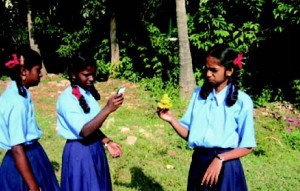
instance, offer some very  effective  approaches to   on-formal education over  radio. Recently, AIR agreed to a  proposal from  Sesame Workshop India  to provide airtime on  national and regional radio  channels for locally produced  versions of the universally  popular ‘Sesame Street’. The programmes would be aimed  at pre-schoolers, and would also  provide under-served children with  access to educational media, especially in rural areas.  India spends just 3.4% of its GNP on education. Over 35% of the  population is illiterate, and the  drop out rate in schools is  staggeringly high, with 40% of all school-going children dropping out  during the primary stage itself. The  percentage of dropouts goes up to 67% by Class X. The Supreme  School students participating in the  chool audio program in Karnataka  Court of India (in 1993) has declared education of children up  to 14 years to be a fundamental right, but school attendance  is related to the perceived importance of education by  parents, and also to socioeconomic factors. Despite rapid developments in communication technologies in the  last few decades, radio  broadcasting remains the cheapest mode of mass communication in  India, catering equally to the needs of the rich and the poor, rural and the urban masses and  reaching the remotest parts of the country. In a country where the  literacy rate is 65%, and fewer than 50% of homes are electrified, the  humble transistor radio plays a vital role in the country’s socioeconomic  and cultural development. Rural and deprived communities,  with low literacy rates and little access to formal education, stand  to benefit the most from distance learning through community radio.  If and when such communities are permitted to set up their own low  power radio stations – and 4000 such community radio stations are  possible in India, according to government estimates – then we  could witness a revolution in education far beyond anything dreamt of by the purveyors of  digital technology in a digitally divided country.  Using radio for education and
community development is part of  the 75-year-old Reithian ambition for radio broadcasting. Children  and youth can be easily and cheaply trained, and the goals of  universal primary and secondary education for all can be reached  more easily with broadcast support. Among the poor and  marginalized people of the country, radio could even create a new class of people – educated but illiterate

LATEST NEWS